
The Thesis Driven Innovation 100, 2026 | #51-100
Meet the 100 people shaping the future of the built world
Meet the 100 people shaping the future of the built world

A 90-minute tactical workshop for real estate professionals and vendors who want to get the most out of conferences
After years of false starts and regulatory confusion, a few serious projects are pointing toward what this technology can actually deliver for real estate

Welcome to the golden age of the mashup


Today's Thesis Driven is a guest letter from Jake Rynar and Andrew Johnson of No Walls Studio, which helps developers create branded spaces that people love. They are also authors of the Substack newsletter The NWS.
We’re living in the era of New Balance loafers, Rimowa cafés, and Alo Yoga smoothies at Erewhon.
The crossover mindset is everywhere. The world has become one giant collaboration, stitched together by hybrids that barely register as surprising anymore: Theragun care packages on United flights, Travis Scott meals at McDonald’s, Crocs with Balenciaga heels, and Louis Vuitton luggage designed for gaming consoles.
Beyond product collabs, we’re watching entire industries collapse into each other in real time—athleisure as officewear, sushi turned into burritos, restaurants moonlighting as hotels. Design, function, and identity are no longer confined to their traditional lanes.
Why?
Because mashups make money. They borrow brand equity, attract new audiences, and open new revenue streams in adjacent markets. They keep brands culturally flexible and financially hedged.
And it’s not just happening in your average consumer goods. It’s also happening in physical places.
How many hotel x club x residences have crossed your feed this year? How often have you heard about the hotelification of the office? Who hasn’t ordered a cortado inside a fashion boutique or noticed the explosion of branded residences in Miami, Dubai, and New York, where condo launches feel more like capsule drops?
We’re living through a structural remix of real estate. And to make sense of it, we need to trace how we got here and what to do about it:
This is a guide to “the everything place” and how to harness its momentum without becoming just like everyone else.
For most of the last century, space was defined by specialization.
Retail sold. Offices worked. Hotels slept. Homes lived.
Each asset class had its own economic structure, operating logic, and cultural script. Banks financed predictability, cities zoned for order, and people understood what belonged where.
Then the 1990s happened and everyone started chasing experiences.
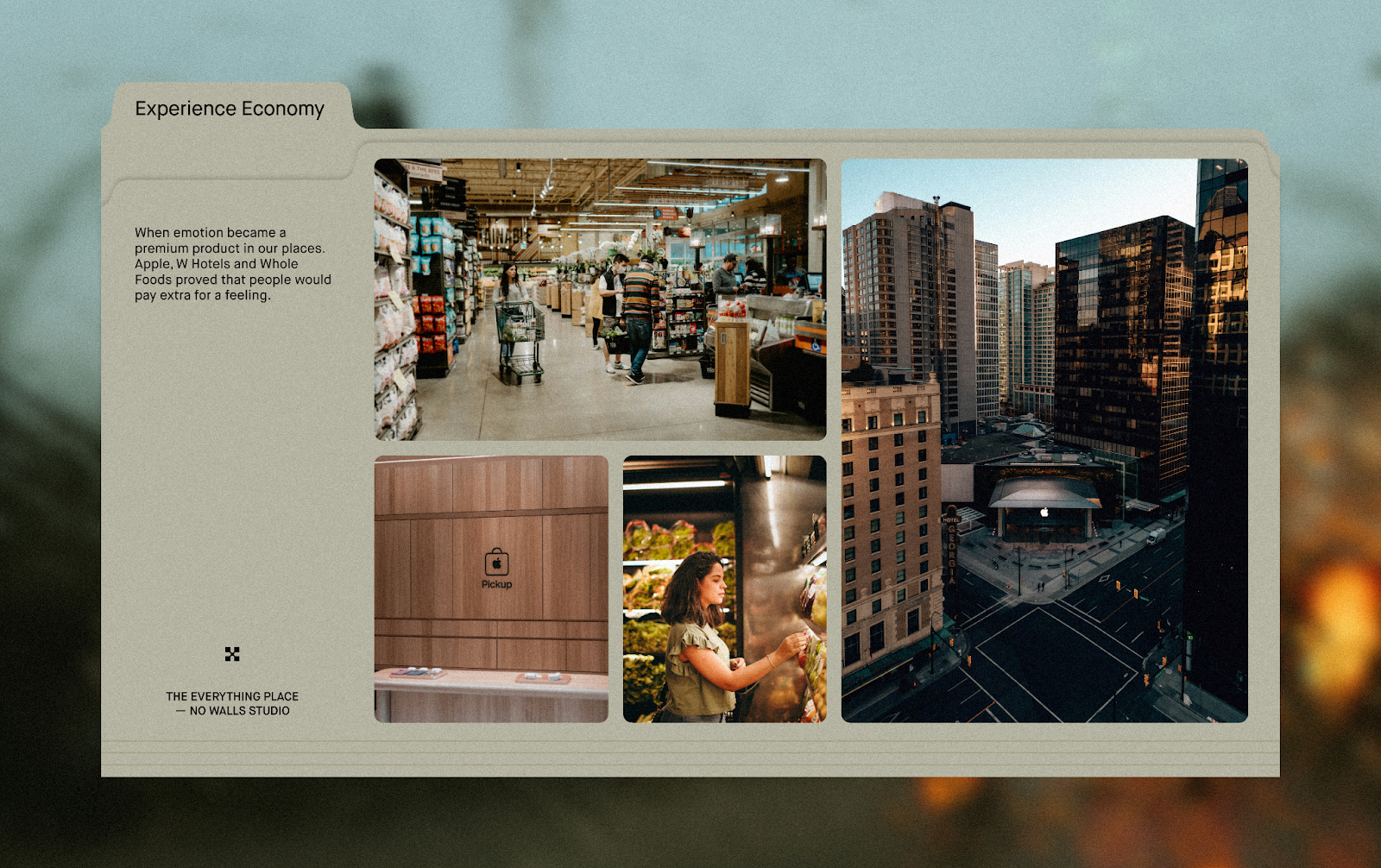
Pine and Gilmore’s Experience Economy reframed value itself: instead of just performing in their lanes, spaces had to offer emotional benefits; experiences earned real estate products premiums in the market.
Apple’s first SoHo store made that idea tangible. It was part classroom, part gallery, part performance. The Genius Bar was theater. Lighting became choreography. The feeling of walking into the store after a product release was magical.
Around the same time, W Hotels flipped hospitality on its head. For decades, hotels were built on consistency, including neutral design, discreet service, and no surprises. W swapped all of that for a sensory brandscape: music, scent, lighting, fashion, art. The lobby became a lounge; the bar was a nightlife hotspot. The tagline, Whatever / Whenever, screamed experience.
Even Whole Foods joined the party, turning the boring old grocery run into something more. They stacked produce like sculptures. Replaced stale signage with chalkboard typography. And framed samples as a gateway into the next health food trend. Whole Foods made everyday consumption feel like participation in a lifestyle.
These examples signaled a broader cultural reprogramming. Gone were the days of buying utility; people started to pay for feeling. And the best short cut to creating experiences? Borrowing from other categories that already offered those same benefits. Retail borrowed from entertainment. Hotels borrowed from fashion.
Once experience became a design principle, spaces started to blur.
Meanwhile, another idea was quietly reshaping the built environment: the Third Place.
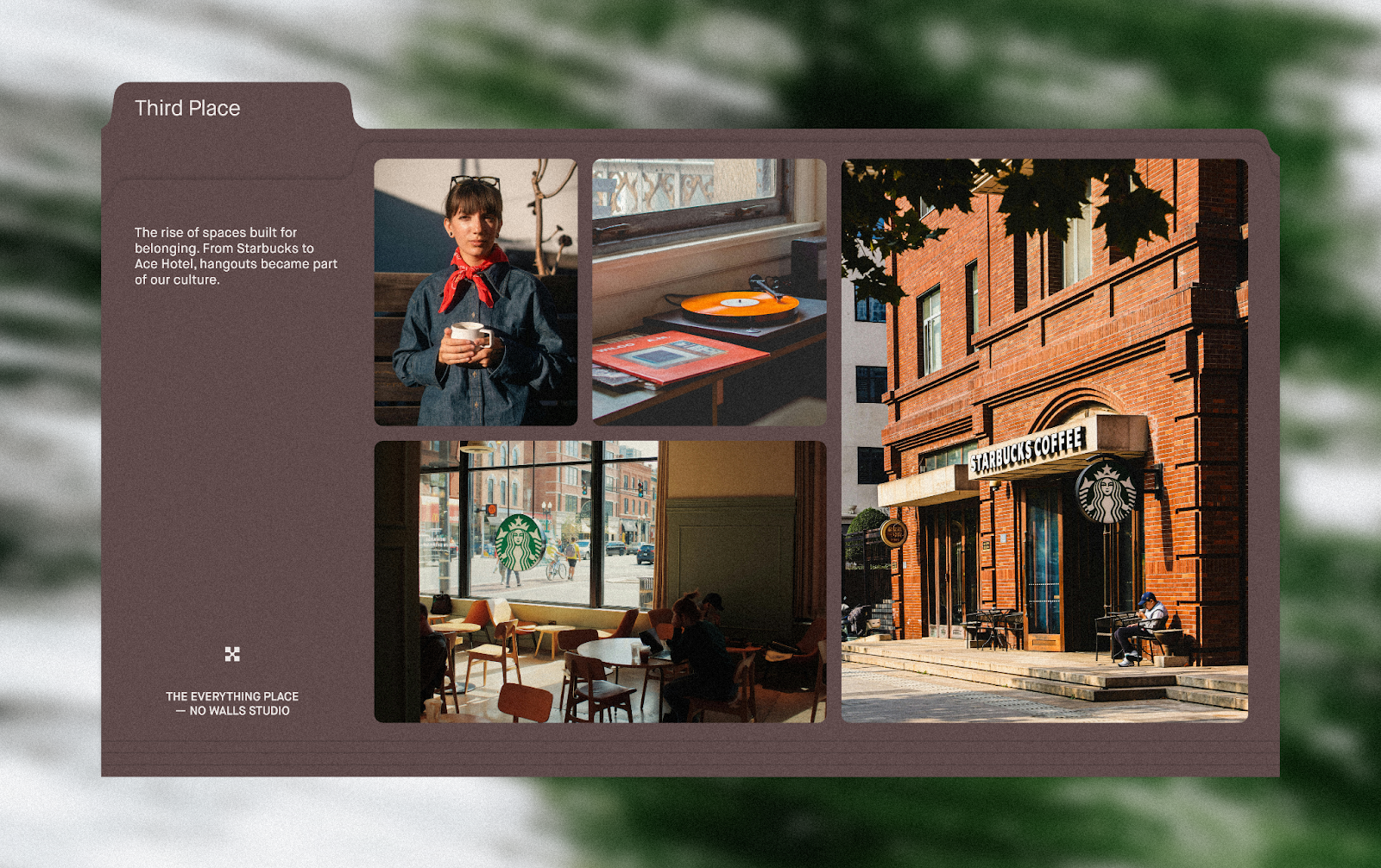
Sociologist Ray Oldenburg coined the term in the late 1980s to describe informal gathering spots—cafés, pubs, barbershops, bookstores—that existed between home and work. Places where civic life happened without pretense.
In the 1990s, Starbucks turned that idea into global business strategy. It industrialized consistent Third Place, everywhere. Above and beyond $5+ coffee, Starbucks was selling permission to hang around. It gave Americans a new social sphere: a public place to have intimate conversations and be productive and a private place to meet up with friends. The brand also arrived at the perfect cultural moment. The rise of craft culture, the early creep of remote work, and mobile tech’s growing presence created the need for flexible, semi-social spaces. Starbucks filled that void.
If Starbucks made the Third Place accessible, Ace Hotel made it aspirational.
When the first Ace opened in Seattle in 1999, it reinvented what a hotel could be. The rooms were spartan and small but fresh. The lobby, however, was bumping; it was an open invitation to locals and guests alike. By day it was filled with Stumptown Coffee, raw denim, and laptops. By night, low light and cocktails. The cool kids crowd stayed the same, but the soundtrack and ambience changed.
That inversion—making private space public—was radical. It captured the early-2000s indie zeitgeist: cross-pollination, creative possibilities, and an emerging culture of remote work.
Ace made hospitality feel social. People came to Ace Hotels just to hang out. The lobby became the blueprint for the modern hybrid: a space that could host work, leisure, and identity all at once. It was an expert execution of Third Place.
The ripple effect was enormous. Soon, hotels became coworking hubs, retail spaces got espresso machines, and “time spent” supplemented “transactions” as a metric of success.
Coffee became the shorthand for this shift: accessible, daily, and brandable. That’s why today you’ll find cafés embedded in Maison Kitsuné, Ralph Lauren, Saturdays Surf, Buck Mason, Rapha and so many more fashion labels. Each one uniquely uses caffeine and cafe styling as a way to turn the brand into a hang out.
Third Places normalized hybridity long before we had the language for it.
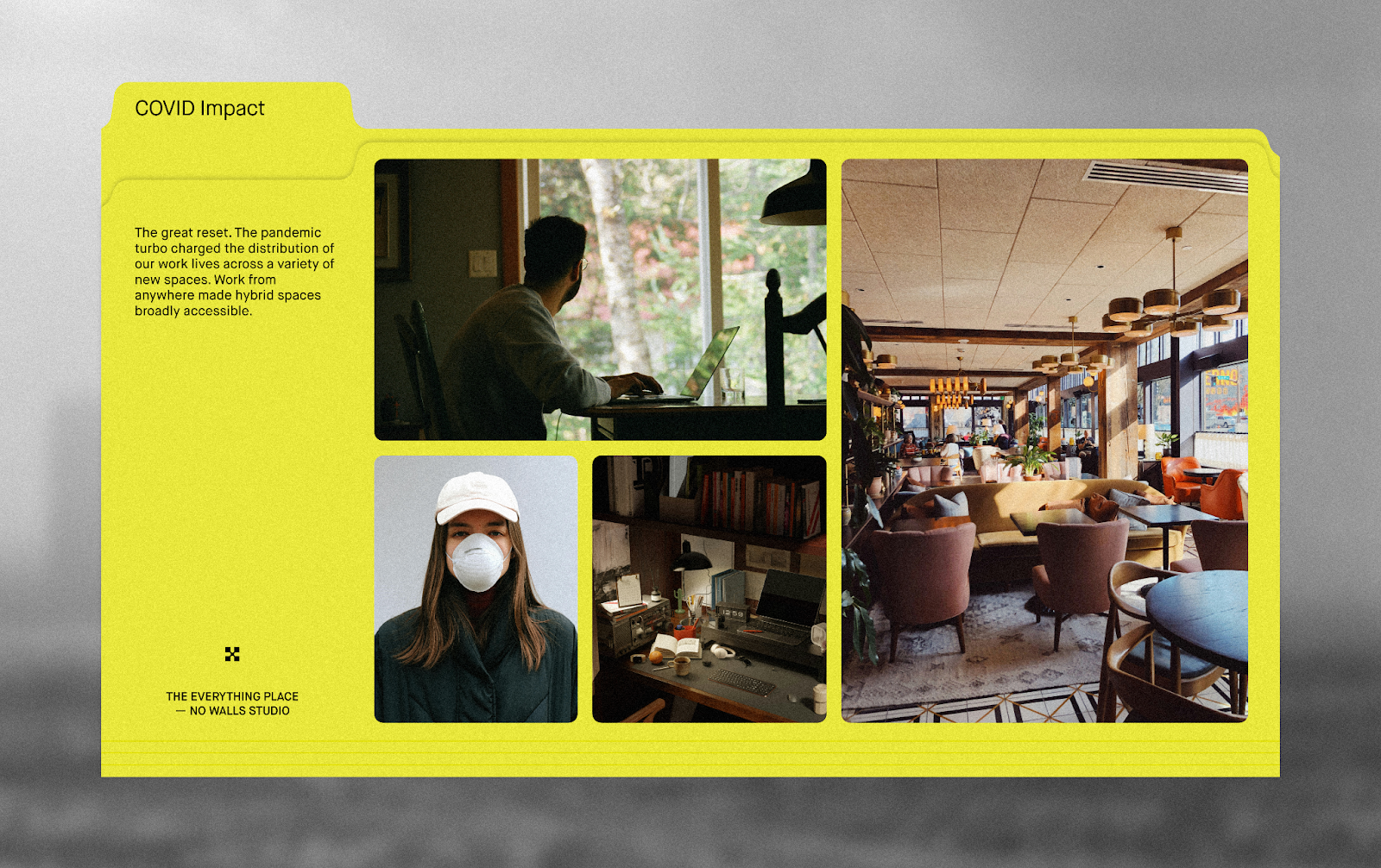
Then COVID hit and every spatial boundary we had left dissolved overnight.
Home became the universal interface. We slept, ate, worked, and streamed from the same few rooms. Comfort and flexibility were givens in every aspect of our lives.
So when offices reopened, the RTO (Return to Office) tension was just as psychological as logistical. Employers were asking people to give something huge up: the autonomy and ease they’d found in remote life. But they underestimated the power of loss aversion—the behavioral truth that people feel the pain of losing something far more deeply than the pleasure of gaining it.
To bring employees back, the office had to outdo home. It had to deliver what the kitchen table couldn’t: energy, connection and service.
Enter hotelification.
Lounge seating, scent programs, wellness rooms, curated playlists, and on-site baristas became standard corporate amenities. Simply put, the post-pandemic office started performing like a boutique hotel.
The same logic reversed across other sectors. As companies embraced distributed work, “anywhere” became the new HQ. The Hoxton launched coworking and venues for corporate offsites. Switchyards transformed retail footprints into local work clubs. Life Time made coworking an amenity within its gyms.
Hybrid spaces became both a cultural expectation and a business hedge. If a space could flex across uses, it could flex across unpredictable market conditions.
COVID didn’t invent the mash up of spaces, but it certainly catalyzed its maturity. It turned “the everything place” from a niche design strategy into table stakes.
So how do you design for a world where boundaries are irrelevant, attention is currency, and every space is trying to be more than one thing?
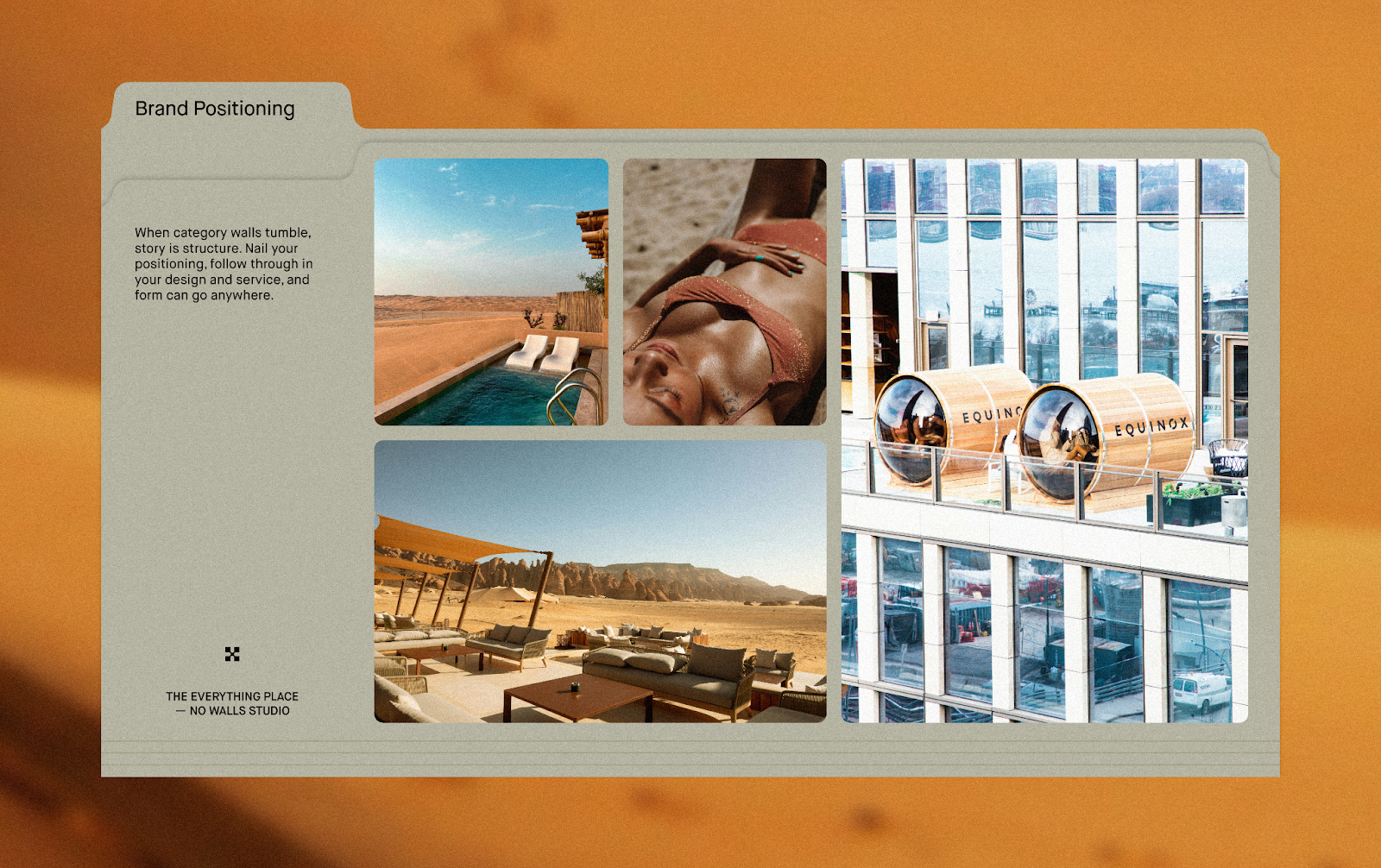
Start with brand positioning.
Positioning defines what emotional territory you own and what problem you’re solving differently from everyone else. It’s the glue that lets you expand without losing the narrative. Some examples:
Aman is elegant, tranquil bliss. It exists to create elevated stillness in the lives of the jetsetting wealthy. That feeling—the brand’s emotional license—lets Aman hybridize without hesitation: resort, residence, wellness sanctuary, members’ club. Each expression reinforces the same state of calm control. The brand’s positioning makes the asset class invisible; the positioning does the work.
The Hoxton runs on low key cosmopolitanism. It’s the democratization of good design, great location, and cool ambiance. The brand’s laid-back sophistication allows it to blend hotel, F&B, and coworking into one coherent world. Every touchpoint—from typography to playlists—connects with this ethos; each new spatial product becomes an exciting extension of the Hoxton brand.
Equinox owns their positioning: hot & fit people + holistic life performance + high end. The brand’s entire portfolio is an ecosystem for this type of peak living. By executing relentlessly on their promise, the brand fluently introduced retail, F&B, and even a hotel product…all at once, into the same footprint.
The pattern is clear: strong positioning gives you emotional clarity, which gives you freedom to experiment with a wide array of spaces. Without positioning, you’re just stacking amenities. With it, you’re building a branded world.
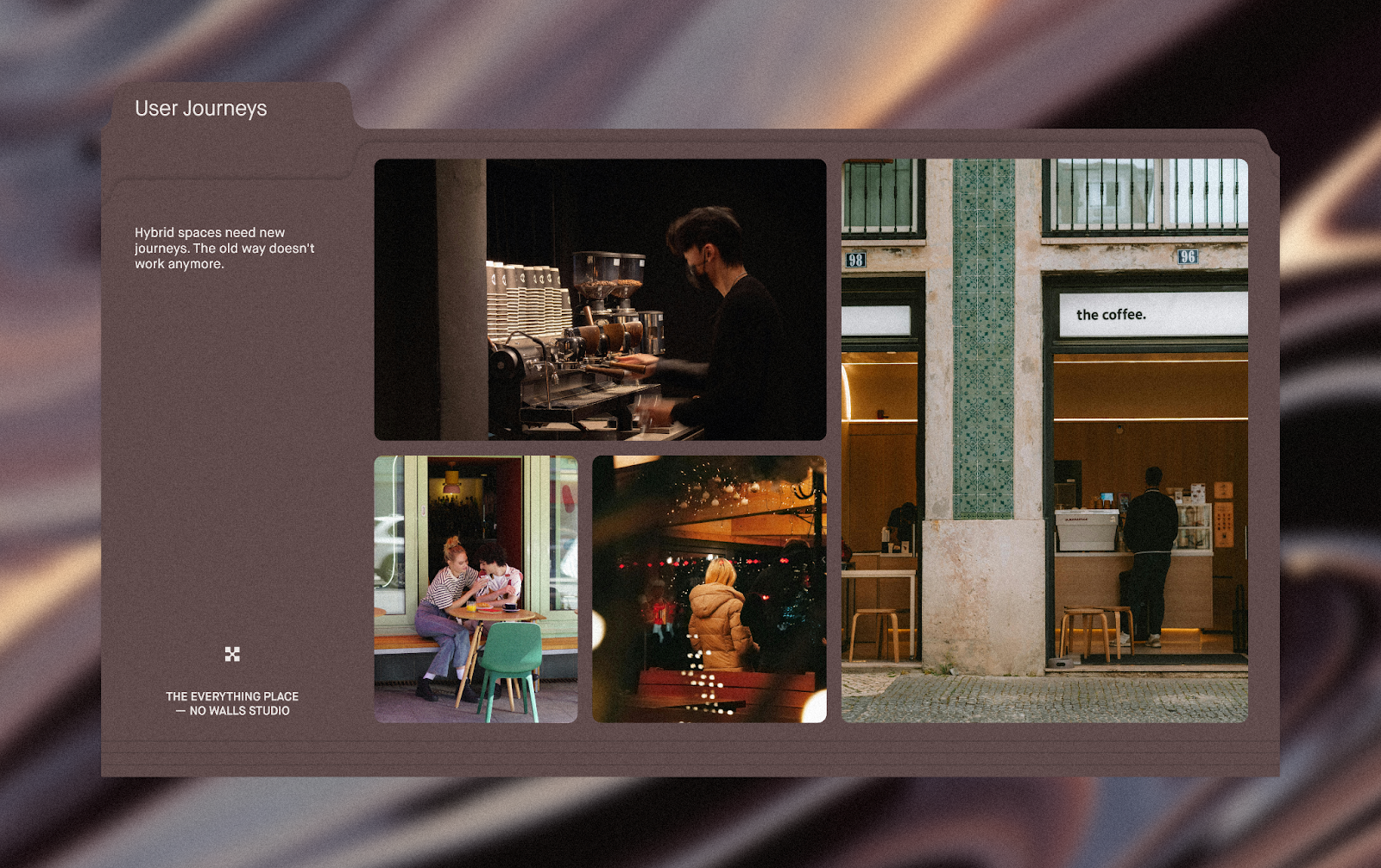
Of course, “everything places” only work if the design choreography matches the story.
If you’re designing a hybrid barbershop and speakeasy like Blind Barber, you can’t let bar-goers wander through the clippings. You design for adjacency and avoid overlap. Same brand world, with different rhythms.
And this logic applies everywhere. A multifamily project with public F&B and short-term rental units needs clear choreography. Residents shouldn’t feel like they live in a hotel; guests shouldn’t behave like they own the building.
A key to creating hybrid space is realizing that you can’t simply stack different space types without creating a new operational paradigm. So throw out the programmatic playbook and map the user journeys.
If you’re building a retail space that doubles as a workspace with an all-day café, start with the real people who use it:
Once you’ve identified them, map their choreography.
Where do they enter? What do they touch first? What do they hear, smell, notice? Track collisions, think about time of day. What does 8 a.m. feel like versus 2 p.m. versus 8 p.m.? What transitions should blend and which should mark a shift? Ex) morning buzz can dissolve naturally into lunch, but the evening crowd needs clear cues like a lighting drop and scent change.
Design around rituals: the behavioral anchors that make a hybrid space coherent. Too much overlap and it’s chaos. Too little overlap and you could stifle the energy. In many cases, the sweet spot is worlds brushing up against each other just enough to feel alive but not enough to compete.
When you choreograph journeys well, people get excited about the mashup of space rather than on guard about the possible friction in their lives.
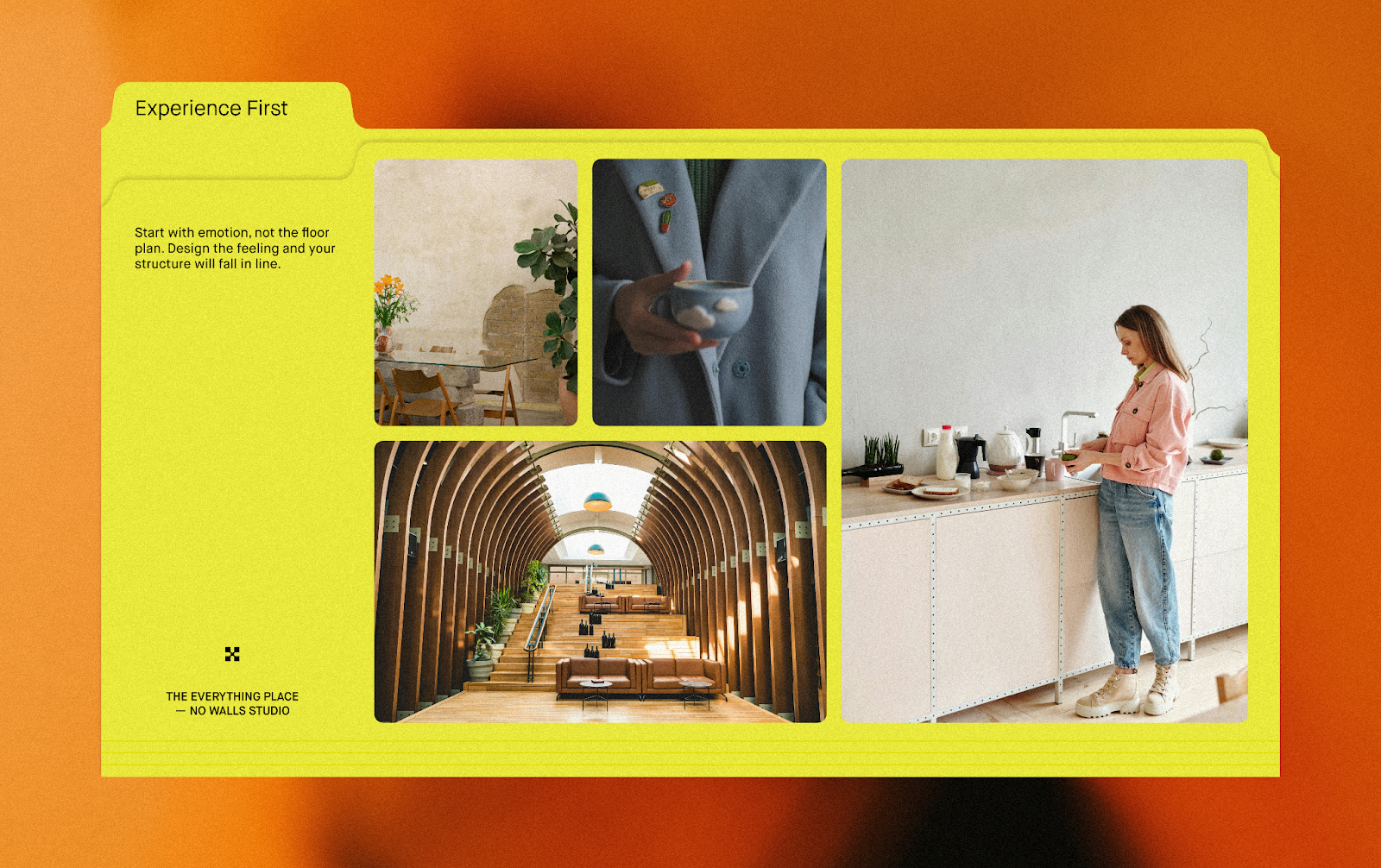
Steve Jobs said, “You’ve got to start with the customer experience and work back toward the technology, not the other way around.” Swap “technology” for space and you have the starting point for “the everything place.”
Start with the feeling. What should people feel? Ease, discovery, belonging? Write the experience brief first: one promise of a feeling that tracks back to your positioning and a short scene for each daypart. Your design and space types will serve this experience.
Translate the feeling into rituals. Design the actions that create your intended emotion, such as a coffee handoff that slows people down or an early evening soundtrack pivot that turns workday into something fun. The more you choreograph those micro-moments, the more cohesive the hybrid experience becomes.
Build sensory rails around the feeling including light, sound, scent, and material. If the morning should feel like “soft focus,” you may need a lo-fi playlist, citrus, and cozy blankets.
Showcase the feeling. Run your space like a show. Script a morning, afternoon and night version. Move furniture. Change lighting. Adjust staff posture. Most hybrid spaces require a level of evolution throughout the day.
Make operations the co-author. Great hybrid spaces are operational systems, well beyond aesthetics. For instance, the barista needs to be able reset the counter without breaking the retail vibe; the front desk needs to be able to check in a short term renter without full time residents getting pissed off. Bring your ops leadership into your design process.
Measure your return on experience. Track metrics that matter: referrals, net promoter scores, dwell time, repeat visits, time-of-day spend, mood, etc. Tie feelings to economics.
Working backwards from the experience keeps hybrid spaces coherent. It gives you another layer of guidance, in addition to positioning and user journeys, for your decisions—including what to combine and what to separate.
A couple examples of brands that do this well?
Kith, Ronnie Fieg’s epic multi-brand retail space is built around the feeling of finding something rare. Each store is a stage for discovery, including mirrored ceilings, marbled counters and sneaker walls displayed like artifacts. The hybrid experience—the Kith Treats ice cream stores embedded in this grown-up retail world—pair high end shopping with the nostalgia of a rare treat. The product matters, but the experience is the real engine of these spaces.
Restoration Hardware takes a similar approach with a different feeling in mind. Its goal is total lifestyle immersion in comfortable, quiet elegance. By pairing its showrooms with full scale restaurants, wine bars and terraces, RH lets you live inside the brand. You don’t just browse for a sofa, you drink champagne on it while you’re waiting for your table. You test the dining chairs by eating dinner in them. You use the flatware for your salad. The line between product and experience disappears completely.
Both brands prove the same point: the best hybrid spaces start with a feeling and build outward. They design for experience first and space types second.
So what’s the upshot on all of this?
We’re heading toward a world where every new project will come preloaded with fragments of other asset classes. The silos are gone. Multifamily feels like hospitality. Hospitality feels like retail. Retail feels like community space. Everyone has a coffee program. At this point, you’d be hard-pressed to find a Class A building that doesn’t borrow from at least two other categories.
The smartest developers are going to compete on storytelling, audience clarity, and experience design rather than program mix. They’ll use brand to make sense of the mash up and to give their project purpose.
Ultimately, the real question isn’t what kind of place you’re building anymore. It’s why someone would choose to spend their time there.
-Jake Rynar and Andrew Johnson
Covering the future of real estate and the people creating it