


Beyond the Hype: An Owner's Guide to Construction Robotics
A realistic framework for real estate owners & operators evaluating robotic adoption

Construction robots have become impossible to ignore.
Developers have likely seen them featured in splashy presentations at conferences, promoted in a contractor’s social media feed, or maybe even in action at a colleague’s job site. The tech is impressive, and the hype is loud. But as with most emerging technologies, the gap between what’s shown to work and what’s proven to work remains large.
What matters are technical capabilities, economics, and workflow fit. Owners need a way to evaluate all three before assumptions harden into the project budget.
Although this uncertainty is often framed as a contractor concern, the financial exposure ultimately sits with owners. When a robot underperforms and its assumed productivity has been baked into a bid, the developer absorbs the downside through schedule slippage, cost overruns, and deteriorating pro formas. When robotics succeeds (and is budgeted early), owners capture the upside through faster delivery and lower costs.
But practical frameworks for evaluating robotic adoption remain scarce. The challenge isn't a lack of information, but rather that most coverage focuses on technical capabilities or contractor experiences. What owners need is different: a clear-eyed assessment of what works today, what remains experimental, and how to influence adoption on their projects.
This letter lays out a framework and primer for how developers should evaluate construction robotics:
- Where robotics delivers real value today and where it remains experimental
- How to assess opportunities across workflow readiness, technology maturity, and integration risk
- What utility-scale solar reveals about scaling robotics in construction and what translates to other asset classes
- Practical mechanisms for encouraging or mandating adoption through GC relationships
Where Robotics Actually Works Today
The term "construction robotics" encompasses everything from proven commercial products to lab prototypes that have never touched a job site.
Let’s do a flyby of what the landscape looks like today and how it’s evolving.
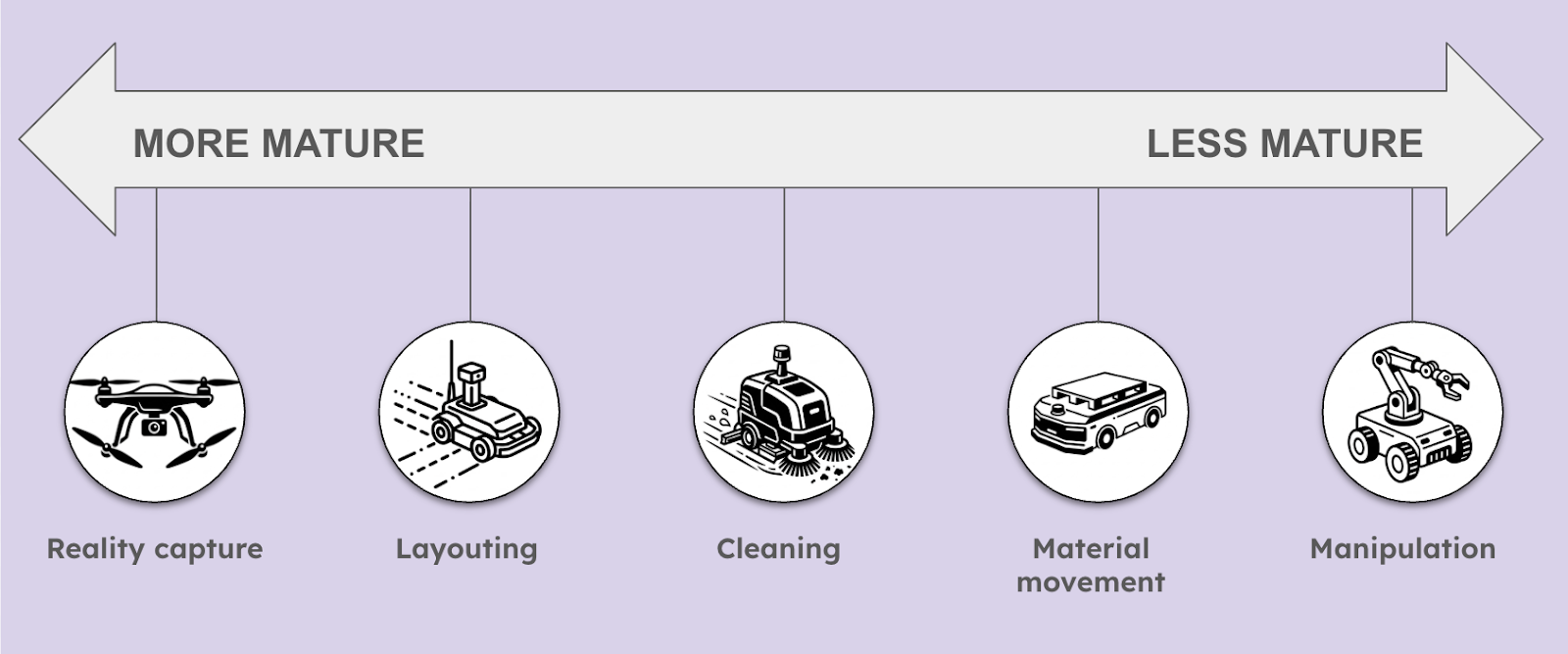
Data Collection and Reality Capture: The Most Mature Category
Drones for progress monitoring, site inspection, and photogrammetric surveys have crossed into mainstream adoption.
Companies like DroneDeploy provide the software infrastructure that makes this data actionable. Boston Dynamics' Spot robot has found a niche in autonomous site walks, capturing 360-degree imagery on a programmed schedule. These systems work because they don't need to physically alter the environment; they simply observe it and package observations in well-rounded software platforms to offer insights.
If a contractor in 2026 isn't using drone-based progress monitoring on a project of meaningful scale, they are missing out on proven technology.
Once a project is up and running, quadruped robots are effective at performing routine inspections in large areas. Pioneered by O&G operators, quadrupeds are cheap enough to substitute for human first-round inspections in large developments like resorts, hotels, and apartment complexes. The value is driven by repeat observations collected on a set schedule, which software can analyze consistently.
Configurability of these robots has come a long way. Owners can pick what matters to them (e.g., HVAC inlets need to be clear of dust; water drains need to be unclogged) and set inspection frequencies or alert triggers.
These robots end up giving maintenance staff operational superpowers. They help catch problems well in advance, allow staff to focus on fixing and upgrading instead of routine inspection, and create a standard log of problem-solution pairs that helps professionalize maintenance efforts. A specialized example is BDR’s roof inspection robot.
Layout and Marking Robots: All About Early Construction
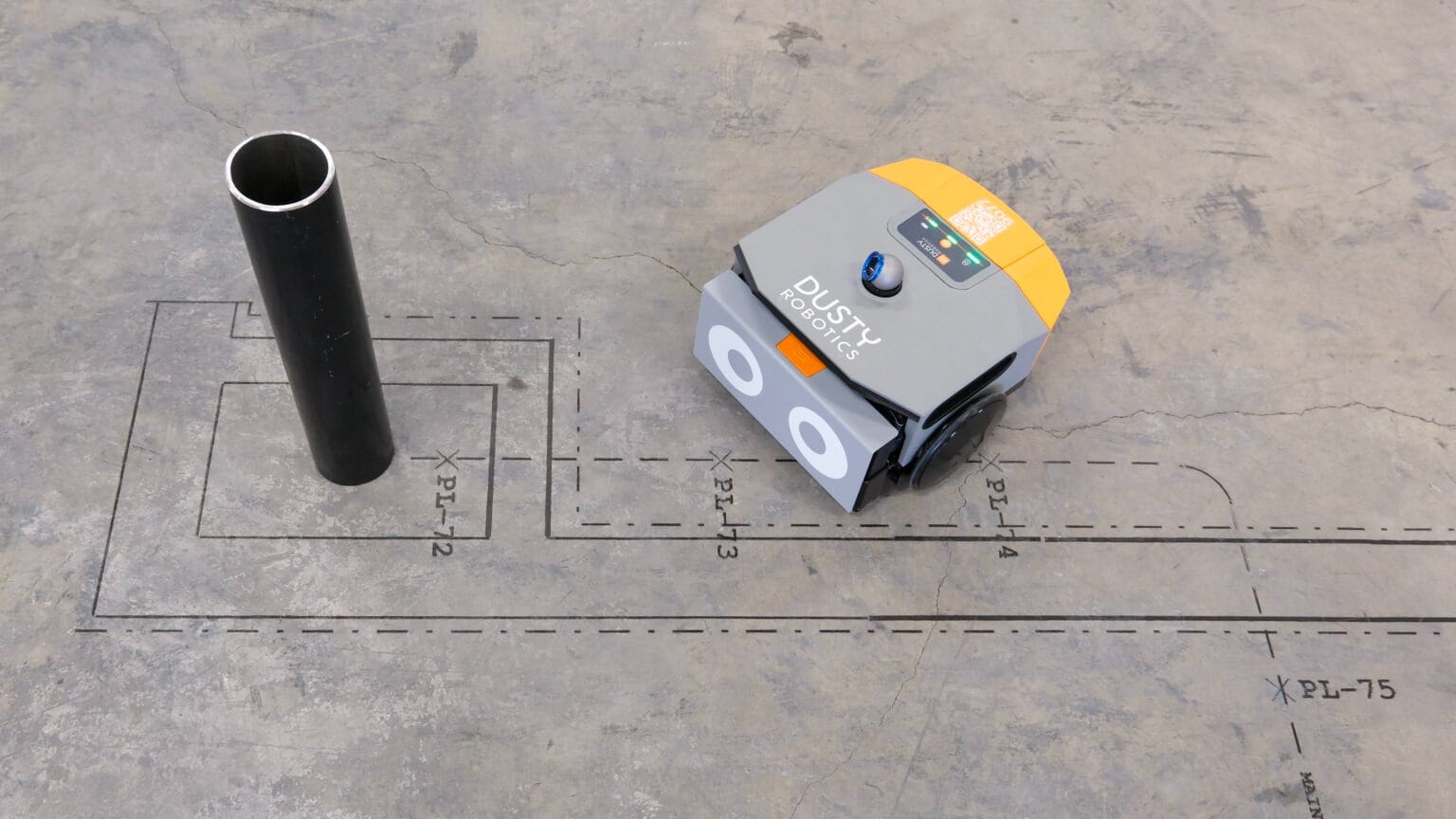
This category occupies the next tier of maturity in construction robotics.
Companies like Dusty Robotics, HP SitePrint, and Rugged Robotics produce machines that print floor plans and MEP layouts directly onto concrete slabs. This eliminates the error-prone process of manual layout, where a single misread dimension can cascade into costly rework. Dusty alone has purportedly printed over 100 million square feet of layout.
The value uplift here is clear: digitally logged layouts precisely printed onto concrete have the potential to serve as evidence for contractor claims, change order disputes, and QA checks. They are also able to print text on the slab, providing contractors with precise work instructions that can’t otherwise be achieved with manual layout methods.
A specific subset of these can be useful in the O&M phases: pavement marking robots like 10Lines. For developments with large-scale striping (and re-striping) needs for parking spots, this solution completely removes the need for an external company. It can be operated by almost anyone.
Cleaning Robots: A Broadly Adopted Category
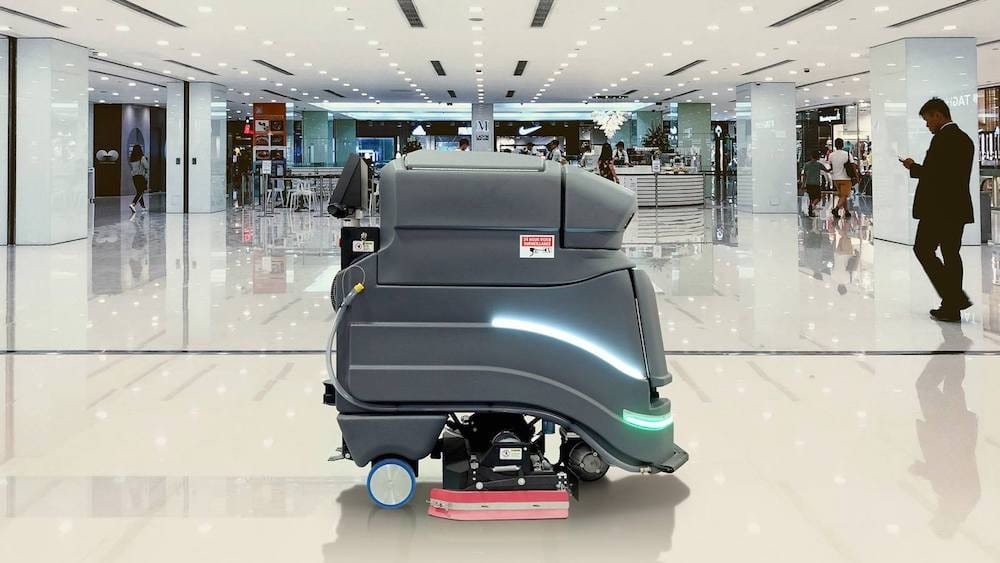
This group is composed of simpler autonomous floor cleaning solutions (the kind seen in airports from companies like Avidbots or Brain Corp) and more complex full-workflow models (such as those from Hivebotics or Loki).
The maturity curve runs in the same direction: while floor scrubbers and vacuums are well understood and can be deployed out of the box, full cleaning-cycle robots are still more complex to integrate and have limitations. The business case is straightforward: cleaning--crew labor shortages and unreliability are among the industry’s most persistent pain points.
Material Movement Robots: Unproven Product-Market Fit
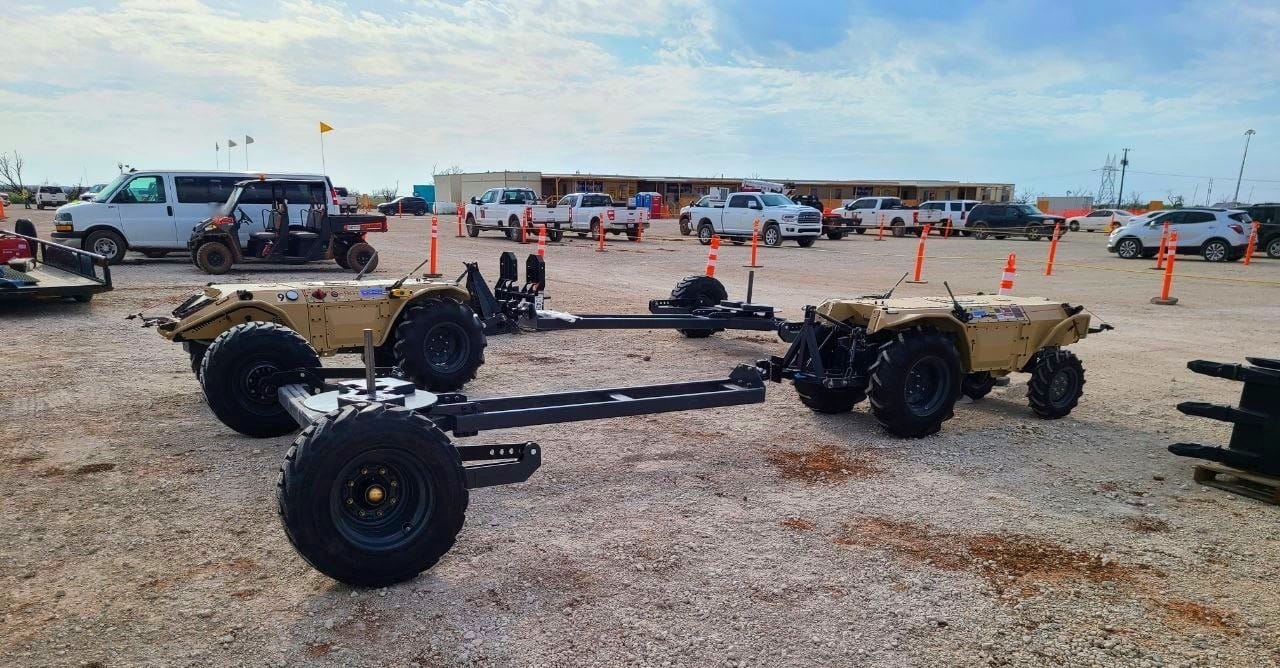
Robots that move materials across construction sites are a predictable category, but one that hasn’t yet found its perfect niche. Certainly, large job sites may benefit greatly from autonomous hauling of material. BotCrew’s robots, for example, are general-purpose ruggedized platforms that can pull heavy trailers within large outdoor jobsites (often in adverse weather conditions).
But for smaller developments or projects with unusual configurations, autonomous mobile platforms lose their efficiency as they are limited by stairways and tight spaces.
The category of industrial AMRs (the ones you would see in a modern warehouse) operates under different economics, and developers may be more interested in jobsite-specific machines.
Task-Specific Execution Robots: Hype Outpaces Reality
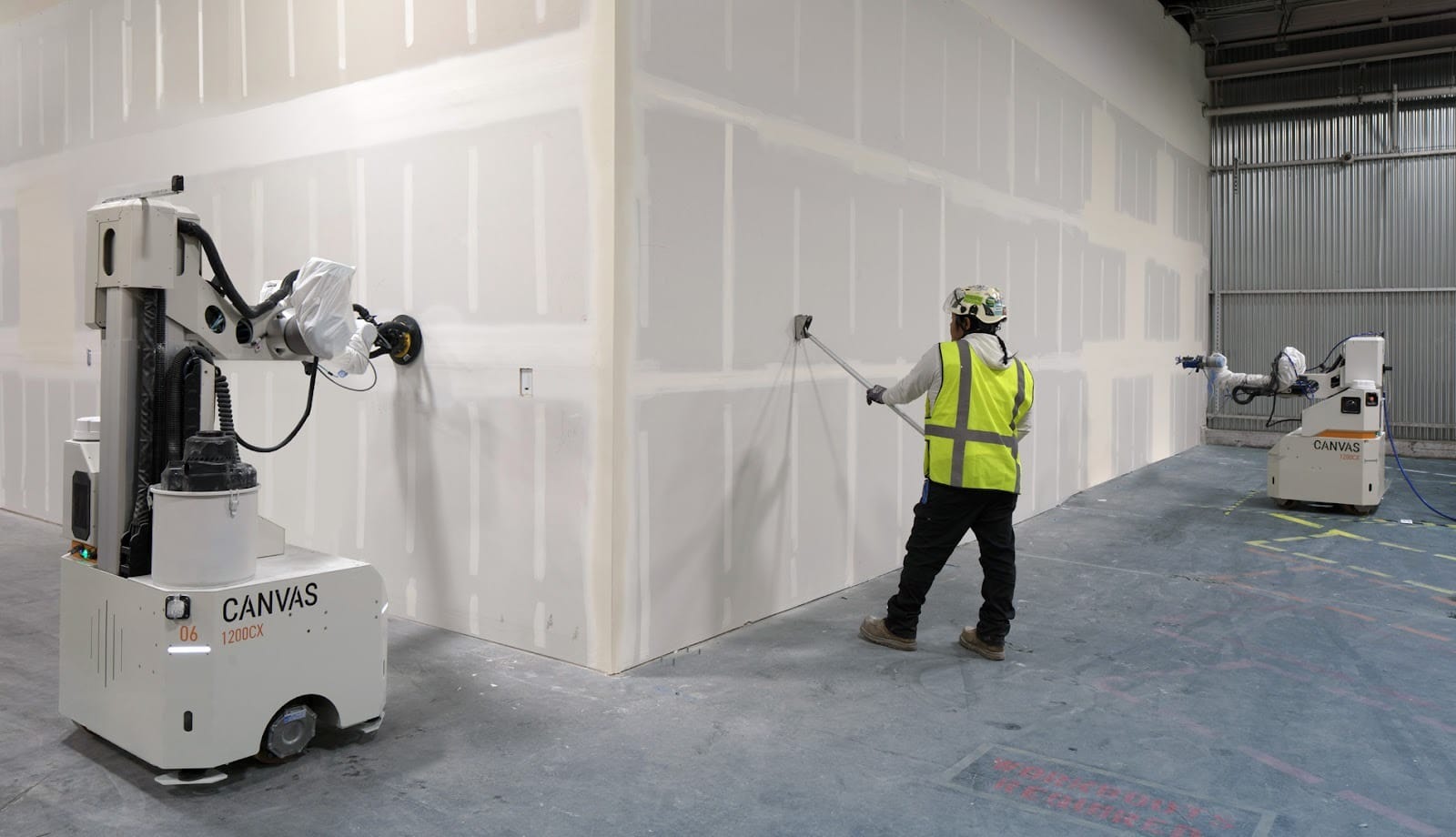
These are machines designed to perform specific physical work: pulling cable, spraying insulation, finishing drywall, laying bricks, polishing concrete, drilling ceiling holes, installing curtain wall, installing roof shingles, or placing solar modules. Unlike data collection or layout, these robots must exert force, manipulate materials, and adapt to environmental variation.
A useful heuristic: if a robot in this category hasn't achieved at least 15 to 20 commercial deployments, treat vendor claims with appropriate skepticism. Very few task-execution robots have crossed this threshold. The ones that do address specific, repetitive workflows with limited variation and integrate into existing processes rather than demanding workflow changes. Also, they tend to solve a problem that field crews genuinely hate.
The Outcome-as-a-Service Option
A business model that aligns particularly well with owners’ incentives is Outcome-as-a-Service. These are robotics vendors that choose to deliver the service, rather than the robot, and act as full-fledged subcontractors. They bid with their own robots' efficiencies in mind, but are prepared to finish the job with traditional labor if the uptime isn’t as high as expected.
They are essentially risking a share of their margin while they perfect the technical readiness of their robots. Because many are externally funded, they can afford to lose money on a job, but they can’t afford to lose credibility and track record.
The O&M Distinction Matters
Operations and maintenance deserves separate consideration because the dynamics differ substantially from construction and often favor earlier robotic adoption.
What makes O&M a great starting point for robotics adoption:
- Standardization advantages compound over time. A building's configuration stabilizes after construction. A robot can learn a building's floor plan once and execute cleaning routines indefinitely.
- Time horizons favor investment. Construction robotics must prove ROI within a project timeline, often 12 to 24 months. A robot that takes 18 months to pay back might be inappropriate for a construction deployment but perfectly sensible for a 10-year O&M scope.
- Owner control is more direct. Construction means and methods flow through contractors. O&M services often flow through direct owner procurement, particularly for larger portfolios.
- Data generation creates additional value. O&M robots don't just perform tasks, they generate information about asset conditions. This data has portfolio value beyond the immediate labor cost savings.
For owners new to construction robotics, O&M often offers the most accessible starting point: lower risk, more direct control, proven technologies, and valuable data byproducts.
A Framework for Evaluating Robotic Adoption
When a contractor proposes robotic equipment, or when vendors approach owners to propose mandating its use, a structured evaluation framework helps cut through marketing noise. Three dimensions matter most: workflow readiness, technology readiness, and integration readiness.
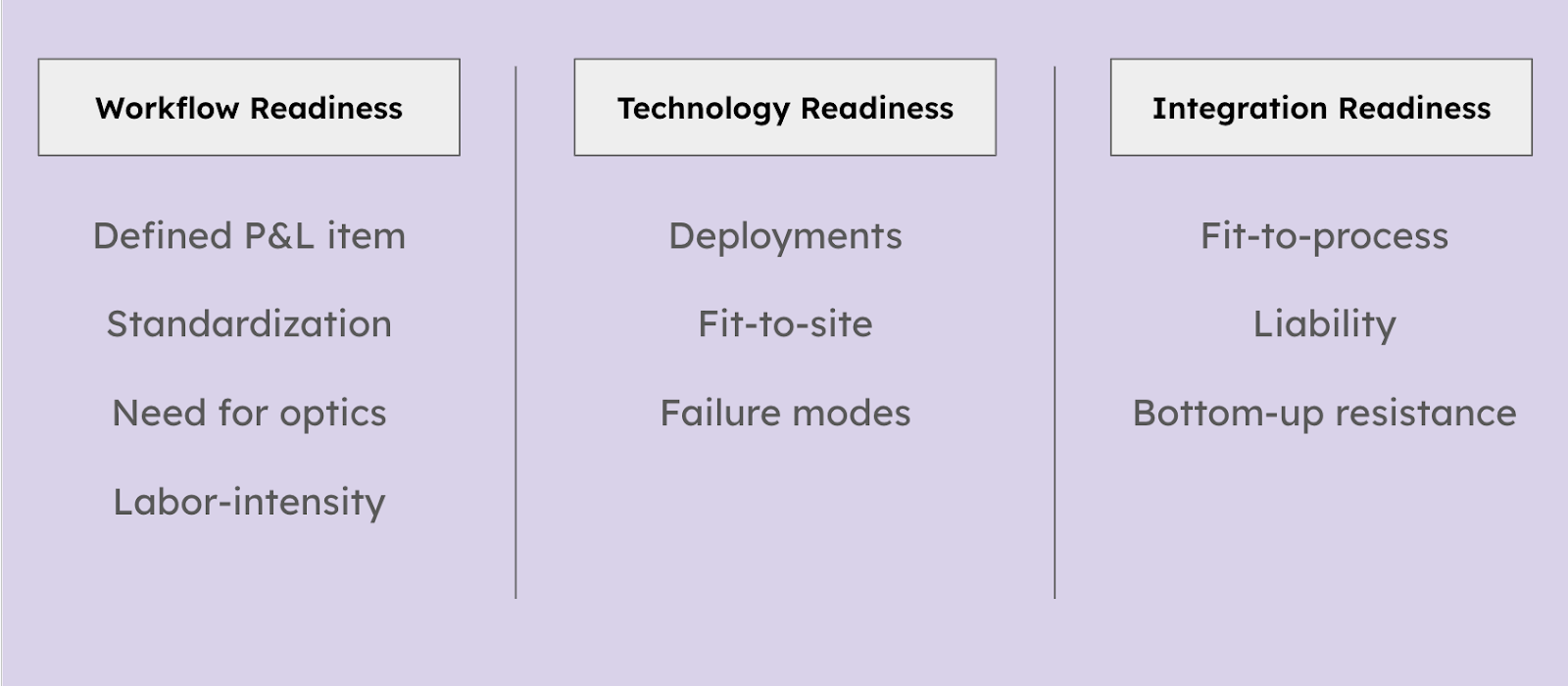
By testing for workflow readiness, we are asking whether the task itself is suited for robotic automation. Key questions include:
- Does this workflow have a dedicated line item in the budget, or is it buried within broader labor costs? Roofing with shingles has a budget line; drilling holes usually does not.
- Is the workflow repetitive and standardized, or does it vary significantly between projects or even within a single project? Installing standardized components in predictable sequences favors automation.
- Does the outcome require perfect optics?
- Does the workflow represent significant labor hours or cost concentration?
Technology readiness evaluates whether the robotic solution itself has proven reliable:
- How many commercial deployments has this system completed? Numbers below 20 warrant caution.
- Can the vendor provide references from projects similar in type and scale? A system proven in temperate climates may struggle in extreme heat or cold.
- What does the failure mode look like, and what's the fallback? When (not if) the robot encounters a situation it can't handle, what happens?
Integration readiness examines how adoption fits into existing processes and relationships:
- Does this require changing the contractor's workflow, or does it slot into existing processes?
- Who owns liability when something goes wrong? If the robot damages property, causes injury, or produces defective work, how does responsibility flow between owner, contractor, and vendor?
- What does the contractor's team actually think? Bottom-up enthusiasm dramatically eases adoption while field resistance can sabotage even technically superior solutions.
Scoring high across all three dimensions suggests a strong case for adoption. Mixed scores warrant a pilot program with defined success criteria. Low scores across the board suggest waiting for the technology or market to mature.
The Solar Case Study: First-Principle Insights
In the last few years, utility-scale solar construction has become one of the most prolific proving grounds for construction robotics.
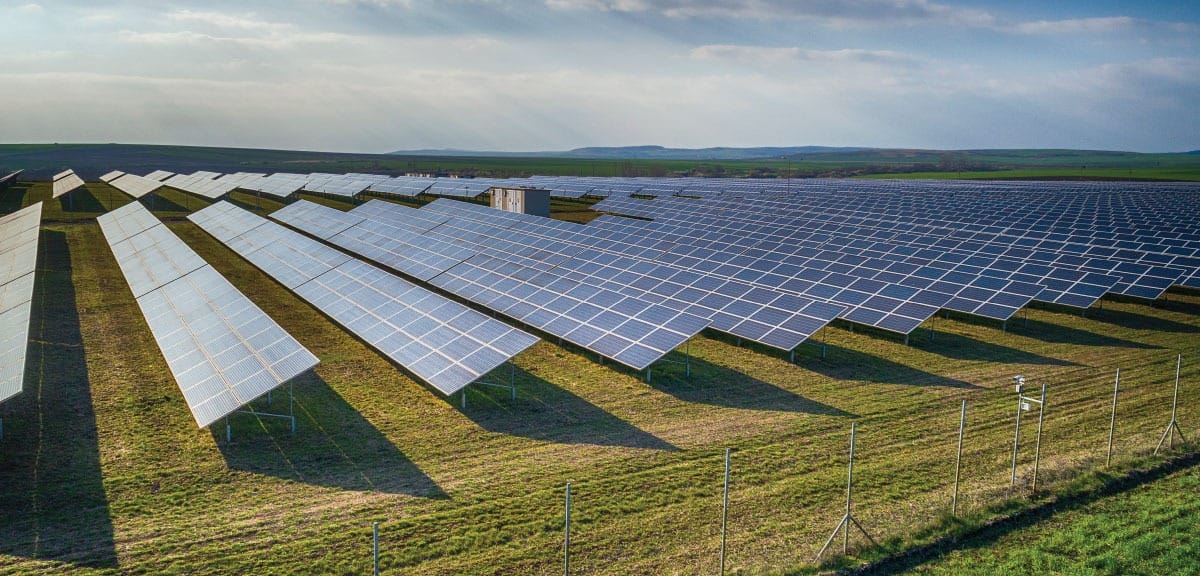
The economics and physical realities of this asset class make it an ideal fit for robotic capabilities. A single utility-scale solar project may involve placing 200,000 identical modules, driving 50,000 identical piles, and pulling hundreds of miles of standardized cable. That level of repetition maps directly onto what robots do best. The work also organizes neatly into discrete phases—civil work, pile driving, tracker installation, module placement, and electrical—each with clear inputs and outputs, allowing robots to target specific steps without needing full-process integration.
Labor dynamics further strengthen the use case.
Solar sites are often remote, exposed to extreme temperatures, and constrained by limited local labor pools. At the same time, solar EPCs (engineering, procurement, and construction contractors that design and build large solar projects) tend to be relatively sophisticated operators. They are actively looking for ways to differentiate and protect margins, which makes it easier to create a “sandbox” where tech vendors can operate while delivering measurable advantage.
That environment has enabled real commercial deployment across several workflows. Robots now routinely pull DC cable beneath solar arrays, reducing crew sizes from 10–15 workers to three or four. Given fully loaded labor costs, payback periods can be measured in weeks, and vendors such as BotCrew have leased dozens of units across major EPCs. Site layout for pile driving has followed a similar path. Module placement is emerging more slowly.
The lessons from solar deployment require some translation. We’re not talking about multifamily, office, or industrial development here, but several first principles do carry over.
Lease-based models that convert capital purchases into operating expenses reduce adoption friction for contractors across asset classes. Full automation isn’t required; incremental tools improving specific workflows have consistently outperformed “holy grail” automation efforts that attempt to rewire construction end to end. Successful deployments focus on unglamorous tasks with clear before-and-after metrics—crew size, linear feet per day—rather than vague productivity claims. Robots generate quality-control records that simplify accountability and make claims easier to resolve. And data capture is one of the great advantages of robots on a job site.
How Can Owners Drive Adoption?
Owners have more influence than they might assume. RFPs and bid requirements offer the most direct lever. Owners can require bidders to describe what robotic or automated technologies they plan to deploy—without forcing adoption into a pass-fail equation. Making automation a scored criterion communicates that innovation matters without disqualifying contractors who haven’t yet adopted specific tools. Requesting references from projects where robotic equipment was actually deployed further separates contractors with real experience from those who simply express interest.
Incentive structures, pilot programs, and O&M contracts give owners additional control. Bonuses tied to schedule, safety, or technology-enabled performance can align contractor incentives with owner goals, while innovation budgets carved out of project contingency create space to pilot new tools without risking entire projects. Direct relationships with robotics vendors give owners a portfolio-level view that individual contractors lack.
O&M contracts—where owners typically control procurement—offer the clearest opportunity to mandate or incentivize adoption in workflows where robotic solutions are already commercially mature.
Separating Signal from Hype
Construction robotics is real, but it is not magic.
The hype cycle has created expectations that exceed current capabilities in most categories. Owners who approach this space with structured evaluation frameworks will extract value; those waiting for fully autonomous construction will be waiting indefinitely. Or at least for a very long time.
Some categories—data capture, layout, and cleaning—have crossed into commercial maturity and should increasingly be expected in serious contractor and O&M bids. Others are still at an earlier stage of commercial maturity, with readiness varying sharply by workflow. Simple screens, such as meaningful commercial deployment history, help separate proven tools from experiments.
That puts the burden on owners to ask better questions. The main one isn't: "when will robots build my entire building?" It's "which specific, repetitive, labor-intensive workflows on my projects can robotic systems address today, and what would it take to make that happen."
Owners who start asking this question systematically might surface opportunities their competitors miss.

Read next

Who is Investing in Real Estate Tech? 2026 Edition
Our annual list of firms actively investing in real estate technology companies

The Marketplaces of the Future
Predicting six new real estate marketplaces to rise over the next decade

The 60% Problem: Why Commercial Buildings Leave $11 Billion on the Table
The gap between finding an energy inefficiency and fixing it has cost building owners for over a decade. Agentic AI is the first technology that can close it.

