
The Thesis Driven Innovation 100, 2026 | #51-100
Meet the 100 people shaping the future of the built world
Meet the 100 people shaping the future of the built world

A 90-minute tactical workshop for real estate professionals and vendors who want to get the most out of conferences
After years of false starts and regulatory confusion, a few serious projects are pointing toward what this technology can actually deliver for real estate

Case studies from real estate companies implementing AI to solve real problems from delinquency to diligence


AI is generating tremendous interest from real estate owners and operators. But outside of case studies from vendors themselves, there are relatively few detailed examples of just how large operators implement the technology to solve real problems in their organizations. In today's letter, Donal Warde shares four previously unpublished case studies of AI in the wild at large real estate managers. -BH
As the real estate industry sees the potential of AI to improve its operations, the constraint has shifted to execution. Over the past month, I spoke with four firms that embody four distinct AI strategies in the multifamily sector.
Each of these companies had a specific, overarching pain point, and arrived at different tech strategies—whether through planning, sweat equity, or serendipity—to solve them. None were top-down approaches. One company even wound up eschewing AI entirely.
In this letter, we’ll look at the spectrum of approaches:
The Problem
When the pandemic hit, WinnCompanies saw delinquencies surge tenfold—from $5 million to $51 million—across its 80,000+ unit portfolio of affordable and mixed-income multifamily properties. Winn offered delinquent Washington D.C. residents a deal: write down the balances to zero in return for six months of on-time payments. But only 5% accepted.
Winn tried everything: payment plans, a nationally recognized eviction prevention program, even extensive manual outreach via a team of 150+ social workers and organizers specializing in housing stability. But the needle barely moved. “It was an all-hands approach from a public health and moral perspective,” explains Trevor Samios, SVP at WinnCompanies.
The first glimmer through the fog came when Samios encountered a team from Colleen AI at a conference. They told him they had a market rate product, but were open to working on customized solutions.
Still, there were challenges. Deploying AI for collections—giving an algorithm direct access to residents—is significantly higher risk than using internal AI tools. Winn had to consider sensitive financial conversations, and operating within complex federal, state and local affordable housing regulations. “Decisions we make are higher stakes because of the risk to vulnerable families,” Samios explains.
The Solution
After a promising pilot with Colleen, Winn handed the project over to another company, Elise AI, and launched with 5,000 units in January 2025. By April they had scaled to 37,000 units. The implementation focused on delinquency management but expanded to include leasing and work order management.
Compliance issues were top of mind at Winn. “With both Colleen and Elise, we sent a detailed list of questions and needs from each internal team,” explains Samios. “And we worked with multiple state housing finance agencies (including the Massachusetts Office of Fair Housing) and regulators to identify concerns early.”
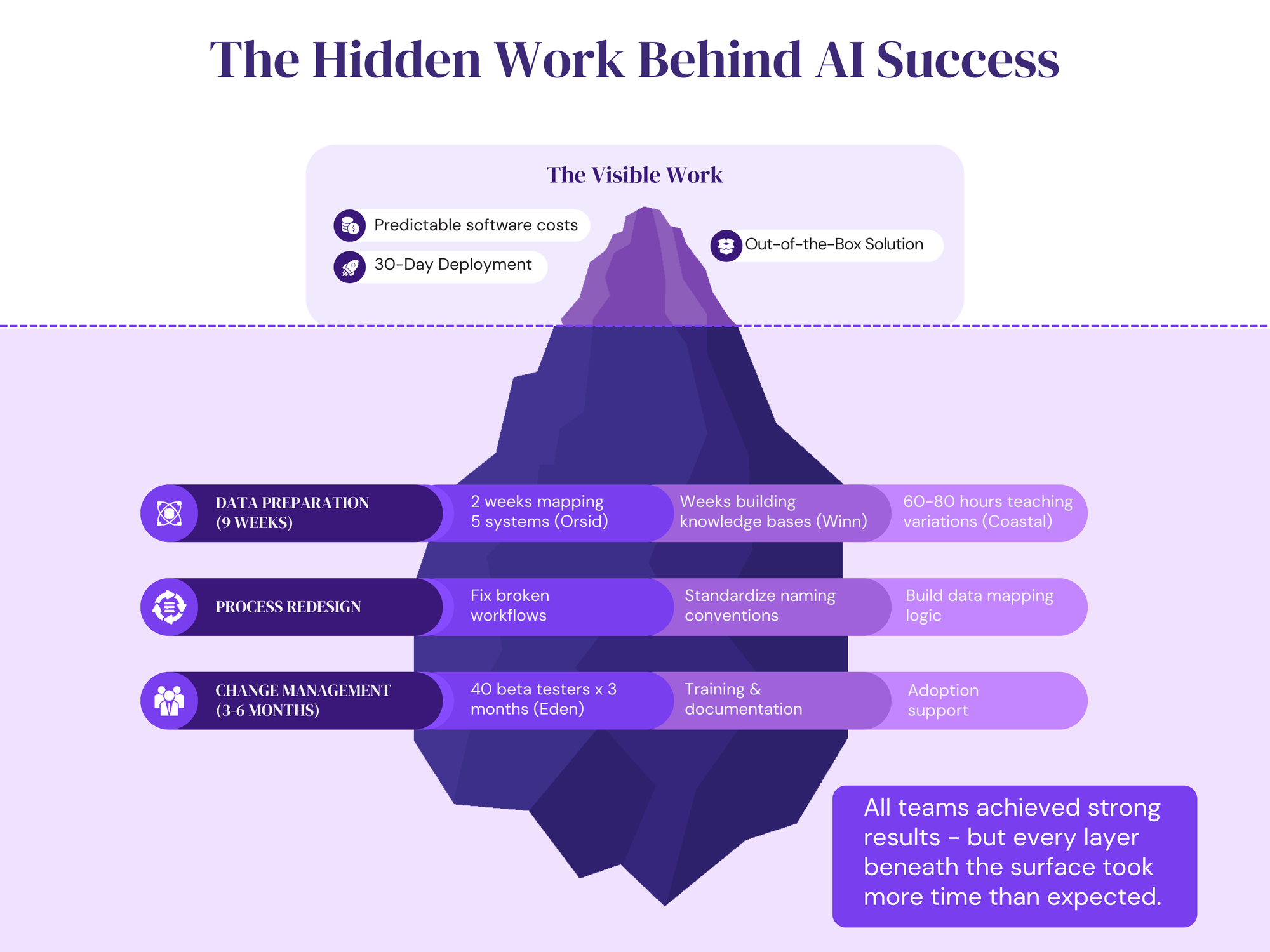
But AI is only as good as its context. Winn had to aggregate all the existing policies, data sources and SOPs. “It ended up being a ton of work to get the properties truly set up with a full knowledge base—weeks with a whole team dedicated only to this launch,” says Samios.
The vendor had its own learning curve. When Elise AI's initial messages to senior residents didn't account for Social Security payment schedules, frustrated family members called to complain. The feedback became teaching moments for the vendor: “This is how affordable housing works,” executives from Winn explained, and Elise adjusted in real time.
The Results
Winn branded its AI agent “Maya.” Despite telling residents Maya is AI, some think she’s real. “We’ve had reviews where Maya is the best property manager—always helpful, always responds immediately. She’s multimodal and speaks many languages, transitioning from English to Amharic or Haitian-Creole in real-time,” explains Samios.
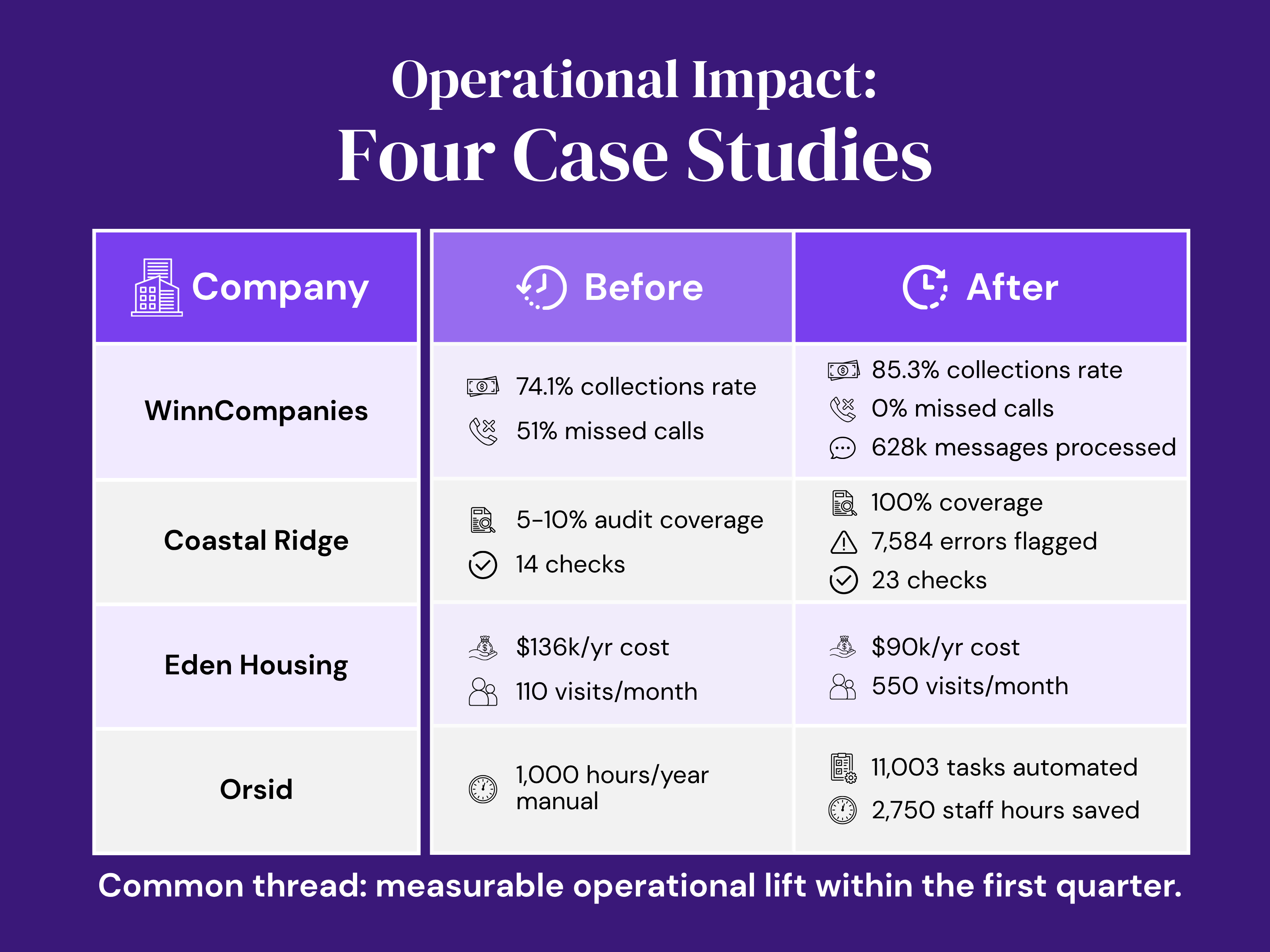
The results were clear: Delinquency balances declined across the Winn portfolio from a 74.1% pre-AI collections rate to an 85.3% post-AI collections rate. They credit Maya, in large part, with bringing it down—especially with on-time payments rising 7pp to 59.5%. From April to October 2025, Maya handled 628,664 resident messages, 11,665 calls and eliminated a 51% office missed call rate.
Anne Hollander, VP of AI and Innovation at Winn, was initially hired as a consultant for the project before transitioning to a full-time role at the firm. Her advice to operators? Start even smaller than Winn did in order to mitigate potential risks and missteps.
“Slow is smooth and smooth is fast,” Hollander notes. The framework she developed for Winn has identified 150 use cases, prioritized the top five and led to Winn building multi-year data initiatives.
The Problem
How many leases does a typical multifamily operator audit? Usually just a representative sample. Coastal Ridge, a vertically integrated investment firm with around 40,000 units and 800 employees, typically audited about 10 leases per property—averaging 5-10% of its overall leases.
But in diligence, buyers check all of them. And during a property sale, the system glaringly showed its limitations. “I just didn’t feel confident that our rent roll was correct,” explains Amanda Pour, Operations Compliance Manager at Coastal Ridge. There were mismatched amenity fees and some fees missing altogether. “It actually came to bite us during a sale because it was so far off what we thought it was.”
When spot checks caught the problems, site teams were told to audit everything—an unplanned, heavy lift on already busy desks. Clearly, something needed to change.
The Solution
Coastal Ridge already had auditing systems in place but they felt inadequate. “We worked with a vendor who took data from Blue Moon (lease provider) and compared it to our rent rolls”, explains Nelson North, Director of Operations Administration at Coastal Ridge. “It was pretty rigid. They weren’t flexible with our lease types.”
Coastal spoke with different vendors across the lease audit space. Some of those systems were still too manual and inflexible. Others were in early AI beta and seemed to be overpromising capabilities.
A colleague introduced Pour to Surface AI, a specialized AI agent platform for property operations. What started with a call to “pick my brain,” per Pour, turned into her primary initiative for the next year.
Coastal made a strategic bet: they would trade internal expertise for a custom-built solution. "I spent months teaching them every lease variation and charge code," says Pour. "But that's why it works so well for us—it was built for Coastal Ridge, not for the general market.”
They started with student housing leases.The system needed to be trained on the complications of those leases—including different templates from legacy acquisitions across states, and pre-leases. Errors were common at first and frustrated site teams as the system learned to recognize Coastal’s lease naming conventions and document formats.
"I read every student lease cover to cover—providing [the team at Surface AI] with every type of important document, including the different items we charge for, and charge codes so they know how to match them,” Pour says.
Management at Coastal could see the potential. The pilot started in March 2025 and full rollout was finalized in July. The time commitment leading to the launch was significant. “It was probably five months of work, consistently at least three or four hours a week”, Pour estimates of her time allocation—totaling around 60-80 hours.
Predictability was a major motivation. New leases could be screened upfront rather than only at once—reducing the potential backlog of errors and allowing on-site teams to more easily manage their workload.
The Results
Lease audits went from inadequate to consistent and reliable. Revenue has been found, errors reduced, and on-site team workloads are lower and more stable.
Coastal moved from 5-10% audit coverage to 100%—auditing 46,508 leases across just three months (August-October 2025) with 16% flagged for errors. The system checks 23 different criteria per lease versus 14 manual checks they performed previously. The massive backlogs have been eliminated. To replicate this manually would require an estimated 13,200 human-hours annually, at a human-equivalent cost of nearly $1 million.
The comprehensive auditing revealed systemic issues that were not apparent under the prior spot-checking process: property teams executing lease addenda incorrectly, missing charges on resident accounts, and using inconsistent documentation across the portfolio. And the real-time feedback loop means errors get caught immediately rather than accumulating months or longer.
Coastal plans a Q2 2026 system rollout to their conventional portfolio. Additionally, acquisitions teams may see due diligence capabilities, and AR pilots are in the works for the accounting teams.
“We're identifying training opportunities and process issues we never knew existed,” Pour says.
The Problem
Michael Dismuke had been at Eden Housing for two decades and saw the same pattern repeat itself. A maintenance technician would retire, taking all the cumulative knowledge with him when he walked out the door. New community managers would frequently have the same questions with onboarding and Eden processes. The information was all available, but fragmented and stored digitally across multiple platforms—including PDFs, emails, and desktops.
“Institutional knowledge walks away at retirement,” says Dismuke, VP of Communication and Organizational Development at Eden. Turnover is a continuity challenge at the 500-person organization managing over 11,000 affordable units in California.
“The amount of time we’re spending training people or answering the same questions, or how quickly job aids become outdated because there’s no governance over who updates them—all that has been a consistent problem,” says Dismuke.
“The day of the file system is dead.The next generation isn't going to know anything about C drives to do their work.”
The Solution
The solution was already inside the building. Eric Tsai, Director of Strategic Initiatives at Eden, had been quietly using Notion since late 2023 as he assisted the asset management team building project management tracking tools. By early 2024, about 20% of Eden staff were using it—a bottom-up solution to a business-unit problem. A Notion power user, Tsai could see the potential for the training and SOP use case.
The catalyst arrived when the SOP vendor contract came up for renewal at $23,000 per year and the vendor had no AI roadmap. Tsai’s internal pitch to the Eden c-suite was straightforward: save money, improve processes.
The financial angle was compelling. Eden was paying $136,000 annually across four platforms: MRI ($105k), the existing SOP platform ($23k), Smartsheet ($7k), and strategic planning software ($1k). Notion's enterprise license would replace all four for $90,000 annually, saving $46,000 in software fees—plus another $22,000 in time savings.
The vendor change was a forcing mechanism to accomplish a long overdue priority: centralize and formalize firm-wide data with clear governance procedures.
“The biggest hurdle was security concerns,” says Dismuke. After being assured that their data was secure and that the AI was not using it to train models, the COO became a champion of the initiative.
Tsai built verification systems for governance and updates. They hired a contractor to check their existing SOPs for broken links, outdated attachments, or dead files. Comment functionality was added so employees could add issues in real time.
It was a rapid rollout. Tsai hired a contractor in January 2025 to build the Notion architecture, and it was completed in February. Beta testing began in March with 40 users—mixing tech-savvy early adopters with skeptical late adopters. June saw the full rollout at Eden’s annual conference.
“We dared beta testers to break it,” Dismuke says. “We said, ‘Let’s make our internal SharePoint as easy to use as Netflix.”’
The AI chatbot was dubbed “Ask Eden,” and gamification at the conference—including bot-driven trivia questions and gift cards for the fastest correct answers—helped generate excitement. “Groundbreaker” recognition awards were given to beta testers.
And small details mattered: The employee interface barely changed. The old “SOP” internal icon stayed, simply linking to Notion now instead of the legacy system. Change for the sake of change? Not needed.
The Results
Eden quantified the results:engagement grew from 110 visitors per month to around 550 on the new Notion system. With such a comprehensive change management campaign, Eden wasn’t surprised that employees used the tool. But they were surprised by how they used it.
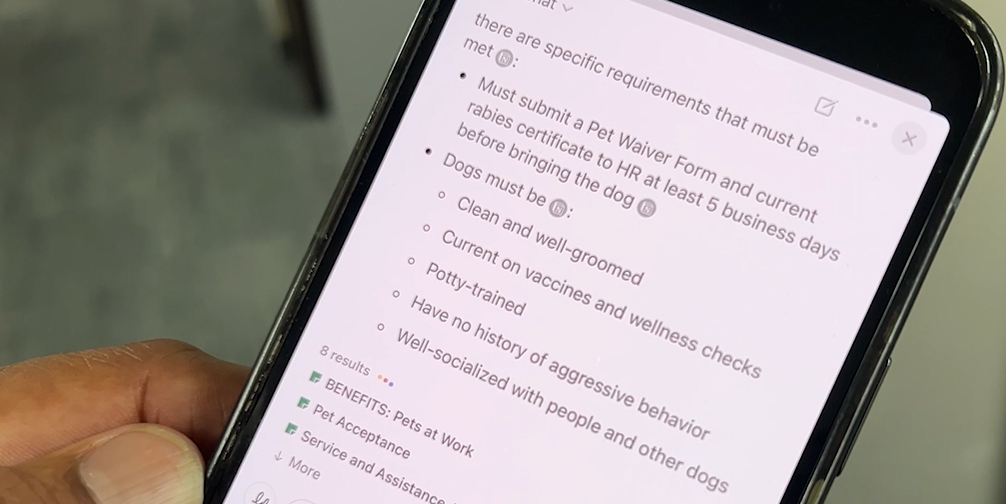
One employee looked up the company’s residential pet policy through Ask Eden. The Notion AI bot returned the correct information, then drafted a compliant tenant letter on the spot.
“We didn’t teach them that,” says Tsai.
When a role becomes vacant, Eden now first asks: can we automate part of this role or upskill someone else internally instead of backfilling it? They created a talent development position focused on knowledge management and data governance.
"A demo early on for the C-suite worked well," says Tsai. Eden ran an exercise with executives: search for specific information using the old system versus Ask Eden. The night-and-day difference sold further adoption better than any standard pitch.
The Problem
Sometimes the best AI path may be no AI at all.
John Davis started his career at Orsid, a NYC-based property manager with over 30,000 units, in a junior administrative role. But after two months of drowning in paperwork, he realized there must be a better way.
Davis, now the company’s Senior Manager of Business Innovation, was managing chargeback requests across the portfolio’s 200+ buildings. The account executive would email the request to an administrative assistant (Davis). The admin would manually fill out a form, attach backup documentation, get written approval, then upload everything to the document management system where accounting would process it.
The manual work added up fast. Orsid estimates 15 minutes per chargeback and processes 4,000 chargebacks per year— roughly 1,000 hours of administrative labor. "If you haven't done the job, you can't give advice on it," says Christine Zeblisky, Senior Director of Operations and Implementation at Orsid. Having seen Davis on the front lines on the administrative team, she was ready to listen.
The Solution
Davis isn’t a software engineer. But he had a degree in Managerial Economics, an interest in automation, and a mandate to improve efficiencies. Starting with Power Automate was an easy decision. Orsid was a Microsoft shop: no vendor approvals, security reviews, or compliance issues.
Notably, Orsid didn’t need to migrate from their legacy property management system. While not cutting-edge, it supported the necessary integrations with Power Automate, allowing them to move faster and avoid costly transitions.
“It was the easiest path because it's low-code,” Davis explains. “I could teach myself in a simple, step-by-step way”.
But why not use AI? “Unless you need intuitive or creative decision making, you can automate without AI," explains Davis. The chargeback process didn’t require machine learning or natural language processing. It was about eliminating manual data entry and enforcing consistency.
While it didn’t require AI capabilities, it did require clean data.
Orsid’s information was stored across five systems with inconsistent naming: a property management platform, an 800-page PDF export, Excel files, bill pay statements, and the document management system. Davis spent two weeks after hours creating a data dictionary with over 50 conditional statements to map everything correctly.
Orsid took a slow and steady approach, building the pilot initiative over time. Final beta testing and rollout took three to four months.
Davis pitched the beta to the CFO with a PowerPoint demo showing side by side examples of the manual and automated workflows. The CFO’s response: “What do you need from us to make this happen?”
Even more than the time and cost savings was the potential for lower compliance risks. Managing a 200+ building portfolio in NYC, Orsid valued consistency, standard processes, and pre-approved language vetted by legal counsel.
For the chargeback automation, the adoption was smooth. It reduced steps for busy account executives—no new tech to learn. The administrative team were provided with cheat sheets with screenshots and arrows showing the new workflows.
The automation even replicated an unloved human task: nagging colleagues until a task is complete. Automated follow up emails “annoy you until you do what you’re supposed to do,” describes Davis. Users learned fast and reminder volumes decreased over time.
The Results
Orsid estimates 1,000 administrative hours were eliminated per year, saving tens of thousands of dollars. The direct software costs were negligible: under $500 per year for a Power Automate subscription, plus several weeks of Davis’s time for the buildout. There were no external consultants or per-event charges.
The automation provided visibility to senior management who could track metrics and identify bottlenecks in real time—especially as the automations compounded and merited a dashboard to track company-wide activities.
With a successful pilot, Davis and Orsid were ready to move onto the next automations. Since that chargeback beta test, Orsid has executed over 40 different automations across the company.
Davis's advice to other operators is direct: “All the tools are out there. So many low-code platforms, and they all work great. It's not magic, it's just time and effort. Effort above all else”.
“Not every project needs AI, " Davis adds. “The real skill is knowing when it truly adds value.”
1. Experience the pain before designing the solution
Operators who did the job themselves came up with better solutions. John Davis at Orsid spent two months with admin paperwork before automating it. Time spent on manual work built the knowledge base needed for successful automation.
2. Match vendor strategy to the complexity of the problem
The vendor relationship spectrum provides a clear framework for operators: DIY when the solution exists and the problem is simple (Orsid’s Power Automate); co-build when no good solution exists and time is available to contribute expertise (Coastals’ lease audits); buy and teach when a solution exists but requires heavy customization (Winn’s affordable housing collections); centralize and replace when consolidation creates meaningful value (Eden’s Notion AI initiative).
The pitfalls to avoid: building custom where commercial solutions already exist, or buying enterprise solutions for problems solvable in-house.
3. Scale slowly at first
Most operators who moved fast initially wished they started slower. Why? At smaller pilots, operators can iterate with lower risk. The lesson: test with 10-20% of users, reveal edge cases early, then expand.
4. Change management: design for actual usage
The best implementations were helpful tools specifically designed for high engagement. Eden kept an old system icon but changed the link beneath it—“why should operators retrain every time we change software?” Design for how people actually work, not how they should work.
5. Automation as forcing function for improved ops & compliance
Automation mandates clarity on process, policies and procedures—forcing operators to fix longstanding issues. Eden leveraged their Notion rollout to centralize legacy SOPs scattered across four platforms. Winn moved from “hundreds and hundreds” of property staff answering questions inconsistently to a single, compliant voice, approved by Winn and regulators.
As Winn’s Hollander notes: “AI offers the opportunity for us to unscale. We can be a small, nimble, flexible organization and operate like we have only 2,000 units instead of 100,000.”
-Donal Warde
Donal Warde is an operating executive specializing in portfolio operations and automation for institutional real estate investors. He has led operational transformations at platforms managing $11B+ in multifamily assets, served as VP Portfolio Management at HQ Capital, and held CEO and Entrepreneur-in-Residence roles at Portico and American Family Insurance.

Meet the 100 people shaping the future of the built world

After years of false starts and regulatory confusion, a few serious projects are pointing toward what this technology can actually deliver for real estate

For an industry built on spreadsheets and market analysis, asset management may be the next AI target.

AI comes for property diligence – with major implications for real estate acquisitions
Covering the future of real estate and the people creating it