

Deep Dive: Rely
AI comes for property diligence – with major implications for real estate acquisitions

For the past few years, AI’s impact in real estate has been most visible in property operations: automating leasing, managing resident communications, and streamlining routine workflows.
That phase is ending. AI is now gaining momentum on the acquisition and development side of the house, transforming how properties are evaluated, risks are priced, and investment decisions are made.
Property diligence is perhaps the most salient of those applications. For one, diligence leans on many of AI’s strengths: ingesting and processing large quantities of information, structuring data, and error checking are all things LLMs do well. In 12–18 months, there’s a good chance most value-add and core real estate buyers and lenders will lean heavily on AI, saving time and dramatically reducing errors.
But the broad application of AI in the diligence phase could upend how real estate deals get done, with some surprising impacts on real estate capital markets and how deals get financed.
Today’s letter will explore this through the lens of Rely, a technology company at the forefront of bringing AI to the diligence phase.
Let’s dig in.
Beyond Operations
In recent years, companies like EliseAI have become the poster children for AI in real estate, and for good reason: AI’s applicability to multifamily operations is relatively straightforward, and the returns are easily demonstrable. LLMs are now more than good enough to schedule a tour, explain an additional charge, or triage a maintenance ticket, saving owners money and headaches.
Until recently, real estate firms’ development and acquisitions teams received relatively little attention from AI pioneers. Their workflows were more complex and varied than those of front-line leasing and customer service agents. And for many developers, deploying AI in high-risk development and AEC functions appeared not worth the risk. We teach an entire workshop on AI In AEC, so we’re familiar with (and generally bullish on!) the technology here. But it’s undoubtedly been slower to market than operationally-oriented AI technology.
But there’s good reason to believe that’s beginning to change. Acquisitions and development executives are increasingly feeling pressure to get on the AI bus, and a handful of applications are seeing real successes in the field.
And perhaps no application of AI is more obvious and straightforward than property diligence. Auditing leases, vendor contracts, utilities, and financial statements is exactly the kind of thing LLMs do well: the inputs are predictable, voluminous, mostly natural language, and subject to repeatable processes aiming to identify errors and mismatches across documents.
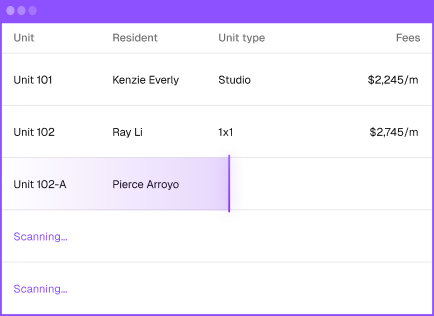
Consider a lease audit, for instance. Is the lease in standard form, fully executed, and current? Does the rent being collected match the rent roll and PMS charges? Were concessions applied correctly? Are any additional fees (pet, RUBS, parking, storage) actually reflected in the PMS and being collected? Were post-renewal increases executed correctly?
For most multifamily buildings, the answer to many of these questions is “not always” — humans make errors, and those errors have a way of persisting throughout a resident’s term. Most tenants, after all, will not go out of their way to tell the property manager they’re not being charged pet rent. So absent regular lease audits, the first time many owners discover these errors is when they go to sell the building. While a collection of small errors won’t kill a sale on its own (it’s upside for the buyer, after all), the agreed-upon sale price was tied to an NOI that may have been artificially low, potentially leaving hundreds of thousands of dollars on the table for the seller.
Lease audits, unfortunately, are time-consuming and expensive, which is why most owners don’t do them on a regular basis. Historically, each lease would be reviewed by hand and cross-checked against the rent roll and PMS. Given the effort involved, lenders typically only require buyers to audit 10% of leases when acquiring a property — basically enough to identify systemic issues that might jeopardize debt service coverage, not the kind of thorough audit that would identify meaningful new revenue.
AI, however, is far better than humans at this kind of content-intensive, repetitive lift.
Ingesting and converting large amounts of natural language into structured data and finding mismatches is exactly where large language models excel. And while lease audits are a prime example of the work involved in property diligence, the other desk tasks — contract and utility audits, bad debt analysis, and financial audits, to name a few — have a similar profile.
And that’s a big reason why we’re interested in what Rely is doing: of all the places AI can be applied to the acquisitions and development world, diligence is perhaps the most obvious. And it’s worth exploring not just on its own merits but for the impact it could have on the broader real estate capital markets as technology upends how diligence happens.
The Rely Story
Rely founder George Matelich is not new to building tools for the real estate industry: he previously held senior product roles at multifamily resident onboarding tool Updater and home equity platform Hometap.
But in early 2025, he and co-founder David LoBosco saw the opportunity in building AI for acquisitions and struck out on their own. And they found an early pilot customer in Cardinal Group, a major owner-operator in both the student housing and multifamily markets. (Cardinal also invested in Rely.)

Matelich and LoBosco also made a point to bring more multifamily chops onto to the team, recruiting former Updater colleague Jake Johnson as Head of Sales. And rather than target diligence broadly, Matelich chose to focus on lease audit automation as Rely’s initial product — from the company’s initial experience, it offers the clearest ROI and least complexity of all the audit steps. In one recent case Matelich cited, a single portfolio lease audit identified more than $1 million in missing revenue, almost all of it from ancillary revenue stipulated in leases that wasn’t being charged to residents.
While vanilla AI document abstraction faces competitive threats from the foundational models themselves, Matelich believes lease audits have some unique quirks that demand a unique application-layer tool. “The document volume in a lease audit today is untenable for a foundational model,” he explains. “If you jam a bunch of stuff in a context window, it would explode.”
Auditing models also benefit from context-specific framing that makes their output more replicable from case to case and user to user. “Each lease audit is unique,” he notes.
While Rely is focused on lease audits today, the company plans to release automation tools for financial audits, vendor and contract audits, and work order analysis in the coming months. “The goal is to take 100% of non-physical diligence and have it done the day they get the data room.”
Ultimately, Rely sees lease audits as a data validation step that should happen continuously, not just at the moment of a property acquisition or other defined event.
“Property owners should be able to catch errors as they happen, as data is entered,” notes Matelich. It’s insane that this functionality isn’t already baked into the property management systems.”
Understanding the importance of accuracy, Rely is building a series of “agents that check agents” — the AI universe’s version of Dr. Seuss’s Bee-Watchers — to ensure entries are accurate and hallucinations are avoided.
Desk work like lease and contract audits are, of course, only half the property diligence process. Another set of companies,like FoxyAI and Restb.ai, have built computer vision tools that automate the “field diligence” steps, transforming property photos into qualitative descriptions (“high-end granite countertops”), quantitative evaluations (“4.5 out of 6.0 on the build quality score”), and specific issues (“fascia and soffit damage”).
When combined with Rely, tools like Foxy and Restb provide a remarkable set of capabilities to automate acquisition diligence soup-to-nuts. We’ve written about the zero-employee property manager, but what about the zero-employee real estate buyer? And perhaps more importantly, what do these shifts mean for real estate capital markets?
90 Days No More
Traditionally, sellers in commercial real estate transactions offer buyers a period of time — typically 90 days, but it can vary — to conduct diligence on the property before closing. In theory, this gives the buyer plenty of time to do all the tasks we described above: audit the financial statements and rent roll, review the leases and vendor contracts, inspect the property’s physical condition, and generally get comfortable that they’re buying what they think they’re buying.
In practice, the 90-day diligence period serves an additional purpose for many real estate operators: it gives them time to raise the capital needed to buy the property.
For real estate operators raising capital deal-by-deal into SPVs, getting investor attention on a deal that isn’t under exclusive control is extremely challenging. Investors are busy, and digging into deals that a GP doesn’t have firmly under control is typically a poor use of time. And for off-market properties, GPs are rightly concerned that investors may simply circumvent them if shown a sufficiently juicy opportunity.
So operators go into contract first and then raise the capital to close during the 90 day diligence window.
But what if the 90 day diligence window weren’t needed? AI applications like Rely, after all, don’t need weeks to pore through leases and compare entries; a complete lease audit can be accomplished in a matter of minutes. And the same will surely be true for the other elements of desk diligence: once the documents are assembled, the actual auditing process is nearly instantaneous.
And the tools reinventing field diligence are almost as fast; many computer vision-powered inspection tools were initially developed for iBuyers like Opendoor and Offerpad whose value proposition depends on speed, making an offer in 24–72 hours and closing within 2–3 weeks.
Of course, audits and inspections aren’t the only thing dragging out closing dates. Title search remains frustratingly antiquated, despite dozens of companies over the past decade attempting — and failing — to modernize it with blockchain. And lenders have their own diligence processes that can slow the closing process down, although there’s no reason they won’t also adopt Rely and other AI tools to expedite their own processes — at their own pace, naturally.
But in a world with automated, AI-powered audits, the 90 day diligence period will increasingly be a relic, a crutch for buyers who don’t have the cash to close by the time the AI agents wrap up their work in a matter of hours. In that future state, sellers will strongly prefer buyers who can agree to an extremely brief diligence period: not just speed for speed’s sake, but as a signal that they have the capital in hand to close and won’t fall out of contract months later when investors don’t materialize.
While that future state of universal AI adoption is still years away, we’re approaching a moment where operators who embrace these tools — and have cash on hand — have a secular advantage in the market.
“Middle market folks have to compete on something,” says Matelich. “Now, they can compete on time. If they can shrink their diligence window, they can win more deals.”
There’s a possibility this moves some real estate operators away from a deal-by-deal approach, toward the fund and JV models favored by private equity and venture capital. If diligence timelines are no longer the primary driver of close timelines, access to reliable capital and certainty of close become an even more critical differentiator among GPs.
As with much of AI today, the early movers will have the advantage here – not just in their understanding of the world to come, but in the offer they’re able to put on the table to a seller.
–Brad Hargreaves

Read next

Can AI Solve Capex Overruns?
New data from Tailorbird shows why two-thirds of real estate operators blow their capex budgets and where AI could actually help

Deep Dive: Metropolis
How a computer vision startup became America’s largest parking operator and a test case for a new model of venture-backed growth

Why Realpage Bought Cherre
Realpage is betting that decades of accumulated data can become an AI-era advantage

AI for Real Estate Acquisitions
We've been building AI acquisitions agents with real estate GPs. On August 13, we're opening the hood in a live 2-hour workshop