
The Stadium is the Easy Part
From Miami to Las Vegas, billions are pouring into stadium-anchored districts, but only a handful have so far proved they can truly work as real estate.
From Miami to Las Vegas, billions are pouring into stadium-anchored districts, but only a handful have so far proved they can truly work as real estate.
A live one-hour session on turning your investor deck into a reusable Claude workflow you keep

The rise of agentic AI and recent software releases prompt hard questions about what “openness” really means
From Miami to Las Vegas, billions are pouring into stadium-anchored districts, but only a handful have so far proved they can truly work as real estate.

On April 4, 2026, Inter Miami CF played its first home match at Nu Stadium, the new 26,700-seat soccer-specific stadium built on a 131-acre site of city-owned land near Miami International Airport. The stadium was the centerpiece and opening salvo of Miami Freedom Park, a $1 billion-plus mixed-use development that aims to add nearly a million square feet of retail, office, and entertainment space to the site. On the pitch was Lionel Messi, widely considered the greatest player in the history of the sport, who signed with the team in 2023. In the stands were co-owner David Beckham and the Mas brothers, Jorge and Jose, the Cuban-American industrialists whose MasTec empire helped finance the project (along with Ares Management, which holds an equity stake). Thousands of fans in flamingo pink had been there for hours before kickoff. "It was packed and it was loud," said one person who attended that evening. "The place was rocking, start to finish."
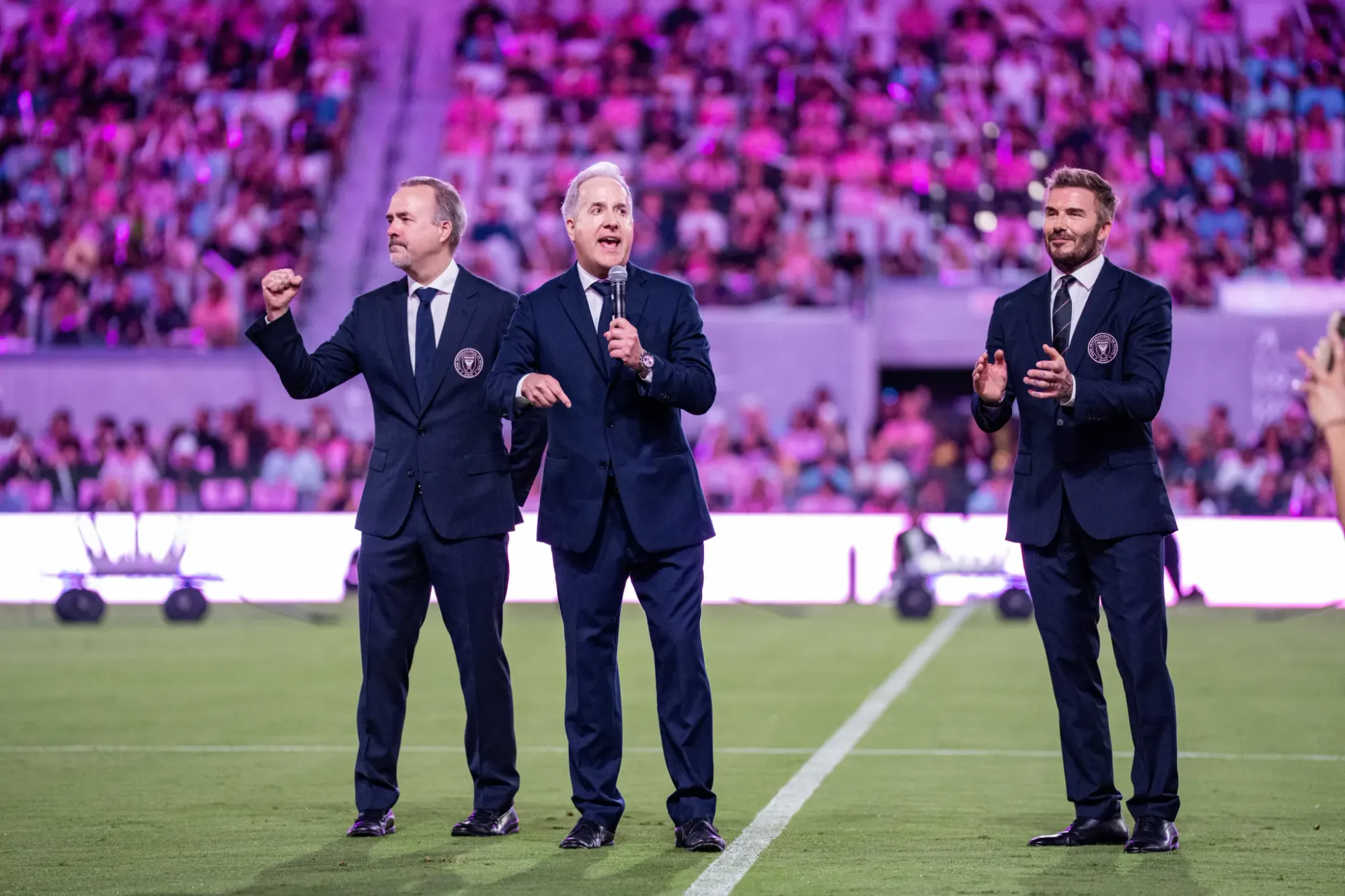
Beyond the stadium's edges, construction equipment sat idle in the dark, the rest of the site still a work in progress.
The night was considered a big success. The harder question is what comes next. What the crowd didn't know was that the stadium had not yet received a temporary certificate of occupancy, or TCO, the permit a city grants to allow occupancy before a building has passed final inspection; the city authorized the stadium to open without restrictions shortly before the game. Around the same time, the city had quietly extended the deadline on a $10 million payment the development group owed for public park improvements.
That detail pointed toward bigger questions. Miami Freedom Park is a privately financed mixed-use project that will need to sustain itself through 348 days a year when Inter Miami isn't playing, and do all of it without a residential component, because airport zoning prohibits it. The real estate industry is watching closely.
The sports-anchored mixed-use district has become one of the most scrutinized big bets in American real estate. The premise: surround a stadium with retail, office, hotels, and residences, and let the real estate returns justify what gate revenue alone never could. Virtually every major sports venue project announced in the last five years, including developments in Washington, DC, Woodland Hills, CA, San Antonio, Las Vegas, and Salt Lake City, has come wrapped in this logic.
The plans have been ambitious. Proving them out has been harder.
Tim Katt, National Director and Managing Partner of Transwestern's Sports and Entertainment practice, has advised on projects across the country. "There's a lot of speculation, hype, new renderings every week, billion-dollar projections," he said. "But the reality is there are only a handful of projects that actually exist, and even fewer have been financial wins."
In this letter we’ll cover:
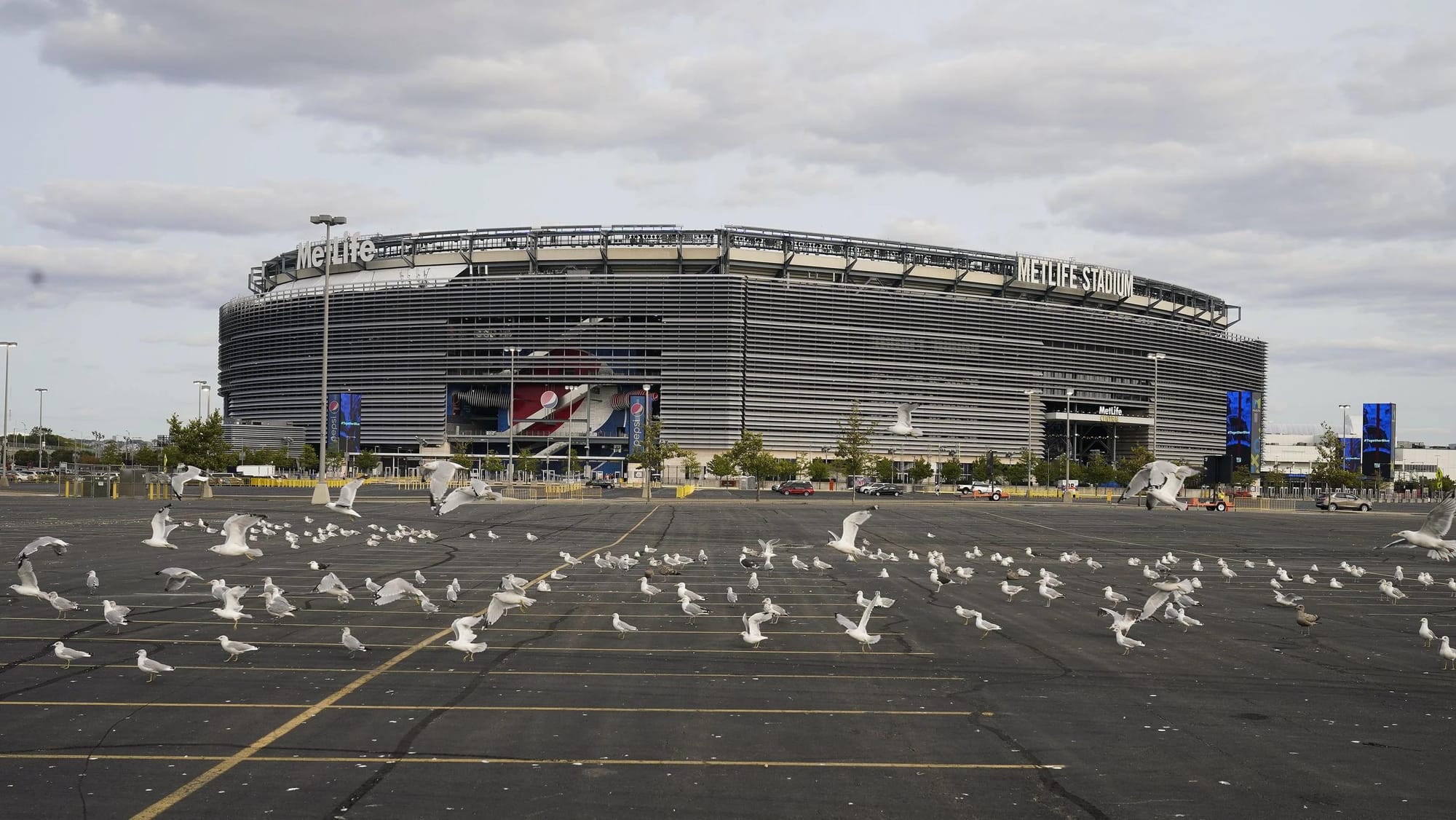
For most of the stadium era, the model was simple: build the venue with public money, surround it with parking, and treat everything else as someone else's problem. The Superdome dropped into New Orleans with parking garages and lots around it, active on game days and dead otherwise. Veterans Stadium in Philadelphia was a single multipurpose bowl shared by the Phillies and the Eagles, surrounded by seas of asphalt, and was demolished in 2004. The Meadowlands situated two New York-based NFL franchises on a swamp in New Jersey with no retail, no residential, and no reason to show up except for the game (and maybe not even then). The original venue was eventually demolished and replaced on an adjacent site by MetLife Stadium, built on that same insular formula.
But a different strategy was forming too. Oriole Park at Camden Yards opened in downtown Baltimore in 1992, trading the multipurpose, parking-lot model for a single-purpose ballpark built into the city grid. More teams began placing stadiums in transitional urban neighborhoods, betting that the venue itself would catalyze surrounding development.
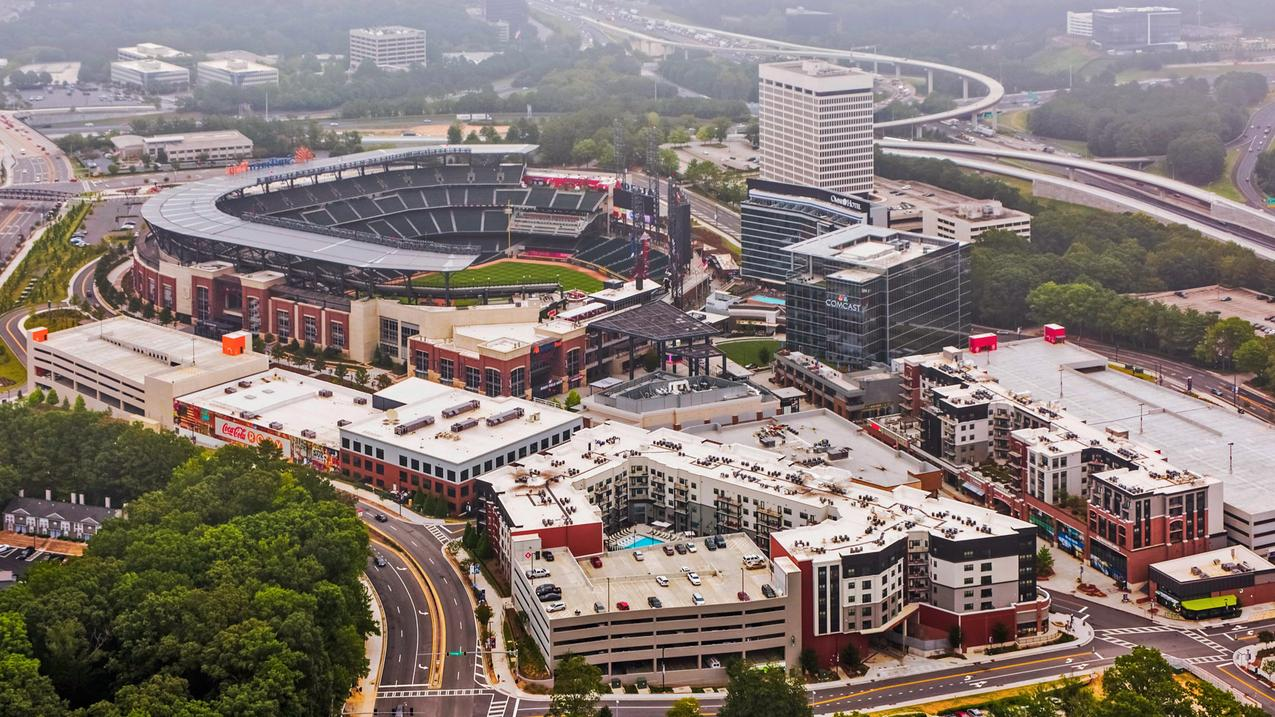
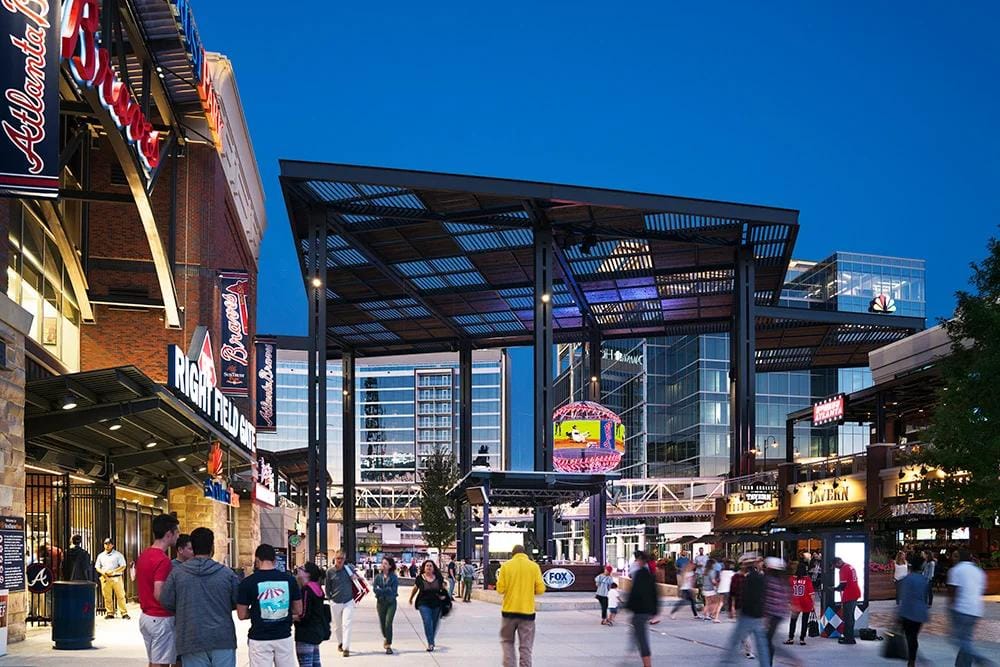
The Battery Atlanta, which opened in 2017, proved that a fully integrated, master-planned district could function as a year-round destination rather than a game-day one. The Braves didn't wait for private developers to follow their lead. They built the retail, the restaurants, the office tower, the hotel, and the residences themselves, alongside the stadium, as a single coordinated development. Once the Battery opened, many major league sports owners with a piece of land started drawing up plans.
The Battery generated $97.4 million in mixed-use revenue in 2025, up 45 percent year over year. For the fourth straight year, the real estate side of the business contributed more to the Braves' adjusted OIBDA (operating income before depreciation and amortization) than the baseball side did.
The conditions that produced those results are highly specific to the site. The Battery sits at the intersection of two major interstates in Cobb County, an affluent Atlanta suburb. It has a residential component that keeps the district populated between games. Its real engine, less celebrated than the restaurants and bars that get the attention, is a major corporate office anchor that creates year-round density, letting the surrounding neighborhood function as a destination independent of the game schedule.
"That's another reason The Battery remains such an outlier," Katt said. "They delivered office, residential, retail, entertainment, and the stadium in a much more integrated way than almost anyone else."
J.C. Bradbury is a sports economist at Kennesaw State University and a lifelong Braves fan who has spent years studying the project. In a piece published in April 2026 by The Conversation, he offered a blunt verdict: "Unfortunately, the Battery hasn't been a boon for taxpayers." His research found that Cobb County's $300 million public subsidy has not been covered by tax revenue generated, running an annual deficit of roughly $15 million — a finding the Braves and Cobb County have disputed. His book "This One Will Be Different," published this year, argues that government commitments to major-league venues are approaching $50 billion, and that a looming wave of new construction threatens to double that figure by the end of the 2030s.
"Most people would give up their religion before they'd give up their subsidies to their sports teams," he told the Show Me Institute podcast in June.
Katt pushes back on that framing. "If you took his argument to its logical conclusion, you'd almost conclude that professional sports teams shouldn't exist at all," he said. "There are intangible benefits that don't fit neatly into an economic impact model."
Meanwhile, the next generation of projects is coming online.
Miami Freedom Park is a rarity in American stadium development: a project of major scale with no public construction subsidy, though the stadium does sit on a 99-year lease of city-owned land approved by referendum. Ownership financed it privately, closing on a $450 million construction loan in April 2025. The Battery proved the model could work when public money absorbed the downside. Miami Freedom Park is asking whether it can work when ownership absorbs it instead.
"Because of its proximity to the airport and the site's zoning restrictions, they can't build multifamily housing," Katt said. "That's a very unusual limitation for this category because residential is normally considered one of the most important components of a successful mixed-use district."
The substitute is an ambitious multi-use program: up to a million square feet of retail, dining, entertainment, and office space, along with three hotels, phased through 2030. Three tenants have signed for roughly 125,000 square feet of the 500,000 square feet of retail in phase one: Fever, a live-entertainment platform known for immersive experiences; PopStroke, Tiger Woods' golf entertainment concept; and Toroverde, an adventure park with zip lines.
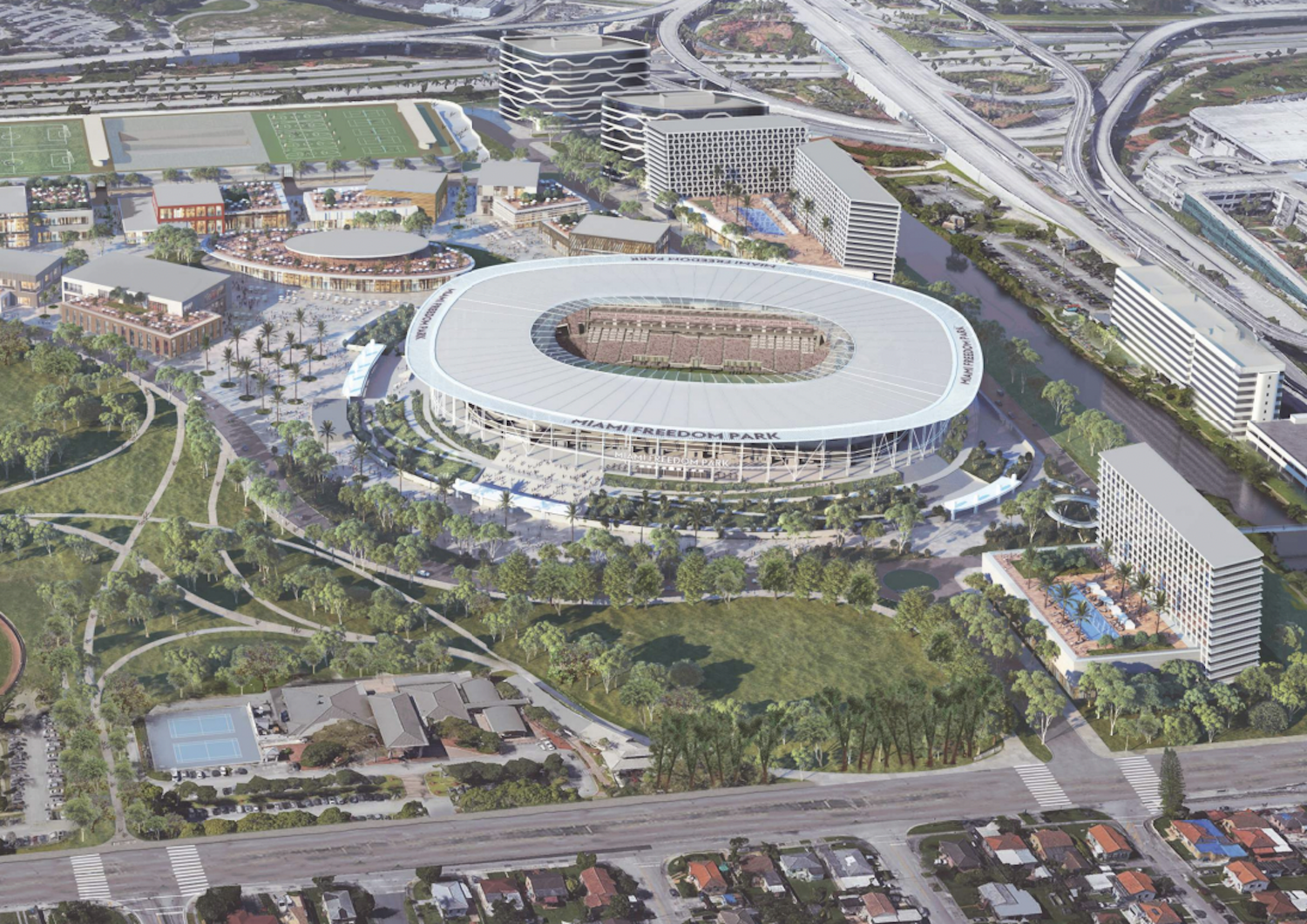
On the office side, Cushman & Wakefield's Brian Gale, who is handling leasing for the project, is pitching Miami Freedom Park as its own submarket. "We are smack in the middle of the city," he told The Real Deal. The most concrete tenant so far is the city of Miami itself, which is relocating its administrative offices and city hall to the site.
But a corporate tenant that drives private sector leasing demand won't arrive until the project's first office building opens in 2028 at the earliest, leaving the district dependent on tourism and entertainment programming in a Miami-Dade retail market where average asking rents fell 8.5 percent year over year in early 2026, according to CRE Daily. Inter Miami plays roughly 17 regular season home games, leaving the district to carry the other 348 days.
"The physical development is only half the story," Katt said. "The ongoing programming is what determines whether these districts become genuine neighborhoods or simply places people visit on game day."
The most telling fact about this category is what it hasn't attracted: conventional real estate capital. Most major projects have been driven by ownership groups or owner-adjacent developers rather than third-party investors evaluating deals on pure real estate fundamentals. Stan Kroenke, the Los Angeles Rams owner, financed Hollywood Park, the 300-acre mixed-use district surrounding SoFi Stadium in Inglewood. The Braves drove the Battery. Institutional investors have entered the category, but through sports-focused platforms like Arctos and Ares that bundle franchise ownership with real estate exposure, not through the kind of straightforward investment that flows into multifamily or industrial.
Two structural issues explain the gap. The first is control: team owners won't give it up, and a third-party developer needs returns flowing to lenders and equity partners, not just to ownership. "Even if the location is outstanding and the market fundamentals are strong, you still have to align the objectives of ownership with the objectives of the developer," Katt said. "A financially successful project can't simply mean that all the profits flow back to the team." The second is alternatives: if a market underwrites well on its own, a developer doesn't need the complexity of a stadium partnership.
The financing has evolved. Even as the academic consensus against stadium subsidies has hardened, cities have found a workaround: routing the money through revenue bonds and similar structures that don't require a ballot measure at all. Kansas City is a case in point. Jackson County voters rejected a sales tax measure for the Royals' Crossroads ballpark district in 2024, and the team spent much of the following two years scouting sites across the state line in Kansas. In 2026, the city council approved up to $600 million in bonds for a different site at Crown Center, backed by stadium-generated revenue rather than a public vote.
"The biggest question is whether traditional real estate capital eventually becomes comfortable investing in these projects, or whether they continue to be financed primarily by team ownership, public incentives, or some combination of the two," Katt said. "That's really the next breakthrough."
So many projects are in motion that it can be difficult to keep track of where things stand. Here's a scorecard:
Open and operating:
Under construction or recently opened:
In planning or entitlement:
Setbacks:
The Chicago situation carries a complication that has received little attention. "There is still something like $600 million in debt service tied to Soldier Field from renovations completed more than twenty years ago,” Katt said. “That debt has been refinanced multiple times. That's an example of how stadium financing can actually go wrong."
"What I actually think would be fascinating is seeing an ownership group sophisticated enough to bring in multiple developers," Katt said. "Everybody talks about wanting to create an authentic neighborhood. Well, that's how cities actually develop. One developer doesn't build the entire Financial District in Manhattan. Different developers build different projects over time."
Covering the future of real estate and the people creating it