
Deep Dive: Cuby
How a Mobile Micro-Factory could give small-to-mid-size builders big-builder economics
How a Mobile Micro-Factory could give small-to-mid-size builders big-builder economics

As multifamily software consolidates and competition intensifies, the maintenance platform adds CapEx tools and a direct line to the owners who pay for capital projects
Operators who’ve seen it say it’s impressive. Whether they’ll switch is another question.
How a Mobile Micro-Factory could give small-to-mid-size builders big-builder economics

Construction costs are one of the biggest barriers to housing affordability and abundance in the US today. While manufacturing has seen dramatic productivity gains over the past half-century, construction has largely missed out, with sector productivity declining since 1968. A shortage of skilled tradespeople worsens the problem. And it's only deepening: 41% of the construction workforce is projected to retire by 2031. Immigration, long our nation’s largest source of skilled construction labor, is politically out of favor.
The prize for figuring out how to bring construction into the 21st century is tremendous. But so are the risks.
Today’s letter explores a new approach to bringing industrial-scale benefits and automation to construction, starting with homebuilding. Cuby treats construction as a logistics problem, rolling out Mobile Micro-Factories (MMFs)™ that let less-specialized labor do much of the on-site work. By borrowing lessons from early 20th-century building trends like kit houses, it’s looking to avoid the pitfalls that have doomed many other construction innovators. For developers, homebuilders, and general contractors, the pitch is concrete: code-compliant homes assembled by small, non-specialized crews without subcontractor bottlenecks, at roughly half the cost of traditional construction.
Let’s dig in.
Most attempts to reinvent construction through technology have underwhelmed. The “modular construction” sector, for instance, is a graveyard of well-funded companies that never seemed to figure out how to get the economics of their businesses to work. And robotics, which has successfully addressed skilled labor shortages in other industries, hasn’t made meaningful inroads into on-site construction, stymied by unpredictable site conditions and low utilization rates. Tesla was able to automate so quickly because it had 50 years of the Toyota Production System to learn from, and 100 years of Ford’s conveyor belt. Where is construction’s Ford moment?
Modular construction companies have suffered from a few problems. “Volumetric modular” concepts — think premade boxes craned onto a site — have generally flopped due to a combination of regulatory challenges, shipping costs, and the technical constraints of having third parties stack and connect them on-site. They are also challenging to customize and tend to have a recognizable “modular” look.
Conventional modular approaches also don’t align with construction lending schedules. Modular vendors need to be paid upfront to produce modules that are then shipped to site and assembled. Construction lenders, on the other hand, expect to disburse capital on a timeline tied to conventional construction milestones, forcing developers to either finance projects with more equity or find a particularly innovative lender. Cuby’s kit model is designed to sidestep part of this problem: components ship to site in stages as the build progresses, and the home goes up like a conventional build, so payments can follow familiar construction milestones.
Cuby co-founder Aleks Gampel is candid about the sector’s shortfalls. I’ve known him since my days building Common, and he has been among my go-to sources on construction tech. Gampel and Aleh Kandrashou founded Cuby almost six years ago, but the company has kept a relatively low profile compared with its peers, despite how much technical innovation it has done.
The best model for understanding Cuby’s approach is found not in recent examples of hot, venture-backed modular housing players, but more than a century ago.
Industrialized construction is not a novel concept. The kit houses of the early 20th century, for instance, were effectively modular buildings that could be hand-assembled on site by unskilled labor, often the homeowners themselves. They may be the most successful example of modular construction to date.

For Sears and its fellow consumer kit home manufacturers, the “modules” were not the volumetric boxes or panels that today’s modular housing companies produce. Instead, the companies shipped a set of standardized components along with detailed, step-by-step assembly instructions. What made it work was the intuitive “kit of parts,” which enabled almost anyone to build a home.
The Sears kit home comparison is just one way to understand Cuby’s approach to prefabricated construction. The difference is that while Sears only allowed customers to choose from a catalog of premade designs, modern software makes it far easier for Cuby customers to mix and match prefabricated modules to build a wide variety of homes, retail boxes, and even industrial buildings and data centers. The upside is the same: By shipping prefabricated “bundles” of custom-manufactured components, last-mile, to the site in stages, along with procedurally generated instructions and dedicated tools and equipment for assembly, Cuby enables workers with relatively little training to assemble complex structures step by step, like a Lego set.
At the center of the company’s production is the Mobile Micro-Factory, a 35,000-square-foot machine that can be assembled near demand pools. Cuby’s factory is purposefully far smaller than the large assembly floors, often 10x the MMF’s size, built by other industrialized construction startups. Rather than emphasizing scale on day one, Cuby chose to optimize for utilization and speed; the MMF can be deployed in as little as 100 days at 10x less cost than typical factories.
While the MMF is unquestionably cool, I find the term somewhat distracting from what makes Cuby’s approach unique. The “mobile” part is less about moving factories than about deploying them quickly and repeatedly near demand hubs; while the structure is technically temporary and movable, Gampel acknowledges that the company is unlikely to move factories often. “Since the factory can ship within a 185-mile radius, I doubt we’d pick it up after a set of projects unless we misjudged demand in the area,” Gampel says.
The “mobile” designation helps with permitting. Unlike a traditional factory, Cuby’s MMF is not technically a building: it’s a giant, sophisticated machine, meaning it doesn’t require the typical, lengthy permitting process for an industrial structure. This makes it far easier for Cuby to get rolling on any given site and to replicate MMFs in every market (like a local Home Depot).
The MMF’s relatively small scale also makes the utilization challenges that have plagued modular housing companies more manageable; it reaches full capacity producing approximately 220 homes per year, according to Cuby. With a practical shipping range that covers an entire metro area, reaching full utilization in a market isn't a tremendous lift. One or two large projects or regional homebuilder partnerships would do the trick. That makes the MMF a partnership product as much as a factory: A master-planned community, built-to-rent operator, or regional builder with multi-year pipeline could anchor one in its own market. With its operational design, Cuby’s model makes it logistically feasible to build 200 disparate homes across that region at the same unit economics.
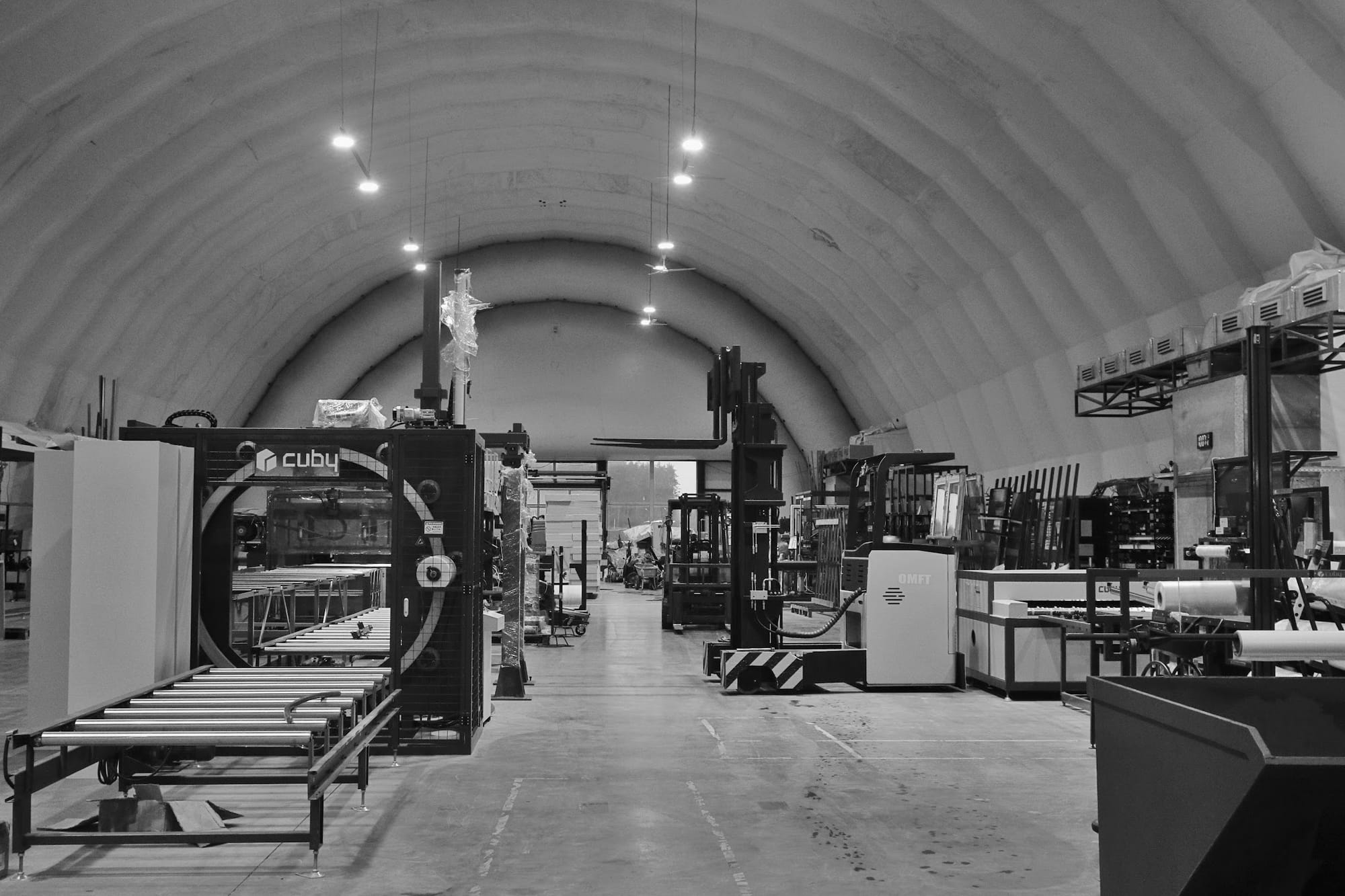
At its core, Cuby’s thesis is that the barrier to more efficient construction is about logistics. Get the right pieces on-site with accurate assembly instructions at the right time, and magic can happen from a cost and timeline standpoint.
The job of the MMF is to produce and prepare those pieces from more than 550 raw inputs. The pieces are then grouped into kits, each stamped with the date and time it should be delivered on-site. Each comes with instructions, like an IKEA manual or a Lego set, but for an actual home. With AI, those instructions can be produced in any language needed by the site team, from Quechua to Cantonese.
“Putting an IKEA table together is straightforward because the instruction manual stays the same,” explains Gampel. “Where it gets really challenging is to imagine that table kept shape-shifting. Those instructions need to shape-shift too.”
The end result is semi-custom, quality homes that can be assembled in less than three months by a four-person, non-specialized crew for approximately $100 per square foot (with a path to $70 per square foot), according to Gampel. “Everything is broken down into discrete steps,” he says. “So any of the four laborers walking up to a kit of parts are scanning a QR code and getting an instruction set of what to do, which tool/equipment to use, and so on. It says ‘go to Toolbox 1 on site, grab tool x, grab this part from the kit of parts, here’s what you’re doing and with whom. You cannot move on to the next task until the previous one is done correctly, and confirmed in the on-site worker application — just pure lean manufacturing principles at play.’”
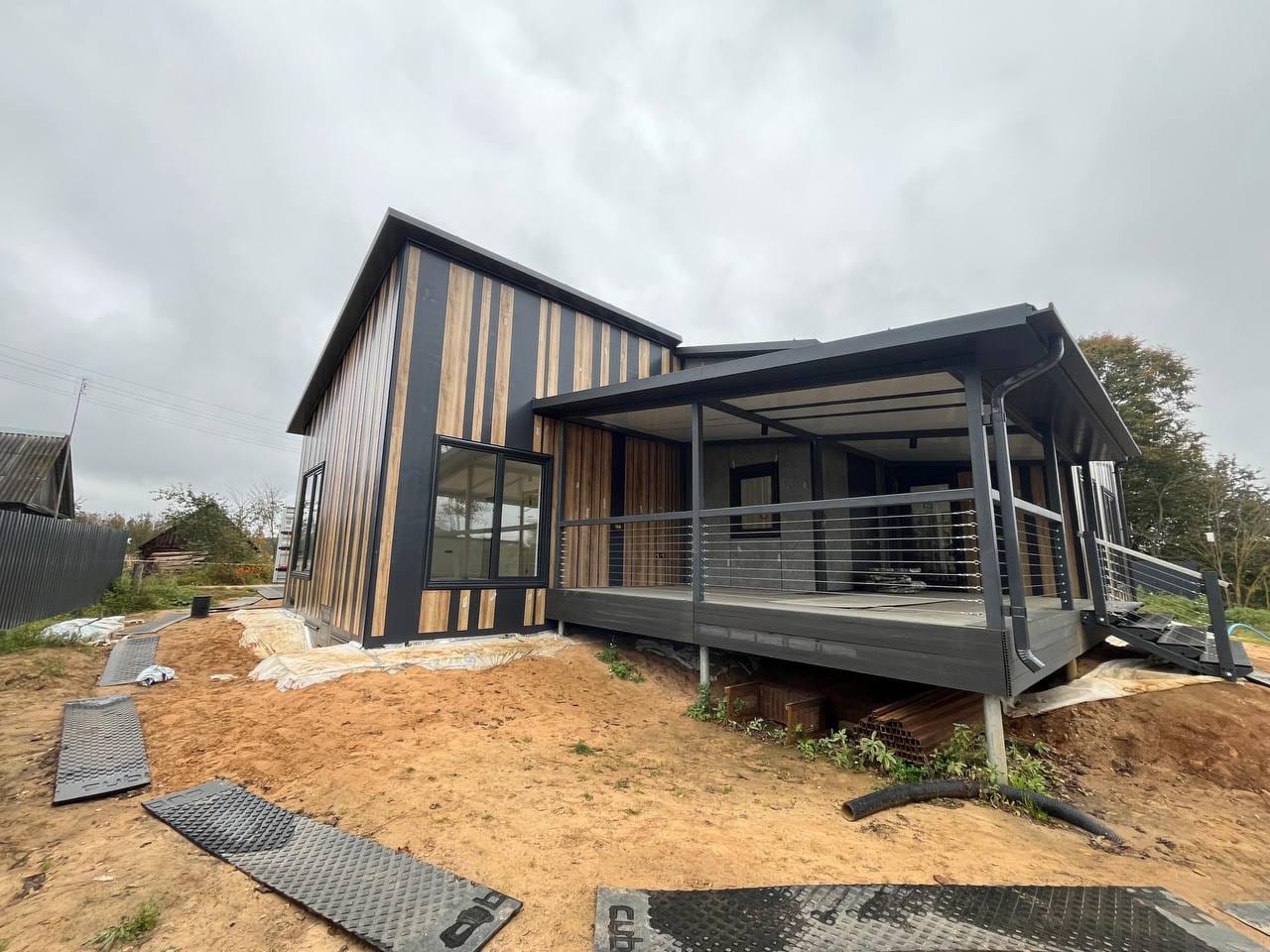
Cuby’s most significant impact might be its ability to make construction work accessible to people with less prior experience. Its user-friendly equipment incorporates enhanced safety controls, lowering the educational barrier to entry without requiring a dedicated machine operator. The four-person on-site team shares responsibilities, with members ranked from one to four based on experience and their capacity to handle more nuanced tasks requiring greater dexterity, rather than assigned fixed, exclusive roles. “Our on-site teams could’ve been working as baristas two to three weeks ago,” Gampel says.
This is a large, underrated driver of Cuby’s stated cost savings. Not only is skilled labor in short supply, but the many modular and robotic manufacturers’ need for skilled technical labor on-site became a major barrier to their success. Yes, a robot might be able to displace some of the work a $30-an-hour bricklayer would otherwise do. But the need for a $75-an-hour technician on-site to babysit the robot more than wipes away any savings.
Structurally, Cuby functions as a general contractor and handles every trade, from foundation to finishes. Because much of the technical work happens in the MMF rather than on-site, there aren’t subcontractors per se; Cuby itself holds the licenses for skilled trades like plumbing and electrical. For a developer, that means one contract, one schedule, and one accountable party in place of a long list of trade bids.
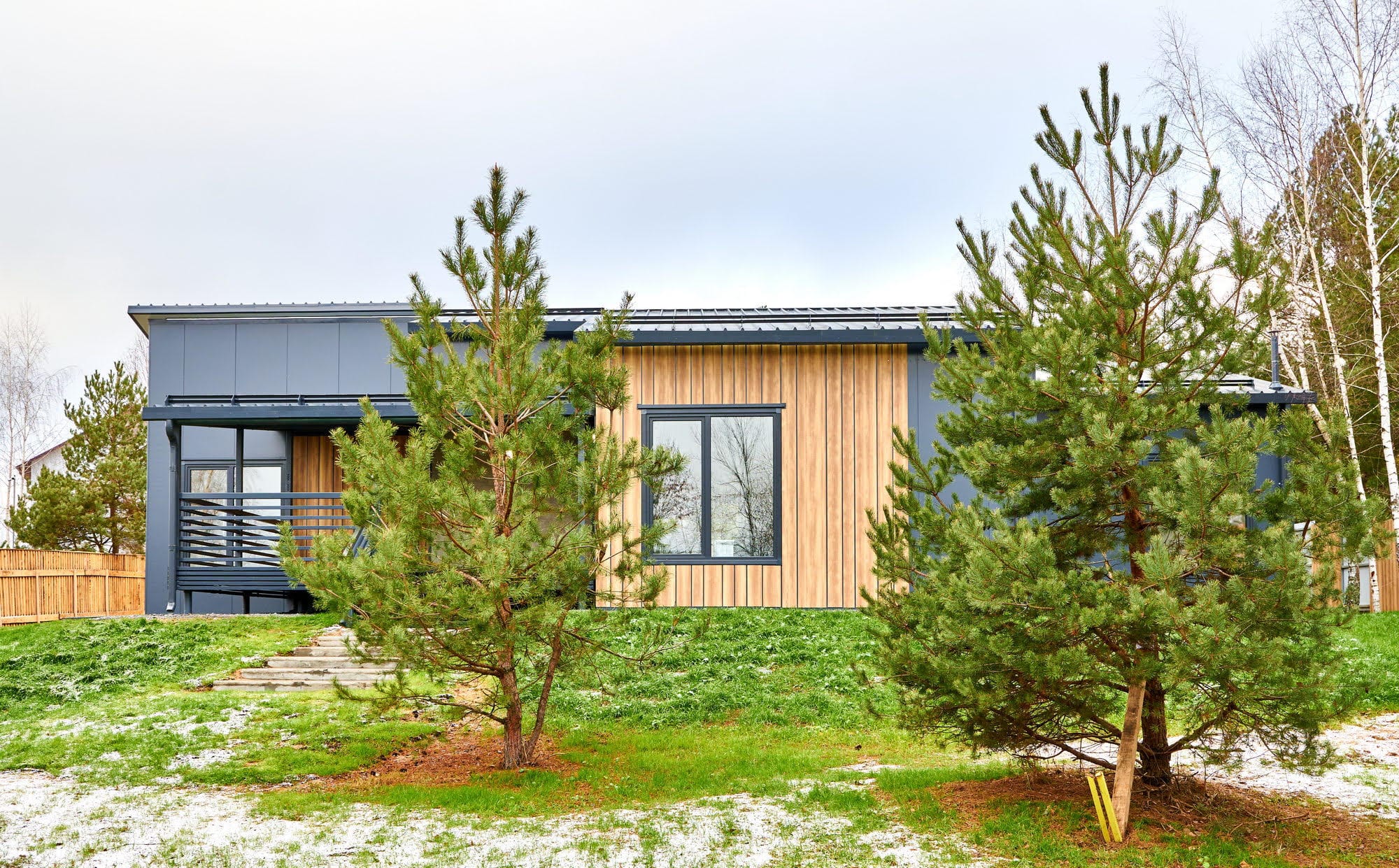
To date, Cuby has constructed a dozen pilot homes. Its most recent, a reference build in Walled Lake, Michigan, was built for $130 per square foot, higher than its target due to the additional costs of operating sub-scale, Gampel says. Builders and developers can tour it on Matterport here. Cuby is targeting $100 per square foot all-in build costs from foundation to finishes.
Cuby’s projects don’t feel like factory-built housing. There’s no blockiness or awkward joins between modules, because assembly works much like traditional construction. And critically, Cuby’s homes can go through the same approval, permitting, and inspection path as conventionally built homes. “We don’t need to test any panels; we don’t need special permits,” says Gampel. “These homes inspect like a Lennar home would inspect.” Cuby is not waiting for regulation to change because it built technology with regulation in mind.
Cuby’s first full-scale MMF is under construction in Las Vegas, Nevada, its initial “scale” market. To start, Cuby plans to serve small- to middle-market homebuilders, firms that can’t match Lennar’s or D.R. Horton’s economies of scale on their own. “The top 10 homebuilders are 50% of the market,” says Gampel. “We want to help the other 50%.” The Las Vegas MMF is roughly 50% complete and is designed to produce about 220 homes per year, or roughly $70 million in annual revenue, on an investment of about $25 million. Cuby is now lining up builders and developers within the factory’s shipping radius to fill its first production slots. In addition to housing, Cuby is rolling out a component set for industrial buildings and data centers, targeting $29 per square foot for the superstructure and envelope, following investment dollars to in-demand sectors.
As regular Thesis Driven readers know, I write a lot about software. Exciting things are happening in the software and AI side of real estate; big companies are being built that are fundamentally transforming how real estate is run.
But solving the housing crisis will require innovation on the atoms side of the equation as well. While skeptics in the media like to dance on the graves of Katerra, Veev, Blokable, and many other companies in this space that have met their end, I see their failures as great tragedies. This isn’t to say those companies should’ve succeeded on the merits (each of their models had serious flaws), but they were tackling a problem that needs to be solved.
The skilled trades shortage isn’t going away. The option of compensating for our lack of homegrown trade talent through immigration is gone, and it’s not clear it’ll ever come back, as many countries that have traditionally been sources of talent get richer and face their own challenges of aging, shrinking populations. If we still intend to build, we need to solve this problem through technology.
I don’t know whether Cuby will work, either. But coming at the problem of construction as one of logistics, of the right parts being in the right place at the right time, rather than something that must be solved in a monolithic factory producing pop-in modules, aligns with my on-the-ground understanding of the sector. Delays rarely happen because a wall didn’t show up pre-assembled; they happen because a part was missing or broken or a contractor installed something incorrectly. If technology can solve that problem, construction may see 50 years of missing productivity gains show up all at once.
-Brad Hargreaves

As multifamily software consolidates and competition intensifies, the maintenance platform adds CapEx tools and a direct line to the owners who pay for capital projects

Operators who’ve seen it say it’s impressive. Whether they’ll switch is another question.

A new generation of companies is betting AI can make the human leasing agent better

Multifamily operators in the lurch; have the PMS wars begun?
Covering the future of real estate and the people creating it