
Deep Dive: HABU and the AI-Native Developer
A Y Combinator-backed real estate developer is betting its own AI can help a small team build faster and cheaper than traditional firms
A Y Combinator-backed real estate developer is betting its own AI can help a small team build faster and cheaper than traditional firms

Here are the seven most interesting proptech startups and new technologies we've seen this quarter

Real estate operators have a data problem. Can Remen Okoruwa help them make sense of it?
A Y Combinator-backed real estate developer is betting its own AI can help a small team build faster and cheaper than traditional firms

Two years ago, I wrote about a thought experiment: what would it take to build a real estate development firm with zero full-time employees? At the time, it was fantastical; while AI had made inroads into real estate operations, it was still on the margins of sticks-and-bricks development.
But since then, AI has made real progress. Now, niche new media publications like Thesis Driven aren’t the only ones writing about it: earlier this year, MIT and Suffolk Construction published a report, “Construction in the Age of AI: An Industry White Paper and Research Roadmap,” estimating that AI could cut the cost of an apartment building by as much as 20 percent. And a new Y Combinator-backed company, HABU, is looking to put that paper’s findings into practice.
For the paper, the MIT/Suffolk team modeled AI across six parts of the building process, from design and permitting to scheduling and procurement. They tested the model against a $179 million multifamily project completed in San Francisco between 2021 and 2024.
The result: costs down 17 to 20 percent, schedules down 22 to 25 percent, and up to two extra points of yield on cost. That margin decides whether a lot of deals get built at all. The authors say it could be “the difference between housing being built and housing not being built.”
HABU’s model is simple: rather than selling software to developers, the company is the developer, running the whole process on software and AI it builds itself. In October, the company went under contract on its first multifamily development site in Phoenix, with several more deals in the works.
Today’s letter explores HABU and the “AI-native real estate developer,” including:
The MIT/Suffolk paper shows how far construction has fallen behind as other industries used technology to get more efficient. An American construction worker in 2020 produced less value than one in 1970, while manufacturing productivity grew 290 percent over the same period, according to the paper. Seventy-five percent of construction projects run late or over budget, and one 2019 study of 2,700 projects found that 44 percent ended at a loss.
Development has the same productivity problem long before construction starts. Finding a site, running diligence, underwriting the deal, and lining up permits all happen before a general contractor ever breaks ground, and most of it is still done by hand. HABU co-founder and CEO Bryan Tharalson counts more than 700 discrete tasks and knowledge-work decisions on a single multifamily project, nearly all of them handled by expensive staff working in Excel, Word, and email or on the phone. Validating a single site typically runs $20,000 to $75,000 in pursuit costs for surveys, environmental reports, test fits, and legal review.

Only about a third of the deals a developer puts under contract ever get built, so most of that money is spent on sites that go nowhere.
Scattered information makes automating those early steps challenging. Zoning, utilities, soils, hydrology, and comps sit in separate public databases. Permitting is split even further: there are more than 20,000 independent permitting jurisdictions in the US, each with its own codes and timelines. Boston, for instance, has 429 zoning districts governed by a code of nearly 3,800 pages that hasn’t been substantially rewritten since 1964.
Cost estimates get rebuilt by hand in a spreadsheet for each deal, and they go stale fast: materials make up roughly 40 percent of commercial construction costs, according to the paper, and those prices change constantly. Tharalson notes that raw construction input prices have risen nearly 9 percent in less than a year, so an estimate built in the spring is out of date by the time the deal goes to the investment committee.
And every month of delay adds construction interest and more exposure to rising costs. In the paper’s sample project, financing and cost escalation together accounted for $14 million of a $179 million budget, and the model found about 17 percent savings in each category just from finishing sooner.
As a result, a development firm can only take on as many projects as it has people to manage them. Developers may counter that cost, capital, or market conditions are the real constraint, but staffing limits how many deals they can pursue. LPs end up choosing from a small, expensive set of deals, many of which deliver late, and some projects that could work never get built at all.
Tharalson started his first company in real estate. At 23, he launched an environmental remediation business that bought polluted land, cleaned it up, and sold it. “I was like, why not do the hardest thing?” he said. “It didn’t work out.” A decade in VC-backed tech startups followed, then a master’s in real estate development at Arizona State, then hands-on work at two Phoenix development firms, including a stint working for Brad Wilde, the original GP behind Tempe Marketplace.
While working at those firms, Tharalson started writing down which development tasks software could handle, until the list outgrew what he could build himself. “I am a really terrible software engineer,” he said. “I would never trust my own code, but I know what is technically possible and how far advanced the AI frontier actually is.”
His co-founder and CTO, Jun Chen, is the engineer. Chen started out managing supply chains for F-35C fighter jets in the Navy, then moved into technical roles at Accenture and Meta. Most recently, he was co-founder and CTO of Tenur, where he built AI tools to automate white-collar work.
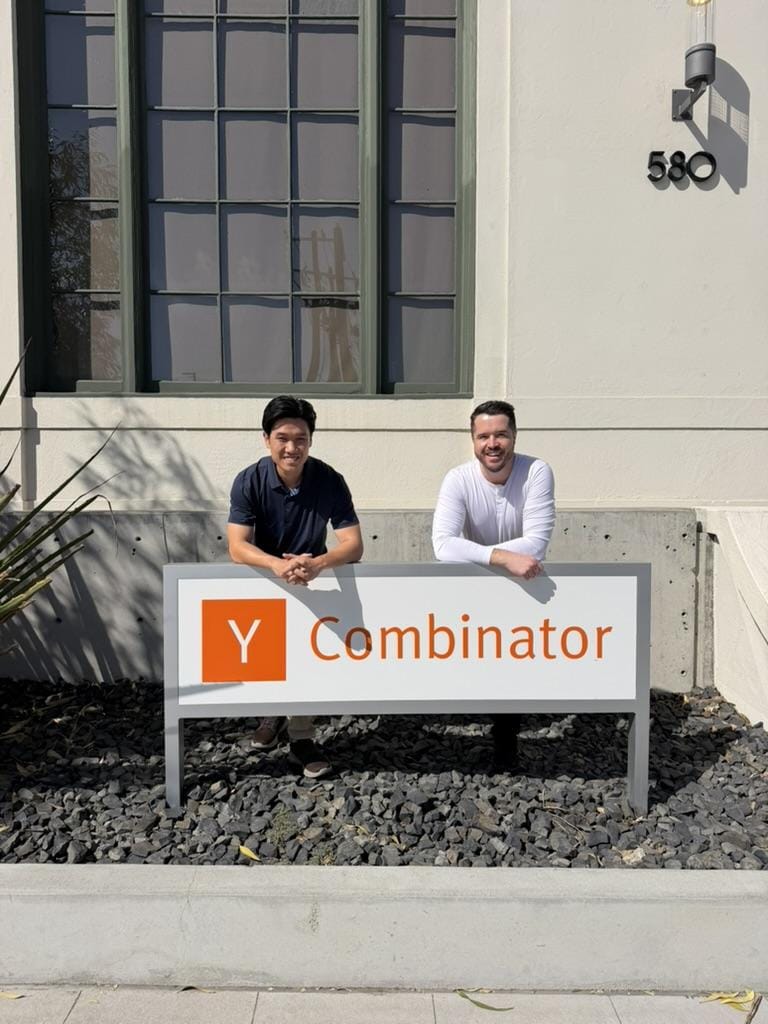
The company’s first product handles site sourcing, due diligence, underwriting, and feasibility as a single continuous workflow. While the white paper’s model assigns no savings to the acquisition phase and puts most of its gains in design and construction, Tharalson believes sourcing is where developers are most in the dark. Commercial real estate has no equivalent of the residential MLS, so most developers see only the deals that come through the brokers and owners they already know.
“Real estate development is the purest form of information asymmetry,” Tharalson said. “If you don’t have the correct canonical information, you lose.”
HABU aims to review as many listed properties in its markets as possible and run a quick, back-of-the-napkin underwriting on each one, so the team only spends real pursuit money on the best of them. Tharalson thinks this screening can raise the share of contracted deals that get built from the typical one in three, to closer to nine in ten.
Several other parts of HABU’s system line up with the paper. On permitting, where the paper estimates up to 24 percent time savings and 8 percent cost savings, HABU uses language models to read zoning ordinances and construction standards. Tharalson points out that reading the code is the easy part. Experienced developers know the written code doesn’t perfectly match what gets approved in the field, so his team is now collecting that local knowledge by hand in Phoenix.
On the supply chain, where the paper estimates up to 10 percent cost savings, HABU pulls current local material prices straight into its underwriting. On design and estimating, where the paper cites 10 to 30 percent fewer engineering hours from AI-assisted estimating, HABU runs preliminary civil and horizontal cost estimates in-house. It uses published engineering formulas and public soil and hydrology data, and still has outside engineers perform the project-required work.
Every site the company underwrites, pursues, or passes on is recorded and reused on later deals, which Tharalson calls a data flywheel. Established developers have more of this kind of history, sitting in decades of old spreadsheets, and Tharalson is open to a co-GP or JV arrangement with a legacy GP that would let HABU run that data through its models.
On fees, HABU looks like any other GP, earning a development fee and a promote on operations and sale. Tharalson’s pitch to LPs is about delivery: projects finished 20 percent faster at 10 to 15 percent lower total cost. Those targets are conservative compared with the white paper’s estimates of 22 to 25 percent faster schedules and 17 to 20 percent cost savings. Speed matters most to LPs: the same profit returned sooner produces a higher IRR.
Y Combinator has spent the past couple of years backing AI-native services companies, businesses that use AI to deliver a service themselves rather than selling software to the firms that provide it. Crosby, an AI-powered law firm, is a well-known example. Tharalson doesn’t put much stock in the label.
“AI-native services is VC language, to be candid, for traditional service businesses that now operate with AI,” he said. “I’m not creating software to sell to developers. I’m not an input. We are the developer.”
The paper’s authors argue that savings compound across phases, with design feeding scheduling and procurement feeding the field, and for that reason they expect the gains to come from many firms working together rather than from any one company. HABU is betting that a developer handling every phase itself can capture more of those gains than a contractor or software vendor working on one piece of a project. Tharalson borrows the reasoning from manufacturing.
“A pretty significant amount of my business thesis actually comes from supply chain economics,” he said. “Identify the weak link or the expensive link and then go solve for that at scale.”
It’s a big bet, and it fits YC and West Coast venture capital better than traditional real estate capital, which tends to reward track records and local relationships. If it works, HABU could grow well past the size of a typical regional developer. Tharalson expects each of his development managers to handle five times as many projects as their counterparts at a traditional firm. With that volume, HABU could take on projects that traditional GPs can’t make pencil rather than holding out for only the highest-yield ones.
The YC network could also help HABU raise money for its projects. The company’s public launch brought an unexpected response from inside the YC and tech communities.
“I was genuinely surprised. After we launched, a couple of YC founders and executives reached out wanting to invest in our projects, with checks in the $100,000 to $1 million range,” Tharalson said. “There is a lot of wealth in Silicon Valley, and most of it is heavily concentrated in one asset class. HABU is a bridge to get some of that wealth out of tech and into something more durable.”
The MIT/Suffolk paper ends by calling for more research across additional projects, geographies, and asset classes. HABU is about to produce some of that evidence with real deals and real LP money. If even half of the paper’s numbers hold up in the field, a lot of projects that don’t pencil today could start to, and the developers building them may look more like startups than the firms that lead the business now.
-Brad Hargreaves

Here are the seven most interesting proptech startups and new technologies we've seen this quarter

Real estate operators have a data problem. Can Remen Okoruwa help them make sense of it?

How a Mobile Micro-Factory could give small-to-mid-size builders big-builder economics

As multifamily software consolidates and competition intensifies, the maintenance platform adds CapEx tools and a direct line to the owners who pay for capital projects
Covering the future of real estate and the people creating it