
Deep Dive: Real Property Captive
As real estate's insurance-cost crisis grows, captives gain popularity and embrace membership-club selectivity
As real estate's insurance-cost crisis grows, captives gain popularity and embrace membership-club selectivity

Eight lessons on why AI pays off for some firms and not others
A quarterly look at feasibility study activity with our friends at TestFit
For decades, feasibility analysis has been the bottleneck that kept real estate developers from moving faster. Algoma has built a platform designed to fix that.

AI is flipping feasibility analysis on its head, and looming changes are coming for real estate development.
A number of tools are tackling individual steps of the analysis, such as underwriting or massing studies. But a new generation of platforms are looking to automate the entire feasibility analysis process, potentially changing how developers find and analyze sites. Algoma, backed last year by construction technology investor Zacua Ventures, is taking that holistic approach.
Today's letter will explore the future of feasibility analysis, including the downstream impact on real estate acquisitions and development as well as the analyst role.
For decades, development shops have analyzed a relatively small number of deals per week. Understanding what could be built on a given site was a huge bottleneck: pulling comps was done by hand, every firm had its own bespoke financial models, and getting even a rough sense of a site's potential required burning time and money across multiple consultants. The process worked, but it was slow; a developer evaluating three or four sites a week was doing well.
I saw this firsthand at Common. Test fits are a major issue with niche concepts like coliving and micro-apartments, where developers don't have a clear sense of what could be built. We solved this by charging $5,000 for a custom "test fit" using our own in-house architectural designers. This was a deal compared to what an outside architecture firm would charge but still a substantial cost to a developer who didn't even know if they'd win the bid for the site. Multiply that across a dozen prospective sites and you're spending real money before a single shovel hits the ground.
AI makes it much faster to get a gut sense of whether a site works or not. It can also tackle other steps of the feasibility process like pulling comps and estimating construction costs. While many companies are tackling individual elements of this, today we'll focus on Algoma, a company attempting to automate the entire feasibility analysis journey.
Algoma's founding team brings together engineering (Josef Bromovsky, previously at AECOM), architecture (Kyle MertensMeyer, previously at Gensler), and business (Seyfihan Usarer, McKinsey). They started with a massing and zoning analysis tool, then added comp analysis, construction cost estimation, and other features over time. Today Algoma operates as a self-serve platform with an all-you-can-eat subscription; developers plug in a site and get a back-of-the-envelope feasibility readout in minutes rather than days.
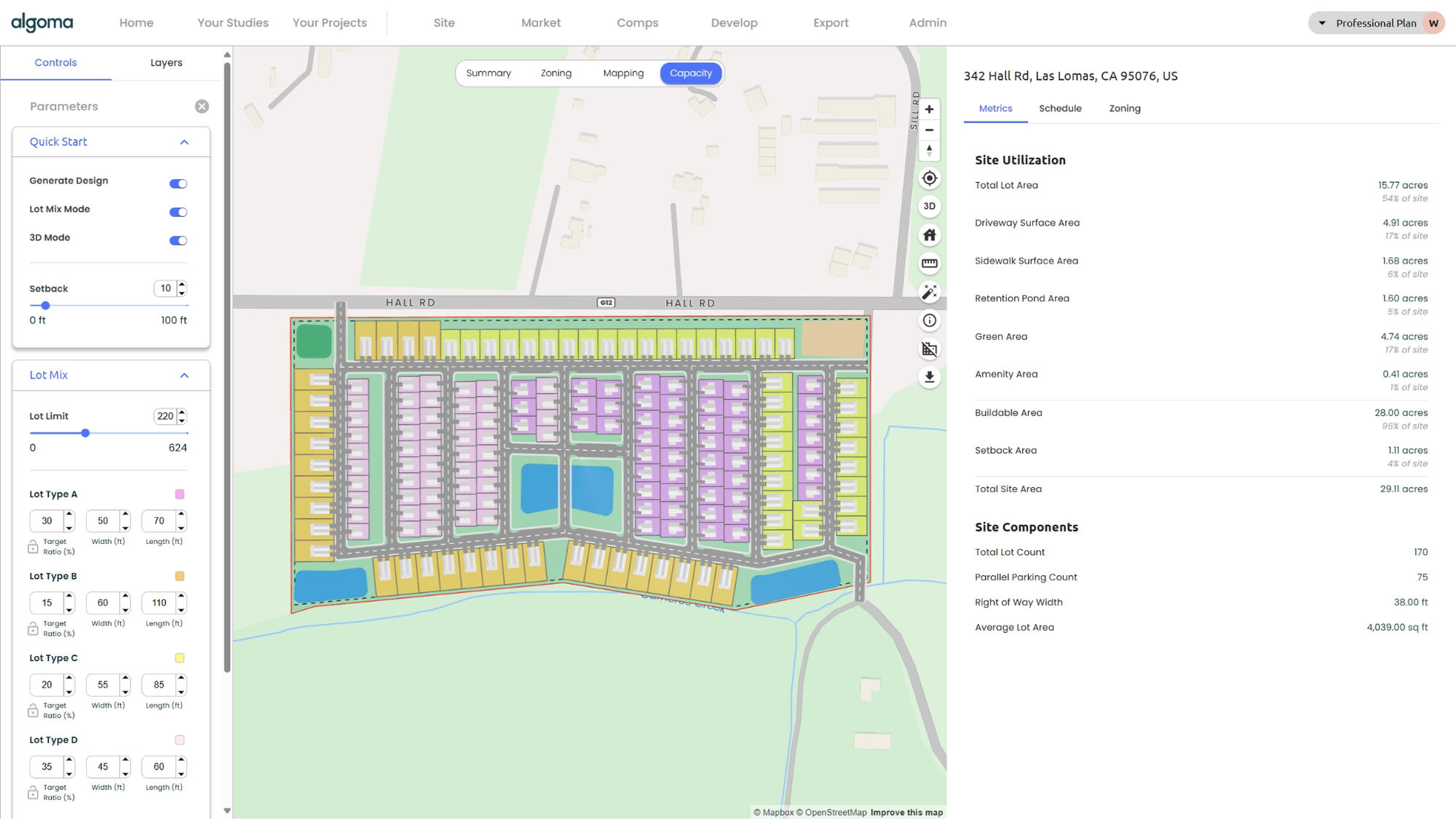
While feasibility analysis automation is relevant to both infill and greenfield developers, Algoma has found particular success with homebuilders and others building single-family communities on greenfield sites. Those sites are generally simpler from a regulatory standpoint, as they have fewer overlays, fewer affordability requirements, and less discretion in the planning process – all of which can trip up automated tools. But those greenfield sites are often tougher environmentally, with complex terrain and numerous GIS constraints that make site planning a laborious puzzle. Those are, on the other hand, things that AI tools can handle well.
"Normally you look up GIS, look at zoning, need an architect to lay out 100-200 homes on a site in CAD,” said Bromovsky. “That might take 3–4 weeks and you're getting 1–2 options. With our tool you can do that whole process within a matter of minutes and you can see hundreds of options, compressing weeks of work into a few minutes.”
The appeal to single-family builders goes beyond speed. "Single-family site plan use tends to be a more complex problem with 20-30 GIS layers. Wetlands, elevations. Stormwater, amenities… so many factors you have to balance, so using an AI solution is the best," Bromovsky added.
The homebuilder market is also notably concentrated. "The top 200 homebuilders build 500,000 homes per year, a third of total units built every year in the US. Getting 20% efficiency you can leverage across all of those projects, all of those homes, gives you a massive benefit as a company," he said.
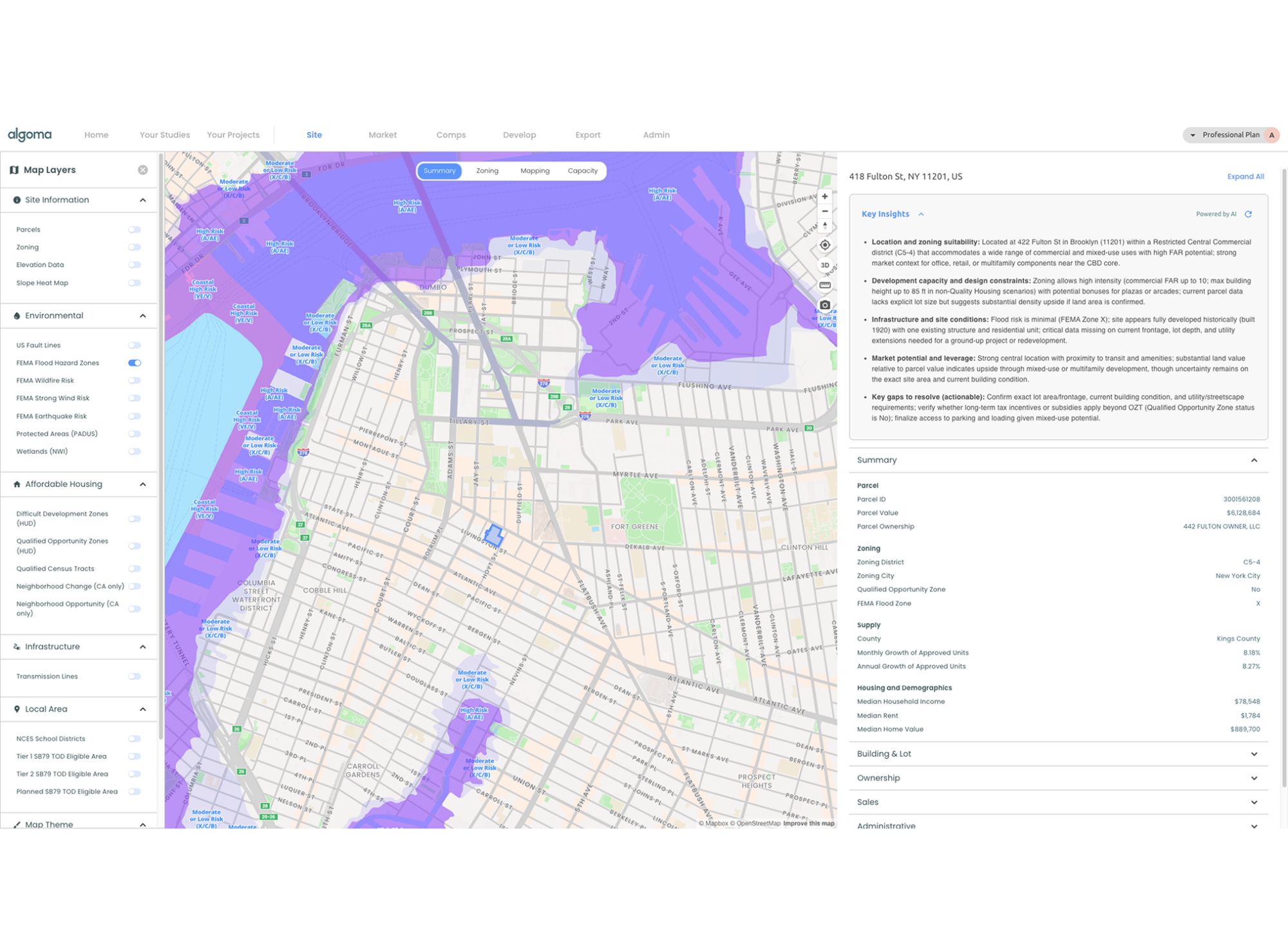
It's worth noting where automated feasibility analysis outperforms and where it falls short. AI-powered tools tend to excel when the challenges are spatial and environmental: wetlands, elevation changes, stormwater management, setback requirements, and the geometry of fitting units onto irregular parcels. They are less effective when the challenges are political; no algorithm can reliably predict what a local councilmember might allow through a discretionary approval process. We wrote about these challenges when we tackled feasibility analysis automation writ large last year.
But the benefits of these tools aren’t solely about higher throughput. Somewhat counterintuitively, speed enables accuracy. In the traditional workflow, a civil engineer puts together a site plan relatively early in the process. As new information emerges—a failed perc test here, a utility easement there—the updates tend to be piecemeal rather than holistic. In a worst case, the entire site plan optimizes toward a local maximum, missing out on more efficient designs had the plans been rethought entirely.
"It comes down to optimization and scenario planning. A civil engineer will put together a site plan pretty early on, and then make small revisions as new information is found,” explains Usarer. “But they're piecemeal updates rather than looking at it all over again because it's so laborious to redesign 200 units in CAD. Their fee doesn’t go up. But as a developer, if you can squeeze in 40 more units, that might be $20 million.”
When regenerating a site plan takes minutes rather than weeks, developers can afford to start fresh every time new information surfaces.
Of course, this isn't being used as the end-all-be-all of what can be built on the site. In most cases, the developer is using the output to decide what to bid on a site. In many cases, the plans will be reanalyzed with sharpened pencils if and when the deal is won, which is where the services layer comes in.
Algoma faced a strategic choice that many PropTech companies eventually confront: sell a software tool, or vertically integrate with architectural services.
The logic for integration is straightforward. Developers don't want to stop at the feasibility step; if they win the bid, they actually want to build it, and they don't necessarily want to redo everything from scratch. "Customers want more than feasibility analyses; they want to break ground on successful projects. As the stakes and CapEx increase, customers have more trust when there is a human expert driving and checking the work," MertensMeyer said.
Selling a tool alone has its limitations. Many developers don't have the technical skills to manage a platform of the sophistication needed to produce quality massings and estimates. Software providers in this space often end up selling into architectural firms as much as developers, which changes the go-to-market motion entirely.
And selling a tool alone also means you're limited in how deep you can go into the process. Architects need to stamp drawings, and they are taking on professional liability to do so. Producing construction documents requires licensed architects to review everything; there's no shortcut around that regulatory requirement, and it's not clear there should be.
Algoma chose to vertically integrate on the services side, building an interdisciplinary team, including architects, to help them scale from feasibility to project delivery. “We have spent a lot of time looking for the right people who can collaborate across disciplines. Our skill sets span software engineering, computation, product design, architecture, and planning, yet everyone has previous training or experience in the AEC industry.” MertensMeyer noted. The AI assists project delivery, handling the computational grunt work while humans focus on judgment calls, code compliance, and the design decisions that require professional expertise.


Of course, Algoma isn’t the only company to take this approach. As we discussed in last year’s letter, Cove and Cedar are two examples of software companies vertically integrated with architectural services firms. But as Algoma sees it, the pairing of self-serve software with deep services is a smart combination: the self-serve software acts as the top of the funnel, with services capturing value further downstream.
"People look at hundreds of sites, and a small percentage of that will then look for full construction documentation," explained Usarer. It's the land-and-expand model: the subscription gets developers in the door, and the services revenue follows when projects move from analysis to execution.
A world in which tools like Algoma are universal fundamentally flips the analyst role on its head. The basic back-of-the-envelope work—comp analysis, financial modeling, figuring out massing and unit count based on publicly available zoning information—can all be automated. For a generation of analysts who built their careers on exactly these skills, the question is obvious: what's left?
The answer, perhaps surprisingly, is quite a lot. Automated feasibility doesn't mean the analyst role is doomed. Instead, it dramatically increases the number of sites real estate operators can look at. A shop that previously analyzed two or three sites per week can now run hundreds through the tool. The analyst's job shifts from producing the analysis to vetting what the AI produces, and more importantly, doing the things AI can't: walking sites, talking to the coffee shop owner next door, understanding the political landscape and the role of discretionary decisions in local approvals. The human judgment layer becomes more valuable, not less, precisely because the computational layer is handled.
AI-powered feasibility analysis won’t just replace the analyst; it will transform what being an analyst means. The role evolves from spreadsheet jockey to something closer to a field intelligence officer: someone whose value lies in local knowledge, relationships, and the kind of qualitative assessment that no algorithm can replicate.
The shift also dramatically increases the importance of off-market deals. Right now, it doesn't make sense for most developers to run back-of-the-envelope analyses on off-market sites. The typical approach is to establish seller interest first, then put in the effort to evaluate the property. Algoma's all-you-can-eat model changes that calculus entirely: run hundreds of sites through it per week, identify the ones that pass an initial sniff test, and send love letters out to property owners before anyone else has even looked at the parcel. Combined with tools like Clay for outreach automation and an autopen for personalization, the future of site sourcing starts to look very different: thousands of custom letters tailored to the specific site and owner, sent before the property ever hits the market.
All of this only works, of course, if the developer can actually use the tool. And that's perhaps the most underappreciated challenge in this space. Developers are not, by and large, technical people. The soup-to-nuts approach only works if someone who still uses Outlook as their primary productivity tool can navigate the platform without a tutorial. That's what this new generation of tools is looking to accomplish.
"We need to be able to serve developers and non-technical people without deep architectural design experience. Anyone can use Algoma to analyze a site," Bromovsky said.
The feasibility bottleneck has constrained real estate development for as long as anyone has been putting bids in on sites. Removing it won't just make existing development opportunities move faster, it will surface entirely new ones. The developers who figure out how to pair these tools with sharp human judgment and aggressive sourcing strategies will have a meaningful edge, not because they have better spreadsheets, but because they're looking at ten times the opportunities everyone else is.
-Brad Hargreaves

As real estate's insurance-cost crisis grows, captives gain popularity and embrace membership-club selectivity

Eight lessons on why AI pays off for some firms and not others

Office demand is recovering, but speculative development in most markets remains stubbornly out of reach

Covering the future of real estate and the people creating it
