
The Rise of Tour Intelligence
A new generation of companies is betting AI can make the human leasing agent better
A new generation of companies is betting AI can make the human leasing agent better

Tracking three months of notable land use and zoning decisions with Shovels

As real estate's insurance-cost crisis grows, captives gain popularity and embrace membership-club selectivity
Computer vision isn't coming for real estate. It's already here.

A couple of months ago, Thesis Driven wrote about the growing and under-appreciated impact of computer vision on real estate, which will likely have at least as significant an impact on the sector as LLMs, albeit with far less fanfare. Like LLMs, computer vision touches a wide variety of things in real estate: operations, design, and development. But it has not generated the same buzz. The consumer applications are limited, and the technology is typically bundled into vertical software rather than sold on its own. It works in the background, inside other products, which is part of why it has been easy to miss.
Today's Deep Dive explores what might be my favorite application of computer vision in real estate to date: transforming how operators understand what sits inside their assets, and ultimately, how capex is managed. Tailorbird, a company helping some of the largest owners and operators manage their capex, earns the spotlight for a simple reason: its technology is the first in some time that genuinely surprised me.
And that surprise is not purely academic. The tech is generating measurable results, from cost savings to shorter pre-construction timelines. It's representative of where value is headed: in the ability to bring new data to the table.
Getting value-add development right comes down to two things: buying and financing deals well, and managing the capex of the actual value-add work.
A number of tools have emerged to address the first part. Diligence platforms like Rely and Surface help operators underwrite; financing management platforms like Built help manage the money once a deal closes. The planning and management of capex spend is just as large a need, and it remains under-addressed.
Broadly, multifamily has had a few tough years. The conventional wisdom is that this is due to elevated rates, which make projects harder to pencil and finance. And while that’s certainly true, it’s not the whole story. As veteran multifamily investors know, value-add deals routinely blow through their capex budgets, a problem that has nothing to do with rates. Nine out of ten run over budget, according to McKinsey. And they do not miss by a little: a full 69% run more than 10% over budget, per KPMG. An FMI/PlanGrid study estimated $177 billion lost every year to miscommunication and rework.
The construction management software that does exist, like Procore, was typically built for general contractors and construction managers, not for owners planning renovation projects over a seven-year (or longer) hold period. That leaves the party writing the checks with the least purpose-built tooling.
But as with many technology problems today, the hard thing to solve is, once again, data, not software features and functionality.
The core problem for acquirers bidding on potential value-add projects, or for long-term holders, is that they don't actually know what's already there.
Beyond condition and quality, the specifics matter: What are the unit dimensions? What are the in-place SKUs, and how many of each? Solve for that, and much of the downstream work, from budgeting and bidding to reporting and long-term planning, becomes far easier.
But the data on what exists today has to come from somewhere. Sending a team into every unit to assess it is a massive workload and usually not feasible prior to closing the acquisition, let alone the dizzying idea of keeping the data up to date year after year. Operators hope that their guesstimates are correct and no major surprises await.
Conventional wisdom is that this step cannot be automated. How can one visualize and assess what nobody has systematically documented?
As it turns out, most buildings have enough scraps of data, publicly as well as in owners’ hands, for artificial intelligence to assemble remarkably high-quality floor plans, material and SKU lists, and condition and quality assessments. Tailorbird pulls from publicly available, unstructured photo data, including the thousands of geolocated videos and pictures posted to social media over the years, to build detailed unit plans and takeoffs. Work order history and photos taken by site staff at various times serve as supplements rather than the foundation.
"Every photo you take, unless you turn off your location settings, has a geo-pin associated with it... [Tailorbird] has a machine learning model that'll go out and find those based on a geotag," said Jeremy Voigtmann, a Managing Director at Harbor Group, which manages 65,000 units of multifamily along with five million square feet of commercial space.
The inputs required from the owner are minimal: a de-identified rent roll with unit mix and a site plan. As co-founder and CEO Tim Cantwell, a former general contractor with an engineering background, puts it, "The site plan can be as simple as a picture of the fire escape plan hanging in the hallway."
In other words, Tailorbird is using Instagram photos the seller’s tenants posted five years ago to figure out specific unit dimensions, takeoffs, and SKUs for any asset.
The company's name doubles as a description of the method. "A tailorbird is actually a bird that builds a nest by putting together parts and pieces. So Tailorbird's the same way — it puts together parts and pieces of all these different photographs," said Voigtmann.
The output has improved sharply over a few years. "Four years ago, their talent was: you send me a rent roll, and in about two weeks I'll turn around a 2D floor plan… they were within maybe a half an inch," said Voigtmann. "Fast forward four years, now in about three days they're turning around 3D models of the full building down to less than an eighth of an inch of variance. Counting everything from light switches to cabinet doors to square feet of carpet."
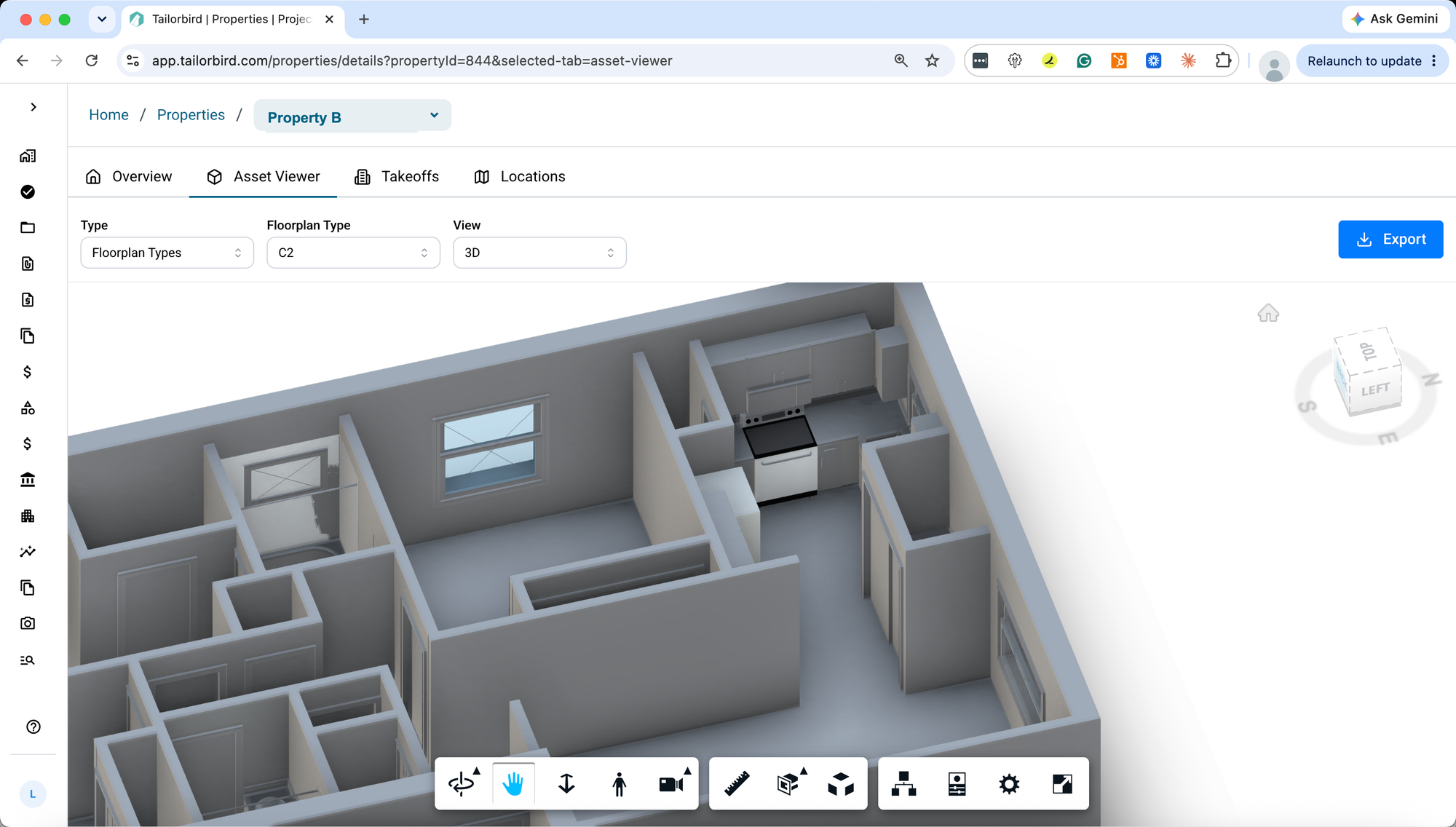
How the model reaches eighth-of-an-inch accuracy from amateur photos comes down to reference objects. "Refrigerators are very standard. Microwaves are very standard. The electrical wall plates are very standard. So using those real-world objects, where dimensions are known, you apply automated corrections using projective plane geometry," explained Ashish Jain, Tailorbird's co-founder and CTO.
SKUs are a messier problem than dimensions. “The SKUs come from everything from Work Orders, photos captured during unit turns, invoices with serial numbers, unit numbers, or other appliance package details,” noted Cantwell. “The truth is that this is some of the messiest and irreconcilable information most owners have sitting around. Tailorbird can reconcile it because we've solved the data normalization problems around units and how everything ties back to the unit.”
The resulting dataset is substantial: Tailorbird says each property yields more than 300,000 data points, with 98% as-built accuracy, in three to five days. From there, it can generate an equipment-level inventory with remaining useful life on every major system. Work orders, unit turns, replacements, serials, and warranties get attached to specific building systems.
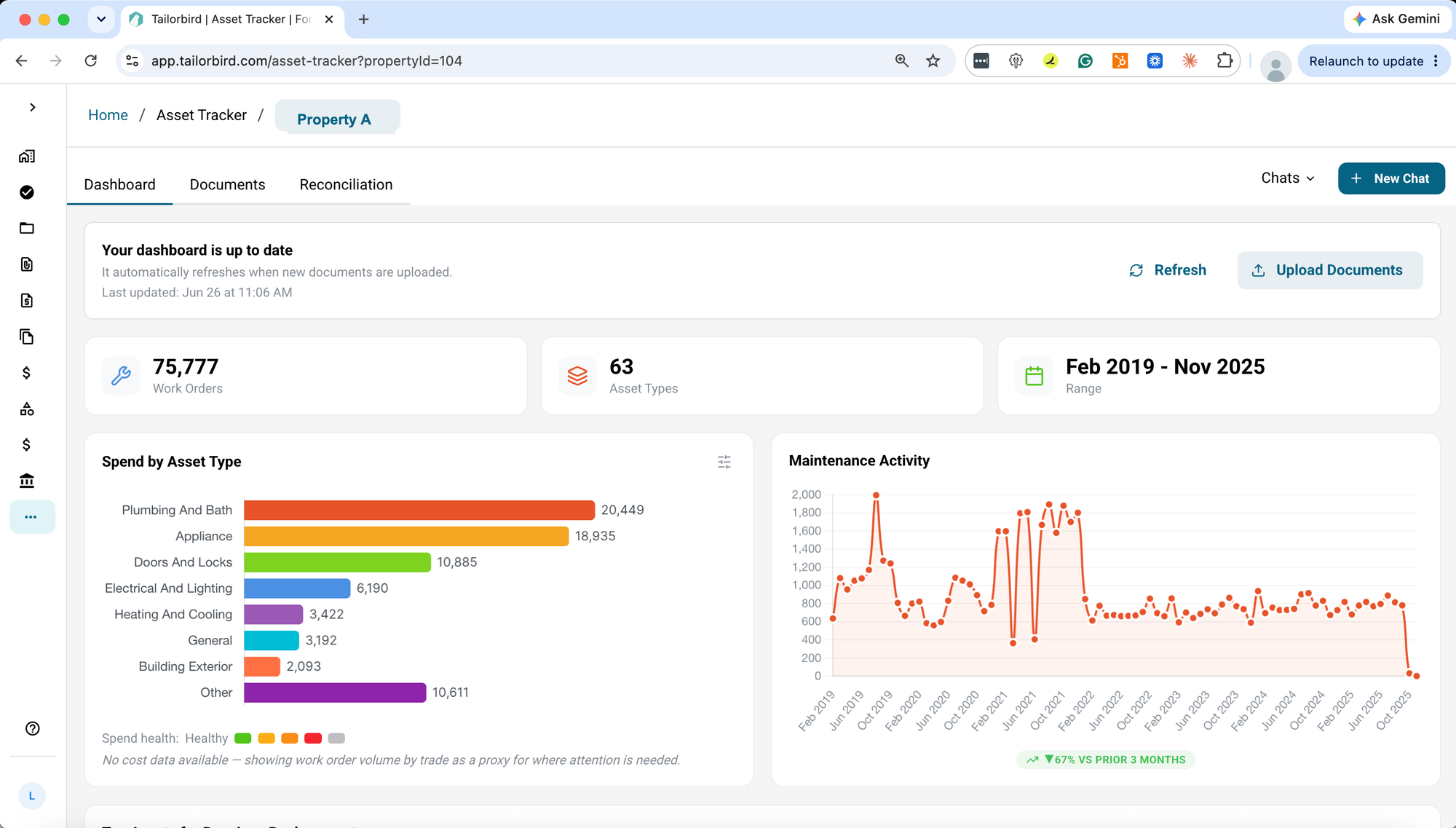
The immediate payoff is a single source of truth. "If I give a project to four different vendors and say count the windows, I'll get back four different numbers of windows. This gives me a truth,” said Voigtmann. “I can tell you there are 486 windows of this size: give me the price for that project.”
Sometimes the data surfaces things no one knew to look for. "We had a high-rise building in Atlanta... it started showing blanks. 'Hey, there's something wrong here. There's a void. Go tell me what that is.' 'Well, we don't have a key to that door.' 'Open that door.' Oh, there's a unit back there. So we actually found a unit and a number of square feet in this building that weren't associated with units. They weren't on the rent roll," he continued.
That kind of discovery has direct underwriting consequences. "That's something that in 60 days of due diligence four years ago, no one would have been able to answer. Now you can answer that really quickly and build it into your economic model, which helps us win deals we otherwise wouldn't," said Erik Roberson, EVP of Investment Management at The Michaels Organization, which manages 76,000 units across military, affordable, and market-rate multifamily.
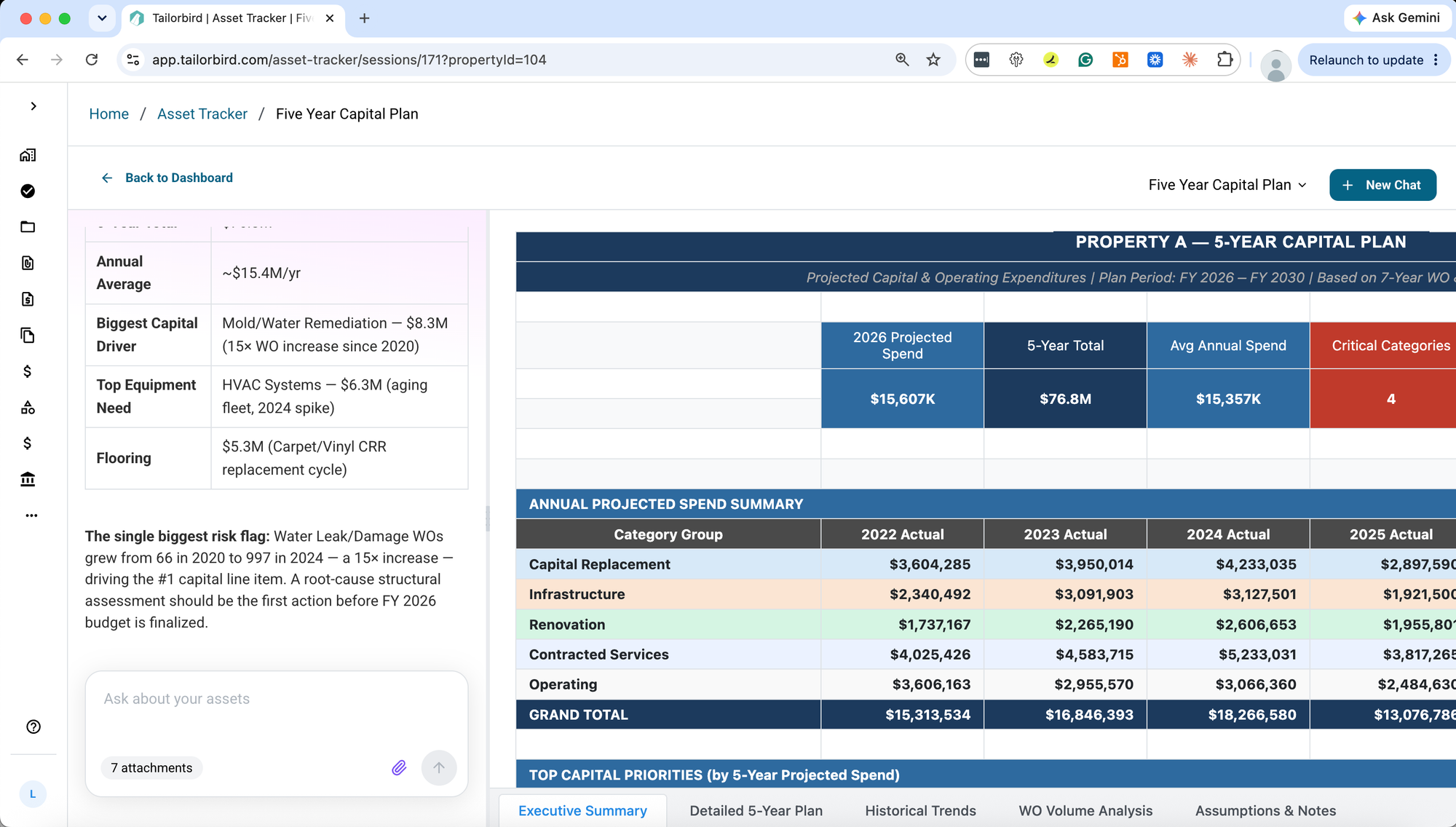
Once the data exists, the capex management features are straightforward to imagine: multi-year capital planning, bid package generation based on actual takeoffs, cross-building cost comparison, contract management, and reporting and analysis. Tailorbird and its clients cite pre-construction cycles cut from roughly six months to about three weeks, as much as 24% savings on a single project, and $100 to $200 per unit per year in avoidable waste.
For a large portfolio, the planning value compounds. "I need to know when that water heater went in and the expected life, so I can have a reasonable capex plan across 20,000 units... You can stay ahead of things and replace them before they break, and maximize their service so you're not replacing them too early," said Roberson.
The approach also handles buildings that defy standardization. "We have 269 homes in one project at Fort Leavenworth that were built before 1919... nobody made plans for these at any point in time. Of those 269 homes, there's probably 150 disparate unit types," said Roberson. "Rather than spending six months with an architecture firm going in and measuring everything... Tailorbird knocked that out of the park for us," he said.
Cantwell frames the endgame as a new software category. "Everyone has a finance team doing job costing. That is where we plug into your tech stack, literally as the job costing module of your PMS. But then at your fingertips you have operations data, the finance data, the vendors/contractors, and the AI. When it all comes together, it's a new category we call Capex Orchestration," he said.
My surprise was not that computer vision could do these things. I had already written about its power. The surprise was where Tailorbird finds its data: not in photo files supplied by clients, but in whatever it can find on the internet. Those publicly available datasets are not a supplement, but a core input.
That highlights one of the biggest themes in computer vision: the real prize is tapping into unstructured data troves, whether inside an organization or out in the public sphere, not merely speeding up the interpretation of data already being processed manually.
While it is easy to say that computer vision and AI make proprietary data more valuable, these capabilities raise questions about what data is truly proprietary. For a real estate owner, the interior fit and finish of specific units may feel like private information. But if tenants are photographing those units and posting them online, that information is effectively free for the taking.
Thoughtful interpretation of someone else's data exhaust could become a real edge. If I were CoStar, I would be thinking hard about this, both defensively (the long-term viability of a proprietary data moat) and opportunistically (where other veins of rich public data might lie).
Tailorbird could have stopped at data. As-builts alone are a $10 billion industry. Instead the company built a comprehensive product for operators managing capex. "There's no value in putting data on a spreadsheet — it's being able to make decisions from that," said Voigtmann. Cantwell describes what sits on top: "All of that intelligence builds your multiyear capital budget, optimizes the repair versus replace in that budget over time, and autonomously works to ensure you have the best price for your jobs."
The broader lesson lands the same way for AI and software more generally. The magic is in the data. And the most impressive software functionality will increasingly be about collecting and processing data that no one else has bothered to structure.
"Data is knowledge. Being able to turn a site into a digestible set of data that we can make decisions on — it's really game-changing for us," said Voigtmann.
–Brad Hargreaves

A new generation of companies is betting AI can make the human leasing agent better

Eight lessons on why AI pays off for some firms and not others

Multifamily operators in the lurch; have the PMS wars begun?

Covering the future of real estate and the people creating it