
The Rise of Tour Intelligence
A new generation of companies is betting AI can make the human leasing agent better
A new generation of companies is betting AI can make the human leasing agent better

Tracking three months of notable land use and zoning decisions with Shovels

As real estate's insurance-cost crisis grows, captives gain popularity and embrace membership-club selectivity
New data from Tailorbird shows why two-thirds of real estate operators blow their capex budgets and where AI could actually help

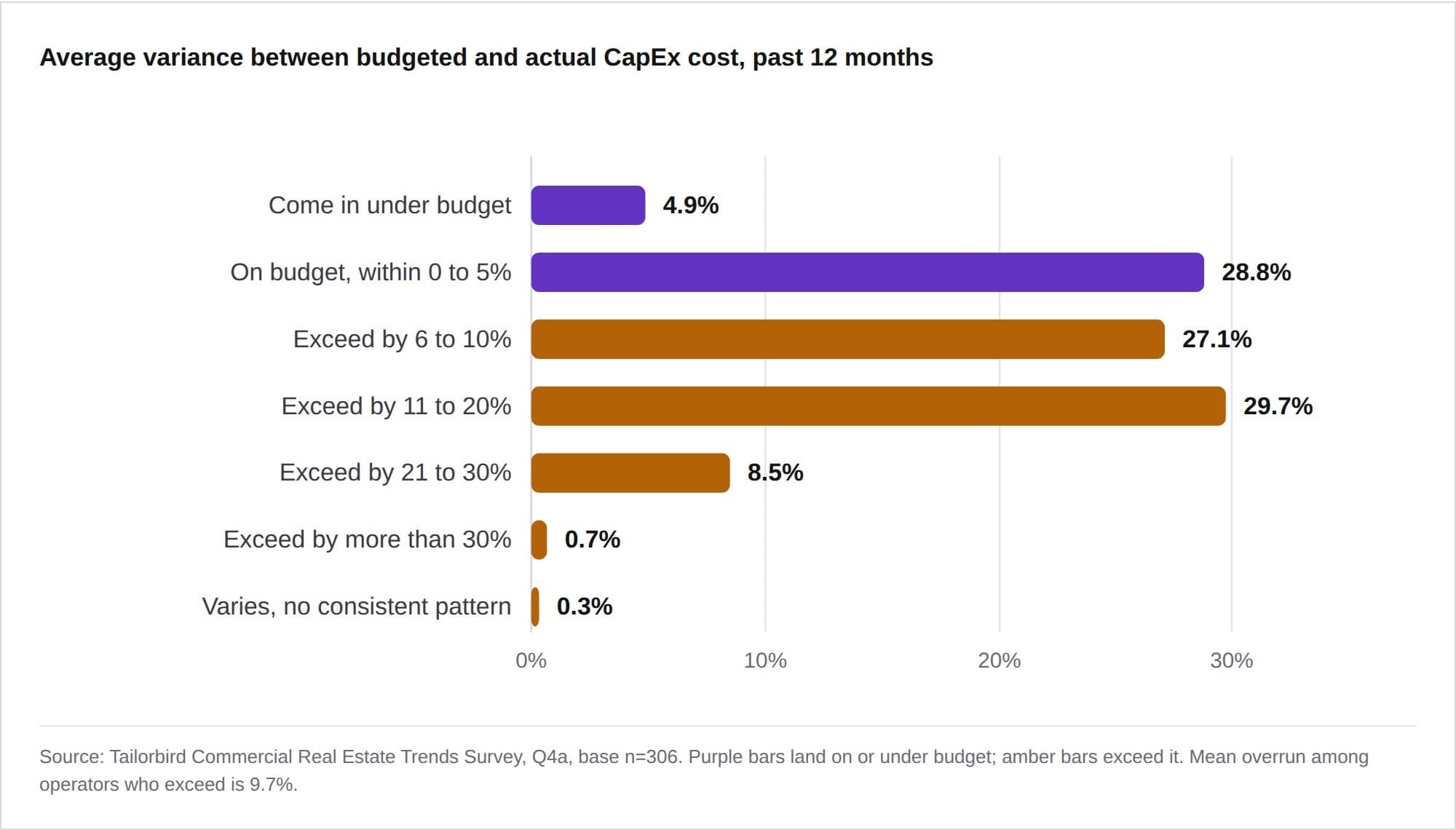
Capital expense overruns have been a part of real estate development as long as people have been spending money to renovate buildings. But despite the frequency of budget overages, real estate operators are still remarkably certain that this project will be the one that hits its numbers: 84% of operators are confident in their capex numbers the moment they’re approved, yet only 34% actually land on or below budget.
Conventional wisdom waves this away as typical developer overconfidence. But what’s really driving the misses? And can emerging AI-powered tools bring the industry to the thus-far-unachievable standard of actually hitting its numbers?
We got an early look at data from the 2027 Commercial Real Estate Trends Report, a poll of more than 300 real estate operators commissioned by Tailorbird, and the results illuminate the gap between confidence and reality on large capital projects. In today’s letter, we’ll explore:
This will be no surprise to the real estate operators reading this, but capex overruns are a real issue. And for operators chasing a promote, overruns can be devastating, especially when combined with delays (as they often are) that push returns down.
Overruns aren’t just a problem with small shops. The 306 respondents to Tailorbird’s survey lean institutional; nobody in the sample runs less than $5 million of annual capital expenditure, 54% deploy between $100 million and $500 million per year, and the mean annual capex budget across the panel is $226 million. Together, this group directs about $69 billion in capital improvements a year.
Yet two-thirds of them exceed their budgets. Among the operators who do, the average overrun was 9.7%, which, against a $226 million program, is roughly $22 million a year in unanticipated cash out the door.
Only a third of respondents reported an average variance of less than 5%, while almost 10% reported variances of more than 20%.
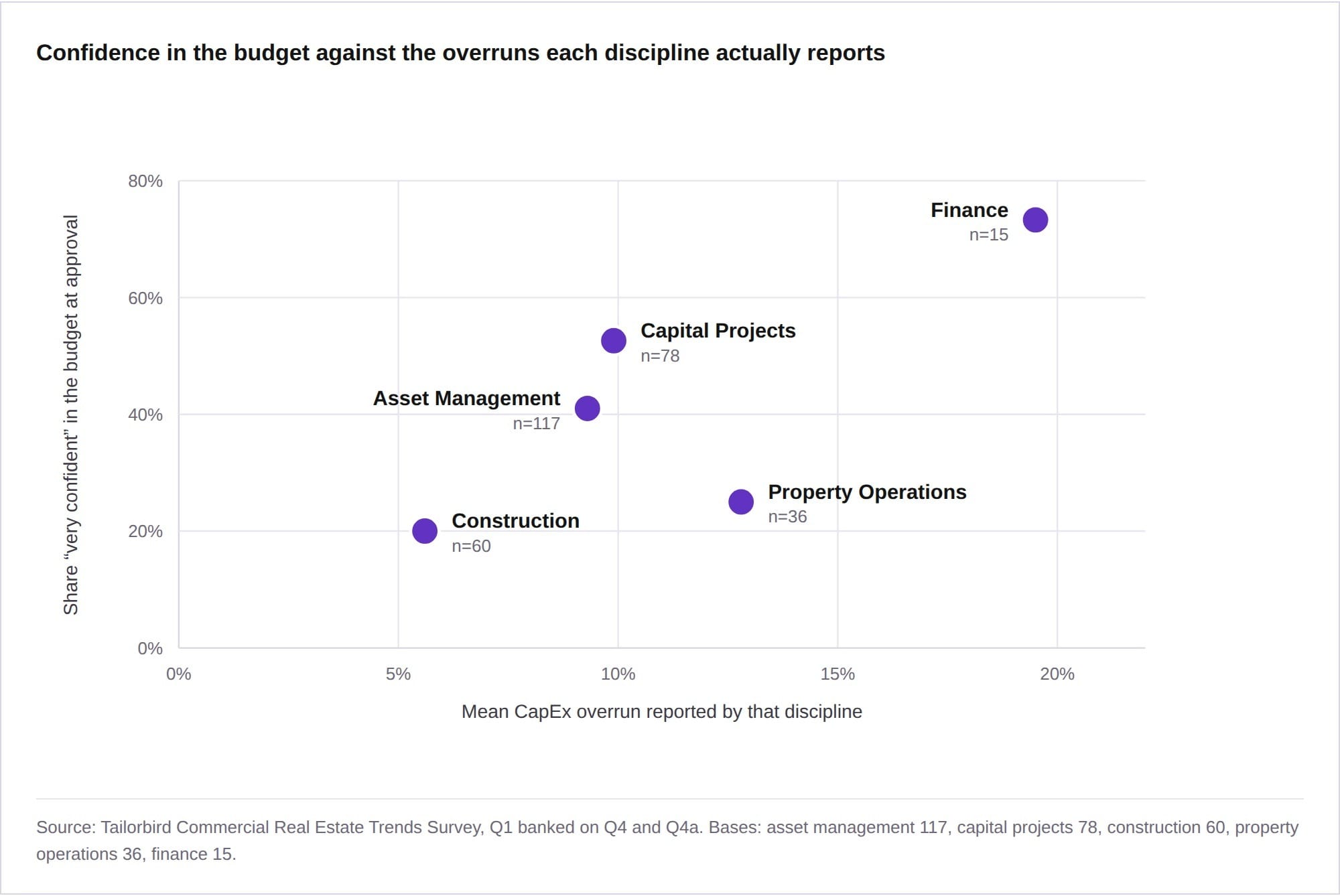
Overconfidence varies a lot by discipline. Finance and capital projects teams are most likely to express confidence in the budget at approval, but are also the roles more likely to report capex overruns. Construction teams are both the least confident in the budgeted numbers and least likely to report overruns.
Unfortunately, there’s no clear answer for the driver of cost overruns: it’s a little bit of everything. Almost half (49.7%) cited bad data at the starting line, while slightly less (46.5%) blamed scope surprises during execution. (Respondents could pick up to five issues, so the data sums to more than 100%.)
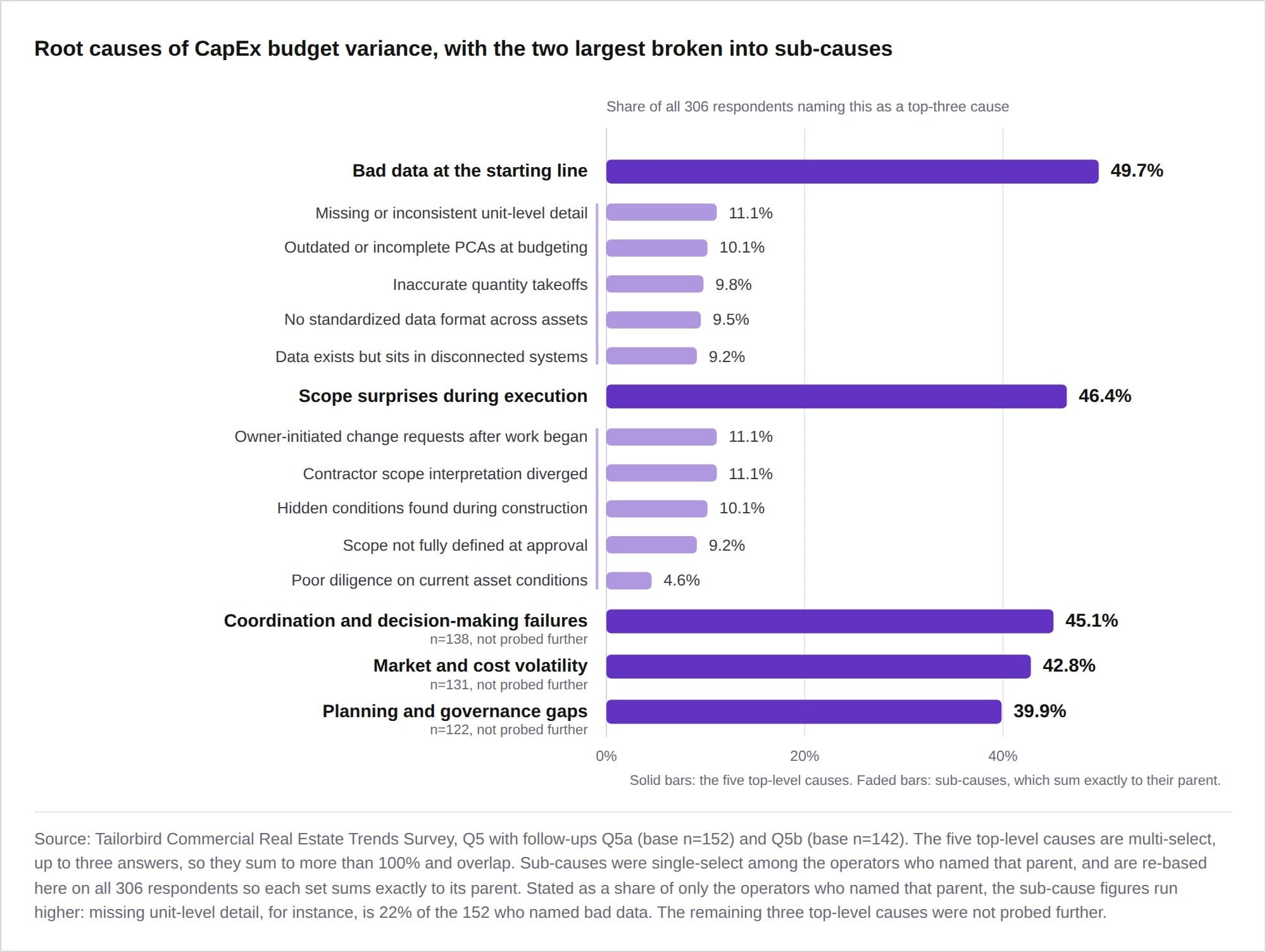
Among the operators who specifically blamed data quality, 22% cited missing or inconsistent unit-level or asset-level detail across the portfolio, followed by outdated property condition assessments and inaccurate quantity takeoffs.
But the problem starts before anyone swings a hammer: just getting numbers in front of the right people is a challenge.
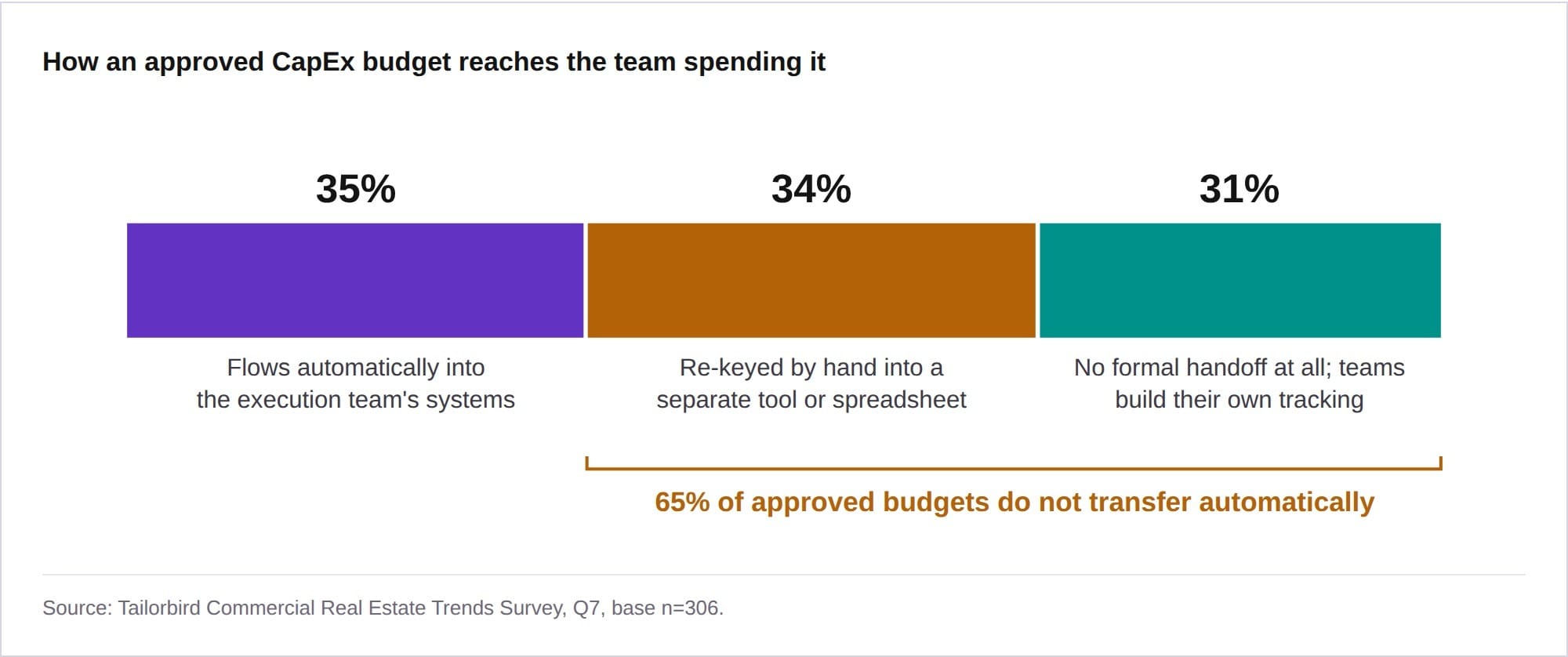
Thirty-one percent of institutional capex programs have no defined mechanism for handing an approved budget to the people executing against it; teams rebuild their tracking from scratch, project by project. Another 34% re-key the numbers by hand into a separate tool. Only a third have systems connected so that budgeted numbers flow into the software where work happens.
Compounding the problem, operators touch an average of 5.1 separate systems to run one capex project from budget approval through completion, including spreadsheets, the PMS, project management tools, and email.
There’s also no definitive answer on who owns capex projects within real estate firms, with respondents splitting across five roles: asset management at 20%, construction and project management at 18%, finance at 13%, property operations at 12%, and investments at 10%. A further 26% reported no single owner, with 14% splitting accountability between two teams and 12% distributing it across three or more.
In theory, technology could help solve this problem. Many of the issues, after all, stem from firms’ inability to get data in the right place at the right time, including over-reliance on manual re-entry.
When we look at the relationship between respondents’ self-reported technology maturity and capex confidence, something interesting happens.
To measure technology maturity, operators placed themselves on a five-point scale from early stage, meaning primarily spreadsheets and manual processes, through developing, moderate, maturing, and advanced. Only 2% of the panel, five respondents, called themselves advanced. Sixty-five percent sat in the bottom two tiers.
Rather than steadily increasing in confidence as technology enters the picture, operators initially see confidence collapse as they migrate from spreadsheets and manual entry to automation. Only 27% of operators in the “developing” tier report being “very confident” in their capex numbers, and among those in the moderate tier, who by their own description use purpose-built software with limited integration, it is 28%.
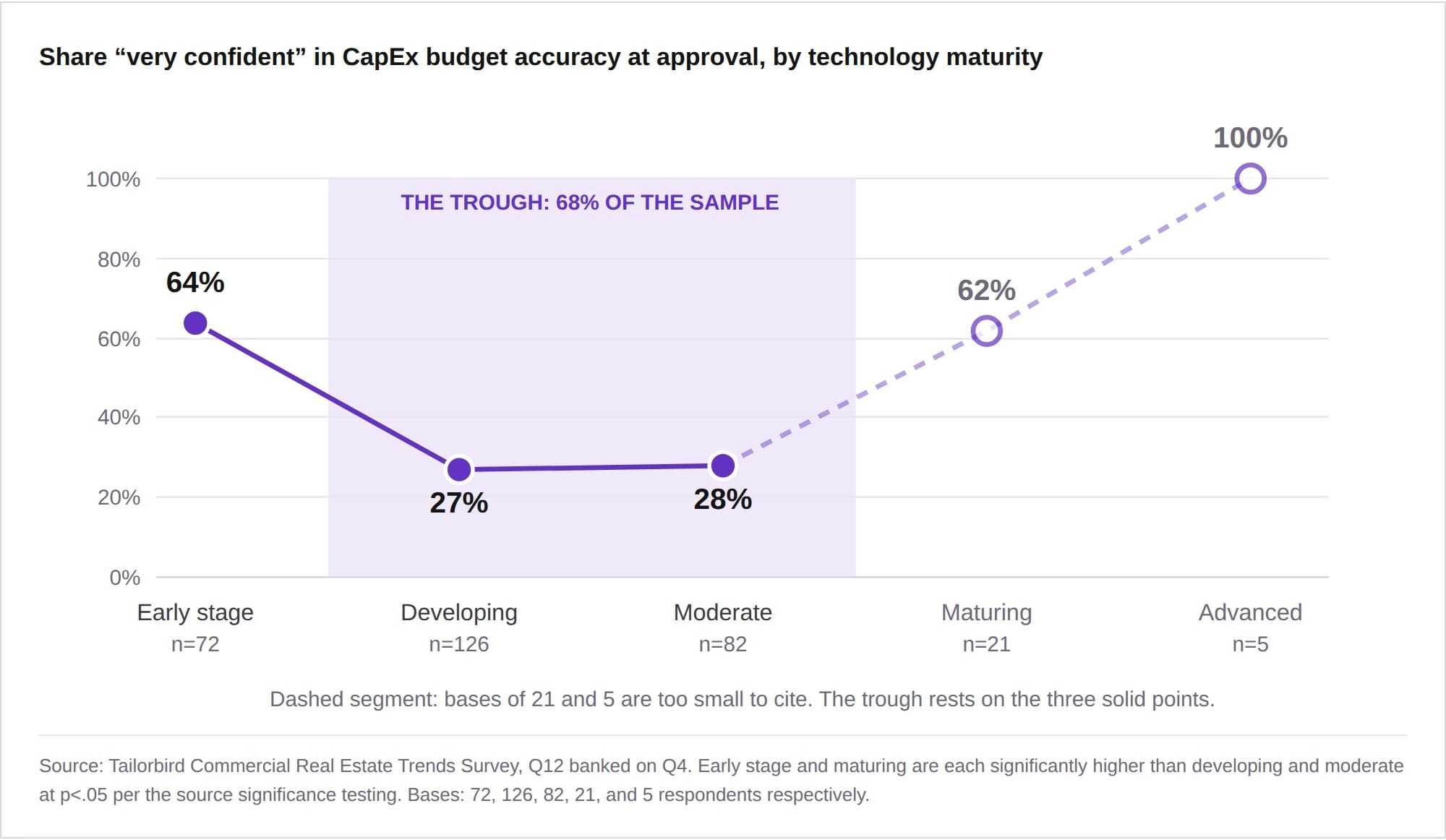
But as operators evolve into the “maturing” and “advanced” categories, confidence jumps, although those sample sets are admittedly small.
The survey doesn't say what's driving the middle-stage sag, but we have a few theories. Halfway through adoption, technology appears to provide visibility but not resolution: AI illuminates the problems, but operators don’t have enough confidence in the technology to say the problem is solved. So projects appear to be going off track earlier and more often as operators gain a real-time window into what’s happening on site.
The groups in the “early stage” segment are the most overconfident of the lot: 71% have revised or reversed a capital allocation decision more than once in the past 24 months, the highest rate of any tier and significantly above the developing, moderate, and advanced groups. Yet 74% are nonetheless “very confident” in their capital decision-making data, and 64% are very confident in capex budget accuracy at approval.
Seventy-eight percent of operators report pressure from investors, boards, or LPs to implement AI across their team and scope, with 29% describing that pressure as significant.
The pressure tracks directly to technology maturity: those with the lowest self-reported maturity face the greatest pressure from outside stakeholders to embrace it. On the flip side, operators who feel they are further along in the adoption journey feel far less pressure to embrace technology.
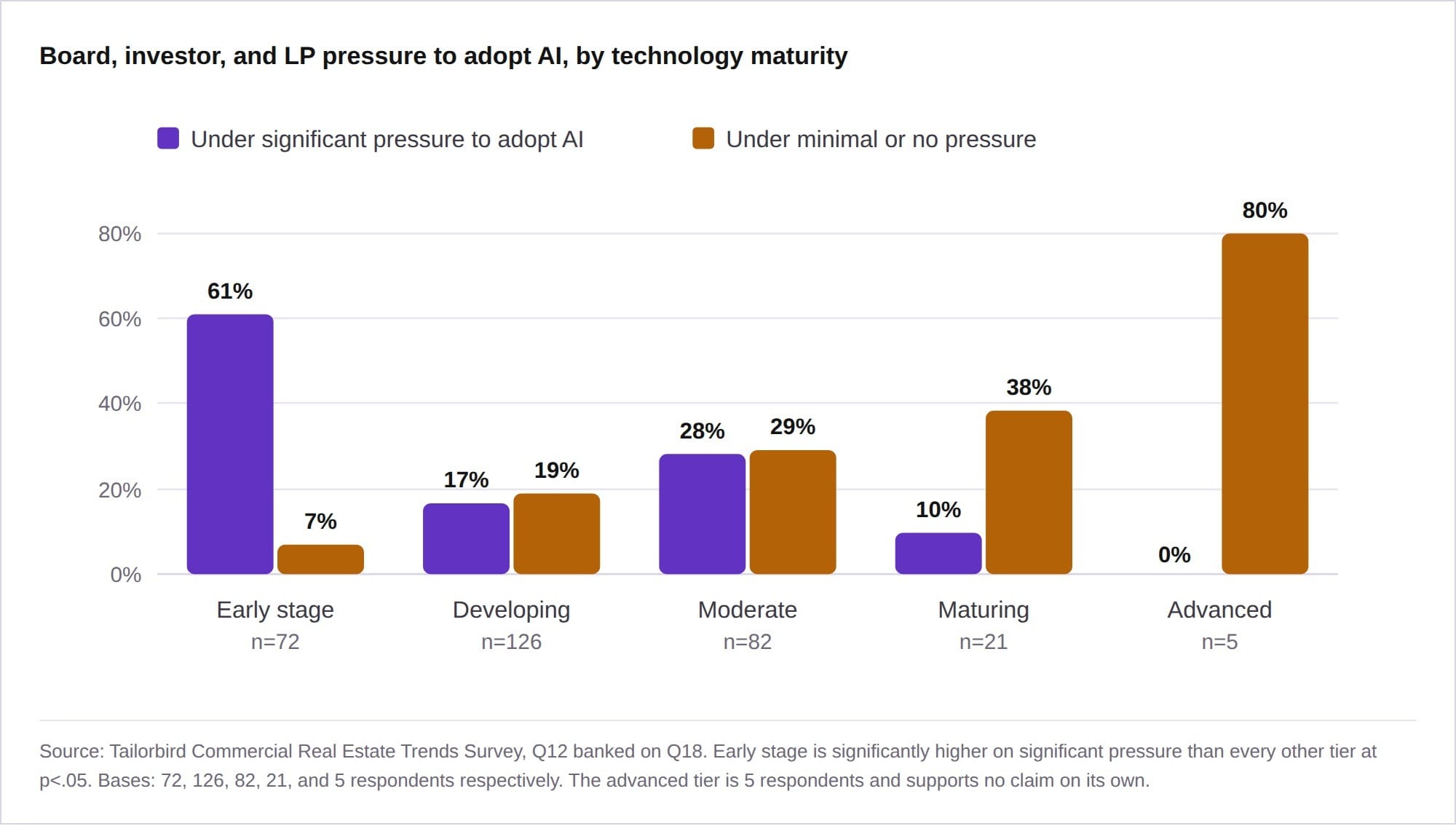
Digging a level deeper reveals that the pressure is going directly to tooling rather than solving the underlying data or systems problems.
When asked what investors and boards focus on most for capex accountability, the leading answer was technology and AI adoption at 41%, ahead of return attribution at 38%, timeline performance at 35%, and budget variance reporting at 33%. Meanwhile, 64% of operators cannot always connect a completed capex project to a measurable change in NOI or asset value. Investors’ and boards’ attention is going to the tooling while the measurement problem underneath it goes unexamined.
To that point, early-stage operators report integration as a reason their AI deployments fell short in 36.1% of cases, significantly above the moderate tier's 20.7%. Deploying AI on top of a spreadsheet will fail; boards should push operators to solve underlying data and systems problems before chasing whiz-bang AI tooling.
Nearly every operator in the survey who has tried AI on capital projects has watched something fall short. Asked to name the reasons for failures among the AI and automation capabilities their organization piloted or deployed, 98% named at least one. Five respondents said they had no failures.
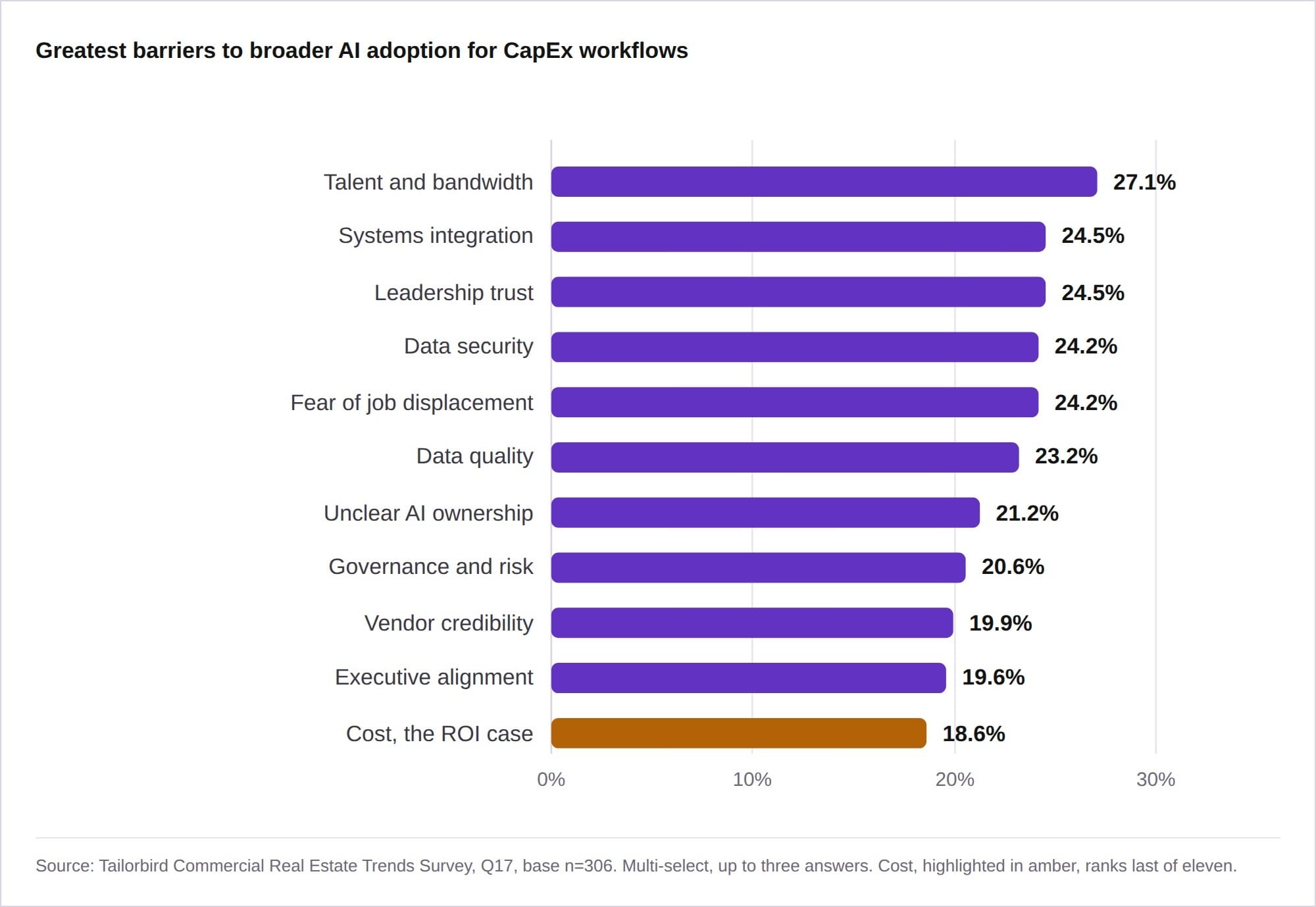
Cost is the smallest obstacle in the survey. It ranks eleventh of eleven at 18.6%, behind talent and bandwidth at 27.1%, systems integration and leadership trust at 24.5% each, and even behind fear of job displacement within the team at 24.2%.
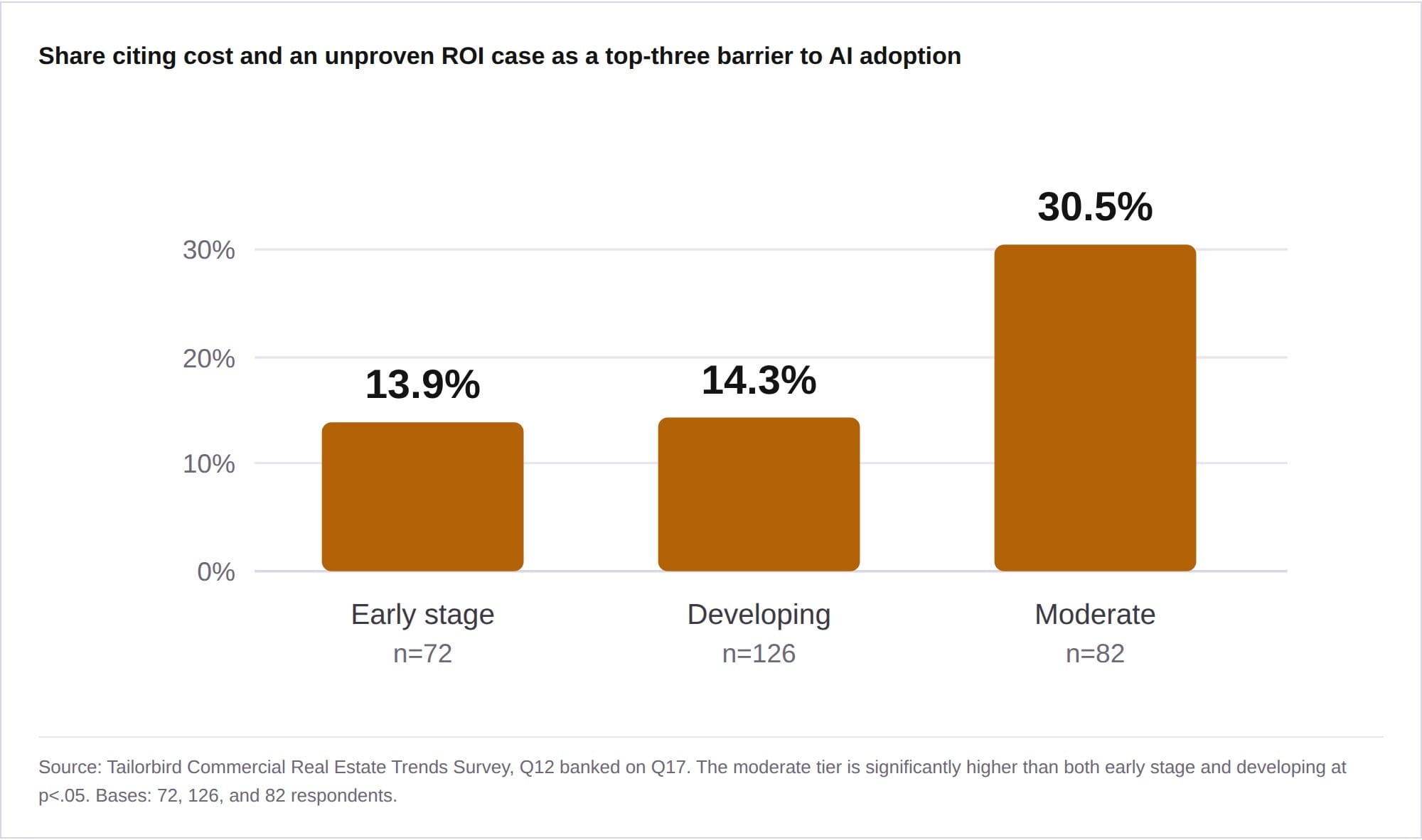
Cost becomes a bigger concern as firms climb the adoption curve. Operators with a “moderate” level of technology adoption are more than twice as likely to cite cost and unproven ROI as primary barriers to AI adoption.
Asked why AI deployments fell short, 48.7% of capital projects staff said the technology required too much manual work, significantly above asset management's 30.8%. Nearly half of those responsible for delivery reported that the AI created more work, not less. Accuracy was a minor complaint in the field: among construction respondents, only 8.3% said the tools were not accurate enough, compared with 28.2% among capital projects staff.
When it comes to implementation, real estate is still early. Across eleven distinct AI and automation capabilities, more than half have never been piloted or deployed by real estate operators.
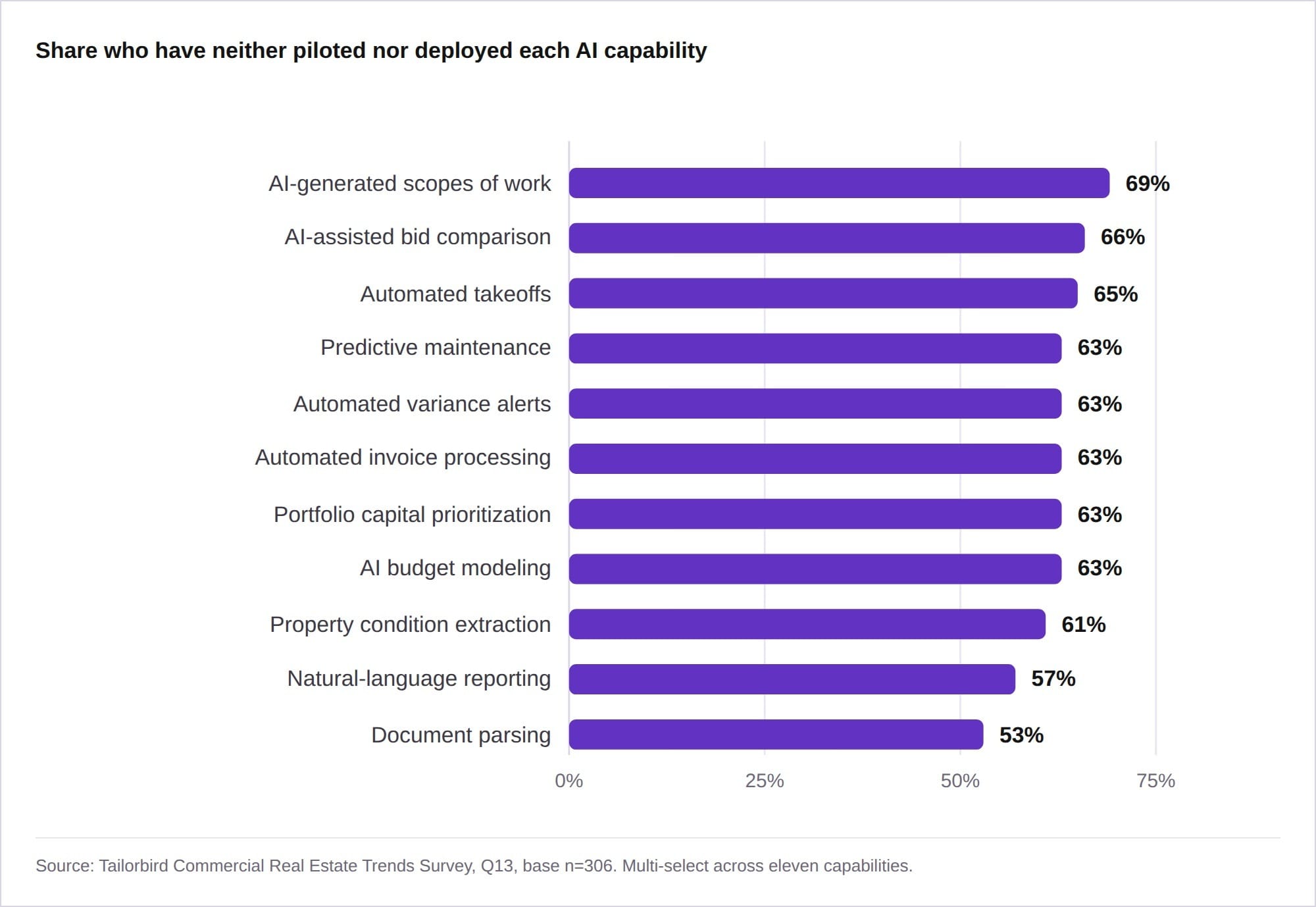
Sixty-nine percent have neither piloted nor deployed AI-generated scopes of work, which is the functionality most likely to address the takeoff and condition-data problems respondents named as their leading cause of variance. Even the most-adopted capability, automated document parsing from PCAs, invoices, contracts, and inspection reports, is untouched by 53% of the panel.
Against that baseline, the industry's timeline is difficult to take seriously. Sixty-two percent of operators expect to be ready to adopt agentic AI, meaning systems that approve routine change orders and update project records without human initiation, within twelve months. The mean expected readiness is 13 months, and 7% say they are ready now. Given the lack of actual deployment today, however, these estimates seem as rosy as their budgeted capex figures.
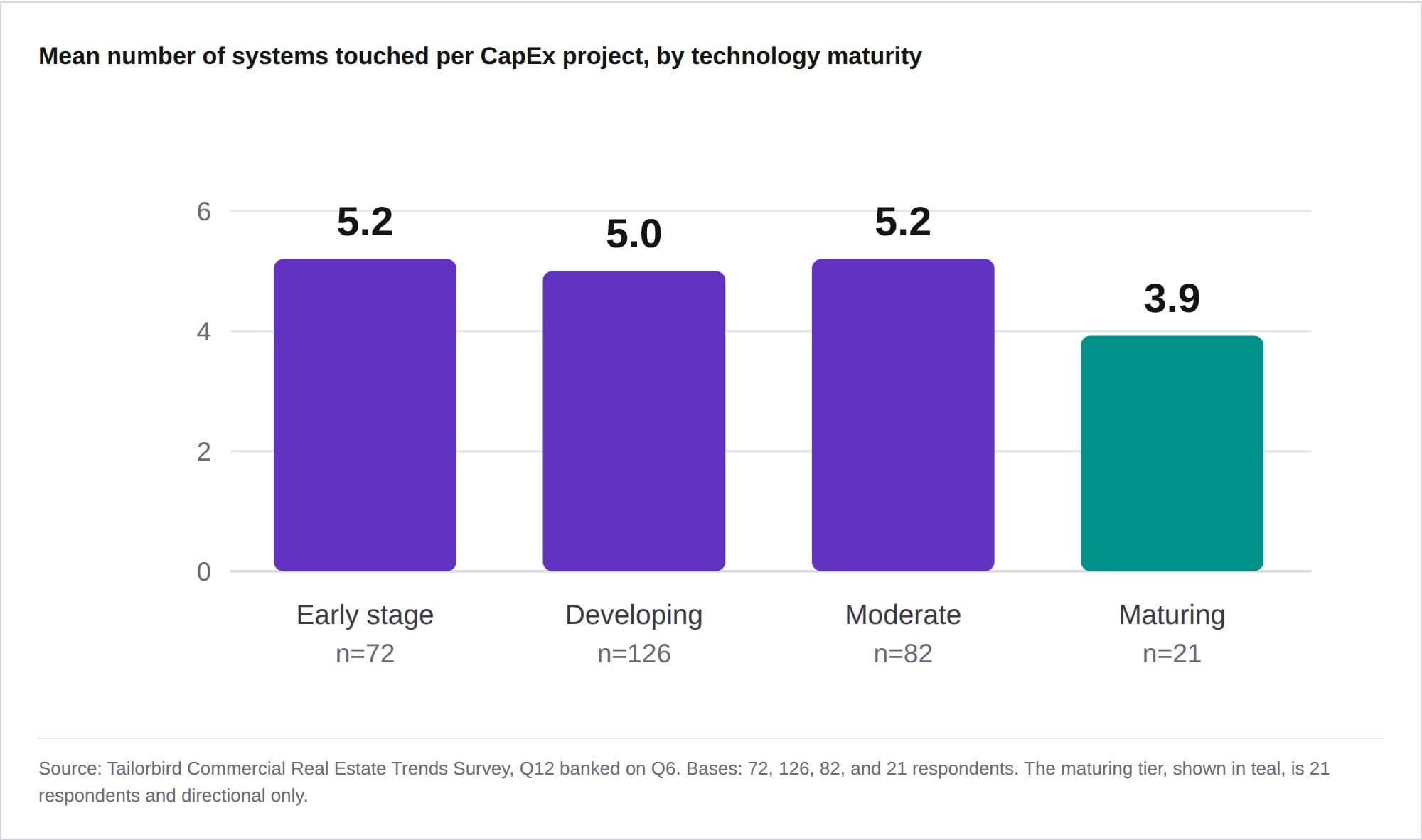
Technology implementations also require a high degree of maturity before they begin to address one of the biggest problems mentioned earlier: too many independent systems. Operators reporting a “moderate” level of maturity operate across the same number of systems as early-stage companies; tech consolidation can’t happen until adoption reaches a more mature state.
What operators say they want from AI shifts as they climb the technology implementation ladder. Early-stage operators ask for plumbing: better integration between capex tools and the property management system (45.8%) and a single connected workflow from budget through execution (40.3%).
More advanced operators, on the other hand, want a clearer connection between capex spend and asset-level returns (40.5%) and real-time spend tracking with variance alerts (36.5%), both significantly higher than for early-stage operators.
All of which points to a near-term role for AI that is narrower and far more valuable than what boards are currently demanding. Not autonomous capital allocation or agentic change order approvals, but simple AI extraction and reconciliation: pulling unit-level condition data and quantity takeoffs out of PCAs, invoices, and inspection reports, then flagging variance in something closer to real time.
This won't be a fun journey for operators. An operator who fixes visibility in 2027 will discover that scope drift affects more projects than they reported, that variance is worse than the approved budget suggested, and that a meaningful share of their overruns trace back to change requests their own asset management team initiated after work started (what 24% of operators already identify as the leading origin of scope gaps).
Confidence in budgeted numbers will fall, and deals that look good on paper today might not pass muster tomorrow.
But the operators who come out the other side may have solved a problem that has bedeviled real estate operators for generations: construction numbers that actually hit budget.
-Brad Hargreaves

A new generation of companies is betting AI can make the human leasing agent better

Multifamily operators in the lurch; have the PMS wars begun?


How a computer vision startup became America’s largest parking operator and a test case for a new model of venture-backed growth
Covering the future of real estate and the people creating it