
What's Happening in Local Land Use | Q3 2026
Tracking three months of notable land use and zoning decisions with Shovels
Tracking three months of notable land use and zoning decisions with Shovels

As real estate's insurance-cost crisis grows, captives gain popularity and embrace membership-club selectivity

Eight lessons on why AI pays off for some firms and not others
The liquidity market private real estate said it didn't need


Private real estate operated for decades on a core premise: investors surrendered liquidity in exchange for institutional-quality assets and risk-adjusted returns. They committed capital for five years or more, took distributions on the manager's schedule, and waited for a sale to return their capital.
That arrangement held across the industry for decades, and investors accepted it because there was no alternative. Now that is changing.
The secondary real estate market set a record in 2024. Roughly $160 billion of interests in private funds changed hands across all asset classes, according to Evercore, surpassing the prior high of $132 billion set in 2021. Real estate represents a small but fast-growing share of that total. Ares Secondaries, which has tracked the space for nearly two decades, logged 163 real estate transactions worth $14.6 billion of net asset value in 2024, up 49 percent year over year and a record for the category. CBRE Investment Management, using a broader definition that captures deals traditional surveys miss, put the real estate figure at $24.3 billion. In 2025 the Ares number climbed again to $20.3 billion.
Liquidity is becoming something private real estate can now produce by design, rather something investors simply wait out.
Real estate is a long-term asset. Value accumulates over years of development, repositioning, and operational grind, but investor circumstances don’t always follow those kinds of lengthy timelines. The pressures that force an early exit are varied and predictable: an allocation committee decides it has gone 300 basis points overweight real assets and needs to reduce exposure, a family office needs cash for a new deal, or a principal's retirement triggers a succession plan that demands liquidity.
Historically, an investor in that position had few good options: wait for distributions that might not come, borrow against other assets, or attempt to sell a single fund interest to whoever would take the call. None of those options worked well.
Rising cap rates have compressed valuations and slowed distributions, which is part of why the secondary market is growing so quickly. Ares pegs rolling annual distributions across global real estate funds at roughly 7 percent of NAV as of late 2025, about a third of the ten-year average. Money that used to come back to LPs on a predictable cadence is stuck in the ground, creating a growing backlog. Burgiss data shows roughly $1.1 trillion sitting in closed-end real estate funds, with $220 billion of it in vehicles more than eight years old, past the point where many funds were supposed to have returned capital.
The secondary market solves a timing mismatch: investor liquidity and asset liquidity used to move together, and now they don’t have to. An LP can exit without a building being sold. The distinction sounds minor; the implications are not. It represents one of the more consequential structural changes in private capital in the past twenty years.
In a standard LP-led secondary, an LP sells its fund interest to a buyer who takes on the position, assuming the future capital calls and distributions. The GP consents to the transfer. These LP-led trades built the market and still account for a meaningful share of it, around 28 percent of real estate volume in 2025 by Ares' count.
Sellers get immediate liquidity and shed a future funding obligation. And buyers get something they almost never get in a primary fund commitment: a full picture of what they are really buying. A primary LP writes a check into a blind pool and trusts the manager to find deals later. A secondary buyer can examine a portfolio of real buildings with actual rent rolls, leverage, and a partially realized track record, and underwrite what is there rather than what a pitch deck promises. The secondary buyer also inherits an investment with a shorter remaining life, which reduces the J-curve drag that GP fees impose on primary commitments.
Price is the other draw. In stressed markets, forced sellers set prices. Closed-end real estate funds traded at discounts of 20 to 50 percent to reported NAV through 2024, well above historical levels, as sellers who needed liquidity ran into a shortage of buyers with dry powder. By 2025, as valuations stabilized and the appraisal lag corrected, those discounts began narrowing toward single digits for core funds. The best entry points arrived when the broader market was paralyzed.
LP-led secondaries address the investor's need for liquidity. GP-led secondaries address the manager's need for time, and they have come to dominate the market.
The core tension in a closed-end fund is the ten-year clock. A fund often reaches the end of its life holding assets the sponsor believes still have significant upside, but the structure demands an exit. Historically that meant selling those buildings into whatever market happened to exist on the expiration date. After the Global Financial Crisis, and again through the recent period of elevated rates, many managers found themselves holding quality assets and facing a forced sale at exactly the wrong time.
The solution: rather than selling assets to a third party, the sponsor moves them into a new vehicle. Existing LPs then choose: cash out now, or roll into the new structure and continue holding the asset. That vehicle is the continuation fund, and it has come to define the GP-led market. Continuation funds represented roughly 90 percent of GP-led secondary volume in the first half of 2024, per Jefferies, with single-asset continuation vehicles rising to 64 percent of that activity, up from 41 percent a year earlier. The market shifted from spreading exposure across old portfolios to concentrating capital into the single highest-conviction asset a GP most wants to keep.
The numbers reflect how quickly the balance shifted. GP-led volume surpassed LP-led volume in real estate for the first time in 2019 and has been dominant since. By 2025, GP-led deals accounted for 72 percent of real estate secondary volume, totaling $14.5 billion, up 60 percent in a single year, with buyers like Blackstone Strategic Partners and Ares purchasing those positions.
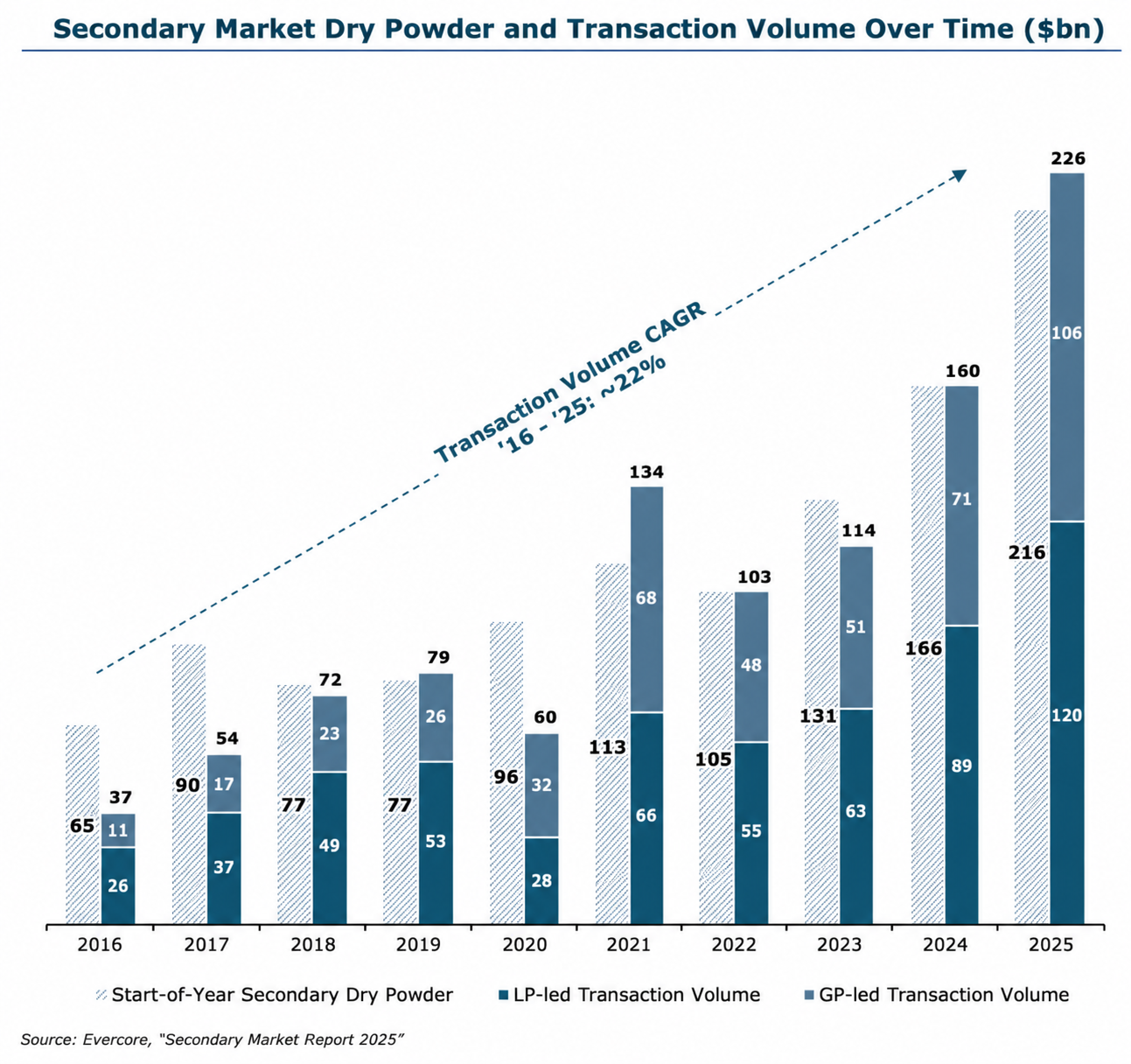
What began as a workaround for stranded funds has become the primary way sponsors manage the later stages of a portfolio's life. Continuation funds tie the liquidity decision to conviction about the asset, not to an arbitrary date on a fund document.
Why real estate fits the structure so well
These funds have proliferated across private markets, and they suit real estate particularly well.
Real estate value accrues over periods that regularly exceed a fund's life. A multifamily portfolio requires years of operational seasoning before it commands full value; a logistics portfolio rides a demand curve indifferent to vintage year; and a mixed-use project may not stabilize until well after the fund's investment period has closed. When a fund's tenth anniversary forces a sale, sponsors frequently exit at a discount to value that would have been realized with more time. Burgiss tracked value-add and opportunistic real estate funds at a net time-weighted return of negative 10 percent since early 2022, a level at which a forced exit crystallizes a loss the asset would otherwise have recovered from.
GP-led deals give sponsors the ability to separate asset quality from fund schedule, a capability that proves most valuable in exactly the moments the direct market seizes up, when transactions stall and nobody trusts the marks. The assets that move through these structures tend to be core holdings, not residual positions.
Multifamily and industrial, two sectors that institutions actively pursue, dominate real estate secondary activity. The market is trading quality, not distress. This is the good stuff changing hands.
Throughout its history, the secondary market has drawn capital primarily from institutions: pensions, sovereigns, endowments, and insurers. The fastest-growing source of capital flowing into private markets—wealthy individuals and family offices—has barely participated.
According to Boston Consulting Group, global wealth investors could add $3 trillion to private markets between 2024 and 2030, reaching $5.8 trillion, and some forecasts reach even higher, projecting wealth-channel allocations to alternatives tripling from $4 trillion to $12 trillion over the decade. Today that channel directs 2 to 3 percent of its capital to alternatives against the 20-plus percent institutional allocators target. That gap is the whole opportunity.
The supporting infrastructure is being built to match. Evergreen and semi-liquid funds, the structures that let individuals subscribe and redeem on a schedule instead of locking up for a decade, have gone from niche to default. Evergreen AUM roughly doubled from $267 billion in 2022 to $534 billion in 2025 and is projected to reach $1.1 trillion by 2029, per PitchBook and Morningstar. Blackstone alone raised $23 billion through its semi-liquid retail products in 2024, around 13 percent of the firm's total inflows for the year.
Federal policy is accelerating the shift. The 2025 executive order opening 401(k) plans to alternatives brought a $13 trillion retirement pool into the conversation. Platforms like iCapital and CAIS have built the distribution infrastructure to reach individual investors at scale, and leading secondaries firms, Hamilton Lane, StepStone, Pantheon, and Neuberger, have launched tender-offer funds to serve them.
The infrastructure to serve smaller positions, however, has not kept pace. The liquidity solutions this new investor base will need do not really exist yet. An individual holding a $1 million or $5 million fund interest does not clear the minimum that most traditional secondary intermediaries require; most are built around $50 million institutional tickets. Transfer restrictions, feeder structures, and transaction costs make small trades uneconomical.
That imbalance will not hold. The same forces that built institutional secondaries into a $160 billion market over twenty years are now converging on the wealth channel: dedicated buyers, standardized documents, purpose-built technology, and brokers willing to trade small positions. The institutional secondary market of 2005 was exactly as underdeveloped. The number of intermediaries and investors focused on smaller positions is already growing.
Secondaries are often categorized as a trading mechanism, a place where positions get bought and sold. That misses what they actually do.
A functioning secondary market changes how capital is allocated across the entire asset class. Investors can rebalance without disrupting a fund. Managers can hold assets to their natural maturity rather than the fund's expiration date. Buyers can deploy into existing, known portfolios rather than blind pools. The result is that long-term investing remains viable while the ability to adjust course is no longer entirely absent.
Public markets have always worked this way. A shareholder can sell Apple stock without Apple issuing or redeeming shares, and that liquidity is what makes the equity markets function. Private real estate spent decades developing ever more sophisticated methods to buy, finance, and operate buildings while leaving the transfer of ownership interests mired in manual, bilateral processes. That is the layer the secondary market is now building out.
The growth of secondaries tracks a larger shift in how private capital wants to behave. Investors expect optionality and managers want out from under arbitrary fund clocks. Capital flows toward structures that let both happen: LP-led deals remain the foundation; GP-led continuation funds have become the main strategic tool; and a wave of wealth-channel money, still waiting on the infrastructure to serve it, is set to drive the next decade of growth.
Private real estate is becoming more liquid without becoming less private. The industry got very good at owning buildings. It is now getting good at trading the claims on them, and that second skill may end up mattering as much as the first.

The carry trade is dead, and capital is moving to whoever can manufacture cash flow. Takeaways from a day with more than 250 investors and operators in emerging real estate.


A workshop for GPs on finding the right JV partner, structuring the deal, and negotiating operator-friendly terms

World Tree Technologies is using a quick-growing hardwood to compress decades-long timber cycles into an investable real estate timeframe

A new model for capitalizing real estate operators from ex-Blackstone, Starwood, Goldman Sachs, and Dune investors
Covering the future of real estate and the people creating it