
A4 & the Flight to Collateral
Small-balance residential bridge loans are a bright spot for private credit
Small-balance residential bridge loans are a bright spot for private credit

K-12 enrollment is falling rapidly. As cities grapple with school closures and property tax revolts, what does this mean for real estate?

A city built around cars and entertainment could be remade over the next decade by forces now transforming both

The gap between finding an energy inefficiency and fixing it has cost building owners for over a decade. Agentic AI is the first technology that can close it.


Today's letter was written by Lucas Turner-Owens, a principal at Building Ventures, covering construction tech and proptech verticals, and supporting portfolio companies Station A, Noda, and Kantiv. Formerly, he was a principal at early-stage venture firm TMV and fund manager at The Ujima Fund in Boston.
For more than a decade, the CRE energy efficiency industry has known where the savings are. SkyFoundry, Clockworks, Gridium, and a generation of fault-detection-and-diagnostics tools have gotten good at finding the broken VFD, the short-cycling chiller, the overpumping loop. Carbon Lighthouse built a whole business around it. The DOE, ACEEE, and the major real estate research desks all point to the same figure: roughly $11 billion in achievable savings going unrealized in commercial buildings every year.
The software finds the problem. The problem does not get fixed.
A 2025 survey of building operations teams by VTS found that roughly 60 percent of a facility manager's time goes to administrative work: work orders, invoice and payment processing, and compliance documentation, leaving a minority for the hands-on engineering work most people associate with the job. That ratio is the real constraint on energy efficiency in commercial buildings. A fault gets flagged, a ticket gets opened, and weeks later the chiller is still overpumping because the person who should have acted on it never got to it. That administrative burden is the 60 percent, and until recently, no software touched it.
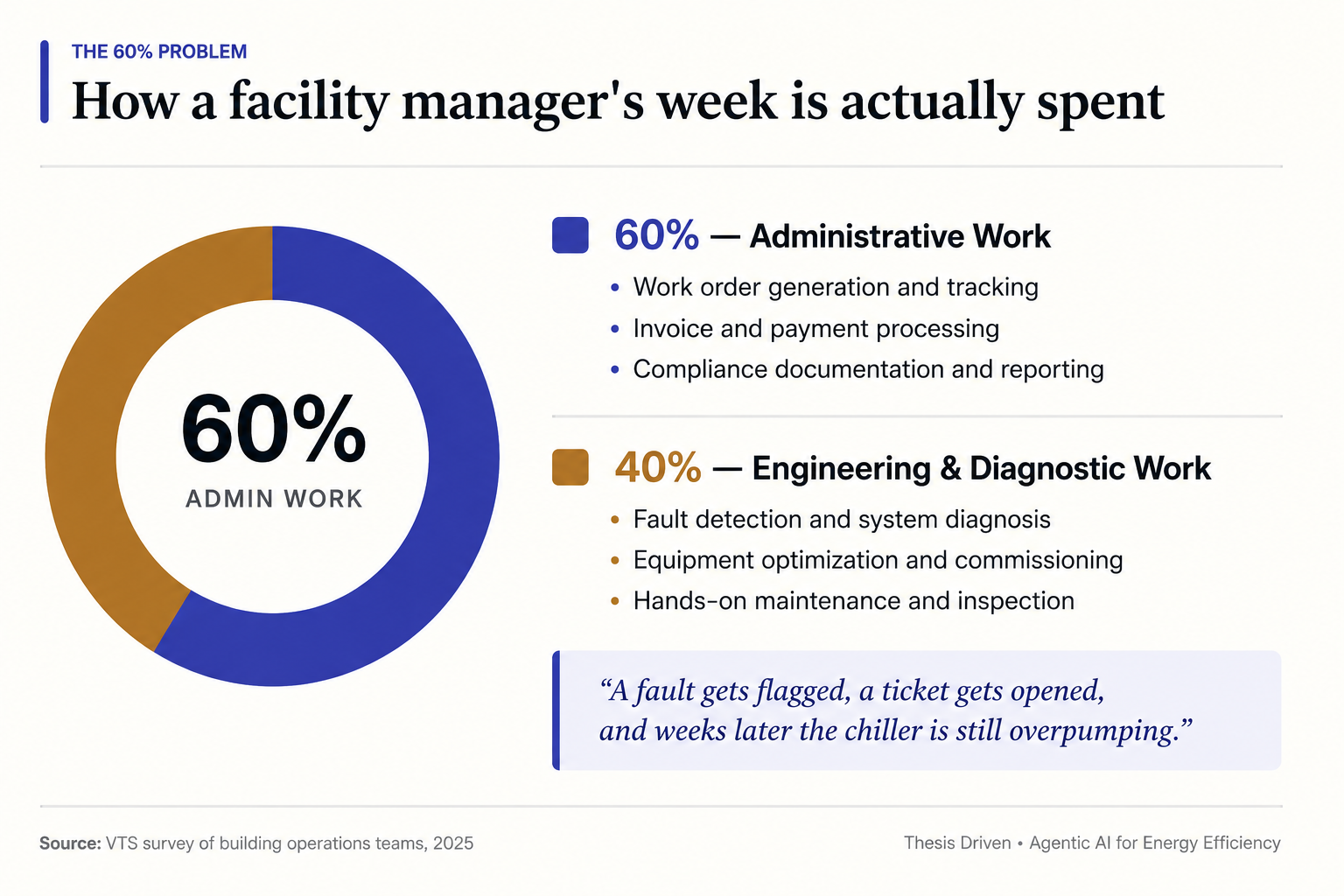
Agentic AI matters because it is the first technology that can credibly take on that administrative layer: the triage, documentation, work orders, and compliance filings that sit between a diagnosis and a completed fix. That technology has arrived at the same moment that labor shortages, rising electricity costs, and building performance penalties have made the administrative gap impossible to ignore.
This letter explains why, where the capital is going, and what it means for owners and operators making decisions now.
Today's letter covers:
The administrative gap has persisted for a decade. What has changed is the price of ignoring it.
The workforce that runs buildings is aging out faster than it is being replaced. JLL estimates the broader skilled-trades shortage could leave roughly 2.1 million U.S. positions unfilled by 2030. That gap will not close through hiring. The only realistic answer is software that lets a smaller team cover more ground.
Electricity costs are rising fast. Commercial prices rose roughly 11 percent year-over-year as of late 2025, the steepest increase of any customer class tracked by the EIA, and data center growth is adding pressure to the same grid commercial buildings draw from.
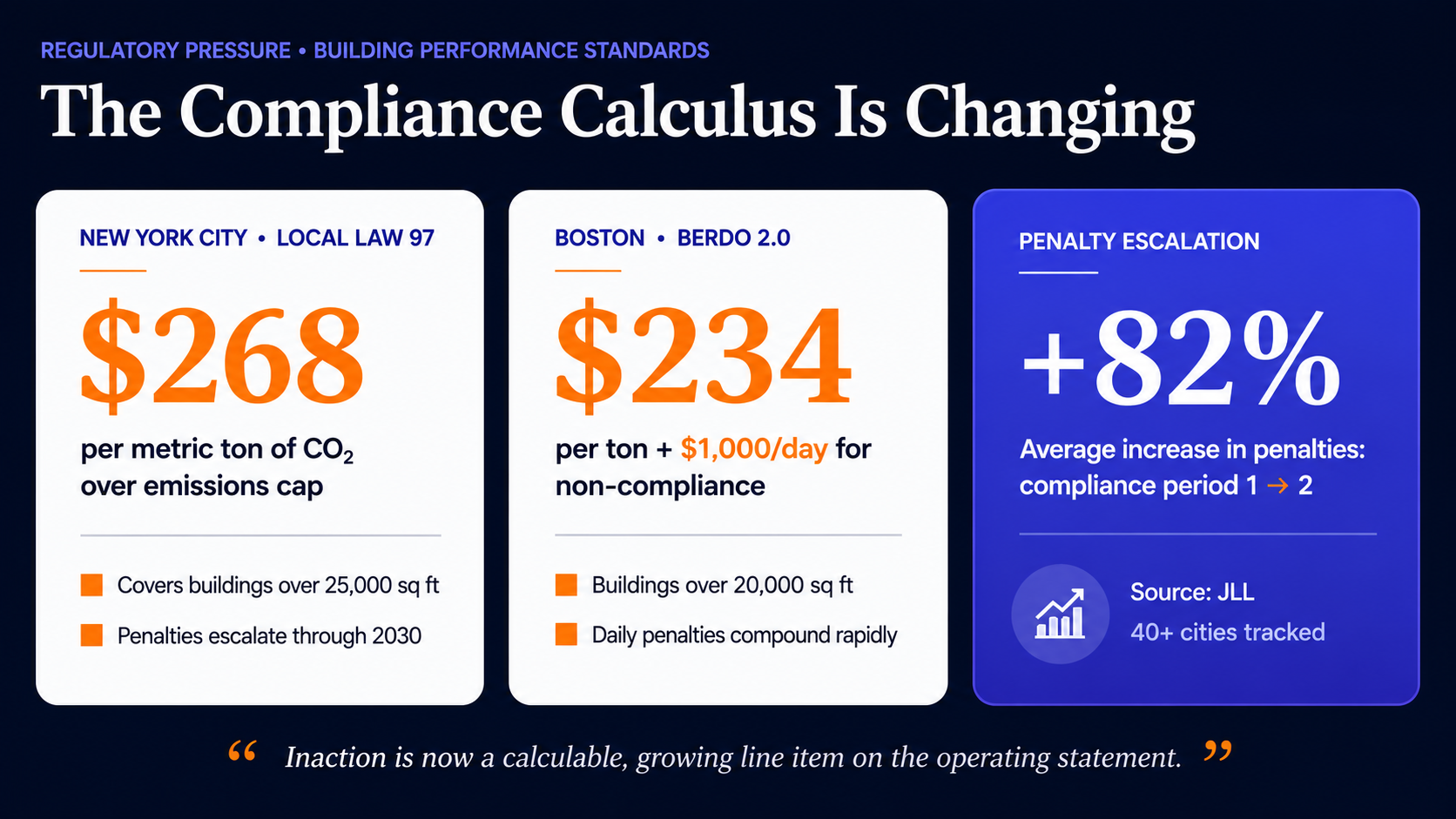
Regulation is turning that pressure into enforceable cost. New York's Local Law 97 fines buildings $268 per metric ton of CO2 over their emissions cap. Boston's BERDO 2.0 charges $234 per ton plus $1,000 per day for non-compliance. JLL counts more than 40 U.S. cities with similar standards in effect or scheduled by 2026, with penalties stepping up an average of 82 percent between compliance periods. Inaction is now a calculable and rapidly growing line item on the operating statement.
Model predictive control has been the gold standard for building energy optimization since the 1980s, deployed in a handful of showcase buildings with dedicated engineering staff. Two failure modes have kept it from achieving mass adoption. The first is calibration: every building needs its own custom-calibrated thermal model, expensive to build and brittle as equipment ages. The second is adaptability: when something unexpected happens, a failed sensor, a tenant who overrides a setpoint, a utility curtailment signal, the model has no answer.
Agentic systems fix both. An LLM acting as a planner can reason about a fault it has never seen before, pull the data it needs, propose a fix, and route it to the right approver. The MPC controller still runs underneath as the executor. The agent doesn't reinvent the physics. It handles everything the model can't, which is most of what actually happens in a real building. That connective tissue between diagnosis and action is where the 60 percent lives.
None of this works without a common language between the agent and the building. The Project Haystack and Brick Schema standards, now converging with ASHRAE's 223P, give buildings a machine-readable description of what each sensor reading and control signal actually means. Without that, an LLM staring at a point labeled "AHU3.SF.SP" has no idea what it's looking at. With it, an agent can ask the building structured questions and get structured answers. The Model Context Protocol standardizes how an LLM invokes tools across systems, making agents work across BMS vendors rather than locking into one.
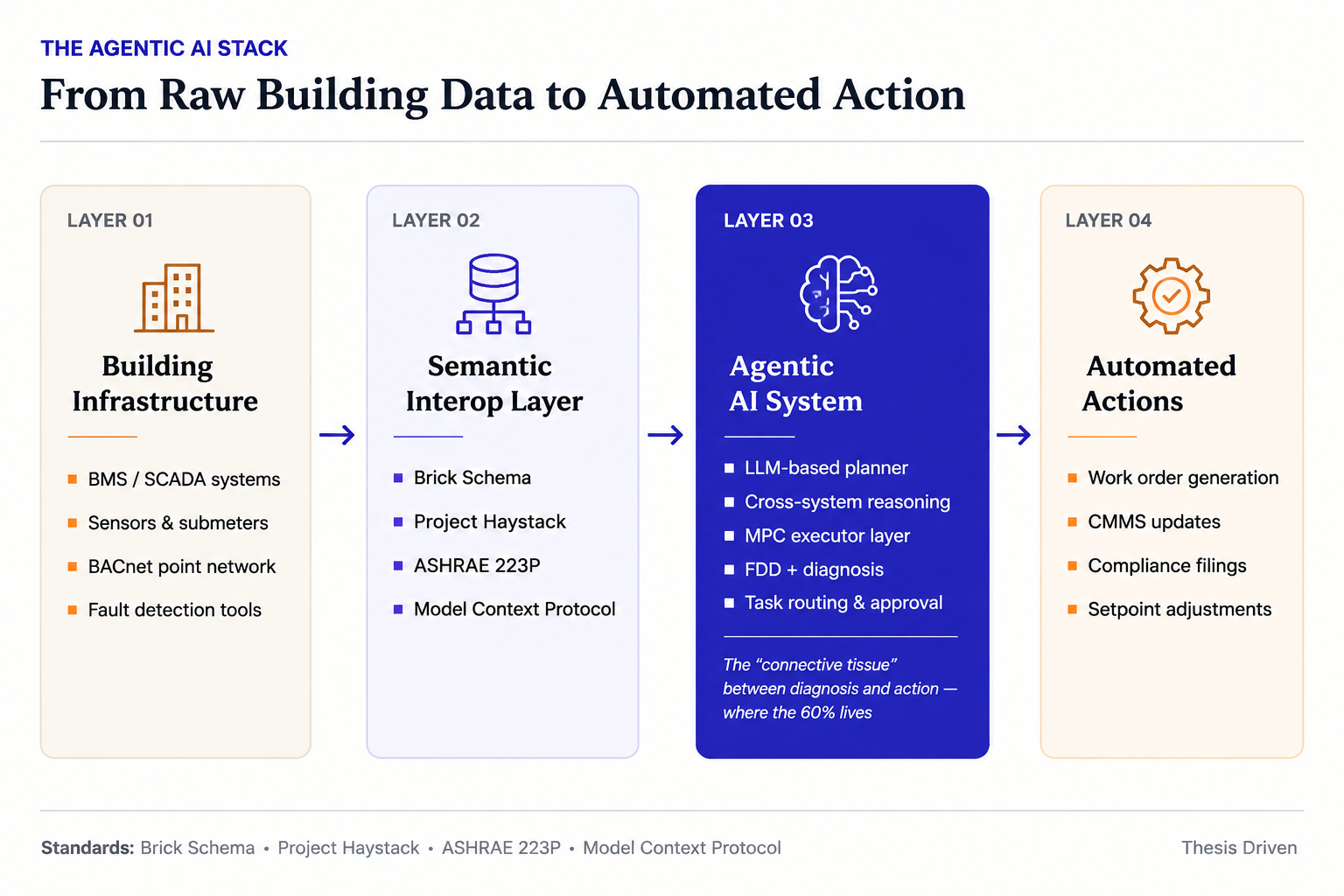
Two years ago, "AI for buildings" meant an anomaly detector or a reinforcement-learning controller running in a sandbox. Today, the full sequence of reading sensor data, proposing a setpoint change, generating the work order, and filing the compliance update can run largely without a person in the loop.
The deals of the last 18 months show where the industry expects value to land.
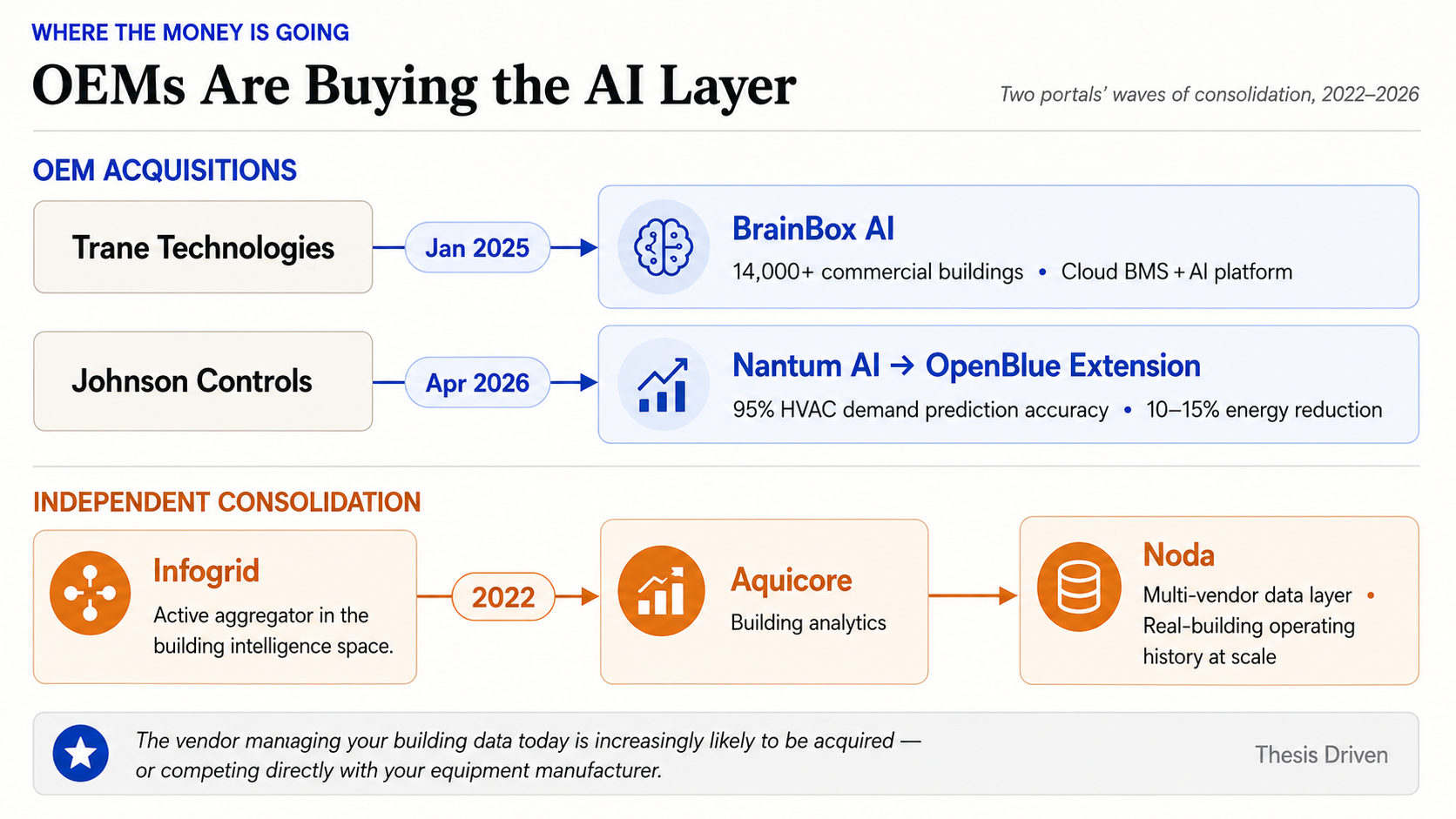
In January 2025, Trane Technologies bought BrainBox AI, a cloud-based AI platform already running across more than 14,000 commercial buildings. Johnson Controls followed in April 2026 with Nantum AI, bolting its control algorithms into the OpenBlue platform. The pattern is consistent: the major equipment makers have decided the controls layer is where the next decade of margin sits, and they are buying their way there rather than building on a timeline that would let competitors catch up.
On the independent side, the story is about data rather than deals. Infogrid acquired Aquicore in 2022 and was later folded into Noda. The result is a concentration of what actually matters at scale: years of clean, multi-vendor operating data across a large base of real buildings. That kind of data layer takes a long time to build, which is why the independents have a genuine advantage over the OEMs, which own the equipment but tend to have weak data hygiene across vendors, and over new AI entrants, which have neither the data nor the customer base. The vendor managing their building data today is increasingly likely to be either acquired by or competing directly with whoever made their equipment. That shift is worth tracking when contracts come up for renewal.
Noda is one of the companies built around this data layer. In a field study with Lawrence Berkeley National Laboratory and Macerich, Noda's system cut peak HVAC demand by up to 40 percent and avoided more than $60,000 in costs across three properties over six months. The share of identified savings projects that customers executed rose from 35 percent to 70 percent, and the time from identifying a savings opportunity to completing it fell from 70 days to under 40.
[Building Ventures is an investor in Noda.]
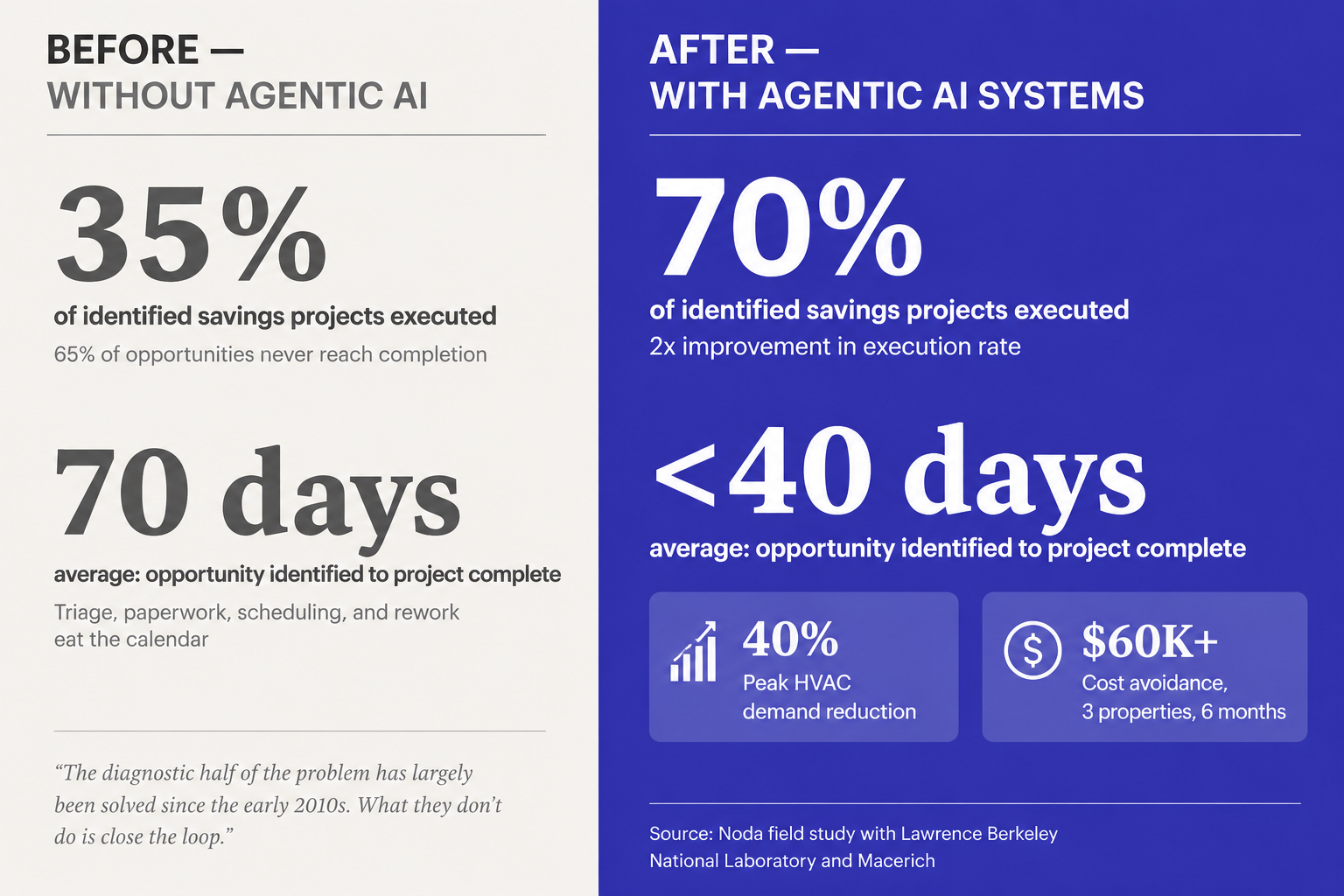
Those results were achieved without reprogramming existing local controllers. The diagnostic tools were already finding the savings. The work was always in turning a finding into a completed project, and that is what agentic systems are starting to do.
The most underrated risk is data quality. Most commercial building management system (BMS) installations haven't had a real commissioning pass in five-plus years. Tags drift, equipment gets swapped without updating the model, submeter coverage is patchy. A system that looks impressive on a clean digital twin can fall apart when it meets the actual building. Winning here requires as much investment in data hygiene as in the agent layer itself.
Trane and Johnson Controls did not buy BrainBox AI and Nantum AI to run neutral platforms. Equipment makers in other industries have used security and warranty claims to lock out third-party software from those systems. If the same playbook runs here, building owners who want to use independent agentic software may find themselves locked into whatever the equipment maker offers.
The contracts haven't caught up to what these systems can do. When an agent's setpoint change saves $40,000, who gets the credit? The software vendor, the engineering firm, the utility, or the building owner? No existing contract has a clear answer, and disputes over exactly this are coming. The liability side is just as unsettled. If that same setpoint change contributes to a comfort or safety complaint, the question of who is responsible has no clear answer either.
The capital picture is getting harder. Proptech investment fell to roughly $16.5 billion in 2025 from $19.4 billion in 2024, and several companies in this category are running on fumes. More distressed deals are coming, and they will probably be struck at prices that reflect the cash crunch rather than the value of the data these companies have spent years accumulating.
This is not a winner-take-all market. There are 5.9 million commercial buildings in the United States, and even the largest player covers a small fraction of that stock. For owners and operators, that fragmentation is good news: it means competitive options and no single vendor lock-in. The question worth asking is whether the vendors already managing their buildings can actually close the gap between finding a savings opportunity and completing it. The majority cannot today. Agentic AI is the first technology that makes it possible, and the window for getting ahead of compliance deadlines and rate increases is narrowing. Better to be evaluating now than explaining later why you weren't.
The $11 billion in unrealized energy savings sitting in commercial buildings every year has always come down to the same administrative gap: the work between finding an inefficiency and fixing it. Agentic AI is the first technology that can actually do something about it.

New data from Tailorbird shows why two-thirds of real estate operators blow their capex budgets and where AI could actually help

How a computer vision startup became America’s largest parking operator and a test case for a new model of venture-backed growth

Realpage is betting that decades of accumulated data can become an AI-era advantage

We've been building AI acquisitions agents with real estate GPs. On August 13, we're opening the hood in a live 2-hour workshop
Covering the future of real estate and the people creating it