
When Will Spec Office Get Built Again?
Office demand is recovering, but speculative development in most markets remains stubbornly out of reach
Office demand is recovering, but speculative development in most markets remains stubbornly out of reach

New data from Tailorbird shows why two-thirds of real estate operators blow their capex budgets and where AI could actually help
One founder's account of the structural reasons autonomous AI property management SaaS gets crushed, and what the right model actually looks like


Today's newsletter was written by Christopher Arraya, co-founder and CTO of Juno, a tech-enabled owner's representative for multifamily developers. He previously co-founded Atria, an AI-powered communications and operations layer for residential property management.
Less than a year after launching Atria, an AI property management startup my co-founder and I built from scratch, we shut it down. At its peak, the software was running across roughly 400 units for a handful of multifamily operators, handling maintenance requests and resident communication without a manager stepping in. The system worked. We could not get it to scale.
The reasons had nothing to do with the technology. Highly autonomous AI property management SaaS keeps hitting the same wall for three structural reasons, and we ran headfirst into all three. Some AI property management companies have found success by staying narrow: EliseAI focused on leasing, where the wedge hits revenue directly and the cost of an AI mistake is manageable. But going broader across the full property management stack is where the model often breaks down.
The business best positioned to win this category is probably not a SaaS company at all.
This letter is an account of what we got wrong and why the category keeps producing the same failures.
Atria grew out of every New Yorker’s worst nightmare: a bedbug infestation.
In the summer of 2024, I was on a leave of absence from college, looking for a software company to build. A friend from school, Ilyas Colie, and I had been talking for months about the right market to go after. Then Ilyas discovered bed bugs in his New York City apartment and spent two hours with the pest prep technician who came to treat it. His business ran entirely on word of mouth and repeat work.
We built him the New York City Bed Bug Helpline, a website that warned NYC residents about the litigious nature of bed bug incidents in apartments and funneled callers toward our client's services via an AI voice agent. We never converted a single customer for him.
His biggest complaint was coordinating with property managers: calls went unreturned, work orders arrived with no context, and building access instructions were often unclear. That sent us to property managers directly. What we heard confirmed what the exterminator had described: communication is where their operations break down. The work is repetitive and well structured, but the communications layer is entirely human-driven.
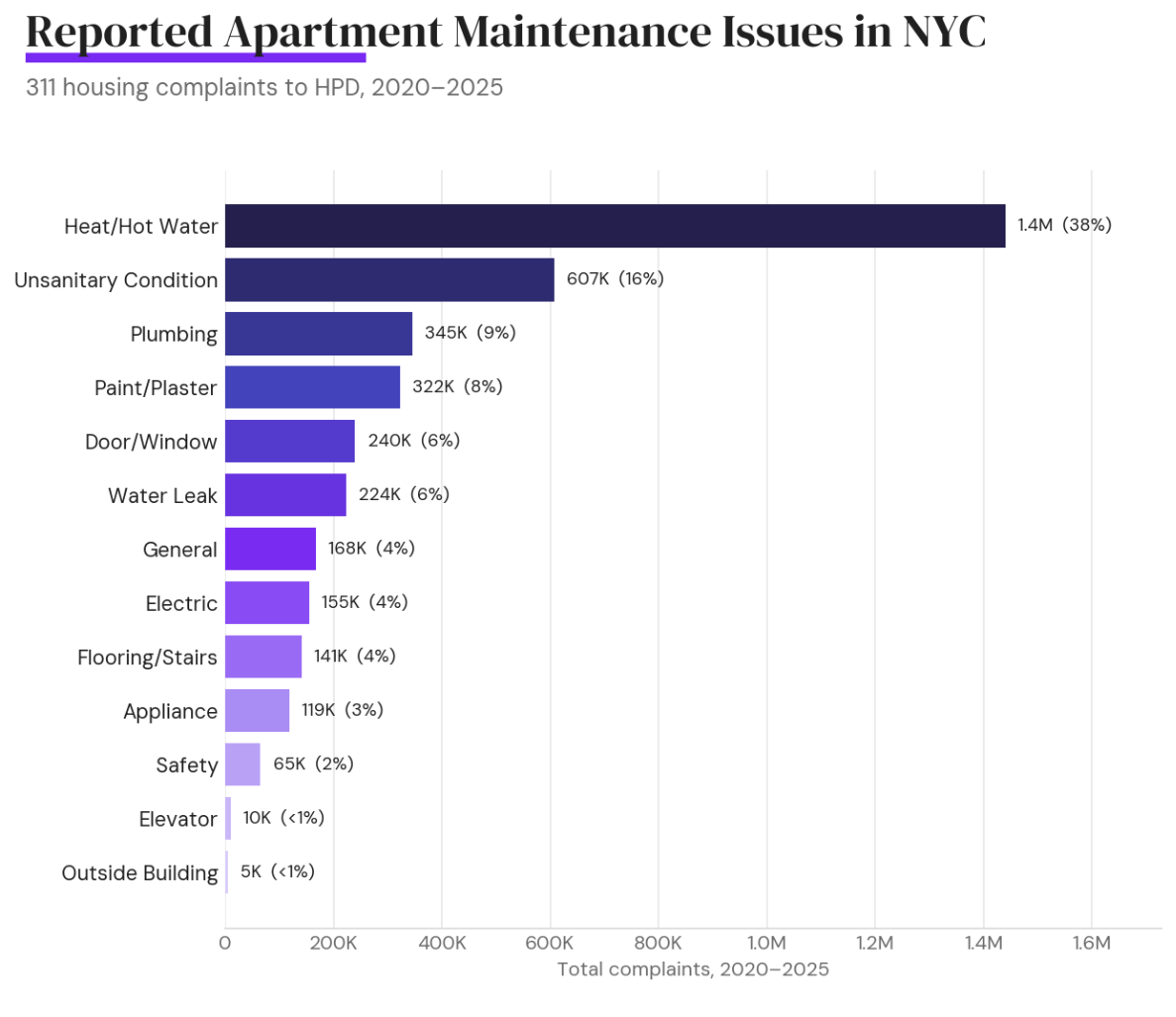
A 200-unit building cycles through those same 15 categories of resident situations and consults the same 10 documents. Yardi, RealPage, and AppFolio mainly function as a system of record. The communications layer was wide open.
We called the company Atria. I served as CTO and Ilyas was CEO. We raised just under $100,000 from a Sequoia Scout, Pioneer, and a handful of angels, and pulled out of pest control to build a highly autonomous communications and orchestration layer for multifamily property management. Every resident message could be acknowledged within 30 seconds. Maintenance tickets were filed, routed, and scheduled automatically.
The core engineering shipped. What did not work was everything else.
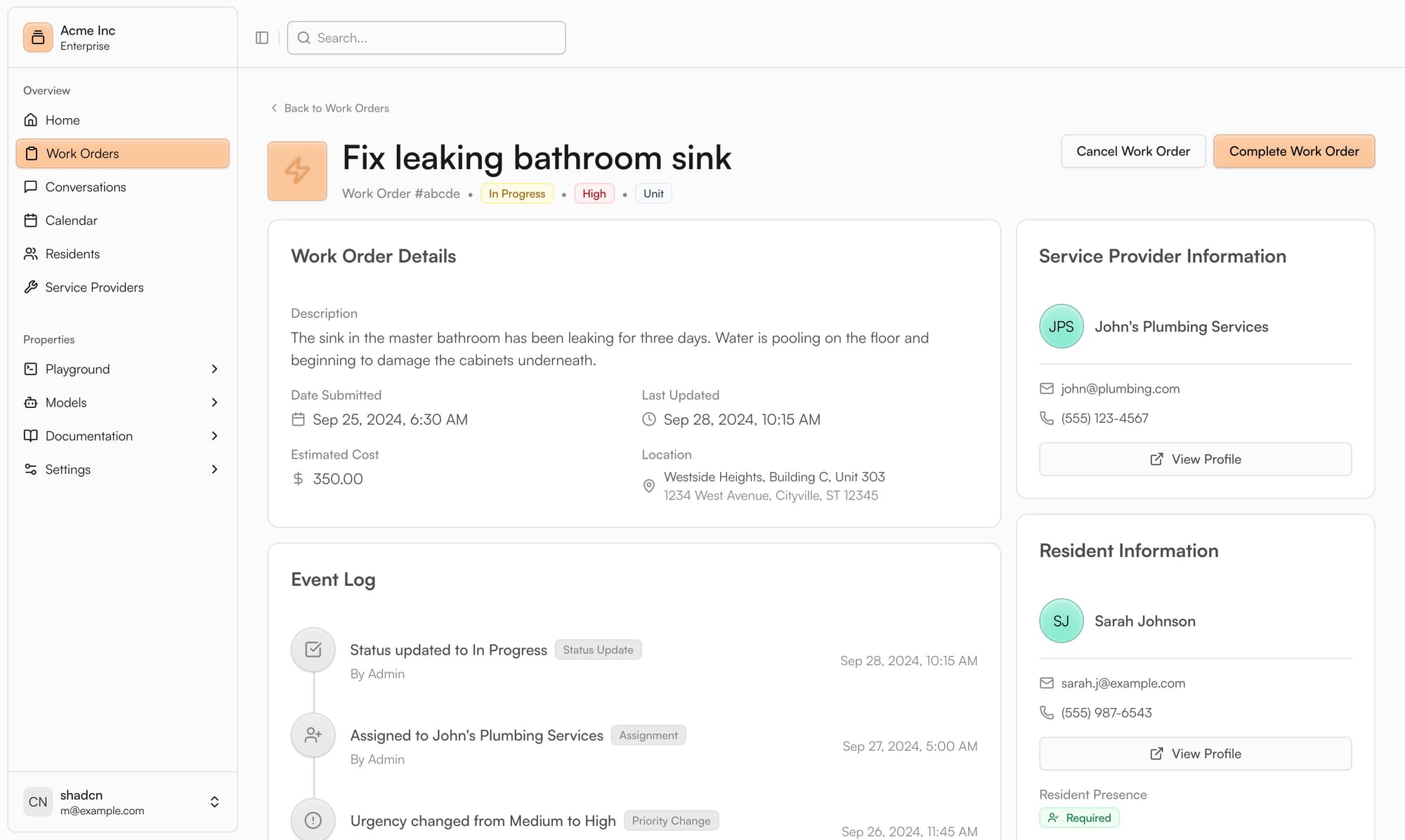
When a human employee makes a mistake, the manager resolves it and the error reflects on the employee. When the AI makes a mistake, the error reflects on the decision to use AI at all. A single non-ideal response surfaces doubts that overshadow every positive interaction the system has quietly handled that week. Two examples make the point.
Consider an interaction where a resident texts late at night about a leak. The system gathers details, files a maintenance ticket with verifiable reasoning behind its diagnosis and plan, and requests manager approval. The manager approves without reading the conversation closely. The service provider arrives the next morning and finds the problem is slightly different from what the system diagnosed, requiring a different service provider. The resident's time was wasted and another party needs to be dispatched. The resident is upset and complains to the manager.
A resident who's been repeatedly late on rent texts on the 3rd asking if she can split this month's payment. The system checks the lease, confirms the building's written policy allows split payments, and lets her know. The manager finds out the next morning. The building's real policy is that split payments are offered only to residents who've been current for the last twelve months. This stipulation was never written down; it lived in the manager's head. Now he has two options, both bad: enforce the remainder against a message that was supposed to be representative of the manager, or eat the cash flow hit and set a precedent for every other resident who tries the same thing.
Both examples end in the same place. The software acted within its rules, and the manager is the one answering for it. The resident doesn't see the software vendor when something goes wrong. They see the manager and the choice to let a machine handle parts of the relationship.
That dynamic had a cultural dimension too. Small owner-operators felt that being a "good landlord" simply meant being the person on the other end, speaking directly to the resident. One manager put it plainly: it was easier to tell a resident that an employee made an error than to tell them the AI did.
Real estate is a trust-based industry, and even a working product has to clear a credibility gate before any portfolio will test it. That gate is a long sales cycle where the buyer is evaluating both the software and the people behind it.
We were pitching operators who had been running buildings for longer than we had been alive. They would sit through multiple demos, ask thoughtful questions, and then go quiet for months.
The operators we could reach were small and mid-sized property management companies and owner-operators. They didn't have the scale to make the ROI argument compelling, but they would at least answer the phone. The operators who would actually benefit most from autonomous AI were institutional property management companies, where a two- or three-to-one uplift in units-per-manager compounds across thousands of doors. Those are also the operators who most demand founder credibility before agreeing to a meeting. The customers who needed the product most were the hardest to reach, and the customers we could reach didn't need it.
The sales cycles were long, the runway was short, and we didn't have product-market fit. We decided there were better places to put the time.
The third structural problem is the most fundamental: what we chose to build and who we chose to sell it to. Wedge is what decides whether a customer keeps paying.
For a small owner-operator managing 10 to 50 units, the person answering the phone is already in place. The dollar impact of better communications is indirect and hard to quantify. The best pitch available was about NPS and retention compounding into revenue over months.
The leasing category shows what a direct wedge looks like, and EliseAI is the clearest example. A leasing inquiry that goes unanswered for hours turns into lost revenue that can't be recovered. AI response time directly shortens the path from inquiry to signed lease. The line from product to revenue is immediate.
For large property management companies, the math changes. They're constantly scaling, their ACV is higher, and they can run each additional building with less headcount. A communications and maintenance wedge that hits cost-per-door can hold together in that context, because the product compounds across a portfolio.
Below that scale, the wedge has to hit revenue directly. Otherwise there is no reason to keep paying.
The three structural problems above are arguments for a different approach in property management. The right approach depends on where a company sits in the market.
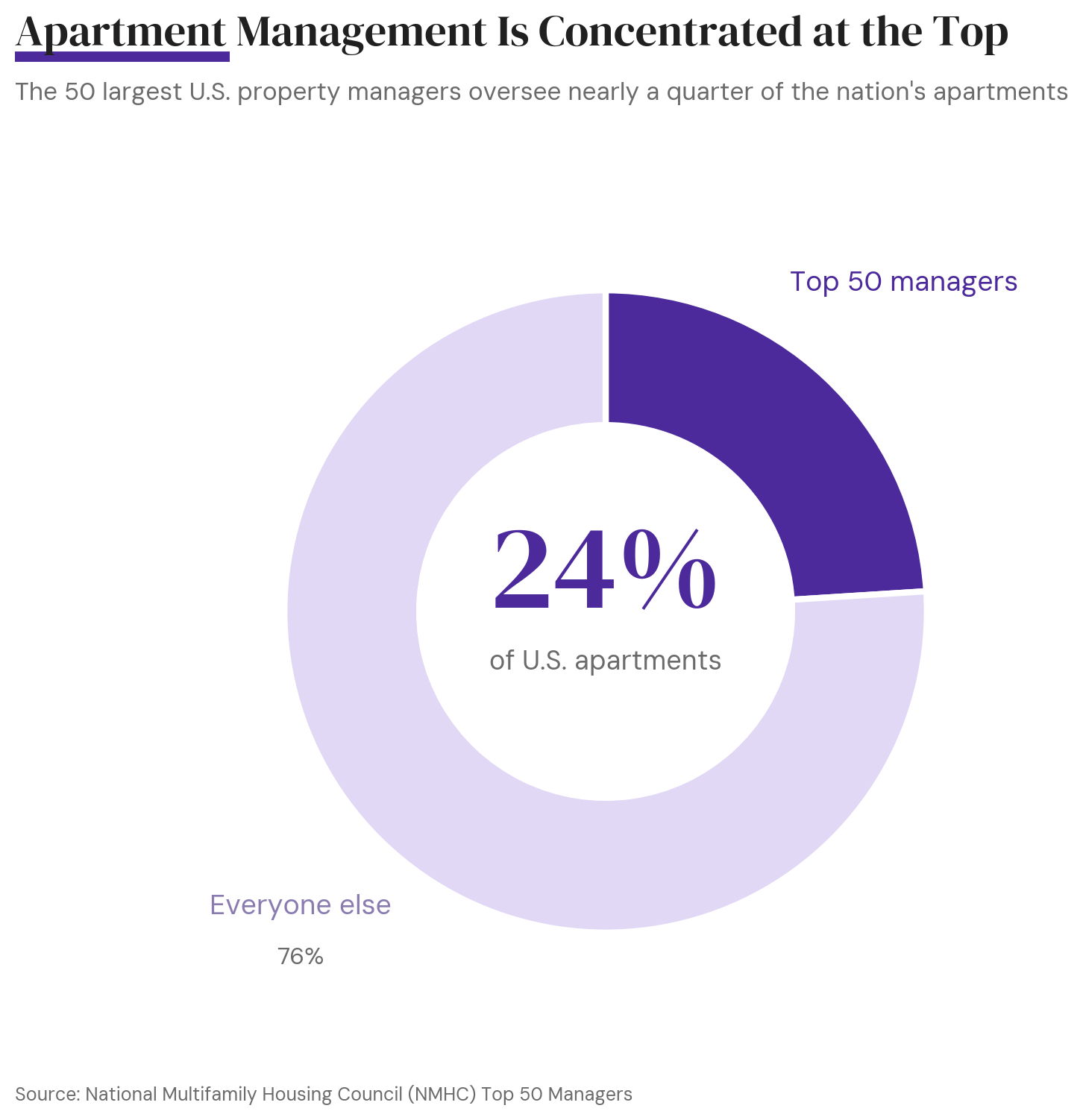
Large property management companies leasing up. The top NMHC 50 property management companies oversee 24 percent of the nation's apartments. They could pilot AI operations on a building preparing for lease-up without displacing existing staff, by hiring fewer people for a new property rather than replacing anyone on an existing one. The switching cost and cultural friction that kills adoption with small operators is less of a factor when the AI is not laying anyone off. Pursuing this path requires three things:
Most AI property management systems respond to issues as isolated incidents. A toilet overflowing in unit 304 and water dripping from the ceiling in unit 204 an hour earlier are almost certainly connected, but a system responding to each in isolation will dispatch two separate service calls instead of one. As maintenance history grows, so does this web of connections, turning into proactive insights across the portfolio.
Tech-enabled property management services. The more interesting path, and the one worth betting on, is to build the AI and run it as an internal operating system while managing properties directly. This removes the accountability asymmetry entirely. There is no software vendor to blame, because the operator is the software company. When something goes wrong, the same company that built the system owns the resident relationship, the P&L, and the engineering required to fix it.
Traditional management companies charge 8 to 12 percent of monthly rent on smaller residential and 4 to 7 percent on larger multifamily. A vertically integrated operator keeps the full fee rather than capturing a per-unit SaaS subscription. A traditional manager handles roughly 100 units with a support team; AI-forward operators are already running 50 to 200 per employee.
AI changes the cost side of property management in a way that a SaaS vendor cannot fully capture. An integrated operator captures those savings directly and keeps all the data inside one company, using every resident interaction, every maintenance ticket, and every edge case to deepen the system's understanding of its buildings and residents. A SaaS vendor with a fragmented customer base cannot replicate that context.
The vertically integrated model dissolves two of the three structural problems outright: the wedge problem resolves itself because revenue is the management fee, and the accountability asymmetry disappears because the software vendor and the operator are the same company. Founder credibility does not go away. If anything it matters more here, because building owners are handing over an actual asset rather than signing a software contract. A founding team that pairs a technical builder with an experienced operator is well-suited to this model.
In-house for small and mid-size operators. Today's frontier models are capable enough that a dedicated manager or owner could configure a system handling the majority of routine resident communication and maintenance triage. These systems will not be perfectly accurate, and that is the wrong standard to hold them to. Every decision should be logged with the evidence it weighed, the policy it applied, and the reasoning in between. Irreversible actions should not be taken unless that log is reviewed and approved.
Anyone evaluating a company in this category, whether as a founder or an investor, should ask three things: whether accountability sits with the right party, whether the founders have the credibility to open the right doors, and whether solving the problem has a direct and immediate impact on revenue. If the answer to any of those is no, the structural problems we ran into at Atria are likely to resurface.
The founder credibility problem is one I took seriously the second time. I am now building Juno, a development advisory firm for multifamily developers specializing in mass timber and industrialized construction. My co-founders bring decades of combined experience in development and construction.
We did not set out to build an AI property management company. We set out to help an exterminator. The market was always the hard part.

New data from Tailorbird shows why two-thirds of real estate operators blow their capex budgets and where AI could actually help

How a computer vision startup became America’s largest parking operator and a test case for a new model of venture-backed growth

Realpage is betting that decades of accumulated data can become an AI-era advantage

We've been building AI acquisitions agents with real estate GPs. On August 13, we're opening the hood in a live 2-hour workshop

Covering the future of real estate and the people creating it