
A4 & the Flight to Collateral
Small-balance residential bridge loans are a bright spot for private credit
Small-balance residential bridge loans are a bright spot for private credit

K-12 enrollment is falling rapidly. As cities grapple with school closures and property tax revolts, what does this mean for real estate?

A city built around cars and entertainment could be remade over the next decade by forces now transforming both

Small-balance residential bridge loans are a bright spot for private credit

Thesis Driven is doing a live interview with the A4 team next Thursday, 10/8 at noon ET. Request to join. Have immediate thoughts or questions on A4? Join the conversation on today's LinkedIn post.
In 2025, a subprime auto lender and an auto parts supplier filed for bankruptcy within weeks of each other. Neither was large for a $1.7 trillion private credit market. But both had borrowed against their own projected earnings, and when earnings disappeared, there was nothing left to recover.
What followed was private credit's first real stress test. On JPMorgan's Q3 2025 earnings call, CEO Jamie Dimon said, "I probably shouldn't say this, but when you see one cockroach, there are probably more." Funds slowed or gated redemptions, non-traded BDCs traded at discounts to NAV, and family offices discovered that quarterly liquidity depended mostly on whether a manager was willing to honor the withdrawal requests.
The key lesson most allocators took from this stress test was to ask: "What is behind this loan, and can I get to it?"
That has a clear answer in residential real estate. A first mortgage on a house in a liquid market has an observable price, a deep buyer pool, a proven foreclosure path, and a personal guarantee. Unlike a seven-year corporate loan, a residential bridge loan pays off in about a year, so lenders can recover the basis quickly through a property sale or a long-term refinance.
Traditional banks, meanwhile, have pulled back. Their share of non-agency CRE originations fell from 43% to 24% in two years. Residential transition lending (RTL) filled the gap, originating over $60 billion in 2025, $25 billion in ground-up construction and $35 billion in rehab, financing the small builders who produce U.S. housing supply.
Almost none of that capital reaches the smallest deals. Sub-$6 million loans are too small for aggregators needing homogeneous pools, too idiosyncratic for banks with unscalable underwriting costs, and too slow for high-volume brokers. This is the market’s blind spot, where a lender gets paid for judgment instead of duration or leverage risk.
A4 Capital Partners is that lender. A4 is the credit arm of Atlas Real Estate Partners, a $1.8 billion firm founded in 2009 that has built a portfolio of 10,000 apartments across more than 50 deals.
A4 originates, underwrites, and services first-lien bridge and construction loans under $6 million on single-family, small multifamily, build-to-rent, and fix-and-flip collateral across the Northeast and select Southeast markets, held on its balance sheet at sub-70% LTV, with personal guarantees, on 6-to-24-month terms. The firm is now raising a $150 million fund to scale the strategy.
In this deep dive, we'll break down:
Over the past 24 months, private credit damage has concentrated in direct corporate lending. When financing an operating company, security relies on earnings, PE owner support, and open refinancing markets, none of which are physical assets.
Recovering against real estate is fundamentally different. If earnings fall short, the lender's claim is against a business whose value is itself an opinion. Getting repaid becomes a negotiation among creditors instead of a sale. How much comes back depends on the loan documents, lender leverage, and on whether credit markets are open when the workout lands. Recovering against a house is a different exercise entirely.
"Yield is the easiest number in a deck to compare and the least useful one when considering credit strategies," says Nick Marcello, A4’s head of finance and previously CFO of Sachem Capital. "Two funds can print the same coupon and be in completely different businesses. What matters is what a lender actually owns on the day the borrower stops paying."
Global private credit assets under management (AUM) has reached $1.7 trillion, driven by retail wrappers like interval funds and non-traded business development companies (BDCs). These introduced liquidity mismatches and valuation ambiguity.
Capital has been rotating, not retreating, moving down the risk spectrum toward senior-secured, hard-collateral, short-duration strategies, and allocators who previously asked about yield now ask about lien position, advance rate, and maturity. "The family offices we talk to are not trying to own less credit," says Arvind Chary, Atlas co-founder and Managing Partner. "They are trying to own credit where they can describe the collateral in one sentence."
Not all private credit is the same asset class, and when something breaks, the structure is more important than coupon in determining what comes back.
RTL demand rests on two facts: the U.S. is short 4 to 5 million homes, and 40% of housing stock predates 1980.
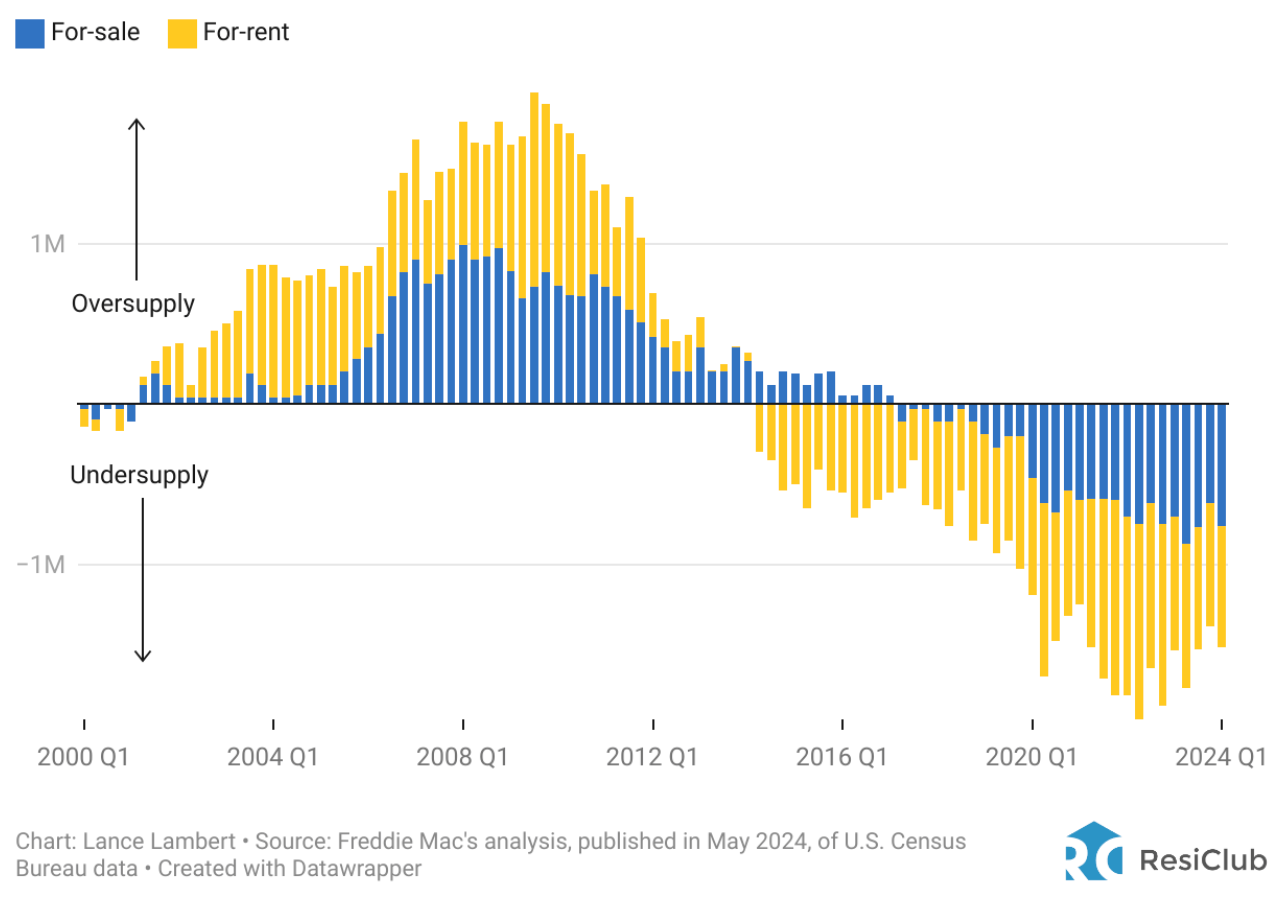
Renovation and infill construction require fast, flexible capital. While institutional capital has flooded large RTL securitizations ($140 million to $260 million deals), loans under $6 million remain ignored because they're too varied to standardize and too small to spread fixed underwriting costs across.
At the top of the market, the supply of that capital has already been institutionalized. Rated RTL securitizations began in 2024 as insurers, mortgage REITs, and private equity all entered the space. Firms like Castlelake and Fidelis have priced deals in the $140 million to $260 million range. Scale capital wants scale collateral: homogeneous loans, standardized documents, and predictable exits.
"Everybody wants to be in residential credit right now, and almost nobody wants to do the work on a $2 million loan in Westport," says Chary. "That’s the reason the pricing holds."
Borrowers face a fragmented broker and lender market with slow closings and re-trades. "We regularly hear from our borrowers that other lenders changed the numbers on them a week before closing," says Alex Foster, Atlas co-founder and Managing Partner. "A sponsor with a hard contract date will pay more for a lender who does not do that and provides stability. They will pay it every time."
Closing that gap takes a lender that combines institutional underwriting with community-bank speed, commits its own balance sheet, services what it originates, and stays committed as a partner on the next deal.
A4 writes fixed-rate, interest-only (IO) first-lien loans ($500,000 to $6 million) on 6-to-24-month terms, priced at 8.5%–10.5% with 1%–2% origination fees. Underwriting caps LTV at sub-70% and LTC at sub-85%, requiring full personal guarantees, FICO scores above 650, proven track record, and verified liquidity.
Each of these terms and credit standards protects the investor. First lien puts A4 ahead of everyone on a particular asset; sub-70% LTV means sponsor cash absorbs the first loss before a dollar of principal is at risk; and the personal guarantee extends recourse past the property and into the borrower's balance sheet. "We are not trying to be clever about credit," says Chary. "We want a real asset, a sponsor who has done this before, and enough of their money in front of ours that they cannot walk away."
Term duration is critical to the strategy, as a 12-month book constantly re-underwrites at current market values and rates. "The book turns over every year," says Marcello. "There is no 2021 vintage sitting in here waiting to be explained."
A4 focuses on suburban Northeast and select Southeast markets with deep resale liquidity.
By investing through a REIT subsidiary, the fund shields its investors from heavy taxes. This structure passes a 20% deduction to taxable investors, blocks complex tax penalties for IRAs and endowments, and protects foreign investors from U.S. tax exposure.
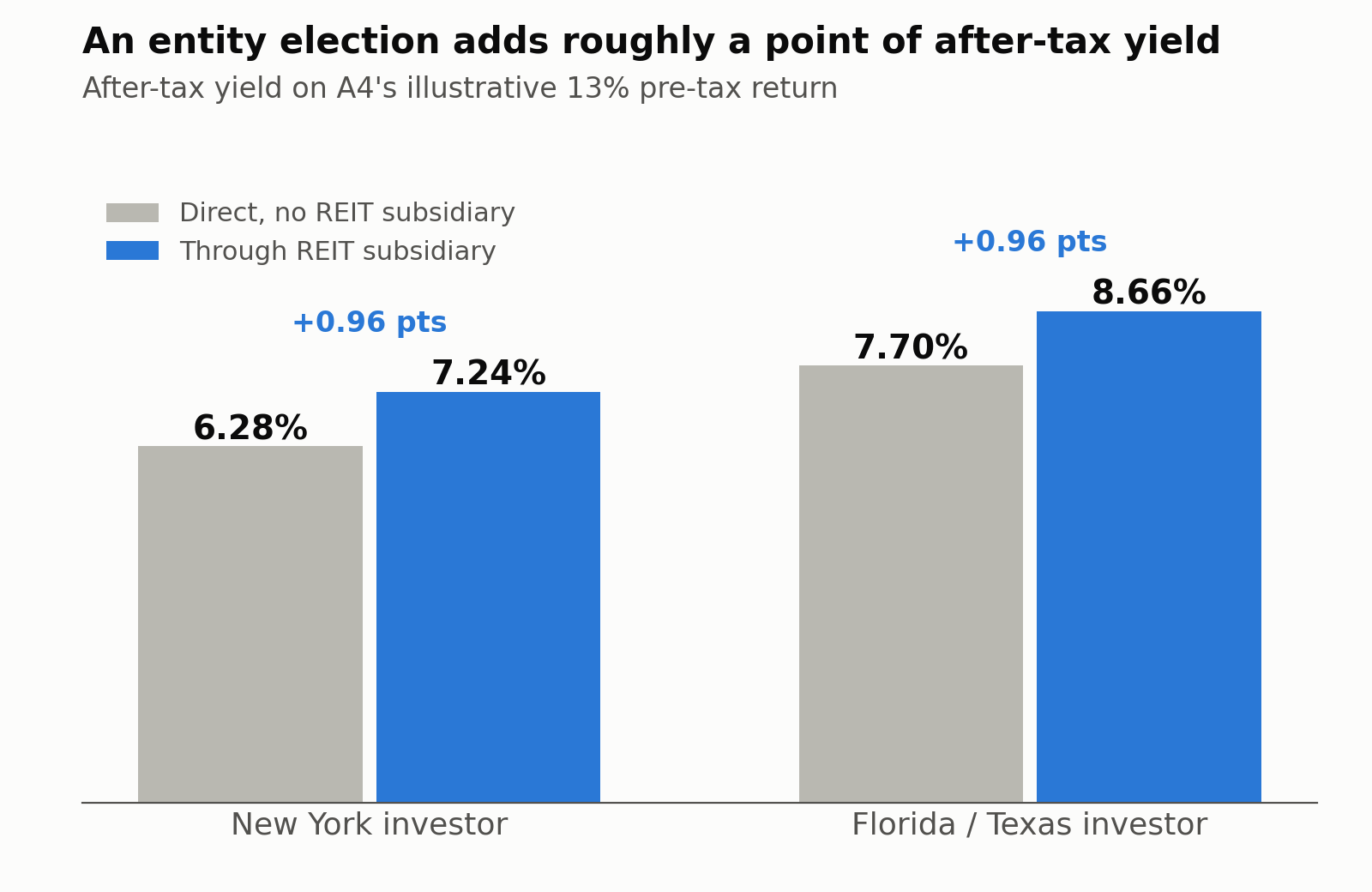
The math is simple: it boosts a New York investor’s net yield from 6.3% to 7.2%, and a tax-free state investor (like Texas or Florida) from 7.7% to 8.7%. That is roughly a full point of extra yield created entirely by smart structuring, not by taking on more risk.
Founders Alex Foster and Arvind Chary have spent a decade and a half building Atlas, overseeing $1.8 billion in real estate transactions. Rounding out the leadership team are CFO Nick Marcello and COO Ben Weber, who was recruited from EY's M&A division to oversee operations.
Succeeding in this niche lending market requires direct operator experience to vet deals, from evaluating general contractor schedules and draw requests to scrutinizing construction budgets and finishes. “I’ve sat on the other side of the table preparing these draw requests, so I know where assumptions can get aggressive,” says Foster. “That experience helps us know exactly what to look for when one comes across our desk.”
A4 leverages the extensive regional network of its parent company for its pipeline. The firm generates roughly $200 million in monthly deal flow, of which an active $44 million across 18 deals is currently in underwriting.
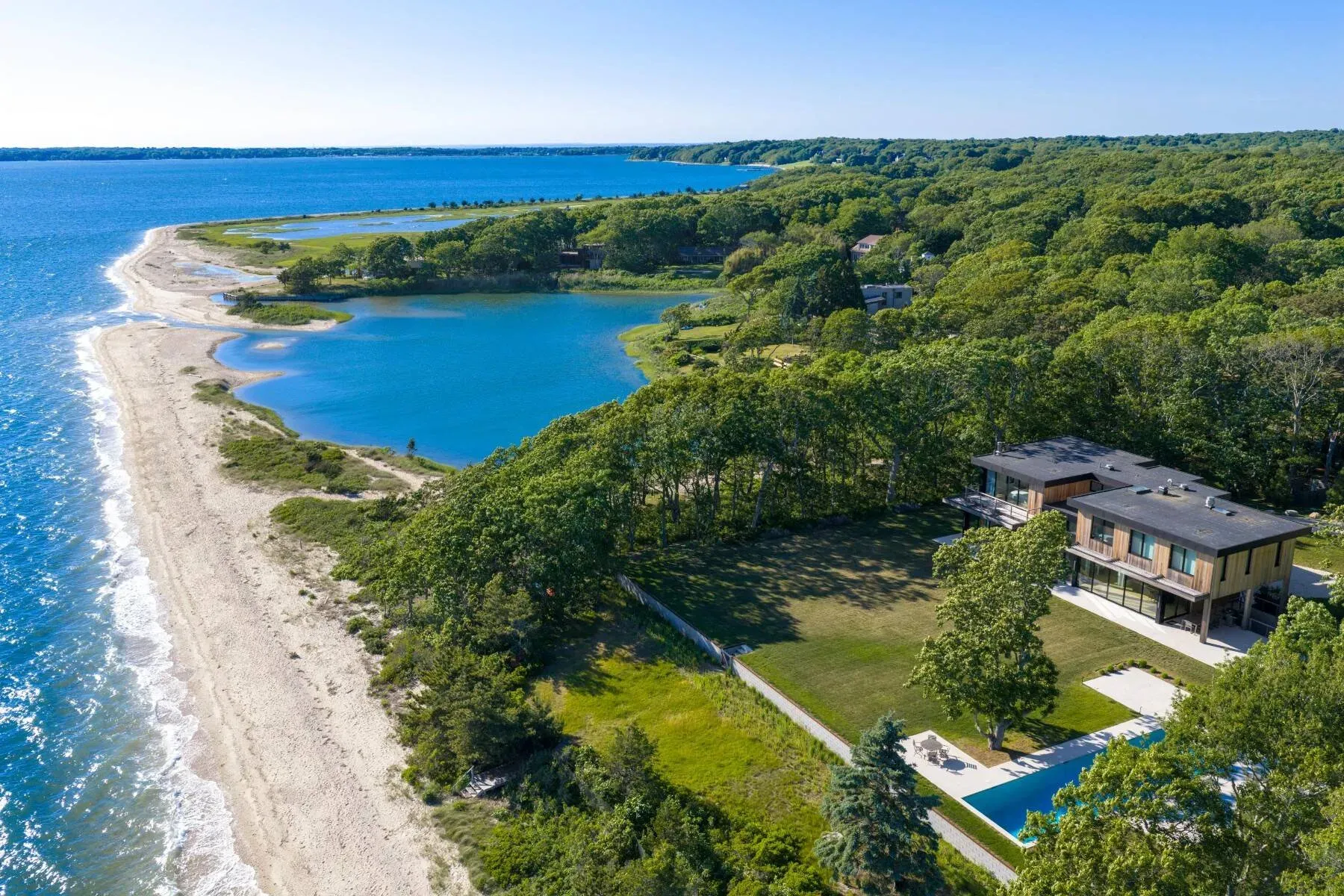
Two recent deals illustrate the strategy:
These are not outliers. Across its first five originations, the platform has deployed $9.9 million at coupons up to 10.25%, maintaining a 58% average LTV.
Atlas's in-house construction management allows A4 to complete and sell stalled projects directly rather than selling non-performing paper at a discount. "We can pick up the hammer with our in-house asset management and construction management capabilities," notes Foster. "In a bad year that is a key difference."
Residential transition lending went from local balance sheets to rated securitizations in roughly a decade, and the segment above $6 million is already compressing as institutional capital arrives. The small-balance lending sector holds its spread by staying small and idiosyncratic enough to repel capital from these bigger players.
Scaling requires disciplined underwriting against abundant deal flow. "The failure mode in this business is not running out of deals," says Chary. "It is getting loose because you have money you have to place. The plan for the next two years is mostly a plan for saying 'no.'"
For private wealth, A4's $150 million fund offers monthly income backed by hard real estate assets. The fund includes an 8% pref, 20% promote (after 50% GP catch up), 1.5% management fee, and 3% GP co-investment. Distributions are targeted monthly starting October 2026, with quarterly redemptions following an 18-month lockup, enabled by short underlying loan maturities.
While A4 itself is a new credit strategy, it leverages Atlas's 15-year execution track record. As Foster puts it: "We are asking them to look at what we have done for fifteen years. And at what the loan documents say."
Private credit's next chapter is being written in asset-backed finance, where recovery depends on a thing rather than a forecast. A house on Shelter Island is a thing.
Covering the future of real estate and the people creating it