
When Housing Disappears Because It’s Too Cheap
In struggling urban markets, the path to preserving affordable apartments may begin with creating more expensive ones
In struggling urban markets, the path to preserving affordable apartments may begin with creating more expensive ones
Office demand is recovering, but speculative development in most markets remains stubbornly out of reach

In struggling urban markets, the path to preserving affordable apartments may begin with creating more expensive ones

Today's letter was written by Robby Mulcahy, the founder of McAuley Hall, a development firm focused on adaptive reuse of historic buildings in Central Baltimore neighborhoods.
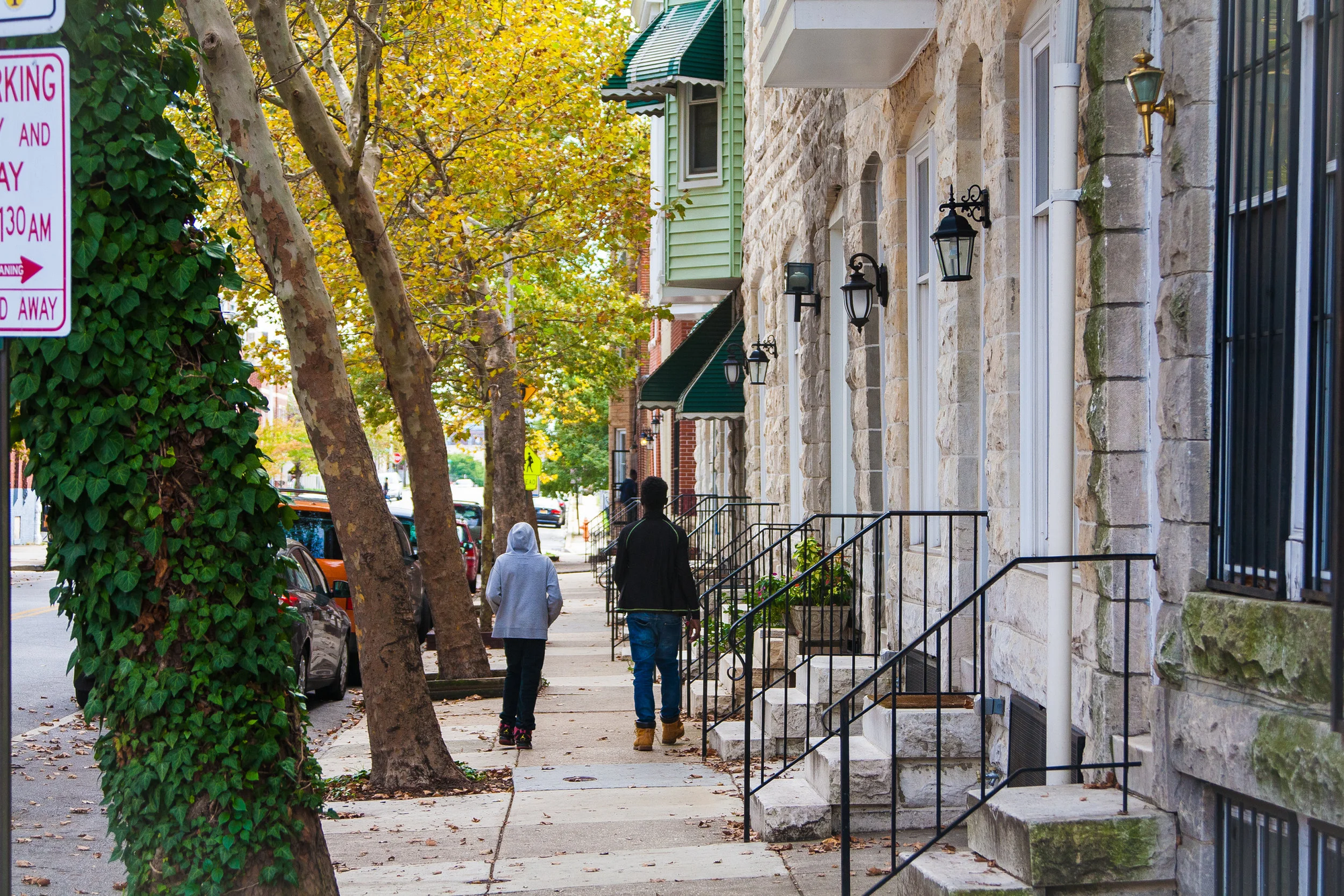
There’s an overlooked corner in Central Baltimore that I visit often. The neighborhood is called Old Goucher, and people spend money there in every direction. Within a few blocks there’s a natural wine bar with an outdoor beer garden, a basement café where the baristas know their regulars by name, and a James Beard finalist restaurant where the line usually runs out the door.
At the central corner of this neighborhood sits a beautiful nineteenth-century five-story Romanesque Revival building, originally built as a dormitory for the all-women’s college from which the neighborhood takes its name. Any developer could see it would make a perfect multifamily apartment building. And yet, it sits vacant. The consensus is that this neighborhood is simply a weak housing market: rents are too low to support new development or adaptive reuse.
And so in this neighborhood, and many others in Baltimore, nothing new gets built, and the existing housing stock is at risk of neglect or outright abandonment. It’s plainly a market failure, given there’s demonstrable demand — people pay to be in this place, every night. But it’s more than just a missed opportunity: it’s an affordability issue. Here, the problem isn’t that housing costs too much. It’s that housing has become too cheap to survive.
This letter argues that what looks like a weak market is often a pricing failure, that the failure ends up destroying existing housing stock, and that the counterintuitive fix may actually be to place an expensive building in the market.
We’ll discuss:
The economics profession largely agrees on what happens when rents are held below what a building's economics require. Stanford's Rebecca Diamond and coauthors showed it in San Francisco: after a rent-control expansion, landlords removed units from the rental market rather than operate them at capped returns. George Sternlieb documented the end state decades earlier in New York and Newark: when a building's income cannot cover its upkeep, the owner defers maintenance, then stops paying taxes, then walks away. Policy meant to make housing more affordable ends up destroying it instead.
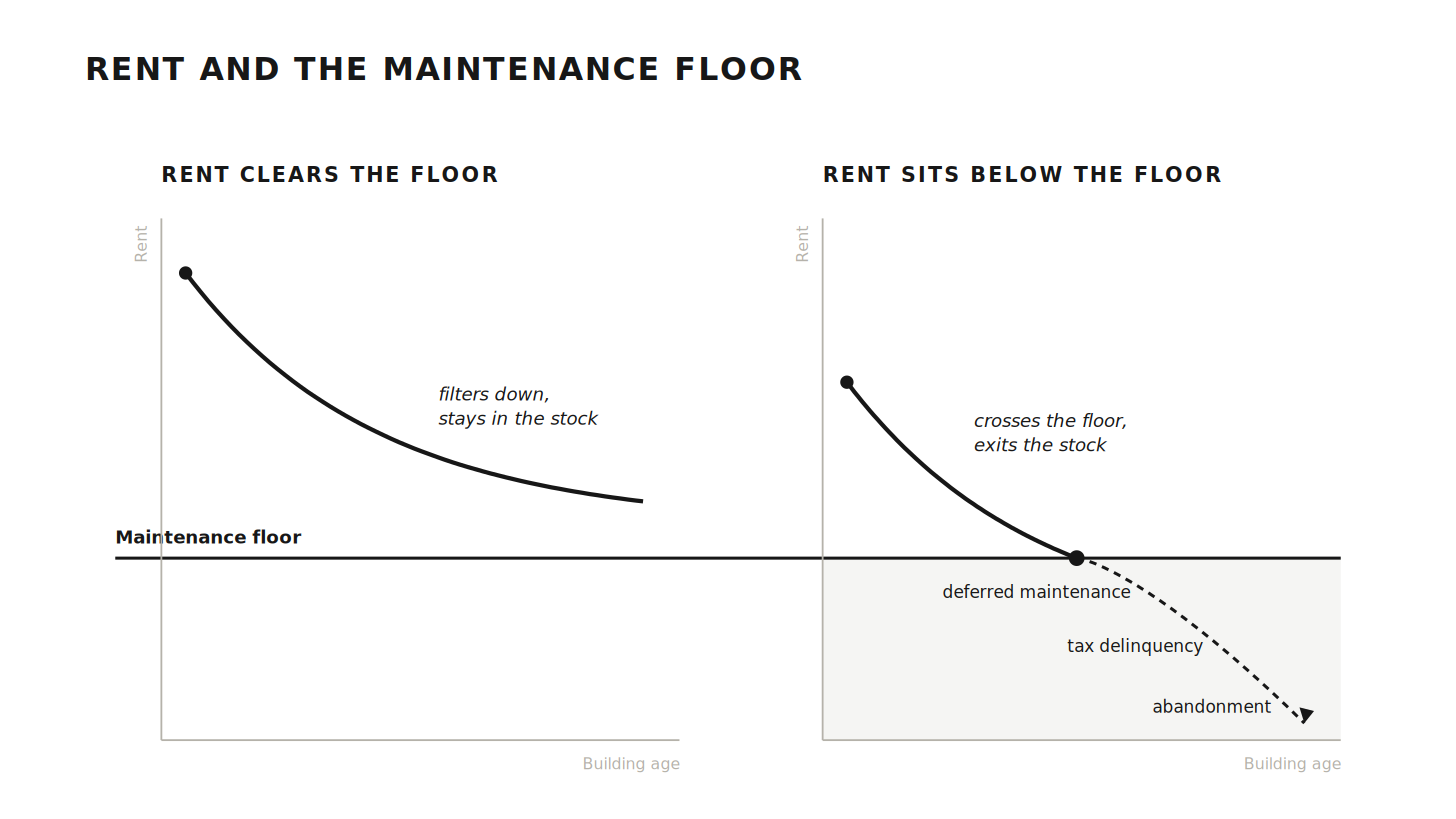
This dynamic can play out even in submarkets without statutory intervention, and Baltimore is a clear example. In parts of the city, the market rent a building can command sits below what it costs to keep the building habitable, what many call a maintenance floor. These costs include insurance, property taxes, code compliance, general upkeep. If rents don’t make the building worth maintaining, the building loses money simply by existing. The owner's decision framework then becomes nearly identical to that of the rent-controlled landlord in cities like San Francisco, New York, or Newark, and the result is the same. Baltimore's roughly twelve thousand vacant buildings are the physical manifestation of this effect.
The obvious culprit here would seem to be weak demand: nobody wants to live in these neighborhoods at prices that sustain the buildings. In some Baltimore submarkets that is certainly true. But in others the answer fails a simple observational test. The restaurants and bars around that Central Baltimore building in Old Goucher sell fifteen-dollar cocktails to packed rooms. Hospitality operators keep opening in the neighborhood at price points that require exactly the customer the housing data says does not exist. It’s like the classic urban doom loop in reverse.
Rather than commercial values collapsing while housing holds, here the commercial layer thrives while the housing layer dies.
So if the demand is real, why doesn’t it support new development, and why isn't it bidding up the existing housing stock? The answer: bidding wars require scarcity. Evan Mast and coauthors, in one of the canonical supply-side housing arguments, showed that when construction is blocked in high-demand cities, high-income households outbid everyone else for whatever already exists because they have no alternative.
Baltimore is the opposite: alternatives are everywhere. A renter with the income and the desire to live in Old Goucher doesn’t bid up a tired apartment with a forty-year-old kitchen. They rent a renovated unit in a nearby neighborhood and drive over on a Friday. In a scarce market, unmet demand bids up prices; in Baltimore, it just leaves for the next neighborhood over.
What’s more, housing tiers compete within themselves. A 2022 study of New York housing by Xiaodi Li found that new towers moved prices only for close substitutes, not for unrelated housing types. That implies that rents of an existing tier of housing may not in fact be a strong measure of demand for a tier of housing that doesn’t yet exist in the submarket. The problem may be a shortage of the right product, not a lack of demand.
If the demand is real and the mispricing is visible, classic economic theory says the market should have arbitraged it already. But that opportunity can be tough to see. Real estate capital prices risk off comparables, and appraisers can only draw comps from deals that have actually closed. That means only the existing tier of housing gets priced. The tier people might actually want, the one that doesn't exist yet, can't be priced at all, because there's no way to measure demand for something that hasn't been built. A submarket where that missing tier has never traded can sit on years of accumulated demand that quietly leaks out to nearby neighborhoods.
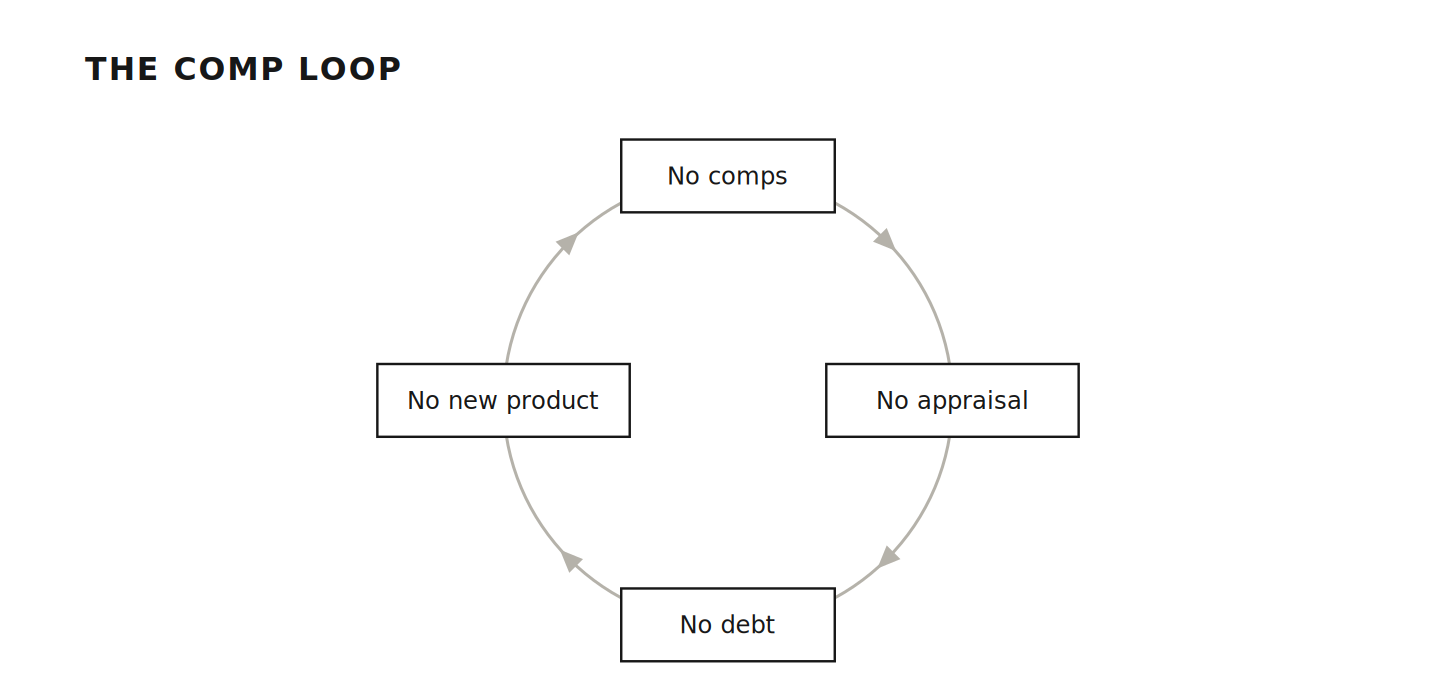
This has downstream effects on financing and therefore new product development: without an appraisal, lenders can’t underwrite; without debt, nothing gets built; without new product, no new comps get created. The market reads the absence of proof as proof of absence. And three frictions keep this cycle going.
The standard case for market-rate housing is filtering: build expensive new units, and wealthier households vacate cheaper ones, sending relief down through the lower tiers. That logic holds where scarcity is real. But Baltimore isn't scarce, it's abundant, and there the same expensive building does something different: it keeps the housing stock around it from disappearing. In a submarket like Old Goucher, one good market-rate building captures demand that's been leaking to other neighborhoods, creates the first comp lenders and appraisers can actually use, and sets a valuation floor that decides whether the buildings next door get maintained or abandoned.
Here's the awkward part. Researchers studying new construction in Minneapolis found that low-priced rentals near new buildings saw rents rise roughly 4.4 percent higher than comparable units in the five years after construction. Supply-side advocates usually read that as gentrification, and in a hot market, they might be right. But where existing rents sit below the maintenance floor, it means something else: new construction is keeping buildings from falling out of the housing stock entirely. It raises the floor under everything nearby, and buildings that couldn't survive on their own start to.
This matters because when an old building is lost, whether torn down or abandoned, it takes something with it that can't be replaced: housing cheaper than anything built today. A skeptic might say let it fall away and wait for scarcity to return, but Baltimore has run that experiment for fifty years, and the market still hasn't rebalanced. Vacancy only makes it worse: it degrades the blocks around it, so demand falls as supply disappears, and whatever eventually replaces the old stock has to clear today's construction costs. That's why preserving what's already standing is the real affordable housing strategy.
This isn't just a Baltimore story. The same pattern shows up in Cleveland, St. Louis, Buffalo, Rochester, Detroit outside its downtown, and plenty of other legacy American cities.
Test it yourself: compare apartment rents to what operators pay for retail space, how many bars and restaurants have opened recently, or how full the sidewalks are on a weeknight. Most of the time, the comparison tells one story: strong demand on both sides. But sometimes the picture splits. The neighborhood's stores and restaurants act like people are desperate to be there, while its housing acts like nobody wants to live there at all. Money is already being spent there, just not in rent. Appraisals only look backward, so housing data can take years to catch up to demand the neighborhood's storefronts have already proven.
The policy implication is simple: subsidy needs a broader definition of what counts as affordability spending. Here, a subsidy that funds one market-rate building buys something bigger than that building. It buys the first comp, the single data point that makes an entire submarket legible to private capital and props up the value of every building nearby.
That value doesn't stop at the deal; it spreads to every neighboring owner whose building becomes worth maintaining again. Aziz Sunderji, founder of Home Economics, a housing research publication, agrees: "This seems like the type of initiative that should garner subsidy — it has massive positive externalities."
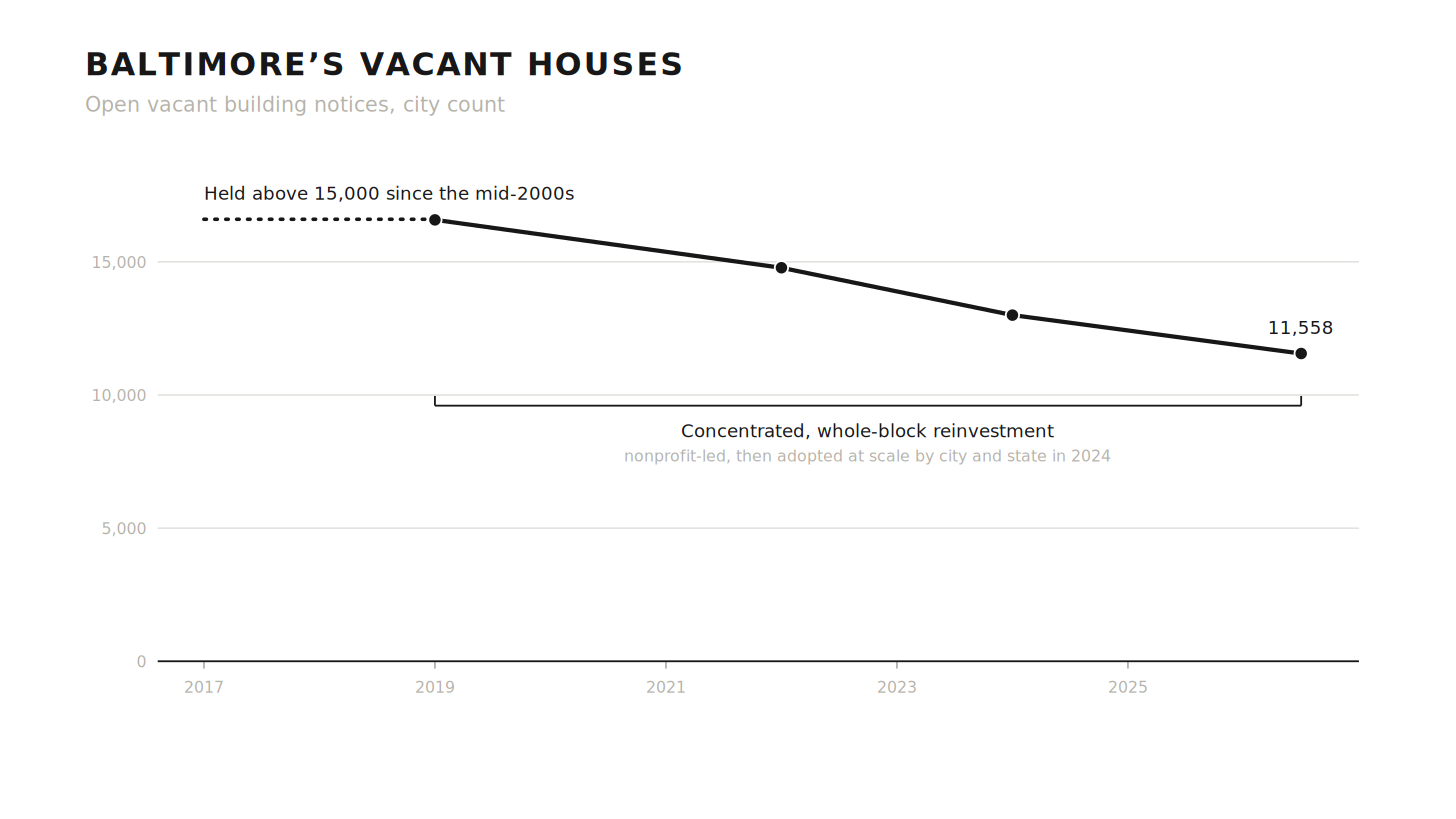
Baltimore's vacant houses sat near sixteen thousand for decades. As of this past August, according to the Wall Street Journal, that number has fallen below twelve thousand under a single mayoral administration. Some homes that couldn't be given away a few years ago are now drawing bidding wars. Nonprofit developers stopped scattering rehab dollars house by house and started renovating whole blocks at once, delivering finished homes in clusters instead of one-offs. In Johnston Square, where vacancy has fallen by roughly half, the median home sold to an owner-occupant hit $280,000 in 2025, up from $160,000 four years earlier.
Homes didn't get cheaper. They got more expensive, and vacancy fell anyway. These are subsidized homeownership rehabs, not market-rate rentals, but the logic holds: put good product on the ground in concentration, and the market becomes real enough for private money to follow.
Comps are one lever, lowering the maintenance floor is the other. If buildings cost less to maintain, more of the housing stock survives weak markets long enough for the broader economy to eventually pull rents back up on its own. That could mean insurance reform, property tax relief, or lighter compliance costs. In Baltimore, property taxes are the obvious target: the city's rate runs roughly double the surrounding counties’, making it the single biggest lever the city actually controls.
An honest strategy pulls both levers. Lowering the maintenance floor buys buildings time. Creating a comp does something different: it resets what the buildings nearby are worth and gives capital a reason to show up.
Federal policy is largely organized around the premise that housing creation is almost entirely a cost issue. It's also a preservation issue. Housing in places like Baltimore is disappearing because the market has gotten too cheap, too cheap even to justify keeping some units in the stock at all. Meanwhile the Old Goucher building that would make a perfect multifamily conversion still sits empty at the center of a neighborhood that fills its restaurants every night. Where observable demand exists, new market-rate housing isn't a threat to affordability. It's the thing that maintains it.

The U.S. modular construction industry has struggled for decades without a large-scale institutional buyer. The Department of Defense may be changing that.


Tracking the past three months of notable land use and zoning decisions with Shovels Decisions


How Angeleno is structuring deals and executing projects in a market where affordable housing is notoriously difficult to build


Tracking the past three months of notable land use and zoning decisions

Covering the future of real estate and the people creating it