
When Will Spec Office Get Built Again?
Office demand is recovering, but speculative development in most markets remains stubbornly out of reach
Office demand is recovering, but speculative development in most markets remains stubbornly out of reach

New data from Tailorbird shows why two-thirds of real estate operators blow their capex budgets and where AI could actually help
Diagnosing what ails California's multifamily sector

No state has passed more pro-housing legislation over the past decade than California. From streamlining multifamily entitlements to legalizing lot splits to enabling conversions of commercial assets, the state has passed rafts of legislation aimed at unblocking housing development. And the state doesn't appear to be stopping soon, with recent laws removing environmental review barriers for housing and upzoning near transit.
Yet California housing permit velocity – for both single and multi-family development – has continued to sag. While interest rates and development costs have surely played a role in keeping construction subdued, the lack of market response to the state's broad-based reforms despite high rents and durable demand raise questions about the efficacy of those reforms.
Today's letter will explore the arc of California's journey to legalize housing through statewide legislation. We'll compare its approach to that of other states and look at California's appeal to the real estate capital markets through both a financial and cultural lens.
Since 2017, California has passed dozens of laws at the state level aiming to encourage housing production, particularly in California's most high-cost metro areas: Los Angeles, San Diego, and the San Francisco Bay Area. In general, these laws attempt to force municipalities to allow higher-density development, whether that's legalizing backyard units and duplexes within low-density zones or unlocking mid-rise development near transit.
California's development landscape is complicated by the fact that most metros are composed of many small cities, each of which has control of its own zoning. While New York City consolidates 8.5 million people and more than 300 square miles under one jurisdiction and zoning code, the San Francisco Bay Area has no fewer than 101 separate municipalities serving 7.65 million people.
This fragmentation creates a kind of tragedy of the commons when it comes to housing. While more housing benefits the metro area as a whole, the cost of new infrastructure falls on the specific city building that housing. Hyper-local governance also makes elected officials more vulnerable to hyper-local NIMBY populism. The end result is a prisoner's dilemma where every player defects every time, creating a devastating housing shortage that is driving people out of California. The state is projected to lose four electoral votes after the next census, so its cities' reluctance to build is having real political consequences.
The solution, in the view of housing advocates and key legislators, is to take housing decision-making out of the hands of municipalities through state pre-emption, essentially forcing cooperation.
I'm not going to get into the weeds of each California law that has been passed over the past decade, but a few notable examples include:
A litany of other legislation enabled conversions of commercial buildings, prohibited downzoning, introduced a permit "shot clock", and limited abuse of environmental review laws, among other things – a wish list of reforms that would, ostensibly, make building housing more appealing to California developers.
Unfortunately, the housing market has been wholly unresponsive. Counterfactuals are always hard – there's no way to know how many units would've been built without those reforms – but there is no question that multifamily development in California has been sluggish at best. Only 38,362 multifamily permits were issued in California in 2024, a decline of more than 24% from the prior year and below pre-pandemic norms. (By comparison, Dallas alone has seen almost 18,000 multifamily permits pulled over the past year despite having a fraction of California's population.)
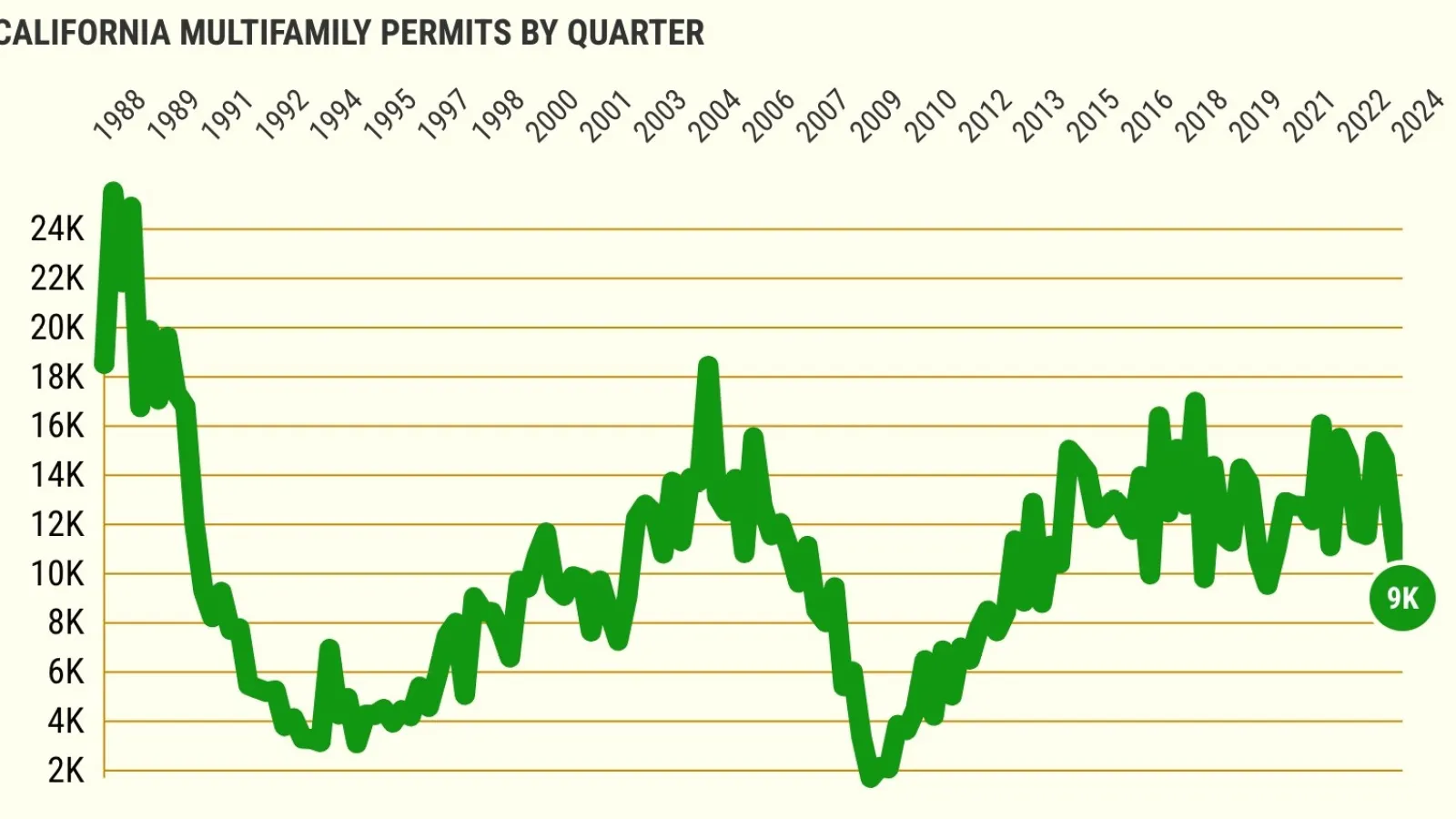
Earlier this year, a damning report from YIMBY Law – a housing advocacy organization – noted that the raft of state housing laws has had "limited to no impact" on the state's housing supply.
“You can think of housing policy as being an elaborate mesh forming a net," explained Laura Foote, Executive Director of YIMBY Action, a housing advocacy organization. "You can pull out threads, but there’s still a lot of remaining threads left in the net. But that doesn’t mean we should stop pulling the ropes.”
The YIMBY Law report points to continued intransigence from municipalities as one driver of the laws' ineffectiveness. “The default assumption is that cities are going to figure out some way to say no, and all that dampens the impact," said Foote. In many cases, cities must be sued into compliance with state law – a favorite activity of organizations like YIMBY Law but unappetizing to most developers who must work with local officials. Foote told Thesis Driven this past summer that she'd like to see more developers fight recalcitrant municipalities in court, but many developers see getting into a legal battle with their host cities as an unwise move. Cities, after all, have many creative ways of making a builder's life miserable – as we'll explore later on.
But YIMBY Law's report also highlighted one flaw in many of the state housing preemptions: costly mandates that make projects financially unworkable.
In California, legislative progress on housing has been driven by housing advocates in combination with organized labor and (at times) pro-tenant groups. From a political standpoint, this coalition has gathered enough heft to repeatedly pass legislation in the face of opposition from environmental organizations, cities, and other NIMBYs arguing in favor of local control.

As AI eliminates administrative burden and capital consolidates around scaled platforms, operational performance is becoming a primary driver of returns


A quarterly read on early-stage feasibility activity with our friends at TestFit


One founder's account of the structural reasons autonomous AI property management SaaS gets crushed, and what the right model actually looks like

Covering the future of real estate and the people creating it
