

DealNav: A Story of Modern Entrepreneurship
Patrick Carino couldn’t find the CRM he needed, so he built one. Then it became a company.

Plenty of Thesis Driven readers are real estate developers. Some are out on their own, some sit at a larger firm, and others do a little on the side.
While developers’ comfort with technology may vary — and they may regularly get frustrated with the tools available on the market—most would never think of going out and starting their own software company from scratch.
The same cannot be said for Patrick Carino, Vice President of Development at The NRP Group, one of the largest multifamily developers in the United States. Over the past two years, he has turned his homegrown pipeline management tool, DealNav, into a real business with hundreds of paying customers, all while keeping his day job as a real estate development professional. (DealNav is a separate venture and is not affiliated with The NRP Group.)
While it’s still a long way from making the Inc. 5000, DealNav offers a remarkable story — one that’s less about the product itself and more about the lessons it offers about building a business in an era where technology is ubiquitous, software costs are pushing toward zero, and social media reach is cheap for those willing to get creative.
Patrick’s Problem
Patrick Carino’s career in real estate acquisitions followed a fairly traditional path. Starting his career at CBRE, he was tasked with tracking properties in northern New Jersey. “We came up with a huge poster board of Jersey City on the wall behind our team with pins in it, and I tied them to entries in a binder,” he explained. “When I moved over to the principal side, I tracked deals in an Excel workbook, a row for each property with owner contact information.”
“I’d drive through neighborhoods looking for off-market multifamily opportunities, and everything would go in that book.”
Carino rose through the ranks of the real estate industry and eventually took a VP role at The NRP Group, a large multifamily developer operating in more than a dozen states nationwide. As his responsibilities grew, Carino desired something more scalable — and visual — than the traditional Excel workbook.
“At one point, we used Google My Maps to visualize deals, but an intern had to go in and update it,” he said. “After 13 years in the business, I finally decided to solve it for myself.”
At the beginning, Carino evaluated the deal CRM options already in the market, looking for a tool that was “simple, affordable, and map-based.” While he explored “12 to 15 tools,” none satisfied all three criteria. DealPath, for instance, had robust functionality, but he saw it as the “Rolls Royce” of deal management with a high price point and commensurate complexity.
Generalist tools such as Monday and Salesforce were affordable and flexible but not tailored to real estate. To that point, they would require customization to incorporate a map. And a third category of incumbents were “primarily parcel data tools with CRM as an afterthought.”
“Many CRMs are overwhelming and confusing to acquisitions folks—they have too many fields you have to enter before you get a deal in. Some CRMs make you enter 40 pieces of info before you press enter.”
So Carino took a very atypical step for a real estate professional: he decided to build it himself. He found a freelance software developer to build the tool to his specifications for less than what most real estate principals will spend taking their kids to the Caribbean for spring break.
In a few months, a beta version of the tool was ready. The early version of DealNav did exactly what Carino wanted and nothing more: collect and track deals and owner information and plot those deals on a color-coded map.
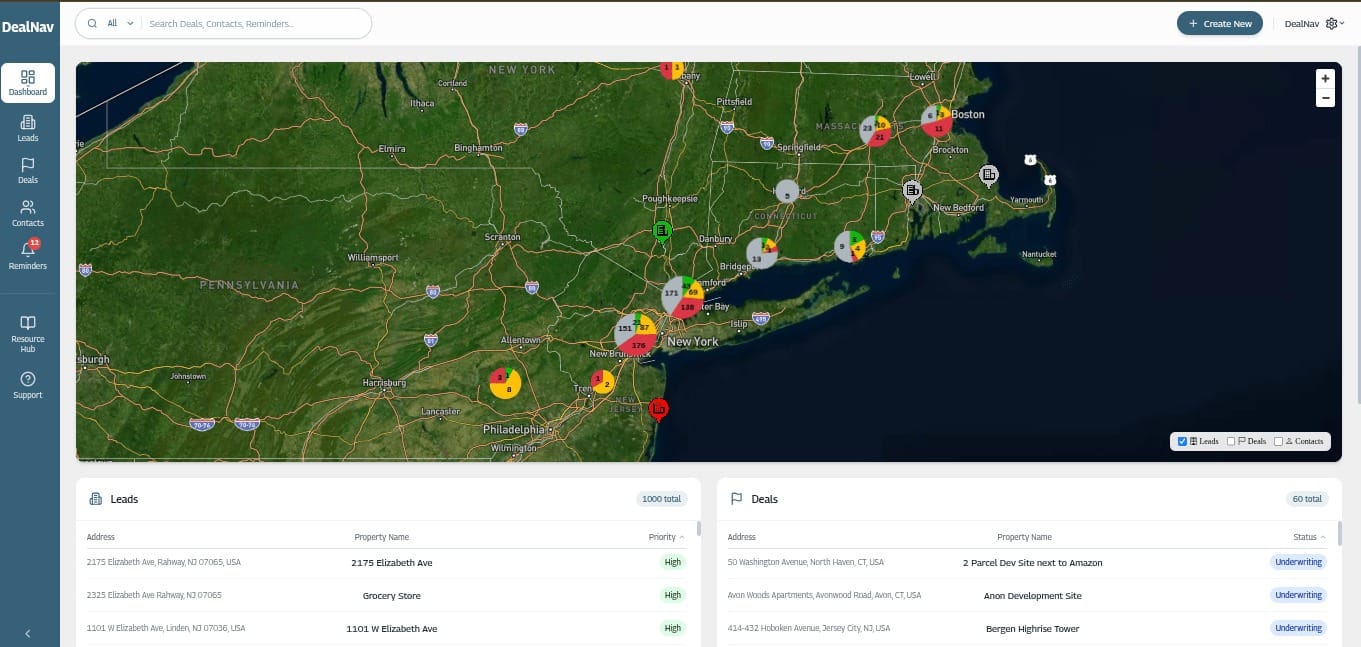
While the story could’ve stopped there—Carino was doing this to solve his own problem, after all — he had an advantage most vertical software builders don’t: he ran the pseudonymous X account @Acquisizioni, a popular account among the exact acquisitions and development professionals who needed what Carino had built.
And as it turned out, he wasn’t alone in his frustrations with the CRM market.
Social Pull
“I posted what I had built on my account,” explained Carino. “And strangers on the internet asked if they could get involved.”
Initially, DealNav’s homepage had nothing but a login. After a number of inbound messages on X from fellow developers expressing interest in the product, Carino decided to add another field that simply said, “Enter email for more information.”
“As soon as I added it, emails started coming in. That’s when I thought, ‘I might have something here.'”
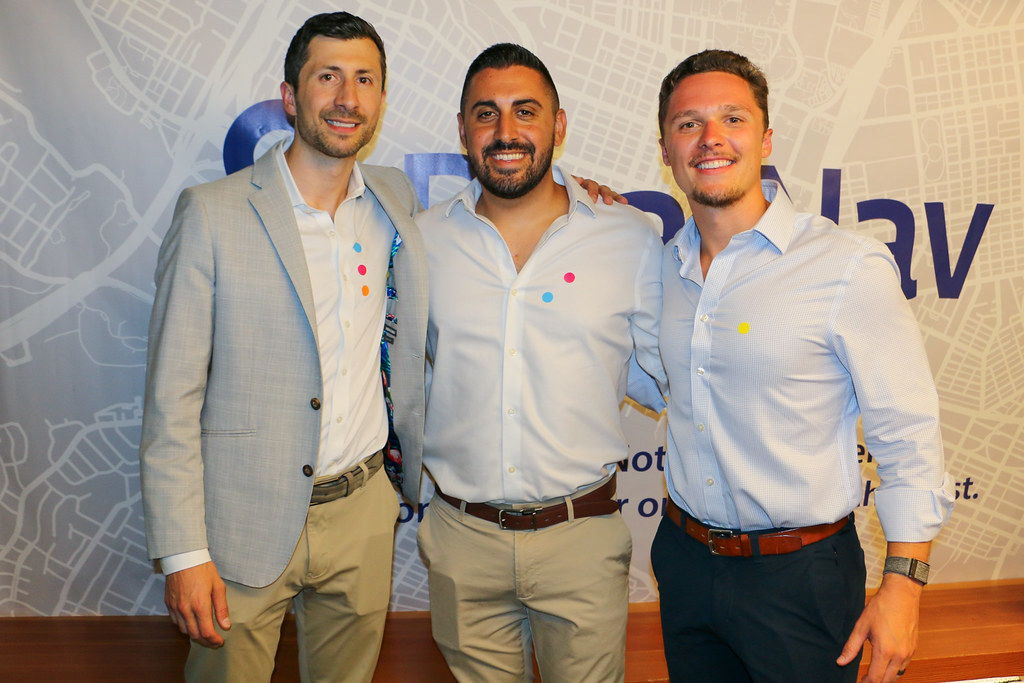
Facing sudden demand, Carino decided to bring on a partner to help handle the inbound — and adapt the product for users other than himself. Rather than quit his role at NRP (“I like my day job,” he explained), Carino handed off the day-to-day operations to Anthony Longo, a friend and real estate broker with proptech experience.
But with pricing still an open question, Carino made a point of joining demo calls wherever possible. “We spoke with one developer in the Northeast who said he paid $30,000 per year for a tool but only used the features we had on DealNav,” he noted. “That was our second ‘we have something here’ moment.”
DealNav’s growth strategy focused on repeating and scaling their early success on social, recruiting other influential X accounts—including @DallasAptGP (Barrett Linburg) and @twallyweb (Tanner Webster) — to talk up DealNav after becoming customers organically.
“90% of our users have come through Twitter,” Carino explains. While he hasn’t yet done any paid advertising, “[my] dad recently retired and has been sending cold LinkedIn DMs,” which has brought DealNav several new customers.
Carino acknowledges that some acquisitions professionals are using it in lieu of their firm-supplied CRM due to its simplicity and data portability. “Acquisitions folks want to own their relationships and deals, and they don’t want to lose those.”
Today, DealNav has several hundred paying customers. And while the product has grown, Carino has stayed true to his vision of a simple, no-frills platform. I began using DealNav myself the other day for some land development work, and the product is still little more than a stripped-down CRM with a map. That said, it only costs $50 per month, one to two orders of magnitude less than similar mission-critical software targeting the real estate industry.
But Carino has no venture investors, nor does he even need to pay himself a salary. Any cash that DealNav kicks off is, at some level, found money that they have been reinvesting back into the business.
The Lessons of DealNav
Although DealNav is useful in its simplicity, I’m mostly interested in the company’s story for what it has to say about modern entrepreneurship.
At no point did Carino need to quit his job at NRP. Conventional wisdom in the venture world mandates a burn-the-boats approach, demanding that entrepreneurs focus steadfastly on their startups to the exclusion of everything else. And that makes sense from the perspective of venture investors who have little desire to put capital behind a founder who isn’t fully committed to the company they’re backing.
But it’s increasingly unnecessary in a world where building software is cheap and distribution is more about creativity and trust than a fat marketing budget.
To that point, there was never a need for Carino to go get a pile of venture money in the first place. He built an MVP and landed his first paying customers with zero technical experience — using only screenshots he shared with a freelance developer. With AI coding tools like Claude Code and Cursor pushing costs down even further, the price of building simple software applications is asymptotically approaching zero.
And as the cost of software drops, the ingredients of success for vertical software businesses shift from engineering to product. In that environment, there’s a huge advantage to solving one’s own problem. The fact that Carino was a real estate acquisitions veteran solving a problem for himself and other real estate acquisitions veterans was key to building the right product without throwing feature spaghetti at the wall.
“The layout, the simplicity, and the terms inside the software are differentiators,” explains Carino. “It was built for me using the terms I use every day. The initial concept was just a map and a few categories — leads, deals, contacts, and reminders — but that’s how my brain works, and other people in the industry think the same way.”
Carino’s roots in the industry lent him an authenticity that many proptech founders lack. One can disagree with how DealNav works or believe it should have features X, Y, and Z, but it’s hard to argue that Carino didn’t understand the market he’s serving. This also pays dividends on the marketing side of the equation. People follow personalities, and Carino had cultivated a niche following among real estate professionals who saw him as an authentic voice who understood their problems. So while @Acquisizioni didn’t have a massive follower count, it had (a) the right people and (b) trust. And some of those followers had their own, larger followings, amplifying the impact.
The Path Forward
Despite the initial success, Carino still has no plans to raise venture dollars. As far as VC funding is concerned, DealNav’s relatively low cost would likely raise questions about the company’s market size: at the current price point, getting to $100 million in revenue would require nearly 170,000 customers—more than the total number of real estate developers in the United States. (That said, Carino was excited to point out that DealNav’s customer base is already expanding beyond the U.S., including into Canada and Australia.) This would put pressure on the company to add features and raise the price, throwing the entire product’s value proposition into question.
Carino sees his dual roles at NRP and DealNav as mutually beneficial. “I meet people through DealNav, which has expanded my network and provided deal flow for NRP. On the flip side, I meet brokers and acquisitions people during my day-to-day who are prospects for DealNav. It’s professionally useful in both directions.”
Carino encourages others in real estate firms to experiment with the entrepreneurial path — although some conditions apply. “I’ve always wanted to do something entrepreneurial in my life, so being able to pursue this has been really fun and interesting.”
“Especially with all the vibe coding now, there are ways to not spend a lot of money and see if it works. Don’t be the guy who spends $500K and the product isn’t even what the market needs.”
–Brad Hargreaves

Read next

Can AI Solve Capex Overruns?
New data from Tailorbird shows why two-thirds of real estate operators blow their capex budgets and where AI could actually help

Deep Dive: Metropolis
How a computer vision startup became America’s largest parking operator and a test case for a new model of venture-backed growth

Why Realpage Bought Cherre
Realpage is betting that decades of accumulated data can become an AI-era advantage

AI for Real Estate Acquisitions
We've been building AI acquisitions agents with real estate GPs. On August 13, we're opening the hood in a live 2-hour workshop