
When Will Spec Office Get Built Again?
Office demand is recovering, but speculative development in most markets remains stubbornly out of reach
Office demand is recovering, but speculative development in most markets remains stubbornly out of reach

New data from Tailorbird shows why two-thirds of real estate operators blow their capex budgets and where AI could actually help
A renewals point solution is becoming something far bigger, with broad implications for multifamily

You’d be forgiven for not noticing Renew, the latest AI-powered company to raise a pile of venture money to optimize part of the multifamily operating ecosystem. With a focus on streamlining resident renewals, Renew has nabbed ten of the top 50 multifamily operators as clients including Bozzuto and Kettler.
But I’m interested in Renew not for its impact on resident renewals – a big lever for NOI, no doubt – but for its growing impact on new resident acquisitions through a private marketplace model.
While AI has reworked much of the multifamily operating stack, marketing has remained relatively stagnant. Large ILS platforms – Apartments.com, Zillow, and perhaps 1-2 others depending on your market – have dominated the space and sucked up the majority of marketing dollars and resident leads. But the ILS model is beginning to show its cracks, with operators frustrated with their dependence on listing sites as well as a dramatic rise in application fraud.
Resident acquisition, in other words, is ripe for new answers. Today’s letter will explore the concept of a private rental marketplace model through a deep dive into Renew, a company that has quietly built such a marketplace now numbering over 500,000 units.
The past decade has seen a proliferation of technology companies tackling specific aspects of the multifamily operations. From Vero and Snappt in screening to EliseAI in resident communications to Livly in experience and amenities, almost every step of the renter journey now has a few — or dozens — of software companies aiming to streamline processes and improve the renter experience.
Resident renewals is no exception. As marketing and turnover costs have grown – and application fraud is an increasingly large threat – retaining the residents already living in a building has become more important. This has driven multifamily operators to apply the same technical sophistication and data intelligence they’ve used elsewhere in operations to the renewals process.
“5 years ago, when talking to multifamily operators, thinking strategically about renewals was a foreign concept,” said Rob Hayden, founder and CEO of Renew. “Even Class A, Top 50 owners were still doing lease renewals with PDFs and Excel.”
Improving the renewals process isn’t just a matter of automating communications and taking work off the plates of property managers. It’s about leveraging the copious data that apartment operators have at their fingertips to make better decisions at both the building and individual resident levels.
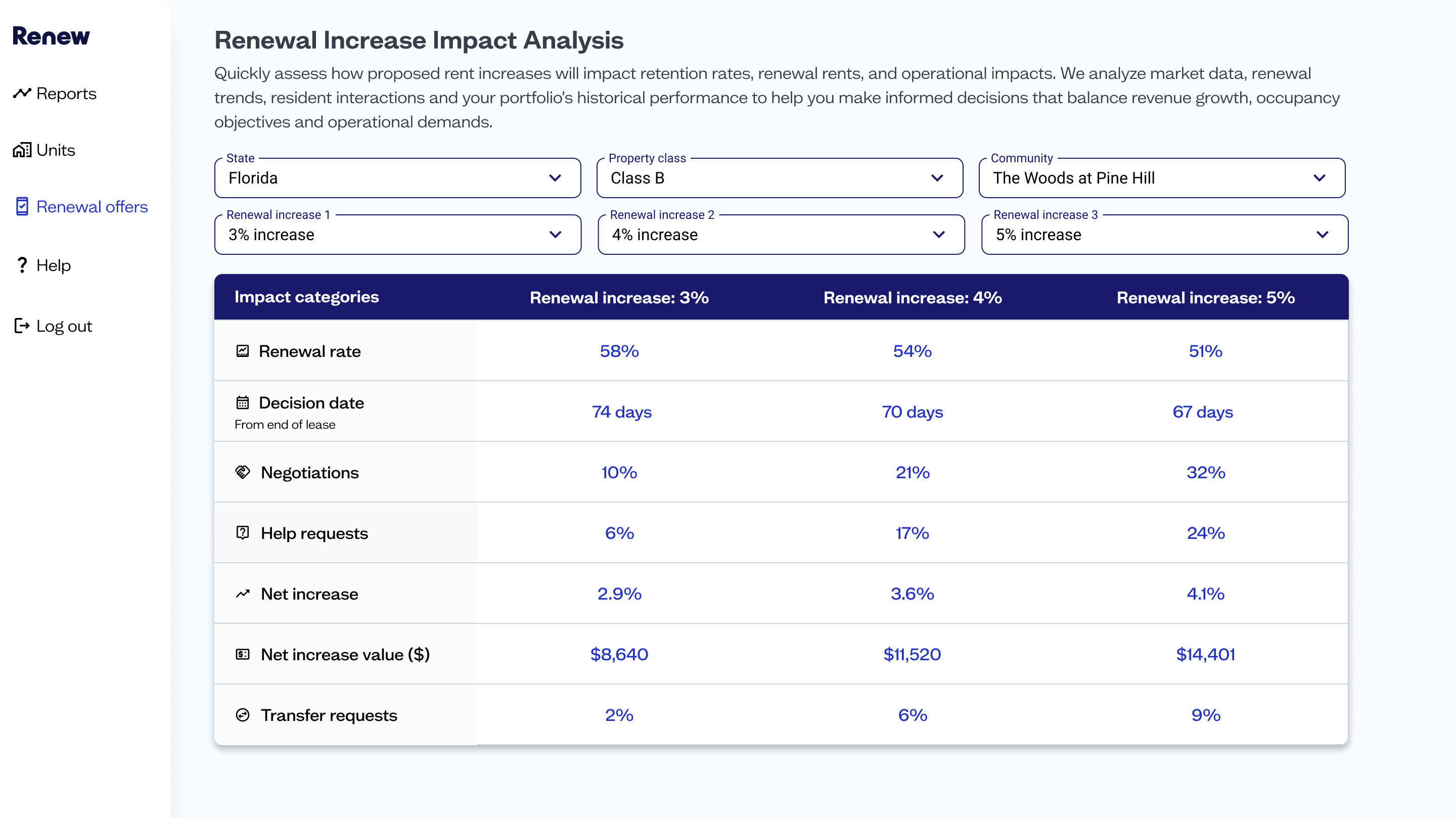
Market-level data, for instance, is relatively straightforward to use. (Hayden refers to this as ‘Tier 1’ data: things that can be found on CoStar.) In a market with higher vacancy, for instance, an operator should be less aggressive pushing renewal increases. An operator may also take into account ‘Tier 2’ data on an individual resident level; for instance, renewal rate may vary based on a resident’s demographics, unit type, and rent.
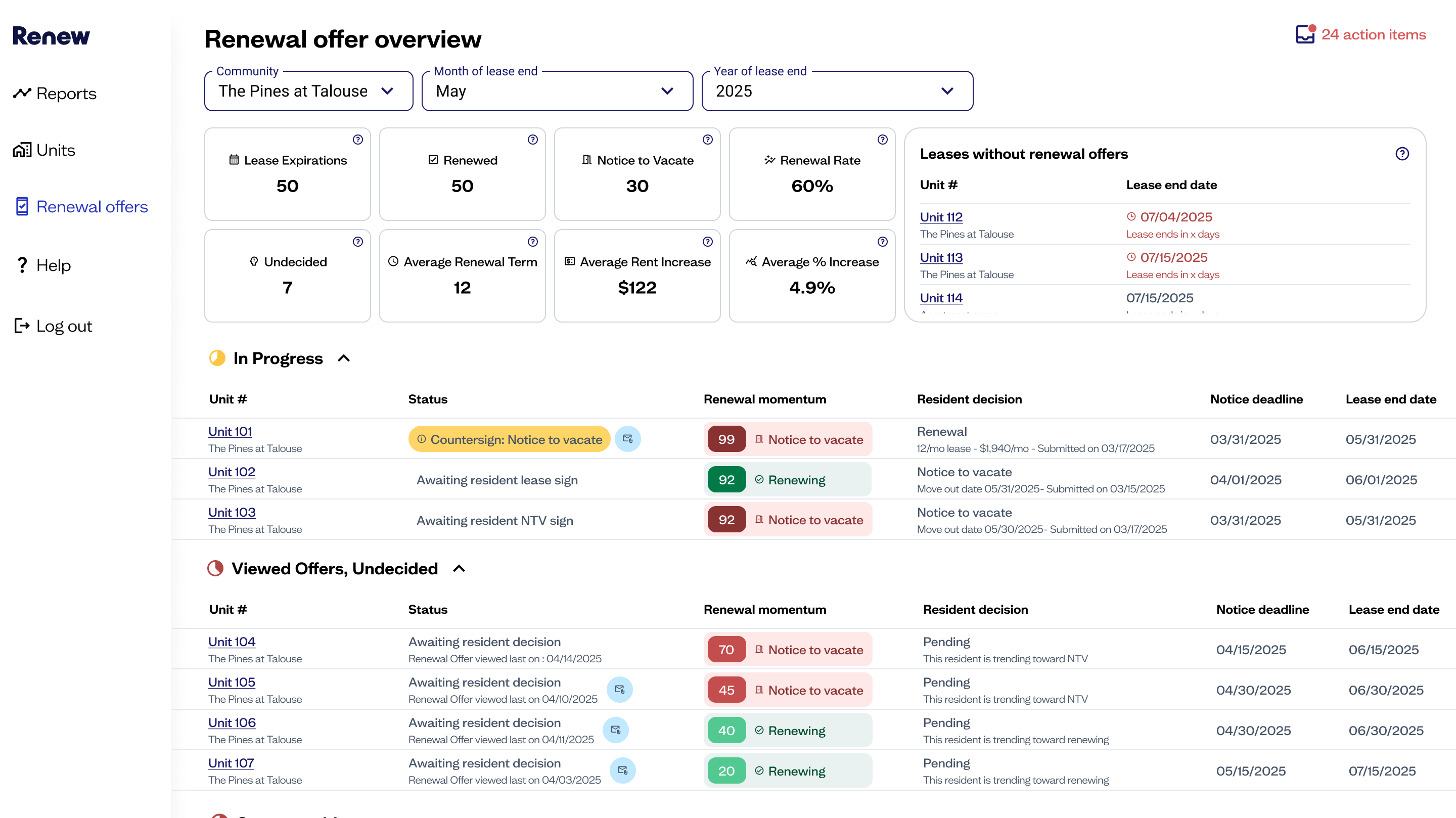
But the most insightful data is ‘Tier 3,’ or interaction-level insights. “Nobody has traditionally used resident interaction data in the renewal process, and it’s incredibly predictive,” said Hayden. “We know if a resident hasn’t looked at his or her renewal offer within 10 days of it being sent, the odds of renewal fall off a cliff.” Maintenance requests, support ticket history, and other interaction data are also predictive of a renewal decision, and Renew’s clients can use this to tailor specific renewal approaches.
Using this data can generate real results: 70% of residents in buildings using Renew complete their renewal without human involvement, and 42% of them add some sort of ancillary revenue product – storage, a parking upgrade, or insurance, for instance – while going through the online renewal process. (Old-school direct marketers would refer to this as a “co-reg path.”)
But all this data has another benefit: it provides Renew – and their clients – an early lens into a resident’s likelihood of renewing their lease. And as we’ll discover, that data is not just useful for optimizing renewals but for unlocking the private marketplace model.
Depending on the market and the asset, renewal rates in multifamily typically vary from 45% to 60%, although rates have been trending up for some time – likely due to a combination of an older renter population and a greater focus on service quality among property managers.
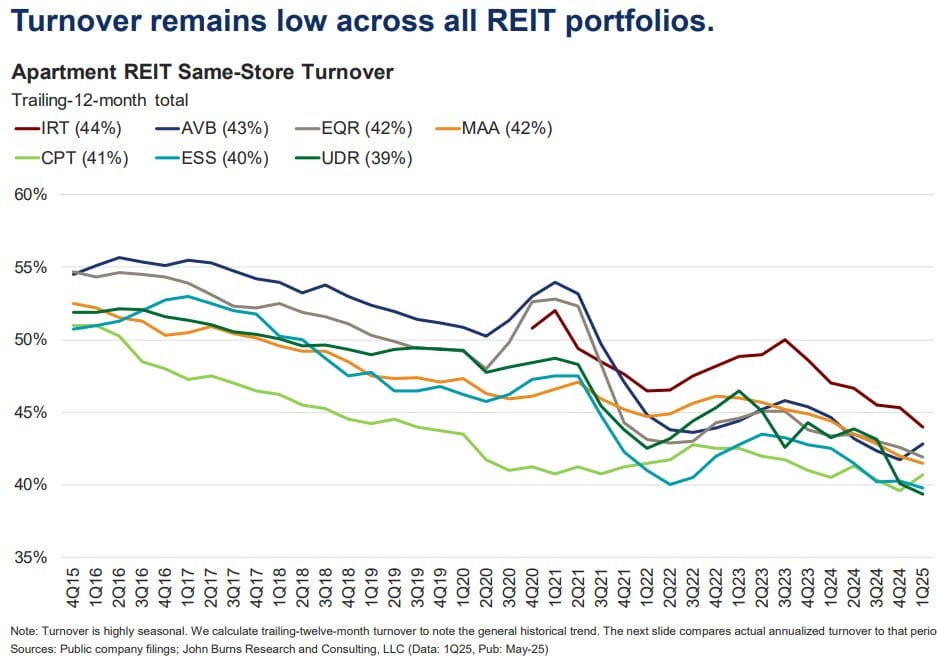
Of course, this still means that approximately 40% of an asset’s renters are leaving in any given year. And as operators know, churn is often more about life stage and changing needs; not every churn is a failure of experience.
“People are renting longer. The average time someone spends as a renter during their life has gone from 7-8 years in 2008 to 14 years today,” says Hayden. “So the lifetime value of a renter has more than doubled when combined with rising rents. But multifamily operators are only capturing a couple years of that.” So while Americans are renting later and later into their lives, most asset operators haven’t evolved how they think about the renter journey to capture more of that value.
“If a renter tells you they’re moving out because they need more space, rent is too high, they’re moving, they’re breaking up with their roommate – you might be able to solve that in your portfolio.”
In other words, Hayden encourages operators to think about renewals in the broader context of retention – that is, keeping the resident as a customer if they move into a different unit or even a different property in the portfolio that better fits their needs. By broadening the definition of what a “renewal” means, property operators could reduce pressure to acquire new residents by filling more empty units across the portfolio with existing residents.“If you have 40% churn at your property, that means 40% of your leases are churning,” said Hayden. “But that doesn’t mean 40% of your customers have to churn.”
Of course, nothing requires multifamily owners to only cross-market properties in their own portfolio. After all, even the largest owner-operators don’t have properties of every type in every city, and there’s a reasonable chance they can’t fulfill a resident’s needs from their own portfolio. This is the logic behind Renew’s marketplace, where multifamily operators can get paid by referring non-renewing residents to any property on the platform, even one owned and operated by another firm – and a growing list of Renew’s clients are opting in, with 500,000 units now listed on Renew’s private marketplace.
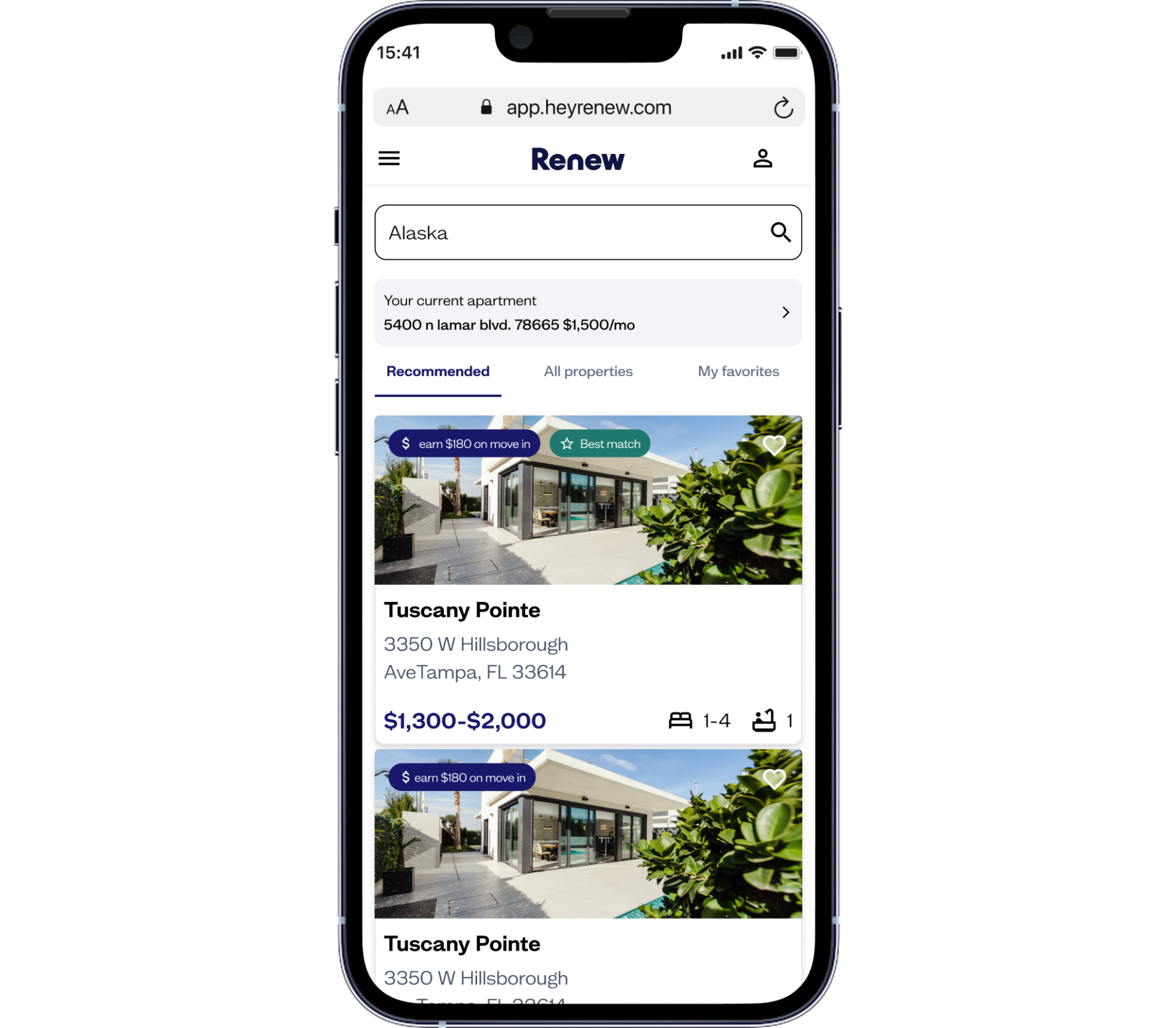
While this may sound great in theory, it is far easier said than done. Specifically, solving the timing problem is far harder than it may appear. Most residents secure a new apartment before giving notice — they want to be sure they have somewhere to land before committing to move. So if an owner waits until receiving a definitive notice to vacate before showing residents other units, they’ll be late to the party; their prospects have already signed a lease elsewhere. But multifamily owners balk at presenting alternative units to a resident prior to receiving a notice to vacate.
Solving that conundrum is where renewal data shines.
For most operators, the idea of presenting another operator’s units to a resident sounds insane. “People recoiled at first,” said Hayden.
But Renew’s gradual, data-driven approach has brought a growing number of operators on board.
One, Renew uses a “phased approach” to introduce residents unlikely to renew to increasingly wide circles of other options. “We don’t expose the marketplace to a renter early in the experience,” explained Hayden. “We’ll first show them alternative units in the building. But if we get data that indicates they’re moving toward a non-renewal, we’ll first show other units in the operator’s portfolio, then finally the marketplace.”
Renew also gives operators the ability to fine-tune the units they’re showing. For in-building transfers, for instance, Renew typically only shows residents units that are more than 25% different in cost or square footage than their current unit. No owner, after all, wants to incur turnover expenses for a resident to move to a similar unit down the hall.
Similarly, Renew allows owners the ability to fine-tune what is shown to residents on the marketplace. “[An owner] can say, “Don’t show buildings within 30 miles of this property address,” explained Hayden. “Or don’t show these fifteen specific properties.”
But Renew’s ability to use data to identify renters highly unlikely to renew is its most powerful tool for convincing owners to join the marketplace. “Renter interaction data is incredibly predictive of renewal,” said Hayden. “We know if a renter hasn’t looked at their renewal offer within ten days of it being sent to him, and those odds of renewal are very low.” By showing their clients the relationship between certain interactions and renewals, Hayden and Renew have been able to convince owners to show third-party units to residents prior to a notice-to-vacate. “The backtested data is a huge trust-builder with our institutional clients that gives us the right to cross-market.”
Residents are also warming to the concept. Of the 40% of renters on Renew’s platform who choose not to renew, more than half (53%) shop for alternative units on Renew’s marketplace. And when those renters choose to rent a unit outside their current operator’s portfolio, their current building receives a referral fee, which can go a long way to offsetting turnover and the cost of acquiring a new resident. These referral fees are also an additional “other income” line in a sector increasingly hungry for new ways to monetize the resident.
While Renew’s marketplace is still in its early days, the benefits to owners beyond reducing marketing costs are becoming apparent. It is far less likely, for instance, that a prospective renter inbound from a peer Class A owner will commit application fraud or become delinquent than a renter coming in over the transom from Apartments.com or Zillow. If a renter has been paying his or her rent on time at AvalonBay for years, they’re likely going to be a similarly good tenant for Bozzuto. With application fraud a growing pain point for operators, the idea of private rental marketplaces is increasingly appealing – a concept we’ve discussed in the past in the context of screening applications.
Transferring through a private marketplace also has benefits for the renter. “We’re picking up all the renter’s data on things like insurance policies, pets, and guarantors and making that transferable through the network,” said Hayden. Renters may also see special offers through a private marketplace like Renew that operators may not want to broadcast publicly, giving them an incentive to browse privately rather than on the ILS.
Of course, Renew won’t be the only company aiming to build the private rental market. Rewards company BILT is rumored to be building its own marketplace, while PMS platforms or even the ILSes themselves are likely to join the fray if the concept gains momentum. But there are reasons to believe owning renewals is the right launching point for such a marketplace. In Hayden’s view, interaction data that gives early lens into renewal intent is the key to making the model work.
“Disqualifying a resident as a renewing resident is key to showing them the marketplace before they’ve already found a new place,” he explained. “If we can show [owners] a track record of success at identifying non-renewals early, that buys the right to show residents other listings. Owning renewal allows you cross market because you have data on intent.”
“We know whether they’re staying or going before any other software. We know it before the PMS knows it.”
But some operators may see themselves in a position to build such a network themselves. Greystar, for example, manages more than a million multifamily units and student housing beds across more than 200 markets in the US, Europe, Asia, and South America – more than enough to serve the vast majority of resident needs in-network.
Building such a marketplace could give the largest multifamily operators the kind of advantage typically seen in technology firms: genuine network effects. While a firm like Greystar’s scale gives it an advantage when negotiating contracts and buying construction materials, for instance, those advantages pale in comparison to the economic power and durability of a marketplace’s network effects.
To compete, smaller operators must align to build their own competing network. (And in this context, “smaller” likely means “fewer than 100,000 units and 20 markets,” or enough to provide residents with a reasonable set of in-network options.) “Once the largest operators create networks that can keep their hundreds of thousands of residents in-network, other operators will have to work together to create that synthetic single portfolio,” says Hayden. And that portfolio may have the advantage over single-provider networks by keeping the platform in neutral hands, unlocking greater reach and diversity of units available.
But that scenario is still far on the horizon, and most multifamily operators still hesitate at the idea of exposing their residents to the “marketplace.” But Hayden believes logic – and lucrative referral commissions – will eventually prevail.
“Putting more options in front of the resident is not going to convince them to move. Any rational operator knows that the consumer has access to Zillow and apartments.com. To think your customer is not searching and comparing is silly.”
– Brad Hargreaves

New data from Tailorbird shows why two-thirds of real estate operators blow their capex budgets and where AI could actually help

How a computer vision startup became America’s largest parking operator and a test case for a new model of venture-backed growth

Realpage is betting that decades of accumulated data can become an AI-era advantage

EG is applying the American real estate private equity playbook to Australia, starting with medical office

Covering the future of real estate and the people creating it