
The Rise of Tour Intelligence
A new generation of companies is betting AI can make the human leasing agent better
A new generation of companies is betting AI can make the human leasing agent better

Tracking three months of notable land use and zoning decisions with Shovels

As real estate's insurance-cost crisis grows, captives gain popularity and embrace membership-club selectivity
By combining computer vision with agentic AI, one platform is taking on the operational work buried in every property manager’s to-do list.

Last month, we dug into computer vision's quiet ascent across real estate, from foot traffic counts at retail centers to construction progress monitoring to amenity sentiment analysis. Technologically, computer vision has progressed much faster than its press coverage might suggest. While LLMs absorb the cultural attention, computer vision tools have commercialized technology that sat on the edge of possibility until recently.
For real estate operators, that technology becomes far more powerful when combined with agentic AI. Agents that can read documents, parse diagrams, watch cameras, and act on what they see are perhaps the next big leap in computer vision’s path from theory to practice. For an industry that runs on visual artifacts (scanned PDFs, hand-marked floor plans, security feeds, drone footage, marketing photos), the possibilities are tremendous.
Today's letter explores the future of agentic computer vision tools through one company bringing them to market today: SurfaceAI, a multifamily-focused platform that pairs computer vision with autonomous agents to handle the operational debris sitting deep on every property manager’s to-do list. But this new generation of tools also represents a frame shift in what software is: away from a UI that humans operate and toward an autonomous workforce that humans supervise.
Most discussion of AI in real estate has fixated on the LLM use cases: chat interfaces, drafting tools, document abstraction. Those are real, and they have moved fast. But they share a fundamental constraint: they typically require digital, text-native inputs.
Multifamily operations, in particular, are not a digital, text-native business. Leases live as 130-page PDFs with handwritten initials in the margins. Vendor contracts arrive as scanned faxes. Inspection reports are photographs taken on a Samsung Galaxy from 2019. The data is there, but its format is often hostile.
Computer vision is what makes that data legible. The technology has advanced in parallel with LLMs, just with less consumer fanfare. It can now read structured fields out of an arbitrarily formatted document, distinguish floorplan elements, count parking stalls from a satellite image, and flag conditions on a security feed in real time. Each capability is meaningful on its own, but when combined with a language model, they become more interesting: a system that can simultaneously see a document and think critically about what it’s seeing.
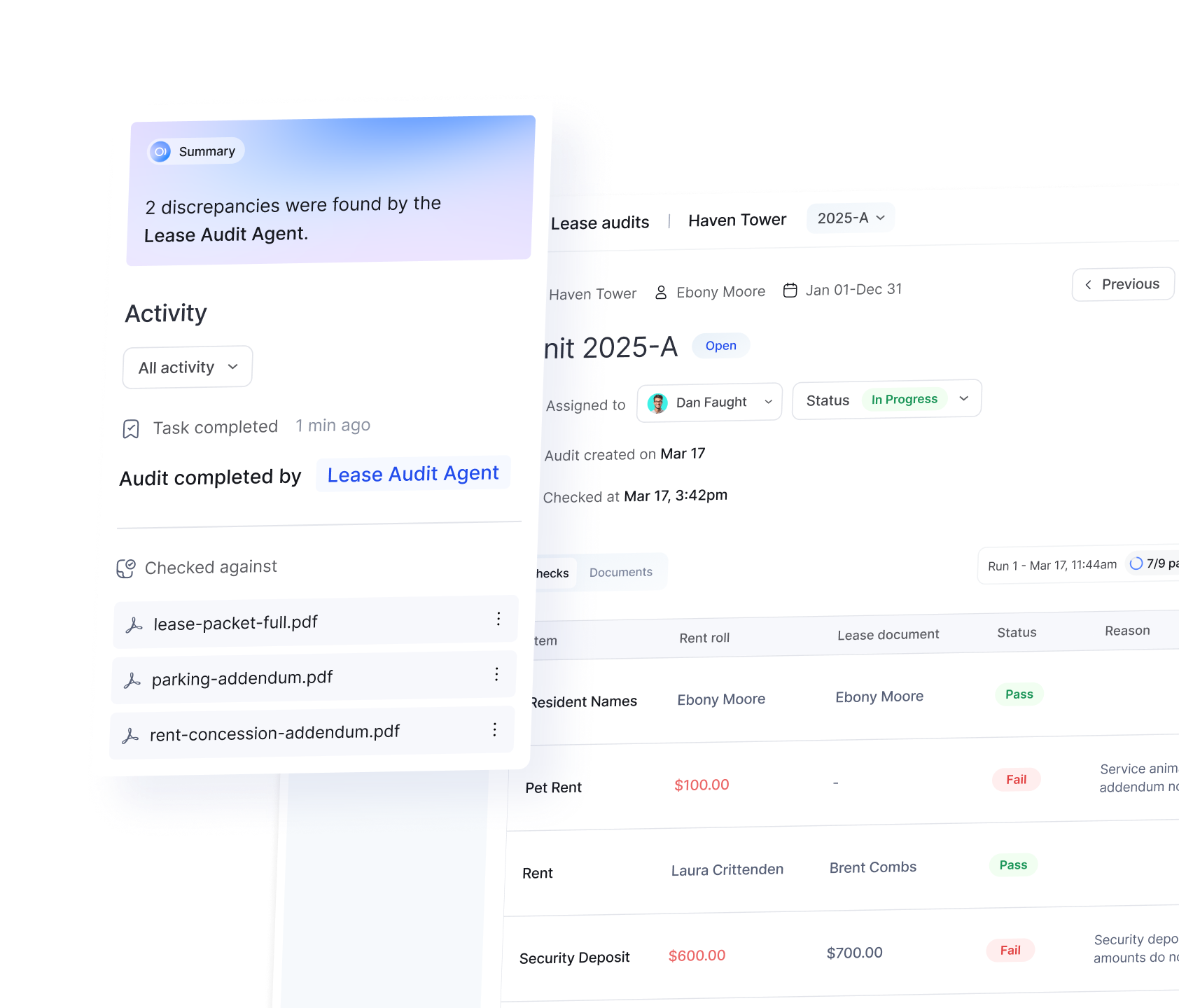
Operationally, agentic frameworks with the capability to act autonomously make this all more practical and not dependent on a human sitting behind a desk issuing commands. An agent is a system that decides when to run, what to do, and how to react to what it finds, moving the human out of the loop on routine work. The analyst agent pulls comps without being asked. The deal sourcing agent monitors LoopNet and flags only sites that match a thesis. The lease audit agent reads through a portfolio's documents every night, surfaces what the asset manager needs to see, and runs again in the background every time a new lease is signed or a change is made to the rent roll.
Stacking those three capabilities (computer vision, language reasoning, and an agentic execution layer) is the unlock. It is also the thesis behind SurfaceAI, which has been building on that stack since 2023, well before either piece was production-ready on its own.
SurfaceAI was founded by Jason Wallis, a technology executive whose résumé runs through Amazon and Wayfair, in partnership with Stackpoint, the venture studio that has spawned several real estate-focused companies.

“The operations side of multifamily is rich in complex workflows, documents, and data buried in them,” Wallis says. "We spent the first five or six months on site, and we quickly realized we could have a big impact on the category.”
Critically, the key data exists. But it often lives in non-digital formats: paper, PDFs, scanned images, screenshots of vendor portals. Contracts, leases, rent rolls, addenda, work order tickets. The information needed to actually run a property is fragmented across various systems, platforms, and formats, and much of it never makes it into the PMS in any structured way.
"By leaning into computer vision and being able to extract meaningful data out of documents, honing that in multifamily, we built this agentic platform," Wallis says. "We're bridging the gaps between what's in agreements and what's in software.”
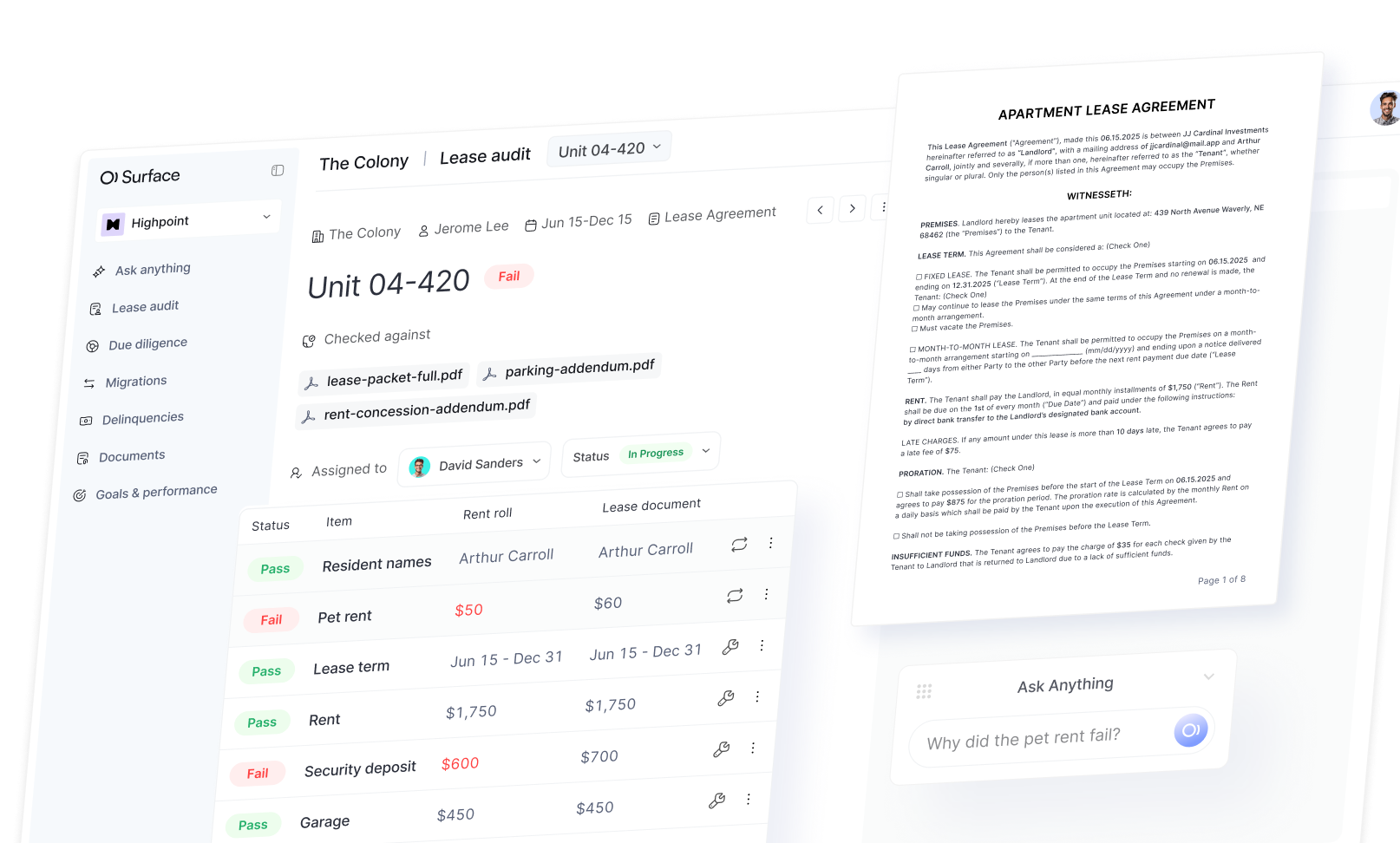
The example Wallis returns to is the lease. A modern multifamily lease can run to 130 pages. Of those, perhaps sixteen contain information that an asset manager or operations team genuinely needs to act on: rent escalations, concession schedules, renewal terms, pet addenda, parking allocations. The rest is boilerplate. Asking a frontier LLM to ingest the entire document and return the relevant fields turns out to be unreliable in production.
"Platforms like OpenAI, Gemini, and Claude are not very good at taking the entire thing and telling you what's relevant," Wallis says. "They hallucinate. They make things up."
The fix is a structural shift in how AI approaches the kind of unstructured data found in a lease or vendor contract. A lease has internal references; section 4.2 will instruct the reader to "see schedule 4," which itself amends section 2.1, which incorporates a rider attached as exhibit B. A general-purpose model reading the document linearly loses the thread. A system that has been trained on the specific document type, that recognizes the cross-reference pattern, and that knows to chase the schedule before resolving the clause arrives at a different answer.
"AI has to be smart enough to see that text. You want to derive the actual meaning," Wallis says.
Document extraction is a compelling use of computer vision, but it’s not a complete product. There are, after all, plenty of other document abstraction tools in the market. The harder (and the more interesting) problem is training agents to deploy the technology at the right time and place, adding value without burning tokens unnecessarily.
"The agentic piece is about having the knowledge and understanding to know when you need to initiate an audit," Wallis says. "To recognize that this is a change worthy of inspecting, of running an audit right now, and to understand the audit pipeline and apply those rules. It sits on top of the core ability to read documents."
The clearest near-term application is lease audit. Multifamily operators routinely lose revenue to mismatches between what a lease says and what the PMS charges. A rent escalation triggers in month thirteen and the property manager forgets to apply it. A concession was supposed to burn off after six months; it persists. A pet fee was waived for a specific unit on a specific addendum; the field never got updated. Across a 5,000-unit portfolio, these errors add up to real numbers.
Operators using SurfaceAI for lease audit report a 6-7x return relative to software cost, according to the company. That ratio is not unusual for an audit product; the novelty is doing the work continuously and autonomously rather than as a quarterly engagement with a consulting firm.
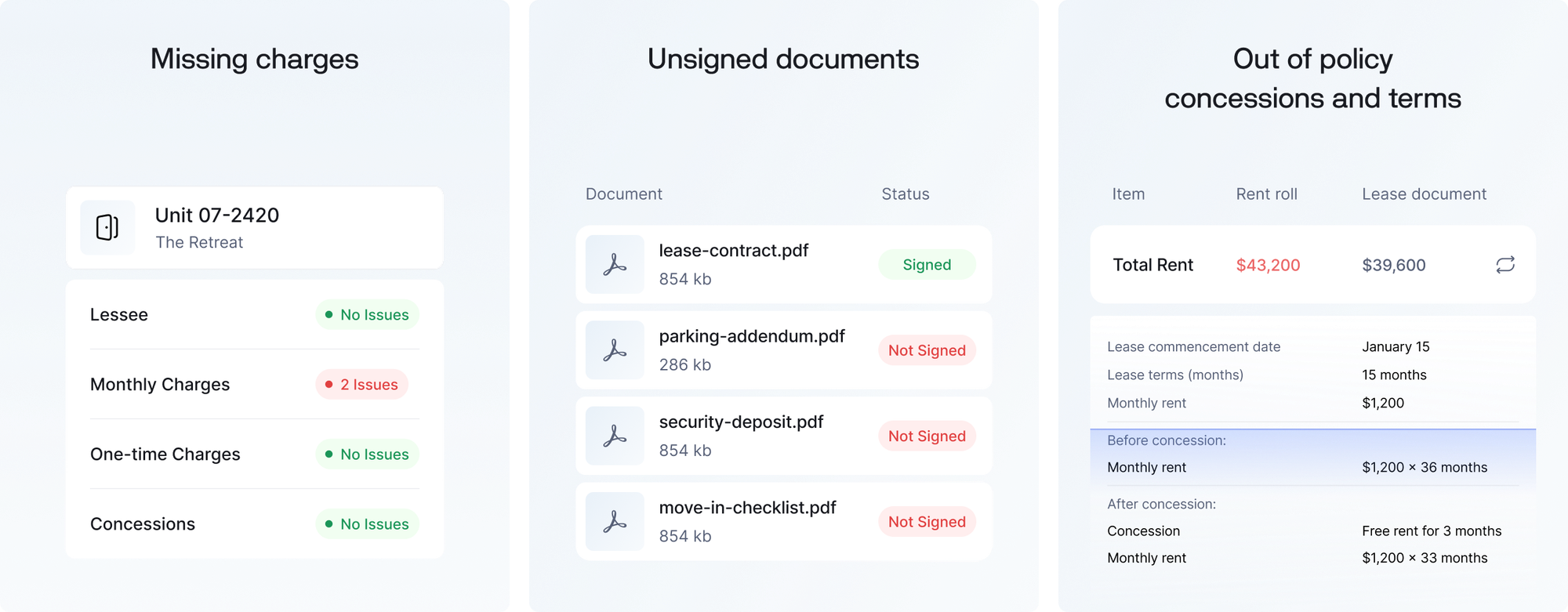
While the lease audit is an easy win, the longer arc points toward a wider portfolio of always-on agents.
"How do we gain insight that gets them ahead of issues they might not see?" Wallis says. "Take the financial analysis agent. It compares the entire budget, both expense and revenue, expense and GL, and from that identifies and flags anomalous things an ops team or AM might want to know about. Get ahead of them before they become problems." In other words, run when it believes it should run, not when an analyst presses a button.
Like all traditional software, today’s real estate technology solutions assume a human operator is sitting at the controls. A human navigates the UI of Yardi, RealPage, or Entrata, opening menus, running reports, exporting to Excel, and acting on what they find. The software is passive; the human is the agent.
In the agentic framing, that relationship inverts.
"We don't want operations teams to have their noses in our tools all the time," Wallis says. "We want to take on this mundane work for them."
The image he uses is the ombudsman, or the watchdog. The software is constantly inspecting the operation: validating that leases match billings, watching security cameras for incidents, monitoring sensor data on HVAC and elevators, comparing actuals against budget, flagging when a vendor's invoice does not match the executed contract.
"If something goes wrong, we either fix it for them or they fix it. We want to be their watchdog, catching items and silently analyzing 24/7."
The implication is a property management interface that looks less like a database front end and more like an air traffic control screen. The operator monitors an army of agents working a portfolio in the background. The dashboard surfaces exceptions, anomalies, and items that require judgment. Routine activity does not require attention.
"The tech wasn't there three years ago to do that effectively," Wallis says. "It is now."
A new PMS model is implied here, one organized around agent supervision rather than data entry. The incumbents (Yardi, RealPage, Entrata, AppFolio) are racing toward their own versions of this architecture, but the legacy data models and UI assumptions baked into those products are not trivial to retrofit. The ground is open for newer entrants to build the agent-native equivalent from scratch.
The SurfaceAI deployments to date concentrate on three internal customers: transition teams, asset management, and operations leadership. Each has a different reason to care.
This is one of the most technology-underserved processes in multifamily operations, and advances in computer vision are beginning to change that. Transition teams, the groups that onboard acquired properties, are immersed in document chaos. Every acquisition arrives as a folder of mismatched files: leases in various formats, rent rolls that don't tie to the GL, vendor contracts with unknown renewal dates. Automating the extraction shrinks the transition timeline and reduces the early-period revenue leakage that follows most acquisitions.
Asset managers are the natural buyers for the financial analysis layer. The job has always been a mix of forensic accountant, operations advisor, and capital allocator. The forensic accounting piece is the most automatable, and asset managers who have built relationships with portfolio-level data products are the most receptive to delegating it.
Operations leadership cares about the ombudsman framing directly. Regional managers responsible for fifteen properties cannot personally audit every lease or watch every camera. An agent that surfaces exceptions to them buys back time that currently goes to spreadsheet reconciliation.
The category these tools sit in does not have a settled name yet. It is not RPA, which never produced real adoption in multifamily. It is not a PMS, since it sits adjacent to one. And unlike an analytics product, the deliverable is action rather than insight. The through line is financial performance across the full asset lifecycle: from acquisition diligence through disposition, the platform is designed to find and recover value at every stage. The closest analog is probably the agentic equivalent of an internal audit function, sized for portfolios that cannot justify a full-time internal auditor.
In other words, SurfaceAI is one company in a category that does not yet have a clean label.
For two decades, real estate technology has been about getting humans in front of better screens. Better PMS dashboards. Better leasing CRMs. Better revenue management interfaces. The unit of progress was the experience the operator had with the tool.
The agentic shift moves the unit of progress somewhere else. The tool now has to do the work, not present the work. The dashboard becomes an exception-handling surface rather than an operating surface. Screen-time-per-employee, long a proxy for software adoption, becomes the wrong number to optimize.
Computer vision is the piece that makes this possible in real estate specifically. Other industries have agents that operate on clean, structured data. Real estate's data has never been clean or structured; the documents, the images, and the sensor feeds that contain the operational truth have stayed inaccessible to software. Vision changes what software can read. Agents change what gets done with what it reads.
The operators who deploy this first will pull ahead on a metric nobody is yet tracking: cost per portfolio unit of operational supervision. Those who wait for the category to settle will find their property management partners building it on their behalf, on their schedule, and at their margin. The upside, for now, sits with the early adopters.
-Brad Hargreaves

Eight lessons on why AI pays off for some firms and not others

We've been building AI acquisitions agents with real estate GPs. On August 13, we're opening the hood in a live 2-hour workshop


EG is applying the American real estate private equity playbook to Australia, starting with medical office

Our annual list of firms actively investing in real estate technology companies
Covering the future of real estate and the people creating it