
When Will Spec Office Get Built Again?
Office demand is recovering, but speculative development in most markets remains stubbornly out of reach
Office demand is recovering, but speculative development in most markets remains stubbornly out of reach

New data from Tailorbird shows why two-thirds of real estate operators blow their capex budgets and where AI could actually help
Pioneering a new members club for families, starting in Brooklyn


Don’t miss Thesis Driven’s Buy Box deep dive on The Beginning next Wednesday, August 13. Register here (for accredited & institutional investors only)

Brooklyn Heights may be best known for brownstones and promenade views, yet two blocks inland an unassuming 1920s warehouse is about to test a thesis that’s rippling through hospitality circles: families—not just parents or children in isolation—are willing to pay club-level dues for a single place that collapses childcare, wellness, dining, and community under one roof.
The numbers tell the story. Sixty percent of private clubs report net-new member growth since 2022, and the category is accelerating toward a $25.8 billion global market by 2027 on an 11.7 percent CAGR. Inside cities like New York, “family economy” spend—everything from enrichment classes to on-demand babysitting—is rising more than 10% a year, even as traditional daycare capacity shrinks. Parents are piecing together jungle-gym visits, co-working passes, boutique-fitness packages, and pricey date-night sitters—a pay-as-you-go bundle that can exceed $2,400 a month for a two-adult, two-kid household. Yet no single venue has woven those fragmented services into a coherent lifestyle platform.
Little Big Hospitality thinks it can. Its first project, The Beginning, occupies 45,000 square feet across seven floors in Brooklyn Heights—soft-play labs stacked above a cinema, a spa, co-working library, and a roof-deck pizza garden. Membership will be priced at roughly $400 per adult and $250 per child per month plus a $5,000 initiation fee, positioning the offering at a meaningful discount to the à-la-carte spend families already incur.
And consumer demand for the family member club concept is real: more than 1,500 families have pre-registered interest—enough to fill the flagship’s planned capacity on day one.
And next Wednesday, Thesis Driven’s Brad Hargreaves and I will sit down with Little Big Hospitality co-founders Michael Schoen and Chris de Koos for a live conversation. (If you’re interested, RSVP here.)
Before we get there, this letter will unpack the playbook. A quick heads-up: in Section 3 you’ll find a six-minute walkthrough video we shot inside the space—worth queuing up when you reach it.
What this letter will cover:
Thesis Driven is a reader-supported publication. To receive new posts and support our work, consider becoming a free or paid subscriber.
A typical Brooklyn-Heights household stitches together life like a patchwork quilt: $500 for a boutique-gym membership, $1,000 for after-school enrichment, $150 for weekend playspaces, $400 for sitters, $350 for a co-working desk—$2,400 a month before anyone buys dinner.
Meanwhile, the market’s “third space” offerings are siloed. Kid-centric playspaces win on imagination but leave parents hunting for Wi-Fi. Adult clubs like Soho House and Zero Bond serve grown-ups well, yet exile children to token “family hours.” And experiential pop-ups like CAMP or Sloomoo scratch the novelty itch, then disappear until the next birthday party.
The result is high friction, high cost, and no continuity for urban families’ daily routines.
Timing, though, has never been better for something different. Hybrid work has untethered schedules; and parents now hover closer to home and prize walkable “third places.” New York families are still boosting discretionary spend by 1%+ annually on enrichment, wellness, and food, even as traditional daycare options shrink. Add in 98 million square feet of under-utilized urban real estate begging for adaptive re-use, and the ingredients for a platform play are obvious.
There’s also a quieter undercurrent: in an age of algorithmic feeds and ChatGPT homework, parents want a safe zone for digital detox—a place their kids’ first instinct is to climb a rope ladder, not grab a tablet.
Designing the solution
Success isn’t a “destination attraction”. It’s the place that shows up on Google Maps as simply home-base with high daily use, sticky retention, and a membership roster that mirrors the neighborhood. And Little Big Hospitality has designed The Beginning to hit each one.
Fifty Columbia Heights is a limestone-and-steel perch carved into the northern slope of Brooklyn Heights. From its roof you can trace the cables of both East River bridges; from street level you are a ten-minute walk to five subway lines and a short walk from the Promenade.

Little Big Hospitality holds a long-term lease on the entire 45,000 square feet, seven-floor stack with its opening slated for summer 2026.
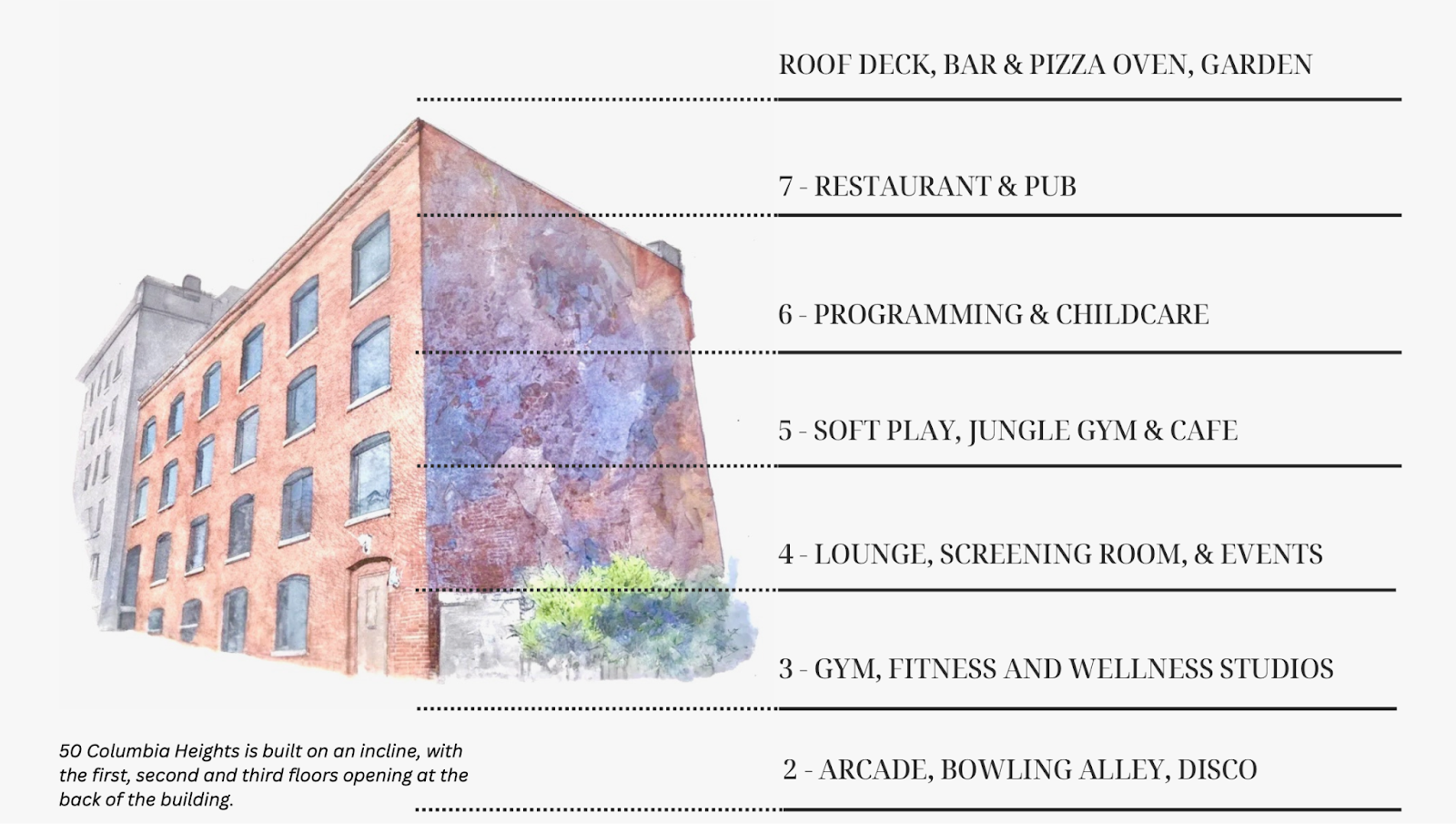
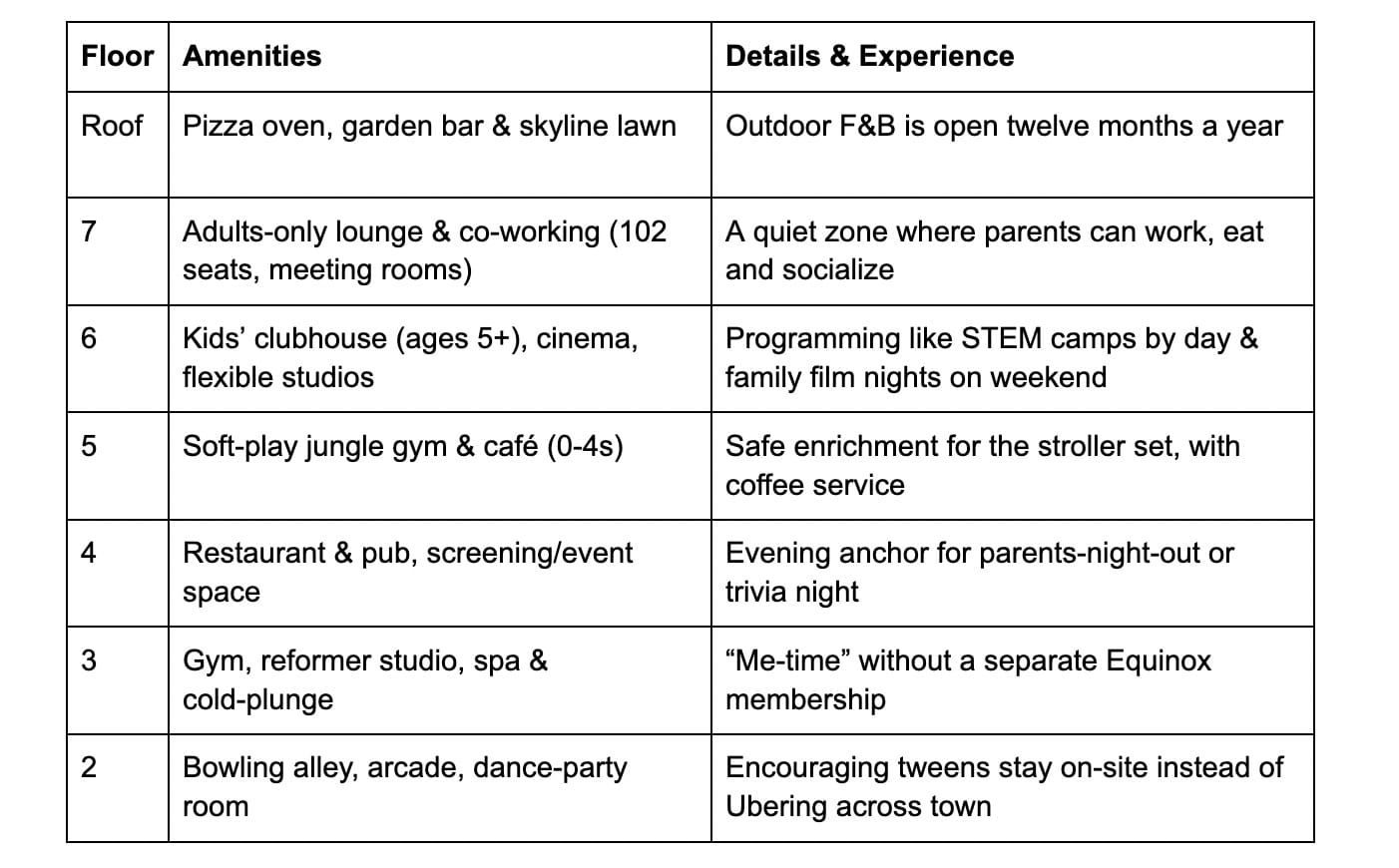
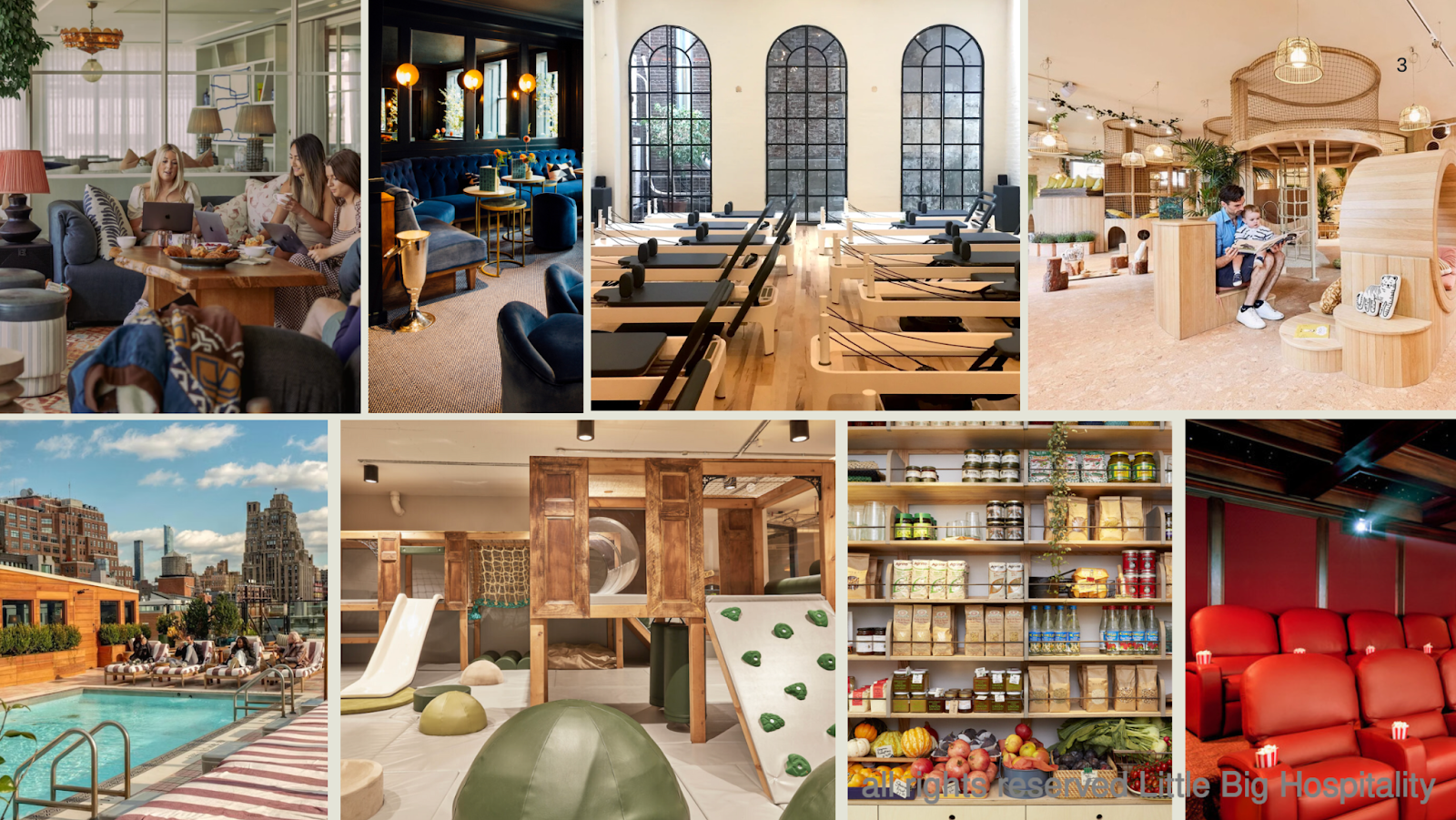
Management is targeting ~$300 per adult and ~$200 per child per month plus a $5,000 initiation fee—a level that undercuts the fragmented status quo while maintaining premium positioning (for context, a four-person Brooklyn family already shells out roughly $2,400/month across gyms, sitters, enrichment and co-working). Capacity planning caps the flagship at 1,500 families, with more than 1,500 pre-registered 12 months out.
At the helm of Little Big Hospitality are Chris de Koos and Michael Schoen.

De Koos (father of one) has run hotel operations and later helped a hospitality-tech firm grow to $22 million in annual revenue before heading enterprise strategy at Vimeo. Schoen (father of one, with one on the way!) has founded two real-estate and co-working ventures and advised brands including WME/IMG, WeWork and Glossier on space and community strategy.
Around them is a team of of F&B veterans, a House & Garden Top-100 designer, and a former private-school board chair overseeing programming.
The Operating Playbook
A proprietary web-and-app platform will support operations including onboarding, bookings, billing and member-to-member messaging while a scheduling engine maximizes room capacity, and a customized CRM tracks engagement and churn indicators.
Membership fees anchor the P&L, but the model intentionally tilts toward high-margin non-dues lines: premium camps, birthday parties, brand activations, and a grab-and-go retail wall. Strategic partners pay for access to a well-segmented audience—turning every STEM workshop or wine tasting into sponsored content. Management expects ancillary streams to exceed 35 % of total revenue by Year 5, a lever that pushes pro-forma EBITDA margins into the low 30s.
The project has possession of the building, completed design documents and a pre-opening team already under contract. Remaining work hinges on finalizing capital, after which the operating system described above transitions from plan to day-one routine.
To learn more, join Thesis Driven’s Buy Box deep dive with Chris & Michael next Wednesday, August 13. (Sadly, we’re only able to open it to accredited investors.)
The Brooklyn Heights flagship is designed to prove two things: that families will pay subscription pricing for a full-stack clubhouse and that the concept can run positive cash flow inside leased real estate. If those hypotheses hold, the next step is replication.
Where could it work? Management’s heat map starts with cities that combine high dual-income family density and under-utilized commercial space—conditions now common in post-pandemic urban cores. The team lists London, Austin, Chicago, Nashville and Toronto as first-wave targets, with additional hubs under evaluation. These markets all offer vacant big-box retail or former office assets at rents below 2019 levels, echoing the 98 million square feet of “stranded” space highlighted earlier in the materials. Converting those shells into clubs follows the same cap-ex template used in Brooklyn: 70% hard and FF&E costs, 15% working capital, and the balance spread across technology, staffing and member acquisition.
Real-estate strategy. For now the team prefers long-term leases, arguing that capital stays light and rollout speed improves when the operating company is not also syndicating buildings. Longer term, an OpCo/PropCo model remains on the table—especially if institutional landlords are willing to co-invest at the property level to secure a sticky anchor. As with other membership clubs, the operating business drives valuation through recurring revenue; the property vehicle could capture upside from repositioning and a compressed cap rate once tenancy is stabilised.
Rollout logic. The plan is staged: finish construction in Brooklyn; operate for 12–18 months to validate pricing, retention and non-dues penetration; then green-light the next two locations in close succession. A three-site cluster is the threshold at which the member network begins to confer real travel reciprocity and procurement leverage. Beyond that point, management projects brand licensing (for ancillary services such as swim academies or summer camps) as an additional margin lever.
The team’s thesis is clear; and the dataset to confirm it is months—not years—away.
We’ll revisit the numbers once doors open, but for now the most useful next step may be conversation. Thesis Driven is hosting a live Q&A with the founders in less than two weeks and accredited readers can register here.
Questions worth asking: How elastic is demand if dues rise with inflation? What does churn look like after the novelty phase? And, perhaps most importantly, can a family clubhouse become the default third place in cities beyond New York?
–Paul Stanton

Office demand is recovering, but speculative development in most markets remains stubbornly out of reach


We've been building AI acquisitions agents with real estate GPs. On August 13, we're opening the hood in a live 2-hour workshop
Covering the future of real estate and the people creating it