


Seven Surprising Facts About the State of AI in Real Estate
What 2025 Revealed About the New Rules of CRE Innovation

We're thrilled to welcome Jim Kaminsky
Wait. Another AI newsletter? On Thanksgiving Day, no less? Yes.
Our reasoning: a long, end-of-year holiday weekend might just be the perfect time to get caught up on the latest developments in real estate’s most discussed, debated, and transformative technology. To be sure, not all operators, investors, and developers are opening their arms wide to give AI a warm embrace. But in 2025, there’s no longer a viable argument that artificial intelligence will be anything less than an industry-wide change agent—snaking its way into every corner of real estate.
Here at Thesis Driven, we’ve tracked these shifts throughout the year, sector by sector, from the wide operational adoption in multifamily and property operations to newer breakthroughs in feasibility, site selection, and land acquisition. We wrote about conservative, heavily regulated lenders taking their first tenuous steps toward AI adoption. We even published thought experiments on what fully automated property management or development might look like, removing human staff altogether. (Those were hypothetical.)
It’s a lot to keep track of, we know. And we’re here to help.
In the spirit of holiday sharing, we’ve pulled together the most insightful AI pieces we published this year, distilling the lessons and takeaways hiding inside them. Some of them surprised even us. No hype here, no futurism or cheerleading. Just the real operational shifts that operators, developers, and investors are encountering right now.
Happy holidays!
Fact 1: Site Sourcing is Going From a Slog to a Sprint
For decades, site sourcing meant slogging through assessor sites, GIS layers, tax rolls, PDFs, and spreadsheets. That bottleneck is finally breaking. A new wave of AI-enabled platforms lets developers describe what they want—rather than patching together multiple datasets—and centralize parcel data, ownership records, utilities, infrastructure, zoning files, and custom overlays in one place. AI and natural language search are now poised to replace the old search-and-filter model with true query-based discovery. As Brad Hargreaves writes, “The exciting part comes from pushing the boundaries of what is queryable.”
 Brad Hargreaves
Read the full story
Fact 2: Feasibility Automation Won’t Kill Off Analysts—It May Double Them
Those assuming AI feasibility automation would wipe out the analyst role should think again: analysts may actually become more important. As Brad notes, “Transformative technology doesn’t pop neatly into incumbents’ existing business processes and workflows.” Someone still has to stitch these tools together, manage the automated funnel, and catch the real-world nuance machines miss—the curb-cut rules, the neighborhood politics, the discretionary calls. In fact, the analyst role seems likely to split: a technical analyst who manages and vets automated tools, and a shoe-leather analyst who handles the qualitative work AI can’t. It’s the opposite of replacement—AI may actually increase headcount.
 Brad Hargreaves
Read the full story
Fact 3: AI in Property Management Only Works When Workflows are Rebuilt From First Principles
Most people still think of AI as a plug-in. Minna Song built a $2.2 billion company on the opposite idea: you can’t bolt AI onto broken workflows and expect transformation. Elise AI compels operators to rethink the process itself. As Song puts it, “A lot of people rely … on this patchwork of point solutions that solve very isolated problems.” The real unlock comes when you redesign leasing, service, maintenance, and resident operations, and let AI run the repeatable, rules-based loops. Elise showed the industry what happens when you rebuild the plumbing, and then apply AI.
 Brad Hargreaves
Read the full story
Fact 4: AI is Ready for CRE Lending—But CRE Lending Isn’t Quite Ready for AI
Lenders should be the textbook AI use case: standardized underwriting steps, structured borrower data, predictable decision trees, and clear risk rules. Tools like Blooma and Archer, and AI-driven diligence from Prophia and LightBox, prove how much of the stack is already automatable. But the AI blockers for CRE lenders are more institutional than technical. Regulators still restrict banks from even auto-summarizing PDFs. Lending culture rewards caution and incrementalism. The tech is here, but the operating environment generally isn’t. Yet.
 Brad Hargreaves
Read the full story
Fact 5: AI Doesn’t Transform Chaotic CRE Operations, it Exposes Them
The hardest part of deploying AI in CRE isn’t picking a model; it’s fixing the organization using it. Most operators don’t have an AI problem—they have an org-design problem. You can’t automate chaos. If ownership, definitions, access, and change management are broken, AI initiatives fall back into shadow spreadsheets and mistrust. Being “AI ready” is less about the tech stack and more about whether the organization can absorb a new way of working.
 Brad Hargreaves
Read the full story
Fact 6: Sometimes the Smartest AI Move is No AI at All
The instinct inside many real estate teams these days is to reach for AI by default. But it can be overkill: Not every operational problem needs an AI model making decisions. Some tasks are rote, rules-based processes that may be better served by simple automation that costs pennies on the dollar. One operator profiled in this piece learned this: his management company needed a reliable way to route and standardize hundreds of chargeback scenarios, a problem of volume and consistency. As John Davis of Orsid noted, “Unless you need intuitive or creative decision making, you can automate without AI.”
 Donal Warde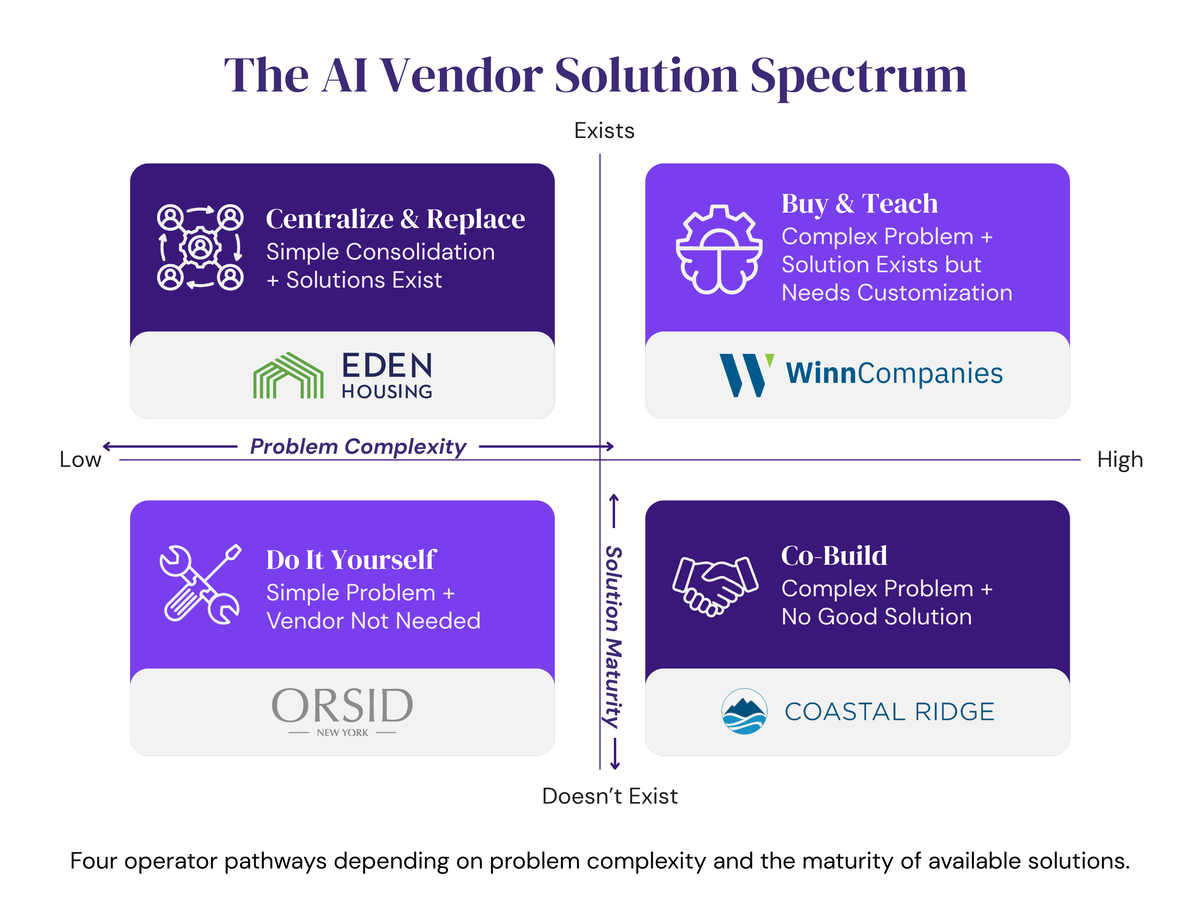
Read the full story
Fact 7: AI Isn’t Just Automating Property Management—It’s Shifting the Entire Economics of the Business
Centralization rewired property management pricing, pushing multifamily operators away from the old pass-through model toward per-unit fees for shared backoffice PM services. Automation and AI are now accelerating that shift by making those centralized functions much cheaper to deliver. Leasing, screening, service requests, and reporting are increasingly handled by off-site teams, and as the letter points out, this gives third-party managers “something they never had before: economies of scale.” That raises the question of who gets the savings: owners benefiting from lower staffing needs, or managers keeping the margin as centralized teams shrink? Should owners still pay 3% fees? As Chris Lehman, co-founder of tech-enabled multifamily operator Groma, put it: “I think the top-level fee is at pretty significant risk.”
 Brad Hargreaves
Read the full story
Read next

Can AI Solve Capex Overruns?
New data from Tailorbird shows why two-thirds of real estate operators blow their capex budgets and where AI could actually help

Deep Dive: Metropolis
How a computer vision startup became America’s largest parking operator and a test case for a new model of venture-backed growth

Why Realpage Bought Cherre
Realpage is betting that decades of accumulated data can become an AI-era advantage
