
Deep Dive: Real Property Captive
As real estate's insurance-cost crisis grows, captives gain popularity and embrace membership-club selectivity
As real estate's insurance-cost crisis grows, captives gain popularity and embrace membership-club selectivity

Eight lessons on why AI pays off for some firms and not others
A quarterly look at feasibility study activity with our friends at TestFit
The new playbook for private wealth


Don’t miss Thesis Driven’s Spotlight interview with the ModerNest team next Wednesday, June 10th, 12:00 PM - 1:00 PM EDT. Register here
Most tax-advantaged real estate products that cross the desks of high-net-worth individuals and family offices look the same: LP stakes in multifamily syndications, passive interests in qualified opportunity funds, or cost-segregation studies stapled to investment decks for industrial warehouses.
These structures work, but the products are opaque and built for allocators, not for private wealth investors who increasingly want to deploy capital into assets they can actually own and control.
A growing cohort of private wealth investors, from 1031 exchangers rotating out of legacy holdings to entrepreneurs sitting on unrealized capital gains, is looking for tax-advantaged real estate that does not require surrendering capital to a blind pool. What they want is straightforward: a specific asset in a specific place, with the tax mechanics of an institutional vehicle and the flexibility to use it personally, rent it out, or both.
ModerNest, created by Nashville developer Meg Epstein, was built for exactly that buyer.
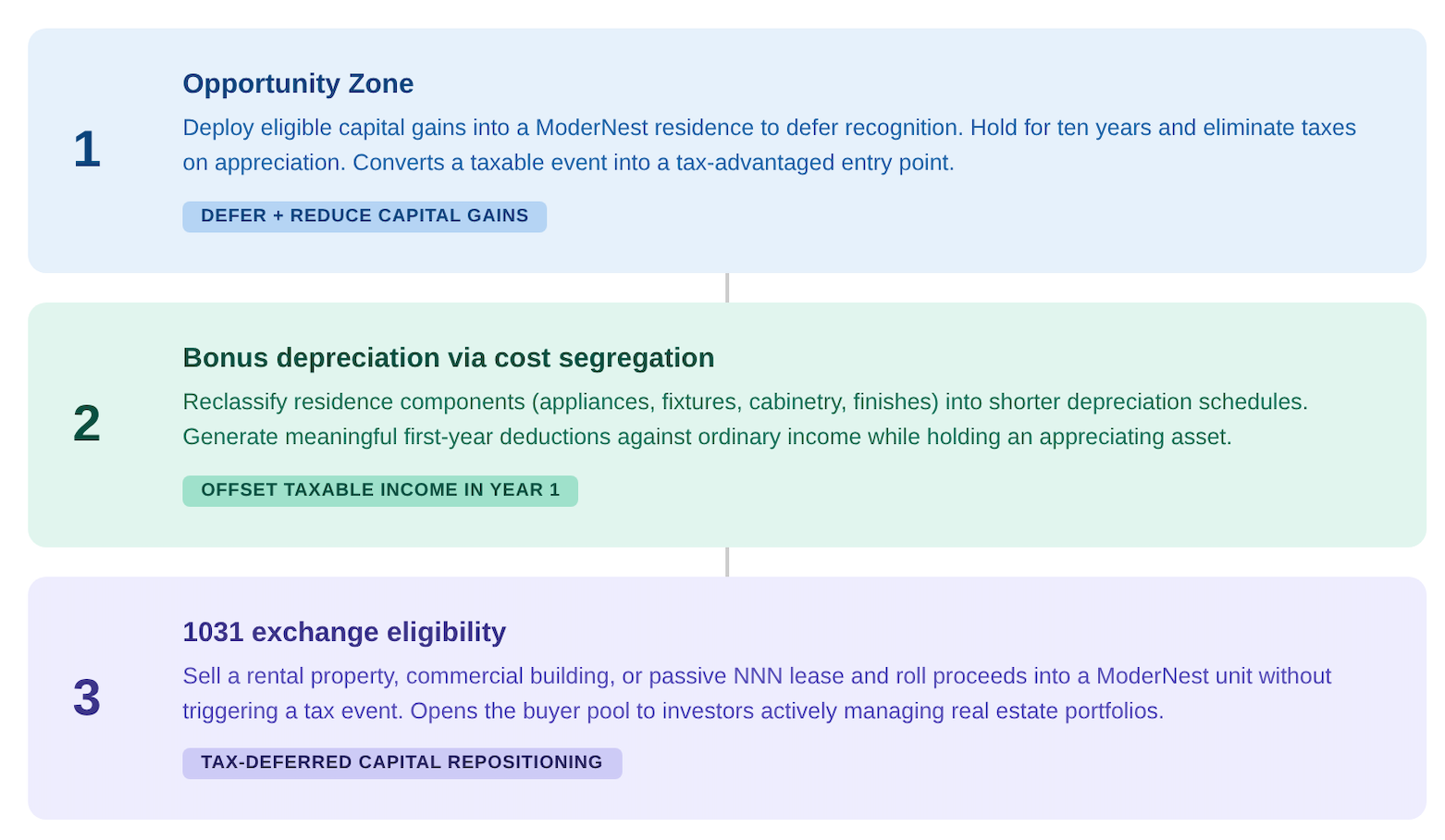
Epstein and her team designed a hospitality-grade residential product around a layered tax-advantaged investment structure, combining Opportunity Zone designation that defers and reduces capital gains, bonus depreciation through cost segregation that offsets taxable income in year one, and 1031 exchange eligibility that lets investors reposition existing real estate capital on a tax-deferred basis. The residence is the delivery mechanism. The tax structure is the product.
The first two ModerNest properties, 129 residences in Nashville's Wedgewood-Houston neighborhood and 131 in Gulch View, are under construction with deliveries beginning in early 2027. Both sit in federally designated Opportunity Zones, and both are managed by Victory Living Group, a hospitality-driven operator that handles dynamic pricing, booking platform marketing, and concierge services. Owners can move freely between personal use and short-term rental income without managing anything themselves.
In this deep dive, we explore:
The tax structure underpinning ModerNest draws on three distinct mechanisms layered on top of each other, each targeting a different dimension of a buyer's tax exposure.
The first is the Opportunity Zone. Both ModerNest properties sit in federally designated OZ locations, which means investors who deploy eligible capital gains into a ModerNest residence can defer recognition of those gains and, if they hold for ten years, eliminate taxes on any appreciation in the property itself. For a buyer sitting on a seven-figure gain from a business sale, a stock liquidation, or a cryptocurrency exit, the OZ designation converts what would otherwise be a taxable event into a tax-advantaged entry point for real estate ownership.
The second is bonus depreciation through cost segregation. A cost-segregation study reclassifies components of the residence, appliances, fixtures, cabinetry, and certain finishes, into shorter depreciation schedules, allowing the owner to accelerate paper losses that offset taxable income. A buyer can generate a meaningful first-year deduction against ordinary income while holding an appreciating asset in one of the fastest-growing metros in the country.
The third is 1031 exchange eligibility. ModerNest residences qualify for like-kind exchange treatment, which means an investor who owns a rental property, a small commercial building, or a passive NNN lease can sell that asset and roll the proceeds into a ModerNest unit without triggering a tax event. This opens the buyer pool beyond the traditional second-home purchaser to the much larger universe of real estate investors who are actively managing portfolios and looking for a tax-efficient deployment.
Combined, the return profile diverges sharply from a conventional condominium purchase: tax deferral on entry, accelerated depreciation on operations, rental income during periods of personal non-use, and long-term appreciation in a Nashville market that has added 136,000 residents since 2020 and shows no signs of slowing.
"We did not start with the residence and ask how to make it tax-efficient," says Epstein. "We started with the tax structure and asked what kind of product would make it sing."
Tax-advantaged investment structures are only as good as the underlying asset. A qualified opportunity fund that invests in a mediocre multifamily project in a flat market still produces mediocre returns, tax benefits notwithstanding. At ModerNest, the product was designed from the start to maximize the performance of the tax vehicle.
The mechanism is flexible ownership: each residence can serve as a primary or secondary home, a part-time retreat that generates rental income when the owner is elsewhere, or even a full-time short-term rental operated as a pure investment.
Owners are not locked into one mode. A buyer who uses the unit as a Nashville pied-à-terre for six months and rents it for the other six captures both the lifestyle value and the STR revenue that activates the depreciation and OZ benefits. That flexibility is what makes the tax structure produce real after-tax returns.
The operational layer that makes this work is Victory Living Group, a hospitality-driven property manager that handles dynamic pricing, listing optimization across booking platforms, guest turnover, cleaning, and concierge services. Victory charges 12 percent of STR revenue, meaningfully below the 25 to 30 percent that full-service hotel operators typically take, while delivering the service standards that short-term rental guests now expect.
"The management layer is what separates this from a condo with an Airbnb listing," Epstein says. "Owners get hotel-grade revenue without hotel-grade operational burden, or the fees.”
ModerNest units also carry an exclusive Airbnb licensing agreement, a structural advantage in a market where short-term rental permits have become increasingly regulated. Nashville tightened its STR permitting framework in recent years, and purpose-built developments with licensed STR rights carry a scarcity premium that conventional condominiums cannot replicate.
"The Airbnb license is the piece most buyers underestimate," says Heather Gustafson, who leads sales for ModerNest and has spent more than two decades in Nashville residential real estate. "It is what ensures the unit can generate rental income consistently, and that rental income is what activates the depreciation benefits and drives the entire after-tax return.
“The license is what turns the tax structure from theory into actual after-tax returns," she says.
ModerNest's first two properties occupy two of Nashville's strongest residential corridors, each with a different character and buyer profile.
WeHo (1425 4th Avenue South, 129 residences) sits in Wedgewood-Houston, the neighborhood that has undergone Nashville's most dramatic transformation over the past decade. Once an industrial district, it is now home to SoHo House, Hermès, Zimmermann, and Truth, one of the city's most prominent live-music venues. Geodis Park, the 30,000-seat stadium that will host Olympic soccer in 2028, is within walking distance. The neighborhood's trajectory mirrors the kind of cultural density that has driven residential premiums in Williamsburg, the Arts District in Los Angeles, and Wynwood in Miami.
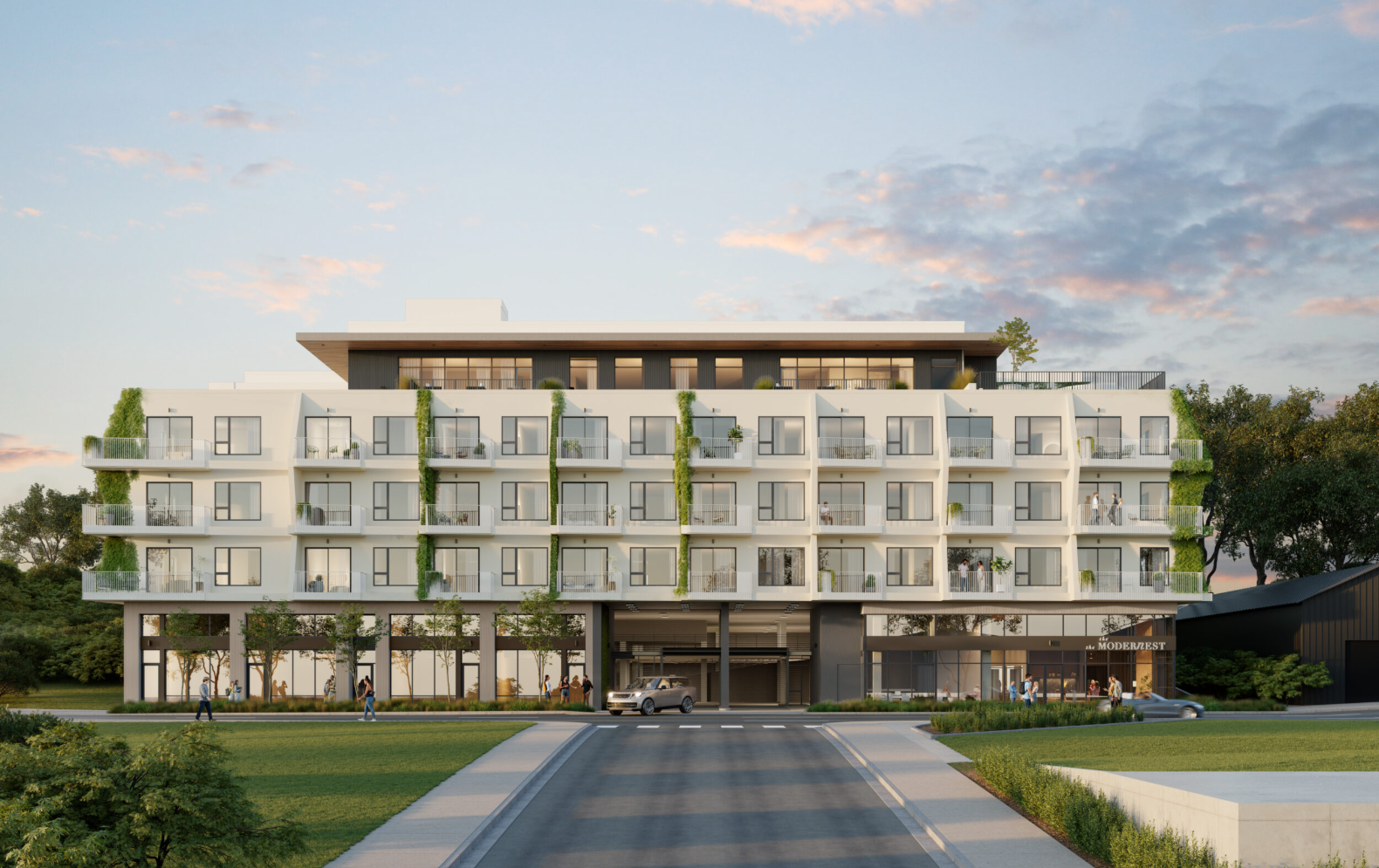
Gulch View (1107 8th Avenue South, 131 residences) overlooks Nashville's walkable urban core, with proximity to Vanderbilt, Belmont University, and Music Row. WeHo draws buyers attracted to Nashville's arts-and-design scene; Gulch View draws those who want proximity to the city's institutional and corporate core. A street-level coffee and wine bar open to the neighborhood creates a hospitality layer at the building's base.

Both properties were designed by Studio APA, the Los Angeles-based firm led by Alex Pettas (formerly of RIOS and Studio PCH), with interiors by Nashville's Comma Design Works.
"The design brief was specific: these units needed to photograph and perform well on booking platforms while still feeling like a curated home, not a serviced apartment," says Gustafson. "That meant wide-plank hardwood, floor-to-ceiling windows, Fisher & Paykel appliances, keyless entry, private balconies. Every detail had to work for the owner living there and for the guest booking it."
The amenity program at both properties reflects the dual-use design: every element is built to serve a full-time resident and a three-night STR guest equally well.
"The amenity mix reads more like a boutique hotel than a residential building," says Gustafson. "The STR revenue that drives the tax math depends on the guest experience holding up against Nashville's hotel inventory. If the pool deck and the fitness studio don't compete with the Thompson, the nightly rates don't hold."
The ModerNest thesis requires a very specific kind of market: strong population growth to support long-term appreciation, a deep tourism engine to sustain STR demand, Opportunity Zone geography, and the cultural momentum that attracts private wealth buyers who want to own (not just visit) a piece of the city.

Nashville delivers on all of it.
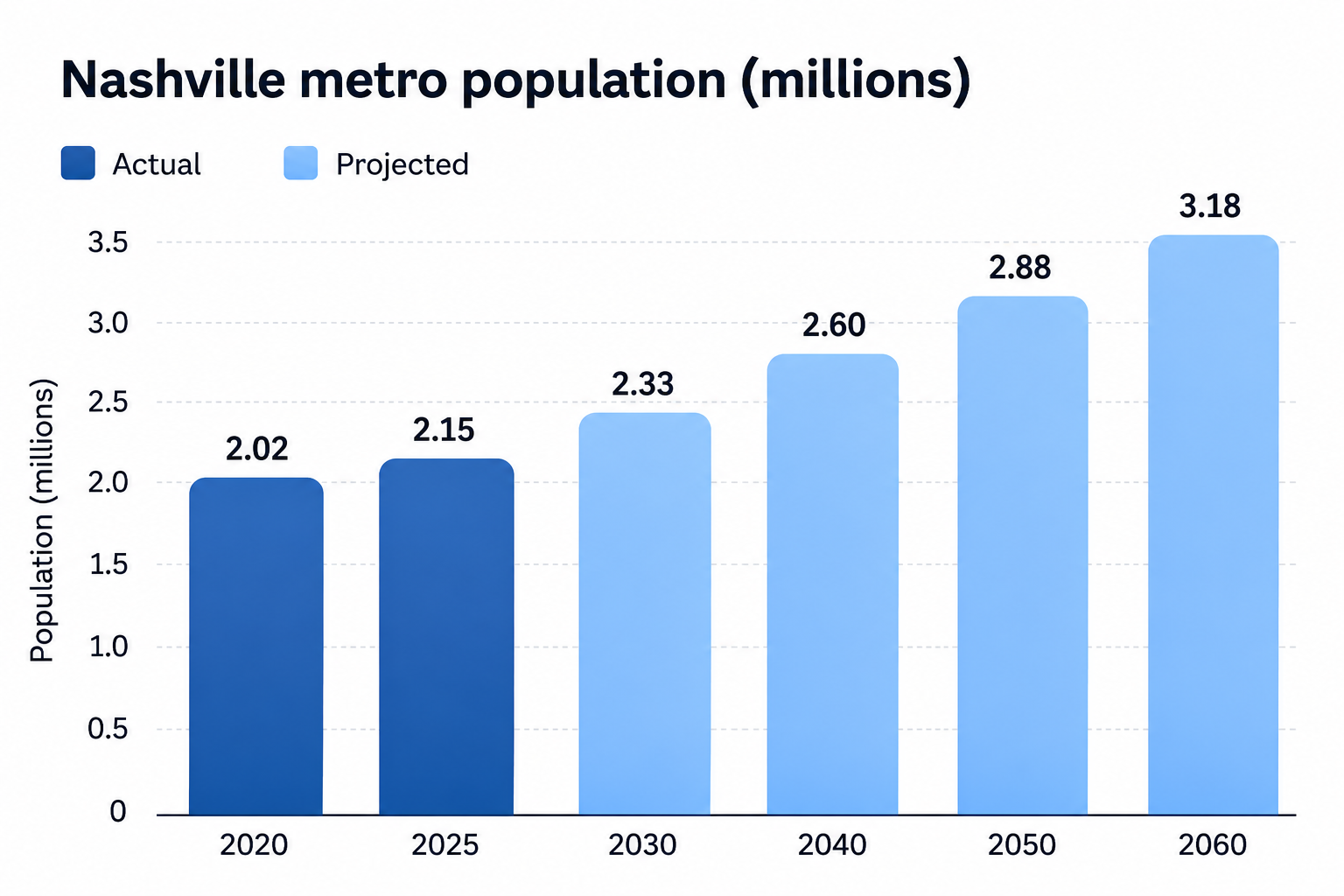
The population surpassed 2.15 million in 2025, up 6.4 percent since 2020, with projections calling for 3.18 million by 2060. Corporate relocations across healthcare, manufacturing, retail, finance, and technology have diversified what was once a single-industry economy, and Tennessee's lack of a state income tax continues to draw high-earning transplants from New York, California, and Illinois.
The tourism economics are equally compelling. Nashville generated $11.2 billion in visitor spending in 2024, roughly $31 million per day, and international visitation hit 450,000 the same year, on a trajectory to surpass 500,000 by 2026. The city recently ranked first on Travel + Leisure's Best Places to Live list. Layer on an events pipeline that most competing markets cannot match: Nashville will host Olympic soccer at Geodis Park in 2028 and the Super Bowl in 2030, a two-year window of sustained national visibility that will drive STR demand well beyond what the underlying market already supports.
Meg Epstein founded CA South, the development platform behind ModerNest, a decade ago. The firm's portfolio now spans 850,000 square feet of industrial and logistics space and 485,000 square feet of residential, across 468 delivered residences, with another 260 under construction.
The bet behind ModerNest is that the model is repeatable at institutional scale.
The combination of hospitality-grade design, flexible ownership mechanics, Airbnb licensing, and professional STR management travels with the market, not the site. Any high-growth, tourism-heavy metro with Opportunity Zone geography and strong STR demand can support it. Nashville is the proving ground, but the playbook is being designed for expansion.
The traditional choice between "live in it" and "rent it out" is collapsing. A growing class of buyers wants products designed for optionality rather than commitment to a single use case: remote workers splitting time across cities, portfolio investors seeking tax-efficient deployment, frequent travelers who want a home base in a city they love.Developers who figure out how to wrap genuine lifestyle quality around institutional-grade tax mechanics will capture a market that conventional condominiums and passive investment vehicles both miss.
Don’t miss Thesis Driven’s Spotlight interview with the ModerNest team next Wednesday, June 10, 12:00 PM - 1:00 PM EDT, where we'll explore how their tax-advantaged flex residential model is redefining. Register here

The carry trade is dead, and capital is moving to whoever can manufacture cash flow. Takeaways from a day with more than 250 investors and operators in emerging real estate.


EG is applying the American real estate private equity playbook to Australia, starting with medical office


Covering the future of real estate and the people creating it