
The State of AI in Real Estate: What We've Learned So Far in 2026
Eight lessons on why AI pays off for some firms and not others
Eight lessons on why AI pays off for some firms and not others
A quarterly look at feasibility study activity with our friends at TestFit

Multifamily operators in the lurch; have the PMS wars begun?
As AI eliminates administrative burden and capital consolidates around scaled platforms, operational performance is becoming a primary driver of returns


Today's letter was guest written by Daniel French, CEO of Northpoint, a nationally scaled property management platform specializing in single-family, build-to-rent, and small multifamily rentals.
Property management has never been a glamorous corner of real estate. The prestige and the money have always belonged to the buy side: developers, acquisition leaders, capital markets professionals. Property managers changed toilets and fielded tenant complaints. It was a career people wound up in but rarely sought out.
But something is shifting. Private equity is pouring billions into operating platforms and demanding returns that only elite operators can deliver. AI is eliminating the administrative drudgery that made the job unappealing and freeing operators to function as genuine asset managers. More than a million apartments were delivered in 2023 and 2024 alone, requiring professional management at a scale the current talent pipeline was never built to handle.
The conventional wisdom says AI will make property management obsolete. The evidence points in the opposite direction. AI is making the best property managers indispensable, better compensated, and for the first time in the industry's history, deliberately recruited rather than randomly discovered. For investors, that shift has direct implications for where competitive advantage gets created in the asset class.
The AI tools reshaping property management are not the same as attempts to replace the property manager entirely. The distinction matters. Fully autonomous systems have struggled to scale for structural reasons. The AI that is transforming the profession works alongside operators, handling the administrative layer while freeing humans to focus on judgment, relationships, and asset performance.
Today's letter covers:
Property management employs roughly 900,000 people in the United States, according to the Bureau of Labor Statistics, yet only a handful of universities offer dedicated degree programs in the field. Hundreds of schools offer real estate finance degrees. Real estate education has always taught students how to buy, sell, and finance buildings; very few programs teach students how to operate housing at scale. The industry has filled the talent gap the only way it could: by recruiting people who never planned to be there.
Emily Watson started leasing apartments at the University of North Texas because it paid half her rent. She is now COO of Lantower, one of about a dozen REITs focused on multifamily housing in the U.S. with roughly $2.5 billion in assets under management.
"It's a lot like most of us,” she recently said on the Rent Roll podcast. “We just kind of accidentally grew up here. I started leasing apartments at the University of North Texas because it was fun, and I got a 50 percent discount on my rent, and my roommate did it as well, so we didn't have to pay rent and we were kind of hooked.
“It was only supposed to be for the summer, but as this industry kind of sucks you in, you get addicted to it and followed the same kind of traditional path: assistant manager and then a property manager, a regional manager, but then jumped over to asset management, and now ultimately the COO of Lantower."
My own path followed a similar arc. I came to property management from the buy side: in 2005, my partners and I were acquiring small investment properties, and by 2008 the GFC had steamrolled our cash position. What we found when we looked closely was an operations problem, not a market one: fraud, mismanagement, poor communication, maintenance overruns. We took operations in-house, and I have been running them ever since, first as a GP and vertically integrated owner, more recently as a pure third-party manager.
Like so many, I muddled through with technology tools that were mostly terrible and workflows that did little to remove the friction endemic to daily operations. That is finally changing.
Property management is moving away from a fragmented "mom and pop" back-office function and becoming infrastructure. Institutional investors increasingly realize that operational excellence can no longer be an afterthought. High-functioning property management should be like clean running water: asset owners should be able to expect high quality operators in any geography, on tap whenever needed. Three forces are driving this shift. Capital is flooding in, the housing stock is growing, and AI is transforming what the job actually looks like.
Private equity and family office capital is pouring into operating platforms; hundreds of millions have already been committed by some of the top firms in the United States. Alpine Investors is one of the most aggressive new entrants, already managing more than 70,000 units with a stated target of 300,000. The firm launched Oakline Properties through acquisitions of Drucker + Falk and Cirrus Property Management. A successfully executed roll-up strategy of a top 5 operator is currently being recapitalized as part of a banked process, with the multiple expected to reach into the 18-20x range, and the valuation reportedly north of $2 billion.
More capital will follow, and as national platforms scale, the talent bar is rising with them.
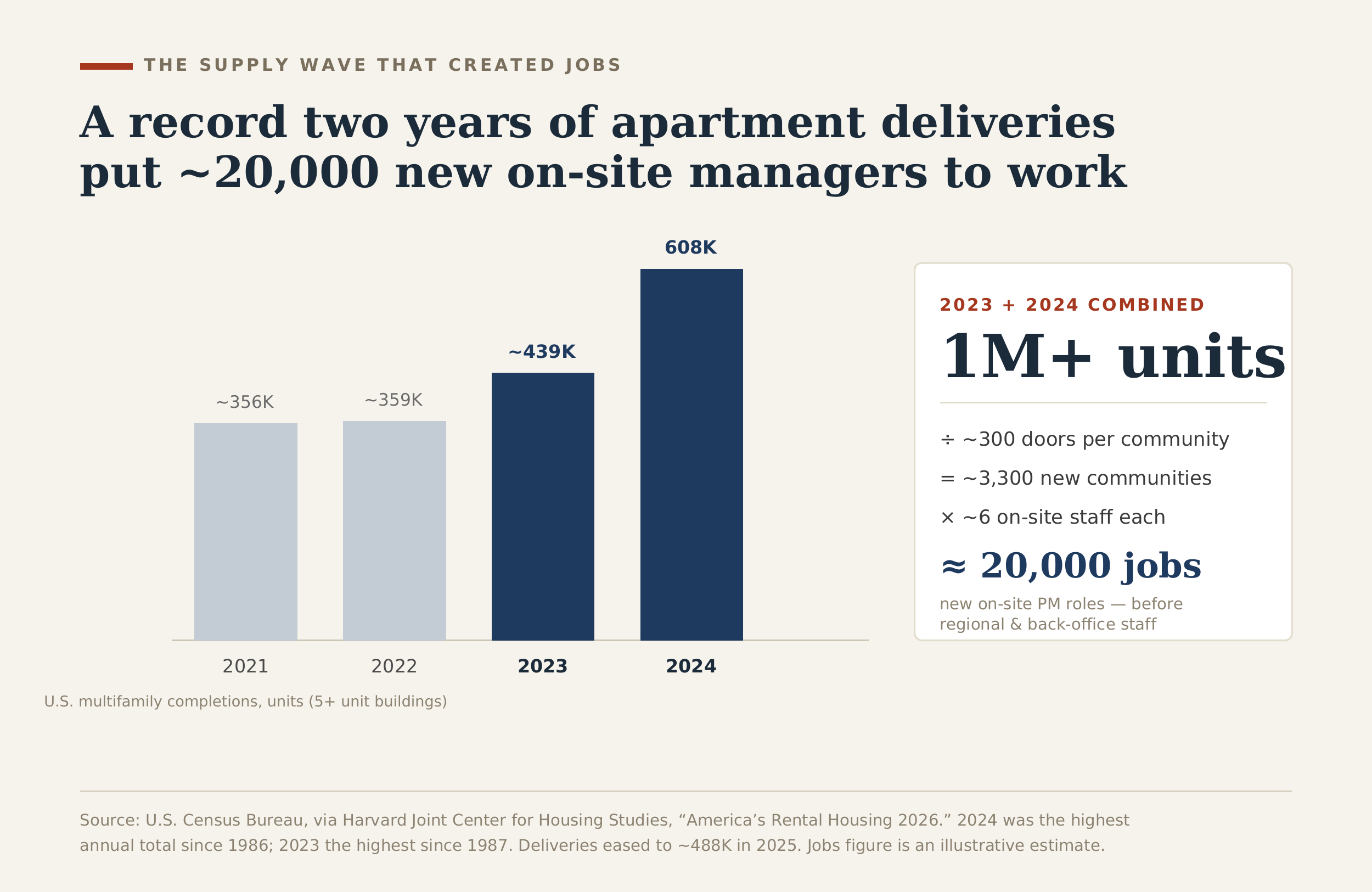
The housing stock is generating its own momentum. Post-COVID, peak multifamily delivery came in 2023 and 2024, with more than a million units delivered nationwide. At an average of 300 units per community, that represents roughly 3,333 new properties. At traditional staffing levels of six on-site operators per community, those deliveries alone created approximately 20,000 new on-site property management jobs, not counting regional managers and back-office support.

The asset management of these deals requires counterparties who are financially literate, think like owners, and have their days freed up to focus on the financial performance of the asset rather than cobbling together reports and amalgamating data.
AI is by far the biggest driver changing this paradigm, and also the most misunderstood. The prevailing assumption, epitomized by “The 2028 Global Intelligence Crisis,” a forward-looking Citrini Research macro report published in February 2026, is that AI-driven leverage will allow fewer people to do more work, decimating white-collar operational roles like property management.
History suggests otherwise. The 19th-century economist William Stanley Jevons observed that improvements in coal-use efficiency in steam engines led to more coal consumption in Britain, not less. Making a resource more efficient increases total consumption rather than reducing it. Goldman Sachs CEO David M. Solomon made the same argument in a New York Times guest essay published in May 2026: automation frees people to do more complex work, and industries that adopt it tend to employ more people over time, not fewer.
“A.I. won’t eliminate 25 percent of jobs,” Solomon wrote. “What’s more likely is that people will find more productive ways to spend their time.”
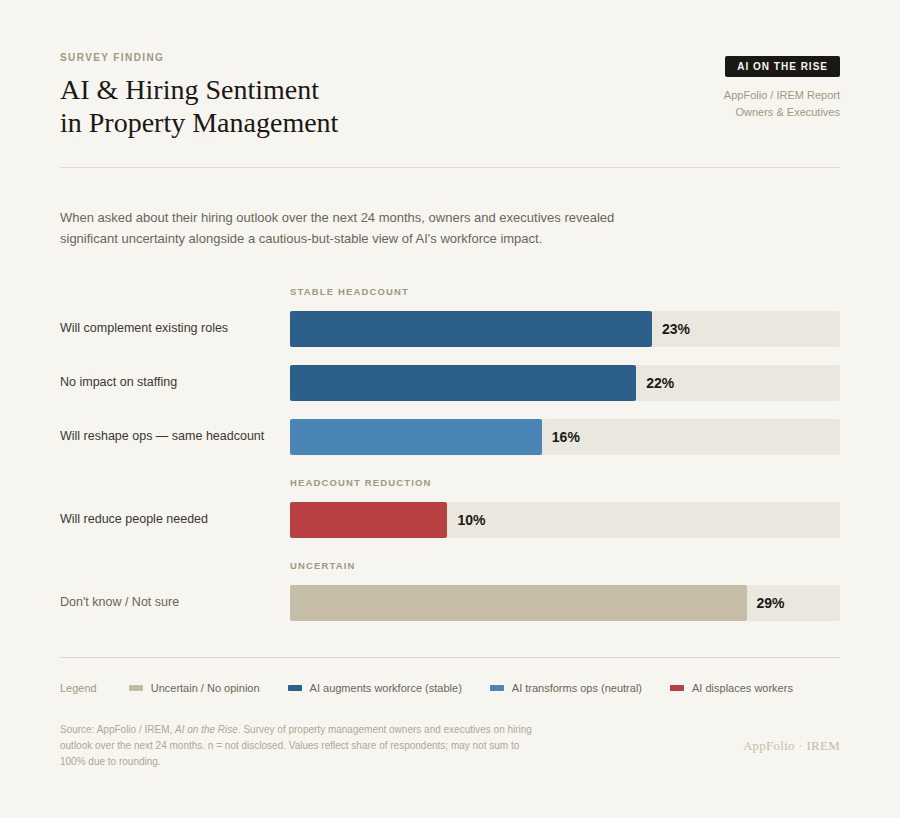
Property management employment has continued to grow despite nearly a decade of AI tools in the industry. According to the Bureau of Labor Statistics, the employment growth rate averaged roughly 2 percent annually from 2014 through 2025. A December 2025 survey by AppFolio and IREM found that only 10 percent of owners and executives expected AI to reduce the number of people needed to run their businesses. The remaining 90 percent expected it to complement or reshape existing roles.
AI-enabled property management frees operators to focus on what owners actually care about: the financial performance of the asset. The numbers behind that shift are already visible. Traditional managers handle roughly 100 units with a support team, AI-forward operators are already running 50 to 200 units per employee. The spreadsheet work and manual data entry will largely disappear. The stewardship work will expand. The best operators will use the time AI returns to them to think like owners, not coordinators.
Consider what this looks like for residential rental owners. A biannual asset management report outlining capital expenditure programs and value-add opportunities is something most owners have never received from a property manager. Property tax grievances, handled proactively with data-driven comp analysis, can meaningfully reduce operating costs. Ancillary income programs, group rate internet agreements and revenue share arrangements, add margin that most operators leave on the table. Insurance claims management is another gap: according to a recent Wall Street Journal report, the five biggest home insurers did not pay out on more than 44 percent of claims resolved last year.
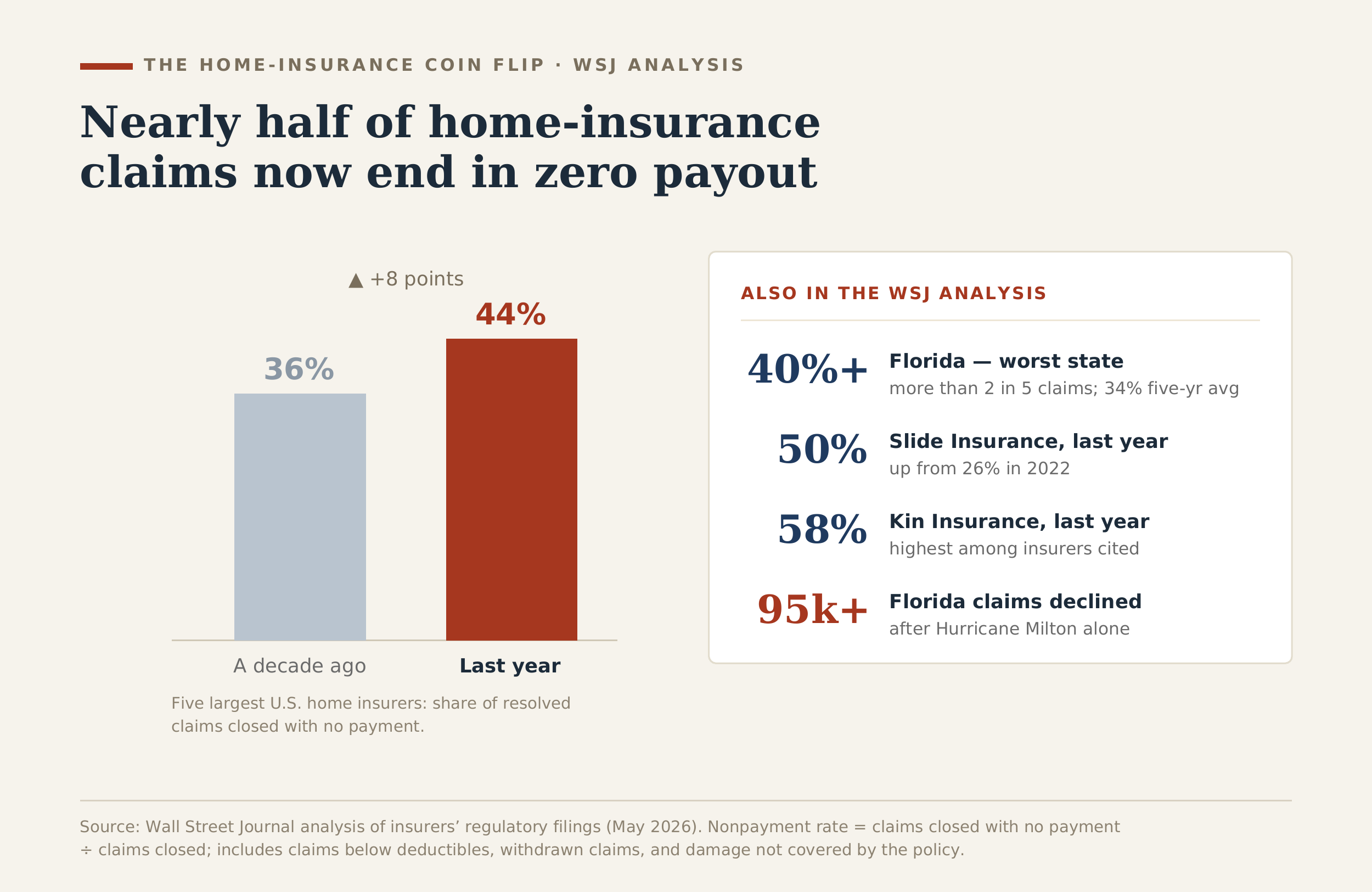
A property manager who prepares proactively for claims and responds effectively when disaster strikes is worth more than one who files a ticket and waits. Operators who can surface the right moment for a refinance, disposition, or 1031 exchange position themselves as financial partners rather than vendors.
Tax advisory and wealth management referrals are a natural extension for operators serving investors who have a significant portion of their net worth tied up in these assets, whether through in-house expertise or partnerships with licensed advisors.
The opportunity does not stop at investment properties. AI is expanding property management's total addressable market beyond investment assets. With roughly 66 percent of American homes owner-occupied, that represents more than 87 million homes that are candidates for professionalized management services, beginning with the more affluent tier. The margin and scale opportunity will encourage a new generation of AI-native property management entrepreneurs, many of whom will launch locally and scale nationally.
The property management workforce is not shrinking. It is professionalizing.
Seeking alpha through cap rate compression and acquisition arbitrage has gotten harder. The investors who are pulling ahead are increasingly the ones who figured out that operations is where the next edge lives.
Evaluating operating platforms is now a fundamental conversation in every GP's boardroom: whether to find new property management partners, remain vertically integrated, or bring management in-house. Most owners have historically asked very little of their property managers. That expectation is changing.
In the coming decade, the greatest source of competitive advantage in real estate may not be access to capital or deal flow. It may be operational excellence.
As AI automates routine work and institutional capital consolidates around scaled operating platforms, the value of elite operators will rise. The firms that win may not be those with the best buildings. They will be the ones with the best people running them.

Eight lessons on why AI pays off for some firms and not others

Office demand is recovering, but speculative development in most markets remains stubbornly out of reach


Covering the future of real estate and the people creating it
