
When Will Spec Office Get Built Again?
Office demand is recovering, but speculative development in most markets remains stubbornly out of reach
Office demand is recovering, but speculative development in most markets remains stubbornly out of reach

New data from Tailorbird shows why two-thirds of real estate operators blow their capex budgets and where AI could actually help
Office demand is recovering, but speculative development in most markets remains stubbornly out of reach

Have some thoughts on spec office development you'd like to share? Join the conversation on today's Linkedin post.
Slowly, the office narrative is changing. Net absorption notched its ninth straight positive quarter (CBRE), and asking rents rose at their fastest pace in six years. Vacancy is falling in 19 of the top 25 markets nationally, with trophy and prime assets performing particularly well.
Nobody talks about “return to office” anymore, and that’s a good thing. Office operators aren’t sitting around waiting for a shift in behavior, they’re serving the market that exists today.
But capital is a long way from catching up to the glimmers of operational hope. Office construction spend continues to decline, mostly as legacy projects work their way to completion. While some new office projects have broken ground over the past 12 months, almost all share one thing in common: an anchor tenant in hand.
Speculative office development, however, is largely dead.
Today’s letter will explore when (and if) spec office development comes back. We’ll dig into the few submarkets where spec office actually comes close to penciling today and make some speculations about when other markets will follow.
It’s no surprise that very few spec office developments are getting financed and built today. Per Micah Rabalais at JLL Dallas, “these buildings need to be essentially 40% or even 50% preleased to even get a construction loan."
“Very few” doesn’t mean “none,” though. Over the past year or so, we count four spec office projects that have been financed and broken ground: three in metro Dallas and one in Manhattan. But those are the extreme exceptions; the office projects getting started today largely have tenants in place: Dallas’s Knox & McKinney (Jones Day), NYC’s Two World Trade Center (Amex), and DC’s 725 12th Street NW (two law firms), for instance.

Rendering of 343 Madison Avenue, on which BXP began construction last year with no leases in hand. But a ground lease termination right held by the MTA forced BXP to commit to the project, making this a debatable example of “market” spec development.
But from a demand standpoint, the office market isn’t as moribund as the absence of spec development may have one believe, particularly at the high end. Asking rents are now growing as vacancy falls in a majority of major markets. The market is also more bifurcated than ever: trophy, Class A assets are in heavy demand while lower-quality B and C product struggles. The same narrative holds for markets: top markets like Manhattan, Dallas, and Miami are performing well while many central business districts in the Midwest limp along at best.
Thehe fact that 70s-vintage officeslop in Naperville can’t land tenants isn’t particularly relevant for spec office development; high-quality Class A product is the market to track.
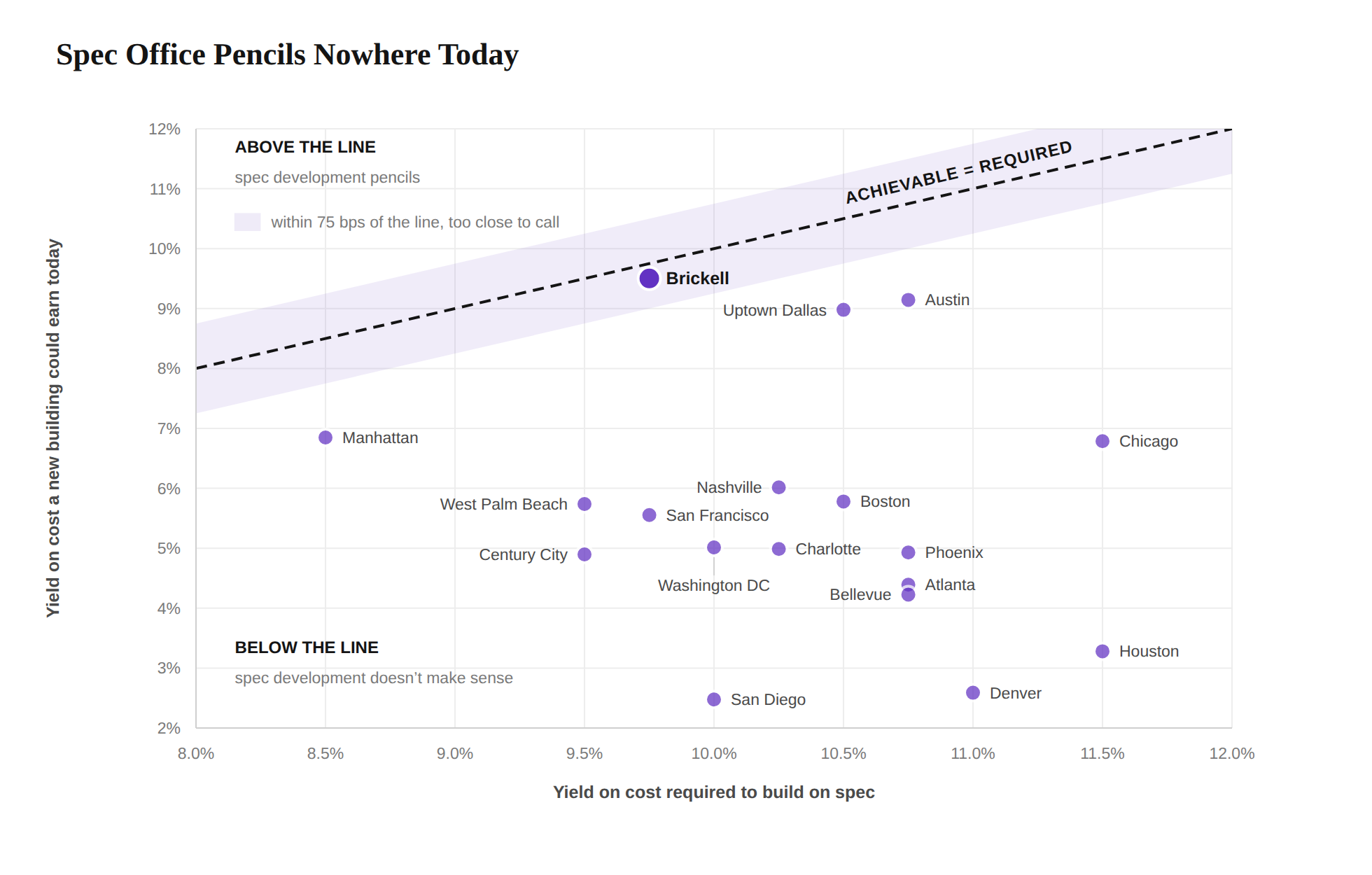
The biggest barrier to spec development today is that the math simply doesn’t pencil. Development costs are too high, rents are too low, and the risk premium is too large to work.It’s a math problem, and we can use available data to see where various markets fall on the does-spec-make sense spectrum.
As we can see, there are no markets where spec office construction currently works in a general case. But some Miami submarkets like Brickell are likely within spitting distance such that individual sites should begin to pencil at the right price. And a number of markets are not too far away: Uptown Dallas, Austin, and even Manhattan might make sense for developers with land at the right price or relatively inexpensive capital.


We've been building AI acquisitions agents with real estate GPs. On August 13, we're opening the hood in a live 2-hour workshop


EG is applying the American real estate private equity playbook to Australia, starting with medical office
Covering the future of real estate and the people creating it