
Who Buys a Closed School?
School districts are putting closed schools and spare land on the market. What does a deal look like from the buyer's side?
School districts are putting closed schools and spare land on the market. What does a deal look like from the buyer's side?

Elevated rates are here to stay, and the maturity wall is real this time.

A Y Combinator-backed real estate developer is betting its own AI can help a small team build faster and cheaper than traditional firms
School districts are putting closed schools and spare land on the market. What does a deal look like from the buyer's side?

Today’s Thesis Driven newsletter is guest-written by Sunil Rajaraman, the founder and CEO of Hamlet.
In December 2025, the school board in Jackson Township, New Jersey, agreed to sell the closed Christa McAuliffe Middle School to Beth Medrash Govoha, a Lakewood yeshiva, for $40 million plus interest. It took two rounds: the board rejected the first bids, then cut its minimum to $44,418,000 and took $40 million, 26% below its first minimum. The buyer paid $35 million at closing in July 2026 and owes the other $5 million over 10 years. By October the district had spent $2.2 million of the $35 million on an equipment lease and $20.7 million on two years of budgets.
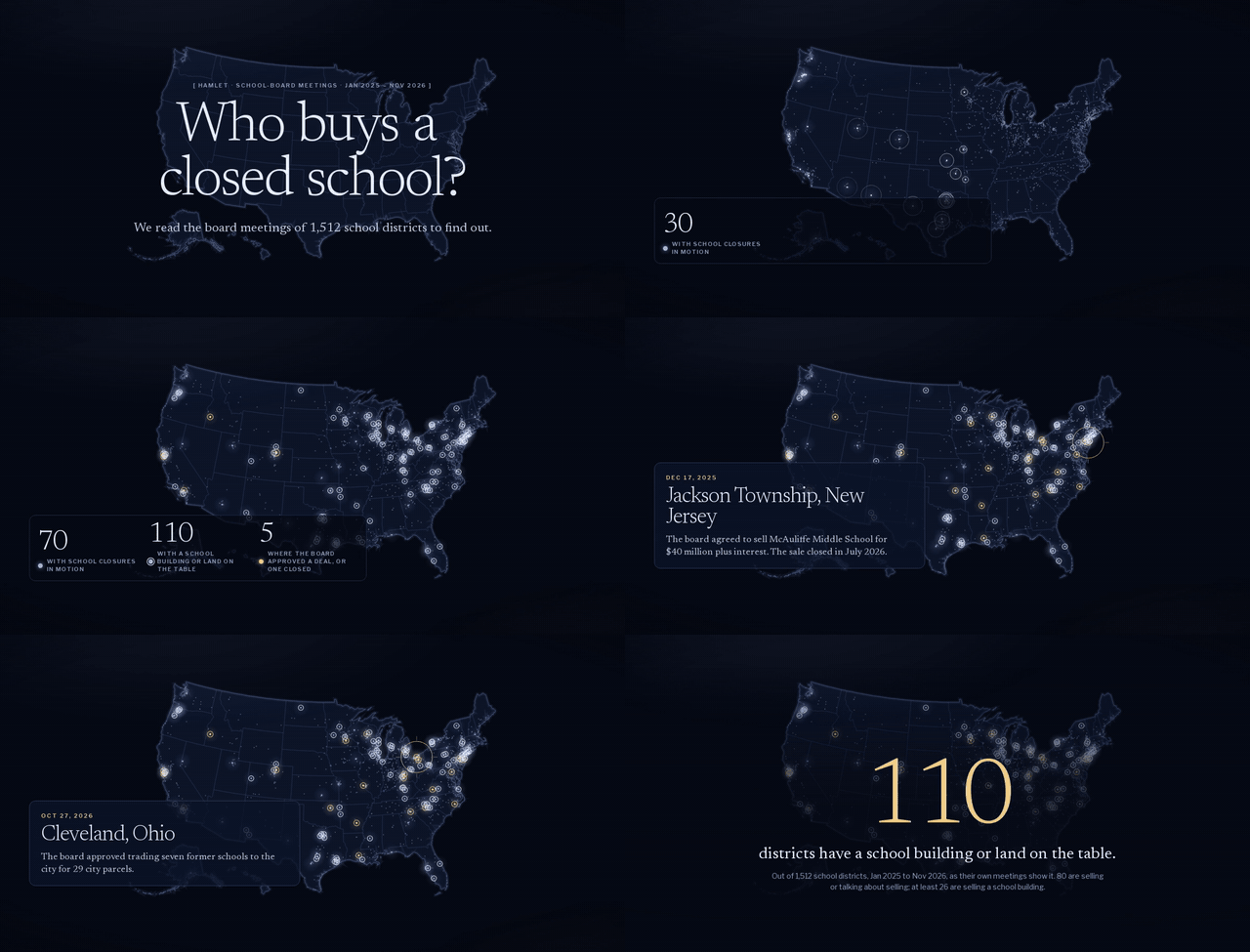
Jackson Township is far from the only district selling a school. Public school enrollment is falling across the US, and school districts are shedding buildings and land. Brad Hargreaves laid out the demographics in The Coming K-12 Crunch: public school enrollment was 50.8 million in fall 2019 and 49.6 million in fall 2022, and it has edged down since, to about 49.4 million in 2024.
This letter picks up at the sale. Hamlet tracks and transcribes local government meetings, from city councils to school boards. For this letter, we searched the transcripts of board meetings in 1,512 school districts to see what these sales look like from the buyer’s side.
What follows is how a closed school gets from its first price to its last, and who gets a look before anyone else.
Jackson Township’s price is the highest we found, and it isn’t typical. Of the 16 school buildings with a sale price stated at a meeting, 12 were priced under $1 million, and eight of those 12 are in Tulsa, Oklahoma. In Jackson Township the board set the price and cut it at open meetings, and the price also fell after the first number in Azusa, California, and South Hunterdon, New Jersey.
We read the surplus-property laws of 12 states, and in at least 10 the law gives a government, a charter school or a tenant a turn before the open market.
This is a snapshot. The 1,512 districts are the ones whose meetings Hamlet transcribes, not a random sample of American districts. We searched 9,035 meetings, held from Jan. 2, 2025, to Nov. 2, 2026; 97% of them took place from October 2025 on, and the median district has four meetings in our data. We did not count a closure or sale that never came up at one of those meetings, so every count here is a minimum.
Today’s letter covers:
Closures are ahead of sales, and most sales so far have been cheap.
Of the 1,512 districts whose meetings we tracked, 70 had school closures in motion. Most are early: in 11 the board had voted to close a school, and in the other 59 a district plan was in front of the board or a formal study was under way. These districts are shrinking faster than the rest: the median one lost 6% of its students between the 2019–20 and 2023–24 school years, compared with 3.8% for the other districts we tracked, according to federal enrollment counts.
“For the first time in its 137-year history, Kyrene is considering school closures.” – Laura Toenjes, superintendent of Arizona’s Kyrene School District, Sept. 16, 2025
In 110 districts, a school building or district land was in play, 170 properties in all. Eighty of those districts were selling or talking about selling. In 37 of the 80, a meeting showed a step past discussion, such as a listing, an offer, a vote or a closing; in the other 43, the meetings show only talk.
We confirmed 32 prices against a transcript, board agenda or news story, and 22 were agreed or completed sales. Their median was $610,000. Sixteen of the 22 were school buildings, and 12 of those sold for under $1 million. Among school buildings, prices ran from $105,000 for Sandburg Elementary in Tulsa to $40 million for Jackson Township’s McAuliffe.
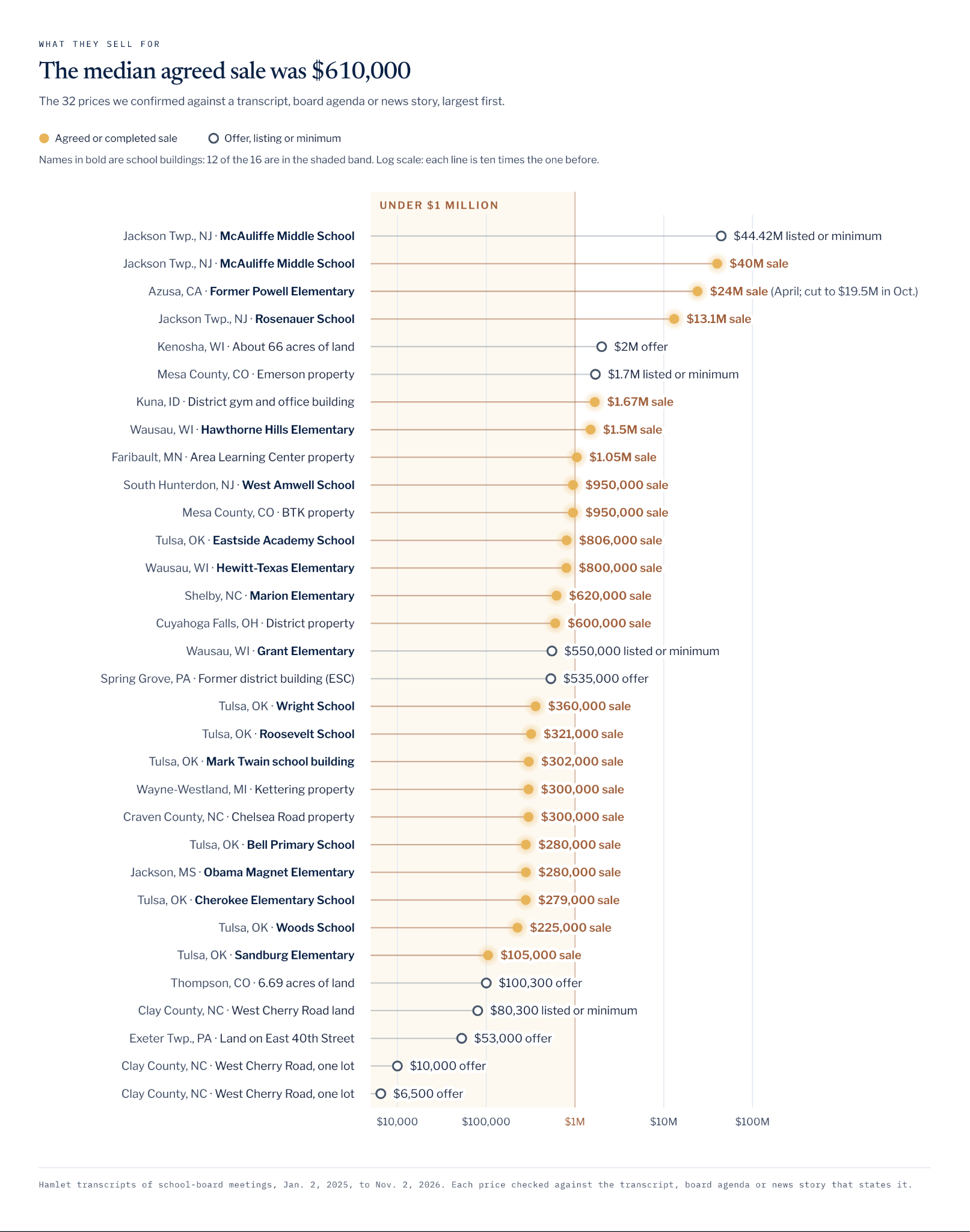
Tulsa pulls the median down. Outside Tulsa, the median agreed sale was $950,000, and the school buildings split evenly: four of the eight sold for under $1 million, and four sold for more. Those four include Jackson Township’s McAuliffe ($40 million) and Azusa’s Powell ($24 million, since cut to $19.5 million and still under contract).
The chart above shows what school buildings sold for; this section shows how the price got there.
In three of the five deals we were able to follow across several meetings and documents, the price fell after the first number was set. We can’t give an average time to close: 136 of the 170 properties come up at only one meeting, and only seven deals show as closed in our data. The two sales we followed from listing to closing took about nine months in South Hunterdon and 10 in Jackson Township; Azusa’s, more than three years after the district declared Powell surplus, has not closed.
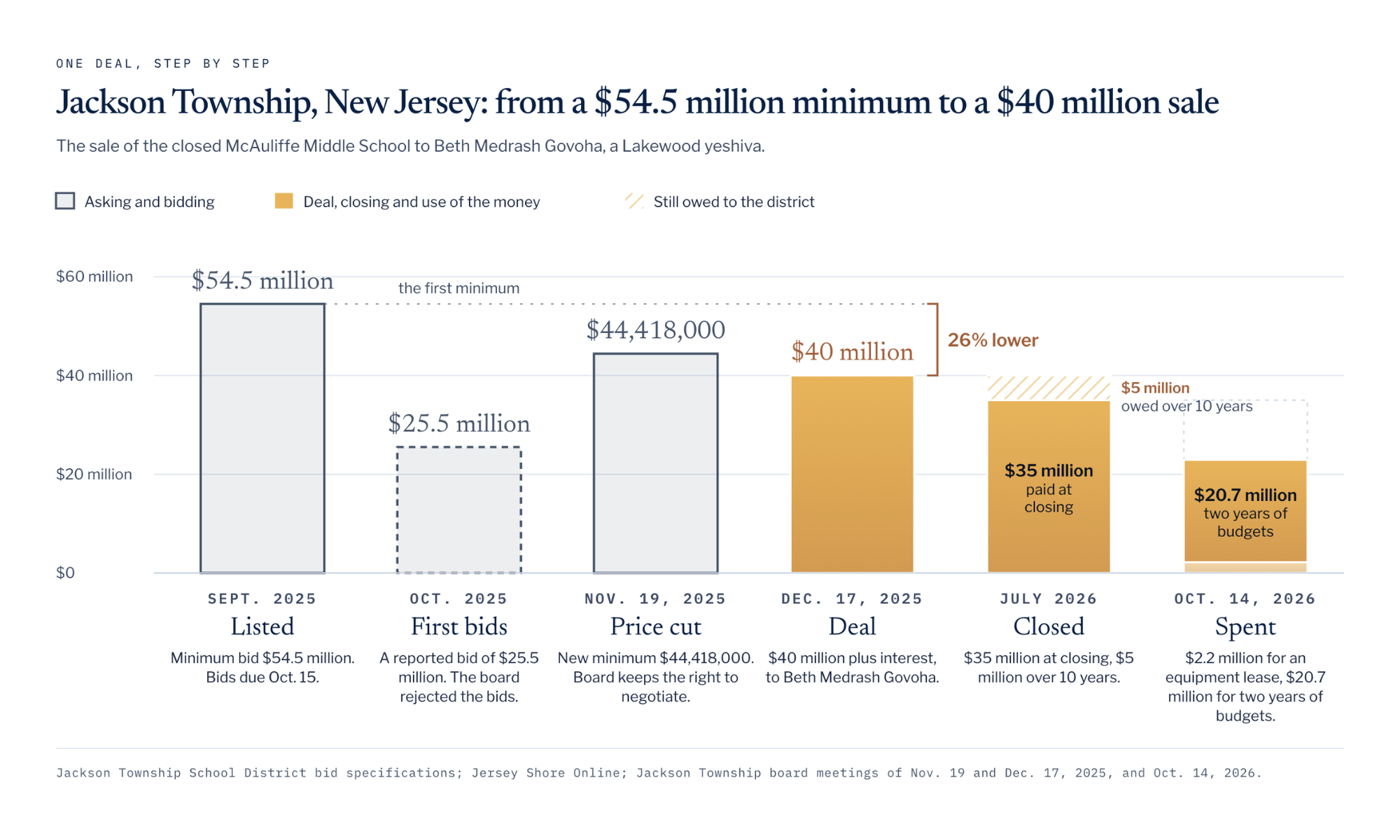
Jackson Township, New Jersey. The district’s first minimum bid was more than $54 million. The first round came in far below that (Jersey Shore Online, a local news site, reported a $25.5 million bid), and the board rejected the bids. In November the board cut the minimum to $44,418,000 and kept the right to negotiate. In December it took $40 million plus interest.
Azusa, California. In August 2023 the district declared Powell Elementary surplus. In November 2024 it signed a contract to sell it to Taylor Morrison, a homebuilder, for $35.5 million. In September 2025 the price fell to $31.2 million, after Taylor Morrison told the district that the entitlement process would force bigger setbacks and fewer homes and cited market conditions. In April 2026, with the buyer citing market conditions, it fell to $24 million plus a share of profits. In October, a fifth amendment set the base price at $19.5 million, 45% below the original, and made Dec. 18 the latest closing date. The sale has not closed.
South Hunterdon Regional, New Jersey. The West Amwell School was up for sale by October 2025. The winning bidder at auction couldn’t close, and the district kept $145,636 of its deposit. A new buyer signed at $1.1 million in February 2026; inspections then turned up problems, and in June the board agreed to drop the price $150,000, to $950,000. The sale closed July 17.
Tulsa. A $486,111 bid for the former Greeley School was withdrawn in March. In July the board approved selling Sandburg for $105,000, reported Anna Colletto and Joe Tomlinson of the Tulsa Flyer.
Cleveland. The district closed 18 schools at the end of the 2025–26 school year and would trade some of them to the city. City Council had not voted as of November. “The projects are far from done deals,” wrote Franziska Wild, the K-12 education reporter at Signal Cleveland, a local nonprofit newsroom.
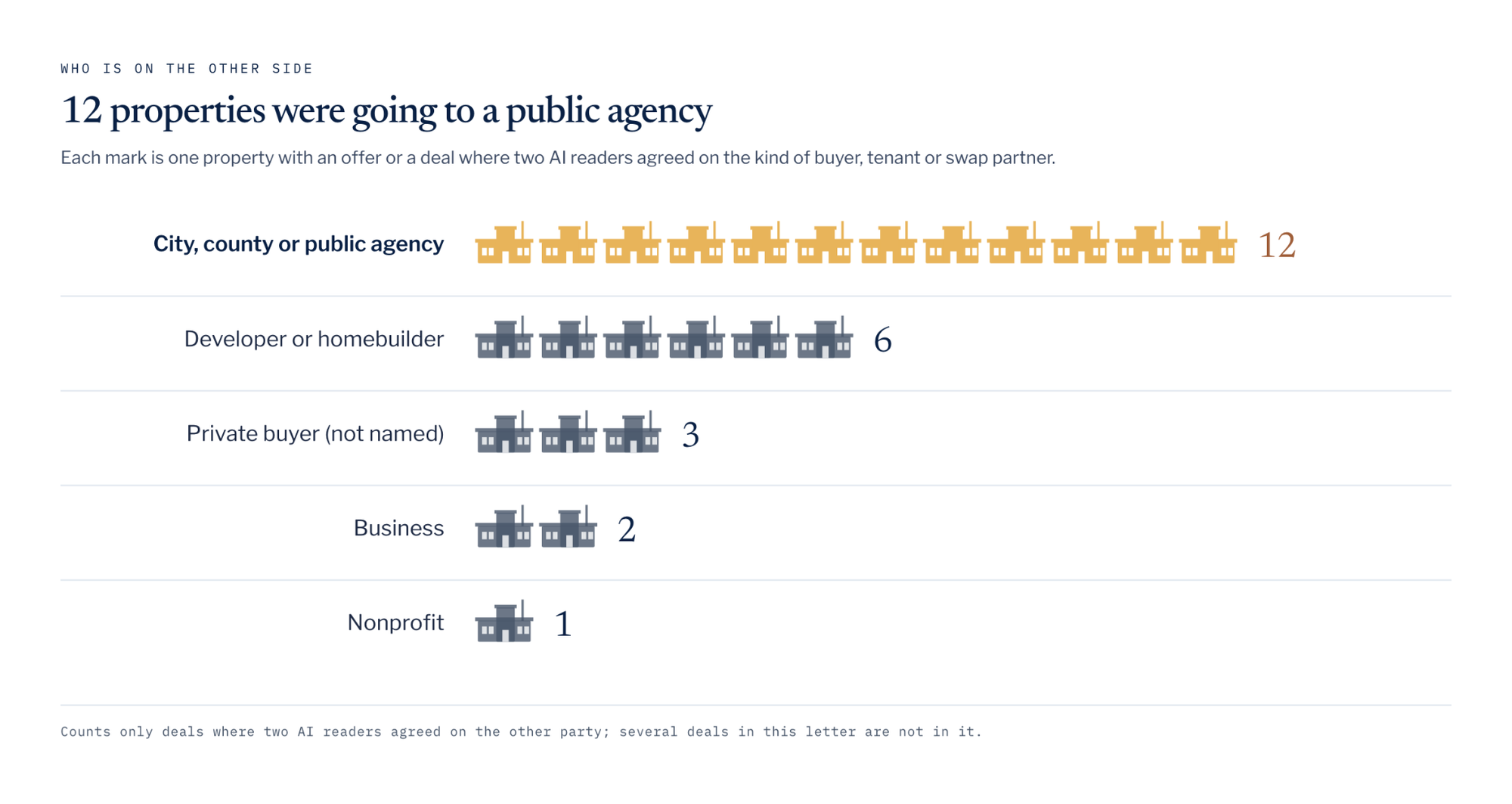
The other side of a closed-school sale is often a public body. At least 12 properties were going to one, and in Cleveland the city is a go-between, choosing which developers get the buildings it takes from the district.
In Cleveland, the city picked teams for nine of the 18 closed schools. For seven of the nine, the school board voted on Oct. 27 to trade the schools to the city for city land, and the city would pass each one to its chosen developer. Mayor Justin Bibb has said he does not want charter schools the city can’t hold accountable to take over the sites, Signal Cleveland reported.
In Tulsa, the board accepted LIFE Senior Services’ $302,000 offer for the former Mark Twain school in June, subject to the tenant’s right of first refusal. The charter tenant, KIPP, then exercised that right at the same price, and KIPP’s board approved the purchase contract in July.
Hillsborough County Public Schools in Florida closed McLane Middle School in 2024. In October its board approved a 55-year ground lease of about six unused acres on the campus to Westbury Commons, FOX 13’s Aaron Mesmer reported. The developer would build 100 to 150 workforce units, with district employees first in line:
“The district will retain ownership of the land and receive annual rent of $1. The proposed 55-year ground lease allows the district to pull underutilized property to a productive public use while retaining ownership of the land and supporting access to safe, quality employer-based housing within Hillsborough County.” – Hillsborough County Public Schools, Oct. 6, 2026
For a developer, the way into a closed school often goes through a government. State law sets the order.
In North Carolina, the county commissioners get “the first opportunity to obtain the property,” at fair market value or a negotiated price (G.S. 115C-518). In Ohio, a district must “first offer that property” to local start-up community (charter) and STEM schools, at no more than appraised value (R.C. 3313.413).
California lists more takers: surplus school property must be offered to the state, the university systems, the county, the city and the housing authority (Ed. Code 17464), and under the Surplus Land Act, when more than one party is interested, first priority generally goes to one that will build housing with at least 25% of units affordable to lower-income households. In Oklahoma, a tenant leasing the property can match any offer the board wants to accept, within 30 days of notice (Title 70, Section 5-117). Most of these rules carry exceptions.
The rules show up in the meetings. Charlotte-Mecklenburg Schools gave the nonprofit Innovative Housing Solutions Foundation an option to lease seven surplus acres next to Garinger High School for 99 years, for about 100 units of educator housing, WFAE’s James Farrell reported. But the county got its chance first:
“...during the April Board of County Commissioners meeting, the county exercised its right of first refusal to the land and declined any interest in the property, freeing it up for CMS Board of Education to take this action.” – An outside attorney presenting to the Charlotte-Mecklenburg Board of Education, May 26, 2026
Ohio’s rule comes with a clock. In Cleveland, a district leader described it: once a building has gone unused for a year, the district must offer it to charter and STEM schools:
“...we do have a year really for doing the planning and processing before we have to just put it out to the open market in, in terms of selling.” – Cleveland Metropolitan School District, Sept. 29, 2026
California’s list played out in Azusa. The district offered Powell to the public agencies on the list. None made an offer, and the district got a State Board of Education waiver of parts of the surplus-sale process so it could pick a buyer through a request for proposals.
We found no first-offer law in Colorado’s education code, but state law and Thompson School District’s policy let a district sell to another government without first declaring the land surplus. In March 2026 the board took up a proposed contract to sell 6.69 acres next to Turner Middle School to its town for $100,300, and staff said the district’s bidding process didn’t apply because the buyer is a political subdivision.
In Charlotte and Azusa, a private party got its turn only after the public agencies passed.
Everything above comes from meetings and public records. The rest is my own read: a buyer's work starts well before the bidding does.
For a buyer, the record is plain. These deals are public and move through several board votes. An investor who has read the state law and follows the board agenda can learn that a school building is coming onto the market well before it is listed.
How we did this. We searched 9,035 school-board transcripts for closings and for sales, leases or swaps of district property. Claude and Gemini, two AI models, read the matches and checked every price against its source, and an item counts only if both agreed on a second review. No person ran these checks. A random sample of 150 skipped meetings turned up three possible closure plans the search missed, so every count is a minimum. The full method is here.

Elevated rates are here to stay, and the maturity wall is real this time.

A Y Combinator-backed real estate developer is betting its own AI can help a small team build faster and cheaper than traditional firms

Office demand is recovering, but speculative development in most markets remains stubbornly out of reach

Covering the future of real estate and the people creating it
