
Deep Dive: Real Property Captive
As real estate's insurance-cost crisis grows, captives gain popularity and embrace membership-club selectivity
As real estate's insurance-cost crisis grows, captives gain popularity and embrace membership-club selectivity

Eight lessons on why AI pays off for some firms and not others
A quarterly look at feasibility study activity with our friends at TestFit
How a generation of superstar chefs and obsessed diners remade urban neighborhoods, inflated rents, and priced themselves out of the streets they made desirable.

Editor’s Note: Food, culture, and real estate are profoundly connected. Not just in the literal form of retail leasing, but as signifiers — and often harbingers — of the rise, decline, and transformation of neighborhoods. Real estate is the business of creating place, and place is nothing without food.
I invited one of my favorite writers, Paul Caine, to write a piece for Thesis Driven on food, culture, and real estate. Paul lives in Brooklyn and is VP Acquisitions at Blank Property Group. –BH
Cucina povera. In Italian, the phrase translates roughly as peasant food, but its meaning is broader: cuisine borne from constraint rather than luxury, dishes that make ingenious use of the limited offerings at hand.
In big cities and small towns across America, a type of cucina povera took hold at the beginning of the new millennium. Between 9/11, the Great Financial Crisis, and COVID, diners, chefs, and food writers rethought fine dining, yanking away the white linen tablecloths and replacing them with something grounded in place, whether that was an urban neighborhood, a local farm, or the food traditions of immigrant ancestors.
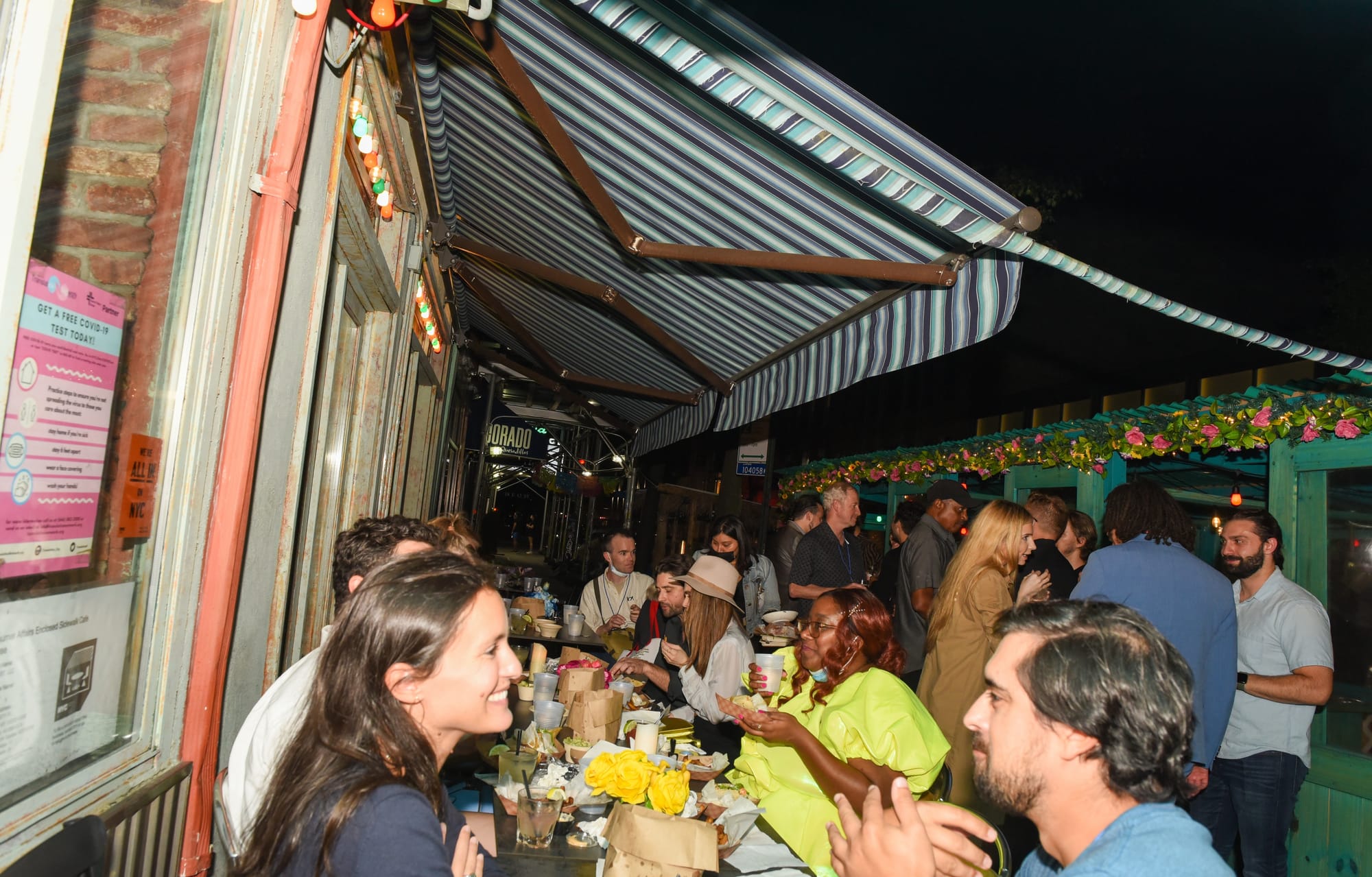
Eventually, the movement would succumb to the placelessness that has raptured away so many other elements of early 21st century life, what Kyle Chayka in his book Filterworld called “airspace,” that “strange geography created by technology.” That’s where we live now, buying coffee in identical-seeming shops in New York, Copenhagen, or Seoul. We wait in lines for novelty pastries we saw on TikTok. The undiscovered hole in the wall is now a contradiction in terms.
The arc of early millennial food culture sheds light on many elements beyond restaurants: the rebirth of the American downtown (and in some instances, the subsequent decline), the emergence of mass affluence, and the homogenization of global culture. And maybe it gives a hint of where we're headed next.
The story of early millennial food culture is, in this sense, also a real estate story: of neighborhoods reclaimed, rents inflated, and independent operators eventually priced out of the very streets they helped make desirable.
Imagine a young person in New York in 2010. He wakes up in his walkup apartment in Williamsburg, walks over to the same laptop he used to write his college essays, points the browser to Eater.com, and reads its roundup of food blogs, local publications, and the stray tweet. He reads it all.
He takes the subway to his office job — everyone worked in an office back then — and starts counting down the hours to lunch. A food cart on his radar today: shredded pork tacos from a corner of Mexico he's never heard of, first spotted on Midtown Lunch, a blog covering casual spots in the city's office districts.
He pays seven dollars for tacos and a can of Diet Coke. It's fine, but perhaps not as enjoyable as the Uzbek restaurant in the Diamond District he tried yesterday, or the sublime Ecuadorian spot built into a loading dock that he visited last week.
But not to worry, he has much more eating to do. Come the weekend, he’ll visit Smorgasburg on the still-under-construction Williamsburg waterfront: cold sesame noodles, fried anchovies, and the lines for a ramen burger (an item he would come to view as a canary in the coal mine for social-media-driven hype).
He will eat well, but more than that, he will immerse himself in food culture: alt-weekly reviews, cookbooks by Ottolenghi and Bowien, Top Chef recaps, craft cocktails from mustachioed barmen who work with the precision of neurosurgeons. He will, in short, spend his days and nights cavorting across a golden age of restaurant culture that no longer exists.
How did we get here? To understand, we must travel further back in time.
It's 1989 and American Psycho protagonist Patrick Bateman is dealing with a perennial problem: the inability to snag a coveted reservation. When Bateman can't book a table at Dorsia, a fictional restaurant so exclusive the maître d' giggles before hanging up the phone, he takes his date to another fictional restaurant, Barcadia. They order shad-roe ravioli with apple compote and a peanut butter soup with smoked duck and mashed squash.
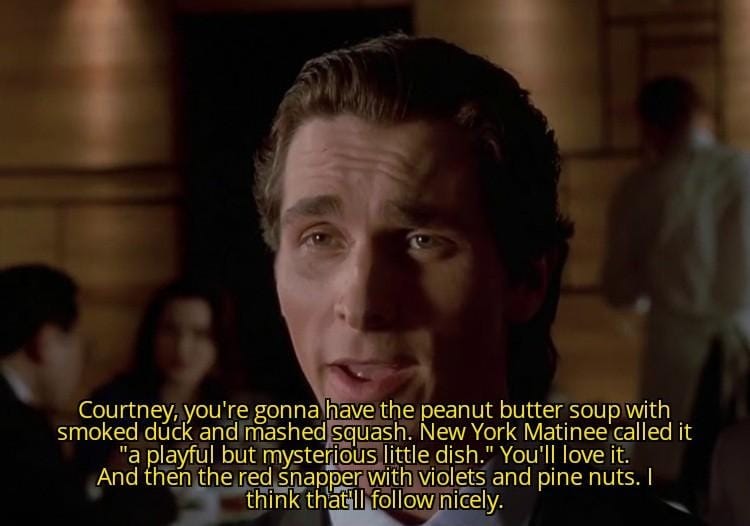
Bateman and his date are Version 1.0 of the foodie. In the 1980s, baby boomers had reached adulthood, returning to the cities their parents had left decades before. And their adventurous sense of taste, encouraged by more frequent international travel and perhaps a reaction to the microwaved TV dinners of their childhood, required an outlet.
The outlet was the "downtown restaurant," perhaps in SoHo, well after the artists colonized the neighborhood but before the luxury brands opened storefronts. Tall ceilings, low lighting, a sense of art direction, "faux-Bohemian casual shit," as Tom Wolfe describes it in Bonfire of the Vanities. The meal, whether it was Italian, Asian fusion, or some rediscovered regional foodway, was inspired by nouvelle cuisine, the post-war culinary movement that combined lightness with the technical rigor of classical restaurant cooking.
These restaurants had begun to prioritize local supply chains, what we now consider "farm to table." Whether it was Chez Panisse in Berkeley or the Quilted Giraffe in New York, menus were no longer content to serve classic French dishes that could be found in formal settings around the world. They began to focus on place. Mimi Sheraton, the venerable Times critic, wrote with astonishment that the Quilted Giraffe "used locally grown ingredients as much as possible, and they even raised some of their own flowers and herbs."
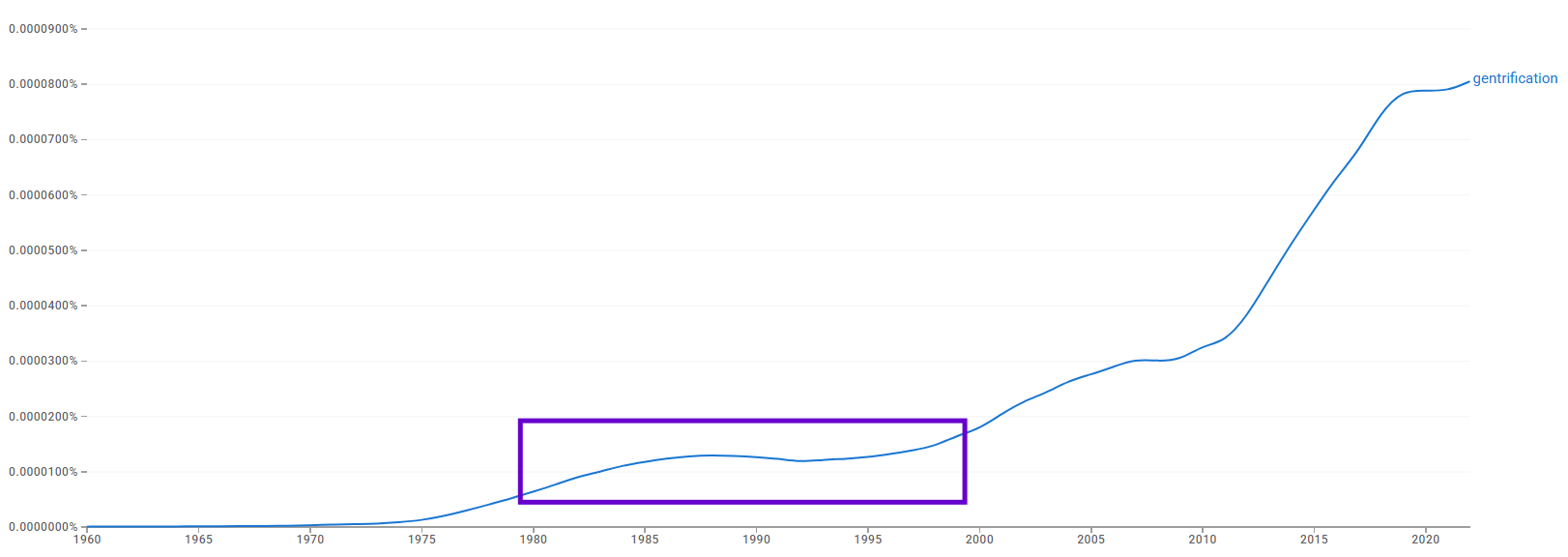
A hot downtown restaurant in the 1980s catered to new urban dwellers who ascribed great cultural significance to the neighborhoods they were reclaiming. "Gentrification" was academic; concerns of displacement and colonization lived well outside the typical discourse and would stay there throughout the rest of the twentieth century.
It’s not surprising that gentrification chatter hadn’t quite caught on; the cost of housing downtown at this time seems impossibly low. In 1983, a 1,200-square-foot SoHo loft would have been a splurge at $1,350, but those who couldn't cut four-figure rent checks had plenty of options, like a one-bedroom in the East Village for $600 a month. And for those looking to buy, a 3,600-square-foot SoHo loft penthouse went for $375,000.
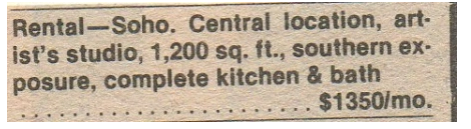
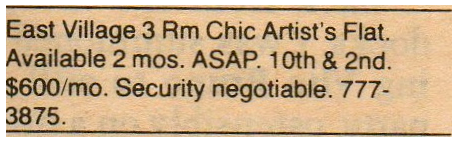

These ads came from the East Village Eye, a long-defunct monthly covering downtown housing, arts, and nightlife, with one piece of the culture notably missing: dining. The previous millennium had not yet contextualized dining as a kind of art unto itself; that would come later, with publications like Diner Journal, Cherry Bombe, and David Chang's Lucky Peach.
The foodies of the 1980s relied on mass media to learn about restaurants. New York magazine hunted hotspots, the Times lavished stars, the Village Voice highlighted the off-the-beaten-path spots. The Zagat Survey innovated an early version of crowdsourcing, but even that was limited; of the 740 restaurants in the 1988 edition, all but 23 were in Manhattan. Brooklyn was still terra incognita to the yuppies.
That would not remain the case. By the late 1990s, Giuliani and Bratton had cut the city's murder rate by two-thirds, and the frisson of danger in “up-and-coming” neighborhoods’ faded through the end of the decade. In 1993, Tribeca's median price per square foot was $182, or $417 adjusted for inflation. By 2003, loft conversions were trading at $703 per square foot, or $1,264 adjusted for inflation.
The quasi-bohemian loft living of the baby boomers had given way to a sleek, shiny version of downtown, exemplified in Sex and the City, and the dining culture followed suit. By the time Michelin released its inaugural New York City list in 2006, a quarter of the starred restaurants were in Manhattan below 14th Street. For many downtown dwellers who had reached the island's southern terminus, the next hotbed of affordability was Brooklyn, and the restaurants followed.
Back to our millennial foodie in 2010, sashaying through a city of inexpensive and high-quality culinary delights. As a resident of Williamsburg, he would have paid around $1,500 a month, roughly in line with the city median. It was not destined to last.
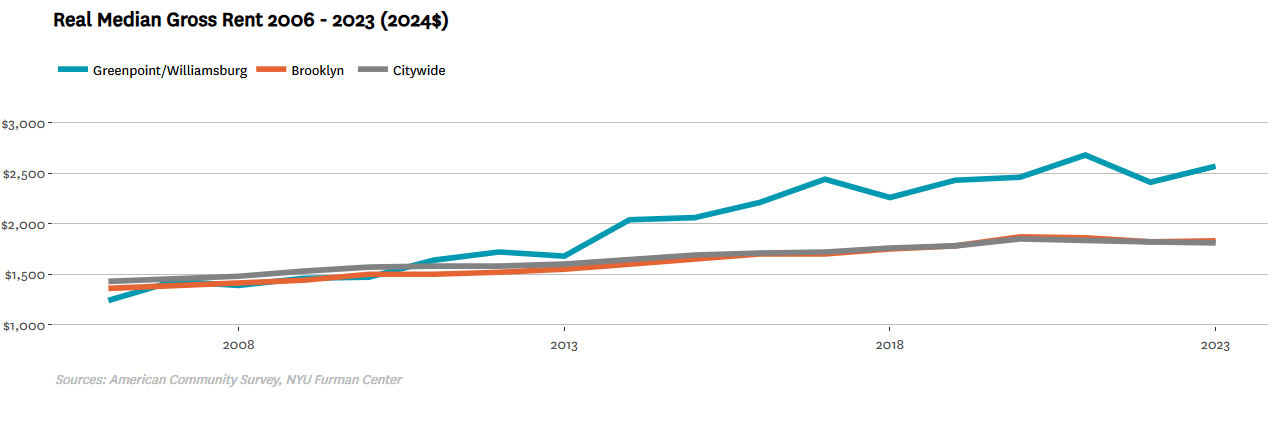
The early millennial food culture sat on a weak foundation. The Great Financial Crisis was a reprieve, not a pardon, and eventually the economic contradictions of an industry with famously low pay and torturous working conditions began to buckle under their own weight.NYC's minimum wage in 2009 was $7.25 an hour, comically low relative to the cost of housing. At a median Williamsburg rent of $1,500 a month, an hourly worker needed 206 hours just to cover rent. The restaurant industry was never in equilibrium, relying then, as it does now, on immigrant labor; over 60 percent of restaurant workers in New York City are foreign-born. In hindsight, early millennial food culture looks less like a circular economy and more like a circular firing squad, with casually employed twentysomethings struggling to afford low-cost food served at restaurants barely paying their own expenses.
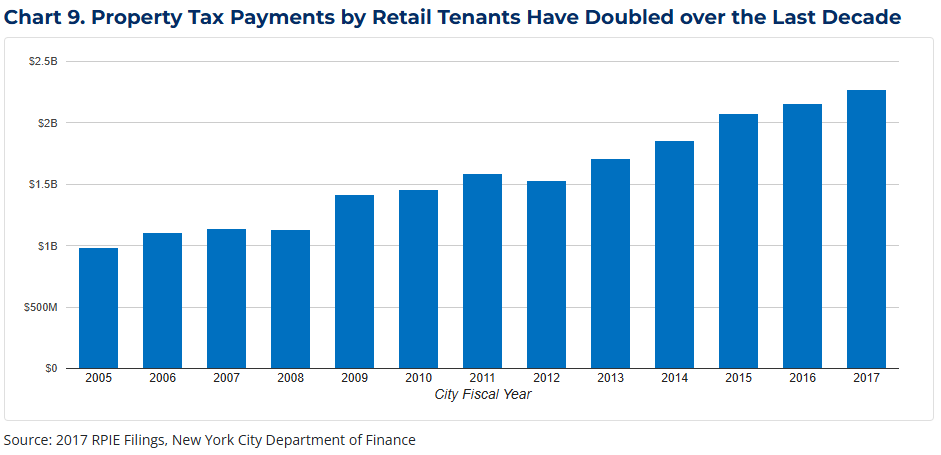
The improving macroeconomic situation was not a salve for restaurants. While commercial rents rose roughly in line with inflation, property values increased much faster, which in turn increased the proportionate share of property taxes owed by retail tenants, including restaurants. The rise of the mini-chain around this time was one attempt for the industry to twist its way out of the economic vise of a resurgent economy through bulk purchasing, scaled human resources, counter service, and off-site commissaries. But a Sweetgreen, for all its blonde wood and sharp branding, is salad airspace.
The "rent is too damn high" complaint became a closing-night trope: the landlord doubled the rent, or the vague "we lost our lease." Politicians across the country have periodically introduced "commercial rent control" bills designed to protect small businesses.
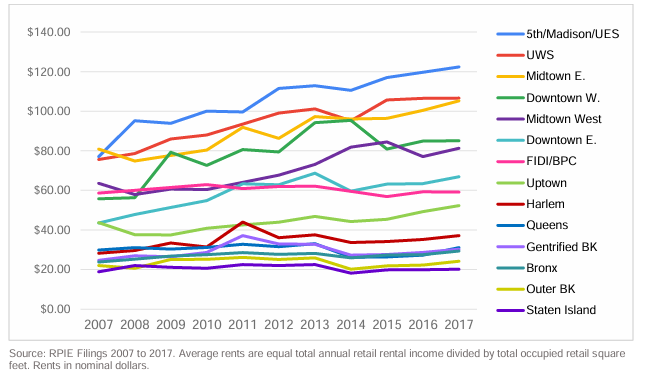
From 2007 to 2017, retail rents increased by around 2 percent per year citywide, but the number was skewed upward by some of the most expensive retail districts, like Madison Avenue and SoHo. Rents in neighborhood retail corridors were generally flat, negative on an inflation-adjusted basis. The decade after the Great Financial Crisis finalized the ascendance of online shopping, putting entire retail sectors on a downward slope from which they would never recover.
The rise of delivery apps began to chip away at restaurant margins. In 2005, Seamless, which started as a matchmaking platform for corporate catering, allowed individuals to place delivery orders directly. Restaurants quickly signed up, hoping higher sales would make up for the reduced margins on delivery orders. By the time Seamless and its competitor Grubhub merged in 2013, there were 25,000 restaurants on the platform nationwide. DoorDash now serves over half a million restaurants.
The frustration of operating a dine-in restaurant, only to watch a large share of orders come through delivery platforms, spilled out into the open. “You could shoot a cannon” through empty dining rooms, restaurant analyst Joseph Pawlak told The Atlantic.
In that same article, Pawlak mused on what the future of the restaurant might look like, suggesting "smaller restaurants with bigger kitchens, expressly designed to cook food not being eaten on-site." CloudKitchens, the ghost kitchen venture from Uber founder Travis Kalanick, rented kitchen space to restaurants seeking to operate in a delivery-first model. But the firm laid off workers and closed sites in Tennessee and New York. Per the Financial Times, occupancy in late 2023 was around 50 percent.
The brutal economics were only one pressure on small operators. Equally damaging was the rise of the social internet, and the parallel decline of an online food blog ecosystem. The glory days of food blogs, often run by young, poorly-paid millennials who graduated college into the maws of the recession, met a slow, agonizing decline. Ad revenue dried up, and fire-sale acquisitions followed.
The millennial precariat had grown up, but that was only part of the story. Social media itself was a walled garden, with the algorithmic feed serving only what the user had already proven to want.
The obsession with local foodways and distinct regional food culture, the lionization of the tattooed chef with a liberal-arts degree and a farm upstate, the quest for the rare dumpling found only in a basement of a Flushing shopping mall, these were casualties of a new paradigm that prioritized virality and mass appeal. The new wave was technicolor ice cream sundaes, tableside service that worked well for vertical video, anything involving waiting in line.
Preferences for food and restaurants had also started to shift. An increased focus on health and performance, biohacking and nutritional optimization, and investor interest in scalability rendered the notion of the chef-driven restaurant increasingly irrelevant. The owner-operator receded and the "entrepreneur" took his place. Delivery platforms grew more sophisticated and improbably inexpensive.
The pandemic was the final nail in the coffin. It permanently shuttered thousands of restaurants and led to food and wage inflation that upended the economics of foodservice.
When restaurants gingerly reopened in 2021, they did so atop the ruins of a lost world.
Mark Greif, in his 2010 essay “What Was The Hipster,” eulogized its eponymous character at a time when the idea of the hipster was culturally prominent. He addressed this seeming paradox in his first sentences:
If I speak of the degeneration of our most visible recent subculture, the hipster, it’s an awkward occasion. Someone will point out that hipsters are not dead, they still breathe, they live on my block. Yet it is evident that we have reached the end of an epoch in the life of the type.
We find ourselves in a similar position with regard to food culture. Foodies still exist, but they are at a moment of transition, deeply influenced by Early Millennial Food Culture, but not of it, and still groping at a new identity, a new raison d'etre. Is it "line culture?” Is it a return to comfort food, the "upscale Applebee's" of hotspots like Corner Store and Bernie's? Is it a recessionary impulse to globally inspired home cooking, a new cucina povera, embodied by the New York Times' popular cooking app?
Whatever it is, one hopes it will eventually emerge into something completely its own. Whatever form it takes, the real question for the American city is whether the ground-floor retail infrastructure that once housed it still can.

K-12 enrollment is falling rapidly. As cities grapple with school closures and property tax revolts, what does this mean for real estate?

A city built around cars and entertainment could be remade over the next decade by forces now transforming both


The carry trade is dead, and capital is moving to whoever can manufacture cash flow. Takeaways from a day with more than 250 investors and operators in emerging real estate.


Covering the future of real estate and the people creating it
