
When Will Spec Office Get Built Again?
Office demand is recovering, but speculative development in most markets remains stubbornly out of reach
Office demand is recovering, but speculative development in most markets remains stubbornly out of reach

New data from Tailorbird shows why two-thirds of real estate operators blow their capex budgets and where AI could actually help
Pop quiz: choose the best equity capital raising strategy


Next Monday, August 18th, we kick off our next cohort of Fundamentals of Capital Raising.
It provides new and emerging real estate entrepreneurs with a playbook to raise capital from individuals, family offices and institutional investors—alongside a community of peers to network, collaborate and share wins along the way. More info here.

Meet Sam. He’s 34 and recently left a job in acquisitions at a Boston-based real estate investment firm. He’s now buying small multifamily projects (8-30 units) and operating a percentage of them as furnished, extended stay rentals to increase yield by 150bps.
He’s closed on two deals with HNWI capital, and has just tied up Washington Place, his largest project to date, and will need $10mm of equity to acquire.
He also has a $200mm pipeline of similar projects ripe for his value-add strategy. And is spinning up his own extended-stay operating brand to manage his properties.
Q: What’s the smartest capital structure for Sam—and what structure gets him to scale without selling tomorrow’s upside to fund today’s burn?
Answer Options:
A) Stay Deal-by-Deal (HNWI Syndicate)
B) Family Office Platform Check (OpCo + Rights to PropCo)
C) PERE Fund Programmatic JV (PropCo Anchor)
D) Co-GP Capital Vehicle (GP Fund)
E) Strategic Extended-Stay Partner (Corporate/REIT/Brand)
F) PropCo Seed + Option (Family Office “First 5” Seed)
G) Fee Facility + Mini-OpCo (Credit + Small Equity)
The Answer:
It’s a bit nuanced, but practical rule of thumb: if the immediate constraint is closing Washington Place with limited OpCo needs, go D or G; if the goal is to scale the $200M program and build the brand, pair B (OpCo) with C (PropCo). If preserving GP promote is paramount, start with F (seed a handful of assets) or D (Co-GP) to prove returns, then step into B/C on better terms. If distribution/corporate demand is the bottleneck, E accelerates revenue—but at a cost to brand control.
We walk through the structures, math, term sheets, and sequencing inside Fundamentals of Capital Raising—and help you pick the right wallet for your platform.
We walk through the math, term sheets, and sequencing inside Fundamentals of Capital Raising—and help you pick the right wallet for your platform.
If you’ve got a live deal (or a pipeline) and need an LP-ready plan, this cohort is a five-week sprint to get prepped for the process. Format and flow mirror the outcomes we laid out in our last announcement, updated with fresh templates and live reps.
What you’ll leave with
The first half of the course will introduce students to different investor types, deal structures and the sponsor’s preparation of underwriting and marketing materials to go out to market for capital.
The second half will walk students through the process of sourcing debt, running the outreach process to equity investors and negotiating a term sheet with an institutional investor.
At the end, students will design and present their own capital raising campaign—and later be provided access to an ongoing online community for students to continue networking, exchanging notes and sharing wins.
The online course is hosted in 5-week cohort programs, which include 1-hour of live Zoom discussion and Q&A each week.
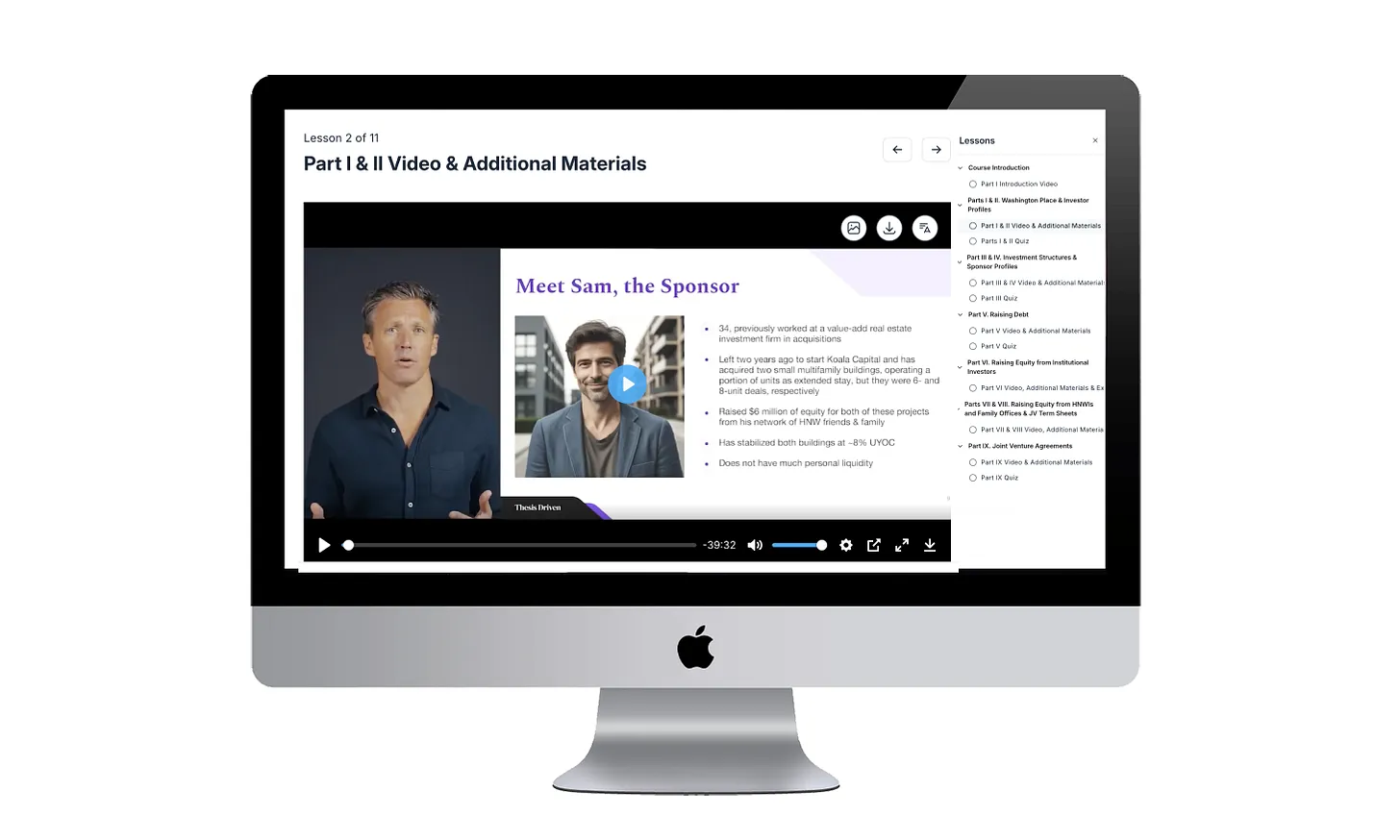
Online & live cohorts get access to the Thesis Driven Circle community & resources
You can go here to sign up and learn more about the course.
Raising capital for real estate projects is intimidating.
It requires a unique combination of sales, marketing, legal and general entrepreneurship skills, plus knowing how – and where – to access investors. But unfortunately there is no guidebook to develop this skill set or navigate the capital raising process, leaving budding real estate entrepreneurs in the dark and on their own.
We’ve personally been there and know the challenges!
So we created this course to help students raise capital with confidence, providing the fundamental skills and knowledge to run a well-planned fundraising process (whether it's for $50 thousand or $50 million) and avoid many potholes along the way.
We expect this knowledge will be broadly applicable to anyone growing their career in real estate, but specifically to new & aspiring real estate entrepreneurs, as well as anyone looking to brush up on their approach to the real estate capital markets.
Note that while there may be some transferrable lessons, this course is not intended for entrepreneurs looking to raise venture capital.
What does it cost?
The live bootcamp in NYC is $1,799 (and limited to 25 students). The online cohort is $1,299, and discussion groups are limited to 15 students. Sign up here.
—Paul Stanton

A live one-hour session on building a Claude workflow that reads any OM, populates your model, and audits the leases against it

A live one-hour session on turning your investor deck into a reusable Claude workflow you keep

Get ready for conference season with a 90-minute session on picking shows, prep, on-site execution, and follow-up

A live two-hour workshop on structuring and raising capital for real estate operating companies plus their underlying assets
Covering the future of real estate and the people creating it