

Deep Dive: Angeleno & Affordable Housing Development in Los Angeles
How Angeleno is structuring deals and executing projects in a market where affordable housing is notoriously difficult to build

Don’t miss Thesis Driven’s Buy Box deep dive on Angeleno next Thursday, March 26th. Register here (for accredited & institutional investors only):

Los Angeles has spent years trying to fix its housing shortage. Voters have approved billions in housing bonds, and Sacramento has passed a steady stream of pro-housing legislation.
Yet despite all that activity, LA is still short of more than 500,000 homes. Hundreds of thousands of households in LA County are severely cost-burdened. And the city actually permitted fewer affordable units last year than it did a decade ago.
Building affordable housing in Los Angeles is extraordinarily hard. Most projects depend on a precarious stack of tax credits, tax-exempt bonds, and public subsidies that must be assembled piece by piece before a shovel ever touches dirt. Each source comes with its own approvals, timelines, and compliance requirements. In practice, affordable housing projects often take five to seven years to reach the groundbreaking stage—and even that is no guarantee of what comes next.
Angeleno was founded on a simple but contrarian bet: that Los Angeles was on the verge of a fundamentally different way to build affordable housing. The LA-based firm develops affordable and workforce housing across the city through a vertically integrated model that includes site acquisition, design and permitting, construction, and long-term ownership. Its strategy is built around a recent shift in local housing policy that is making affordable housing projects easier to approve and finance.
City and state leaders have started to chip away at the biggest bottlenecks, making it faster to approve and build 100% affordable projects. The result is a new development pathway that looks very different from the traditional subsidy-driven model. And Angeleno is one of the firms positioned to capitalize on it.
In this deep dive, we’ll explore:
- Why Los Angeles remains one of the hardest places in the country to build housing
- The policy changes opening a new path for affordable development
- How Angeleno’s vertically integrated platform is structured to move through that system
- A closer look at the firm’s Colfax project in Valley Village
- What this means for affordable housing as an institutional asset class
The Los Angeles Housing Market
The housing numbers tell a stark story. More than 494,000 low-income renter households in LA County have no access to an affordable home. Among the city's most economically vulnerable residents, 77% spend more than half their income on housing. Only 17% of Los Angeles households earn enough to afford a median-priced home, which now costs $849,410.
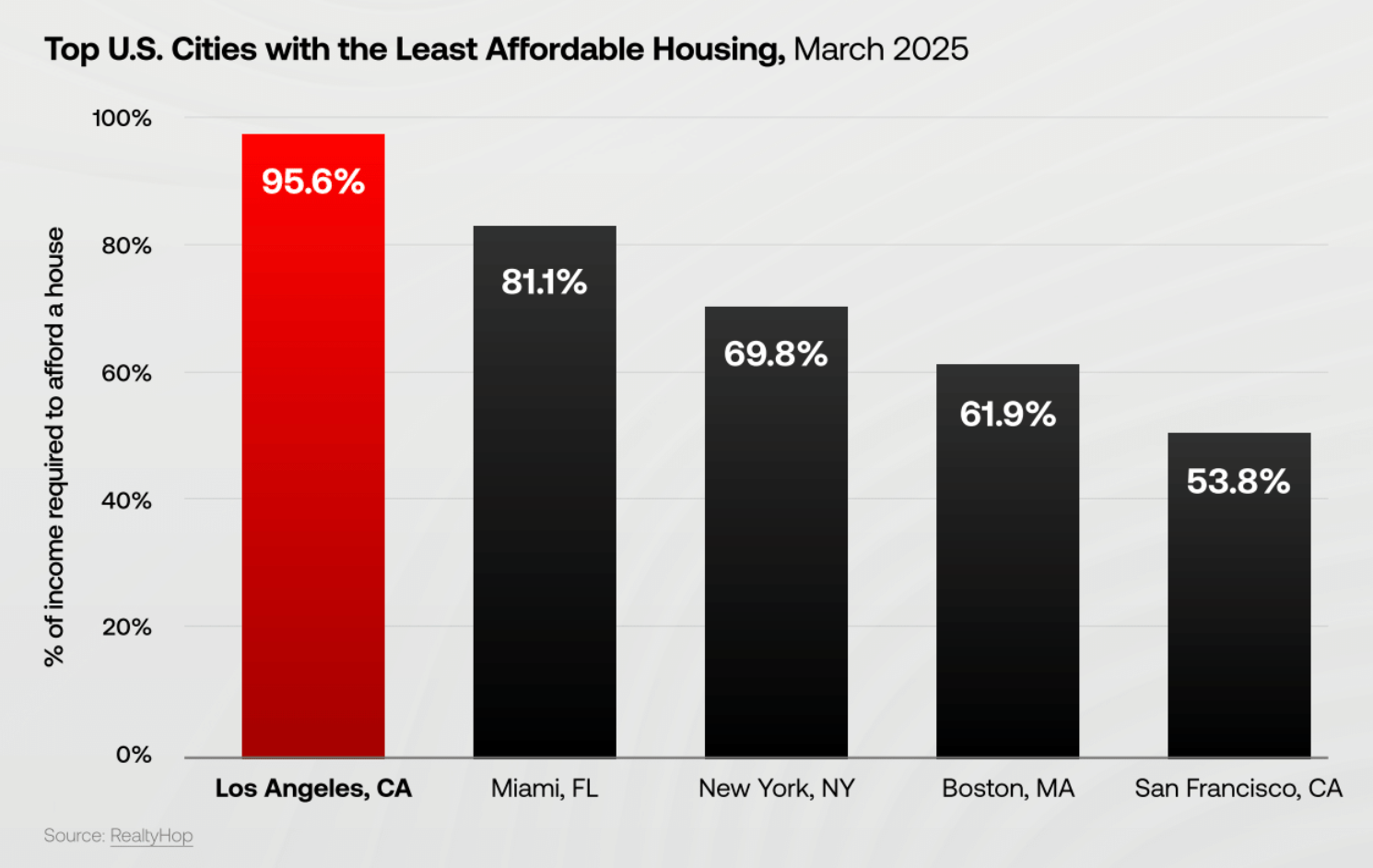
The supply side of the equation has been broken for decades. Between 2010 and 2023, LA County added more than 600,000 jobs but fewer than 200,000 housing units. Houston, Dallas, Atlanta — even high-cost coastal markets like Seattle and Austin — have all built housing faster on a per-capita basis. That gap reflects something more stubborn than market conditions. It reflects how decades of policy, zoning, and political inertia have made Los Angeles structurally resistant to building at scale.
The reasons are deeply embedded. Much of the city’s residential land remains zoned for low-density housing, limiting the ability to add units in many neighborhoods. Developments face layers of environmental review, zoning approvals, and discretionary entitlements that can stretch timelines by years. Community opposition regularly delays projects through appeals and litigation. And Los Angeles has some of the highest construction costs in the country, driven by labor costs, regulatory requirements, and complex building standards.
Those are the obstacles every developer in Los Angeles faces. For affordable housing, there's an additional layer. And that’s where the opportunities now exist.
A Policy Shift Is Creating a New Development Model
The public subsidy system that finances most affordable housing in Los Angeles is itself a notorious bottleneck. Low-Income Housing Tax Credits, tax-exempt bonds, state and local programs — each requires a competitive application, its own compliance framework, and its own timeline. That's a large part of why five to seven years from concept to construction start became standard.
California and the city of Los Angeles have begun attacking this differently, by stripping out the regulatory friction that makes building so slow and expensive. The reforms that matter most:
- Executive Directive 1 (ED1), December 2022: Mayor Karen Bass signed an order requiring city departments to complete all pre-construction review for 100% affordable projects within 60 days — cutting a years-long process to under two months.
- Affordable Housing Incentive Program (AHIP): Allows developers who commit to full affordability to build more units on a given site — more floors, fewer restrictions.
- State legislation: AB 2334 allows qualifying projects to add up to three additional stories. AB 2097 eliminated minimum parking requirements near transit. AB 1763 and AB 2345 expanded density bonus provisions for affordable housing.
For developers who know how to use these tools, the economics of building affordable housing in Los Angeles look meaningfully different than they did five years ago.
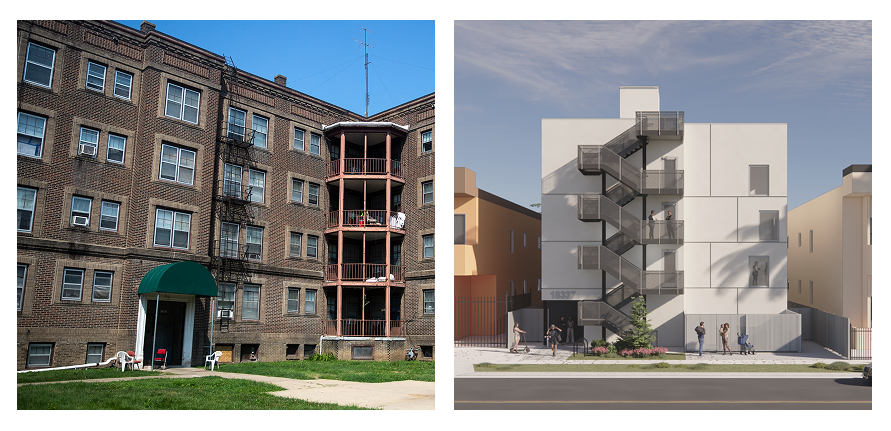
"The traditional affordable housing system was designed for a different era," says Angeleno CEO Brandon Hance. "ED1 and AHIP fundamentally changed the calculus. “For the first time, you can build 100% affordable housing in Los Angeles on a timeline and capital structure that looks more like market-rate development."
But better policy alone doesn't build housing. Someone still has to navigate the nonprofit partnerships, the city agency relationships, the long-term affordability covenants, and the construction execution — all at once, all on a compressed timeline. The execution barrier is real, and most developers, faced with that complexity, keep doing market-rate work. The ones who can combine policy fluency, capital markets access, and construction expertise in a single platform are the ones who actually get units built.
That is exactly what Angeleno set out to do.
Angeleno's Vertically Integrated Platform
Brandon Hance and Sterling Jawitz didn't come to affordable housing through the traditional nonprofit or public finance route. Hance had spent years as both a developer and general contractor in Los Angeles, overseeing more than 200 residential projects totaling over half a billion dollars in portfolio value. Before that, he had founded and sold two technology companies. Jawitz brought 15 years of experience across multiple real estate asset classes and most recently led real estate at Common Living, where he developed housing models built around affordability.
What they shared was a conviction that the policy shifts underway in Los Angeles represented something most of the market hadn't yet priced in.
Before they acquired a single site, they spent six months doing something unusual for a development firm: they interviewed everyone who touched the process. Architects, land use attorneys, nonprofit housing organizations, construction professionals, city agency staffers. The goal was to map every friction point in the affordable housing development process before committing capital to navigate it.
"We wanted to understand where those friction points were and how to build a platform that could move through them, not around them," says Jawitz.
What came out of that process was a vertically integrated platform managing the entire development lifecycle in-house: site sourcing, design & permitting, capital markets, construction, and long-term asset management. To support deal flow, the firm built two proprietary technology tools:
- MICA screens parcels across Los Angeles by zoning, policy overlays, and development feasibility to surface acquisition targets.
- DASH tracks every deal from initial site identification through closing.
In a market where good sites are scarce and move quickly, that sourcing infrastructure is a meaningful edge.
Angeleno works exclusively within the City of Los Angeles, where the firm has spent years learning a single regulatory system well enough to move through it faster than developers who spread themselves across multiple markets. Each project is structured as a partnership with a nonprofit housing organization, which handles affordability compliance, reporting, and resident services. That partnership also unlocks the welfare property tax exemption, which materially reduces operating costs and improves project feasibility.
The in-house general contracting capability is what separates Angeleno from most affordable housing developers. The firm completed foundation and four-story framing on its first projects in eight weeks and took on third-party general contracting work for another affordable developer, delivering that project six months ahead of schedule. It is now fully leased and stabilized with Section 8 voucher holders.
"Controlling construction is non-negotiable in this market," says Hance. "When you're building affordable housing in Los Angeles, every dollar of cost overrun and every month of delay directly affects whether the project pencils. Our ability to frame four stories in eight weeks is both a construction metric and an underwriting advantage."
Angeleno currently has 11 projects under ownership and two more in escrow. The target tenants are households earning between 80% and 120% of Area Median Income — teachers, healthcare workers, municipal employees. These are the people who keep Los Angeles running and have been slowly priced out of the city they serve.
Case Study: Colfax Boulevard, Valley Village
The Colfax project is the clearest illustration of what Angeleno's platform looks like in practice. The site is a roughly 17,000-square-foot double lot in Valley Village, a neighborhood in the San Fernando Valley with strong demand for workforce housing and good access to jobs and transit.
Angeleno sourced it off-market. The site came vacant, which matters more than it might sound. Relocation requirements for existing tenants are one of the most common sources of delay and added cost in affordable development, and avoiding them entirely compressed both the timeline and the budget.
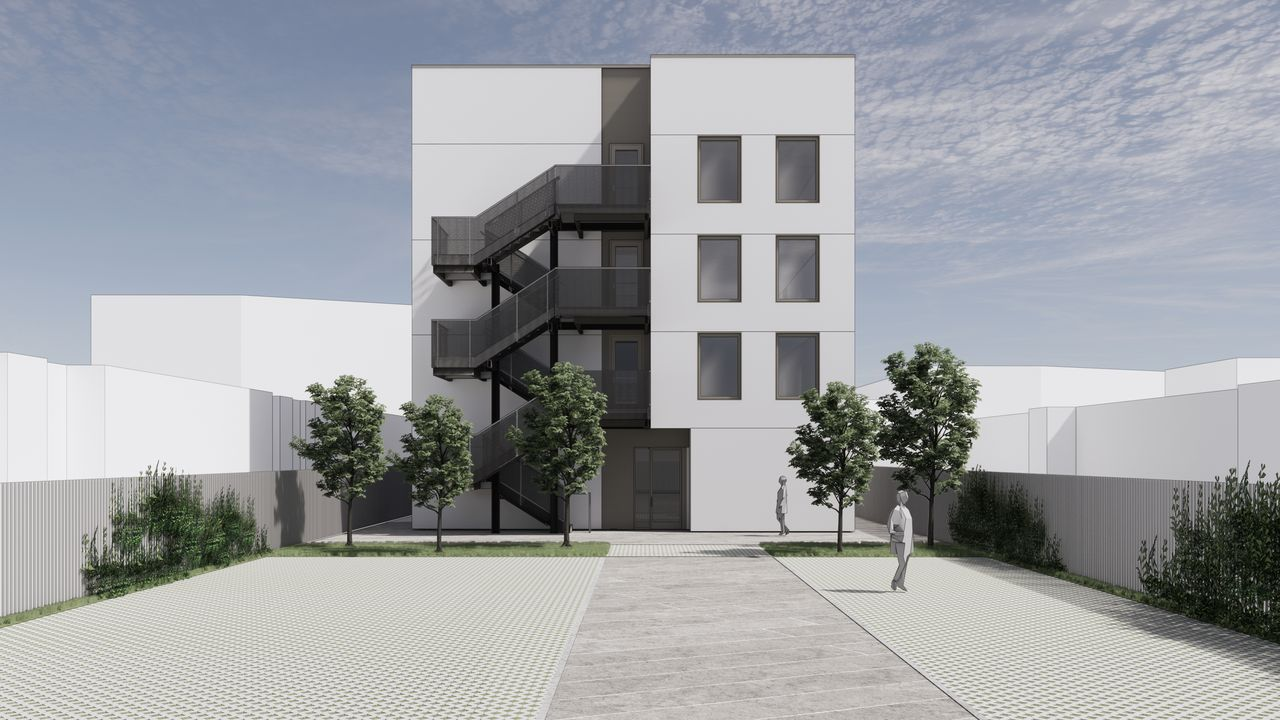
The project calls for 58 units, with 20% targeted at households earning up to 120% of Area Median Income and the remaining 80% at households earning up to 80% AMI. By layering the state and local incentive programs described earlier, the project achieves significantly higher density than conventional zoning would allow while shedding many of the restrictions that typically inflate costs. The building uses Type V wood-frame construction, substantially cheaper than podium-style construction, and rear alley access allows for an efficient site plan that includes 22 parking spaces — added voluntarily to improve marketability, not because the law requires them.
The capital structure reflects the new development model Angeleno was built around:
- 35% equity, 65% construction loan — privately funded, without reliance on public subsidy programs
- Limited partnership structure with a nonprofit partner
- Grant funding from a public institution providing additional capital support
The development timeline runs roughly 12 to 15 months for the ministerial permitting process, 18 to 20 months for construction, and six months for lease-up. The project is currently in design and permitting.
The base case financials are straightforward. Total project cost is approximately $17.25 million. Rents are underwritten to HUD covenant levels, which run 10 to 15% below current fair market rents in the surrounding area, reducing lease-up risk while maintaining a 7.7% yield on cost and an operating margin of approximately 78%, supported by the welfare property tax exemption.
The upside is considerable. The property sits in a Tier 2 Section 8 voucher zip code, meaning tenants may be eligible for Housing Choice Vouchers. If voucher participation materializes, stabilized rents could increase meaningfully, pushing yield on cost above 9.0% — roughly 150 basis points of additional return above the base case. The long-term hold strategy includes a potential refinance through agency permanent financing once the project stabilizes.
Affordable Housing as an Institutional Real Estate Strategy
For most of its history, affordable housing sat at the margins of institutional real estate — a mission-driven corner where tax credit investors and specialized nonprofits operated largely apart from mainstream capital. That has changed.
According to CBRE, institutional capital flowing into affordable housing grew at nearly 59% annually over the past decade, rising from $674 million in 2009 to $13.5 billion in 2021. That's not a niche anymore. CBRE also found that affordable housing values have tracked the broader multifamily market closely since the financial crisis — meaning investors are no longer treating it as a charity venture.
Affordable housing holds up in ways that market-rate housing doesn't. Demand is structural, rooted in a shortage that no single development cycle is going to fix. Below-market rents mean tenants are less likely to leave and more likely to be committed, long-term residents. When Fannie Mae flagged rising national multifamily vacancy in 2025, the culprit was a surge of expensive Class A supply. Affordable and workforce housing barely felt it. There's a cost advantage too for privately financed projects: by sidestepping the prevailing wage requirements attached to public financing, developers in high-cost markets like Los Angeles gain real flexibility in construction procurement — in a city where labor and regulatory costs already push projects to the edge of feasibility, that matters.
"There's a lot of capital that wants to be in affordable housing right now," says Jawitz. "The constraint isn't demand for the strategy — it's the supply of teams that can actually execute it. You need policy expertise, construction capability, nonprofit relationships, and compliance infrastructure all working together.
“That's what we've spent the last several years building."

Read next


AI for Real Estate Acquisitions
We've been building AI acquisitions agents with real estate GPs. On August 13, we're opening the hood in a live 2-hour workshop

Investing in Australia
EG is applying the American real estate private equity playbook to Australia, starting with medical office