
When Will Spec Office Get Built Again?
Office demand is recovering, but speculative development in most markets remains stubbornly out of reach
Office demand is recovering, but speculative development in most markets remains stubbornly out of reach

New data from Tailorbird shows why two-thirds of real estate operators blow their capex budgets and where AI could actually help
A new model of urban agriculture aims to be the highest and best use for your parking lot.

Few novel real estate concepts rose as fast or crashed as hard over the past ten years as indoor farming. By 2021, almost a dozen companies had raised significant capital to build futuristic, efficient, automated vertical farms that promised to produce tons of fresh produce without the traditional mess of dirt and variability of weather.
And almost all have failed.
Bankruptcies came quickly, with firms beset by technology failures, high capex, and weak margins. Bowery, AeroFarms, Kalera, and many more shuttered over the past two years, casting doubt on the very concept of vertical agriculture. As novel concepts go, the sector isn’t just in a trough, it’s in the Mariana Trench of disillusionment.
But not all lights in indoor farming have gone dark. Today’s Thesis Driven explores the future of urban agriculture by profiling one company bringing a new model to market by building upon the sector’s lessons. Area 2 Farms sees itself less as a high-throughput indoor farm than a unique amenity tapping into the broader trends of direct-to-consumer brands, experiential retail, and healthy living. And for real estate owners, it represents another opportunity to generate incremental revenue from underutilized square footage.
Today’s letter will explore urban farming’s next chapter, including:
While it may not be obvious how an industrial-scale indoor farm is connected to your local community garden or CSA, they each represent an end of the urban agriculture spectrum – and understanding the sector’s future requires grappling with lessons from the full spectrum.
Farmers’ markets are ostensibly the most successful attempt to directly connect food production to the consumer. The number of farmers’ markets in the US boomed during the 2000s and early 2010s, growing from under 2,000 in 1994 to more than 8,000 by 2019 before plateauing in recent years. While often criticized for high prices, farmers’ markets have become an enduring symbol of affluence and localism and a fixture of weekend mornings in neighborhoods throughout America.
A CSA, or community-supported agriculture program, is a related concept that has gained traction in recent years. As a direct partnership between farmers and consumers in which households buy a “share” of a farm’s harvest upfront, members receive regular boxes of seasonal produce throughout the growing season. CSAs have expanded from only a few hundred programs in the early 1990s to several thousand nationwide today, reflecting steady growth in consumer demand for local, farm-direct food.
Similarly, community gardens have grown in scale and number across the US over the past decade, experiencing 44% growth between 2012 and 2018. But unlike farmers’ markets or CSAs, community gardens are best seen as amenities alone; the amount of actual food they produce is far below the level required to sustain or meaningfully supplement an urban neighborhood. But they can be great at fostering community and educating people on the work that goes into producing food; in some multifamily buildings, rentable garden plots have become in-demand amenities.
Large-scale indoor agriculture exists on the other end of that spectrum. While indoor farms have had their own unique approach, the overarching thesis was that by controlling the farming environment – light, water, temperature, humidity – indoor farming companies would be able to produce more and not be subject to seasonal or environmental conditions. By eliminating external environmental factors, indoor farms would need neither herbicides nor pesticides, appealing to health-conscious consumers with an affordable product.
But a wholesale business model and low margins spelled that business model’s doom. By selling in bulk to major retailers, indoor farming companies were not able to generate the revenue and margins required to make the model sustainable. Beginning in 2022, vertical farming companies began to go bankrupt.
Area 2 Farms is taking a different approach, using vertical farming technology to scale and professionalize a community garden’s value proposition: bringing the farm to the people in a small-footprint, consumer-oriented format. In other words, Area 2 Farms aims to combine the best elements of the full urban agriculture spectrum, building a business with the direct-to-consumer margins of a farmer’s market, amenity benefits of a community garden, and tech-forward approach of the last generation of robotic farming companies.
Let’s dig in.
Oren Falkowitz does not have the prototypical profile of a farming entrepreneur. A former NSA analyst, Falkowitz founded and built two technology companies: Sqrrl (acquired by Amazon) and Area 1. The latter firm was notable for unearthing several Chinese and Russian cyberwarfare campaigns before being acquired by Cloudflare for $162 million in early 2022.
Falkowitz decided to apply his technology chops to a new, hairy problem: urban food. But rather than replicate the behemoth robotic farms raising massive venture rounds at the time, Falkowitz decided to take a small, modular, consumer-focused approach, co-founding Area 2 Farms with indoor farming veteran Tyler Baras. And he quickly won the backing of one of my favorite technology investors, Slow Ventures. (Slow was an investor in my last business, innovative housing operator Common, and Slow partner Yoni Rechtman wrote a Thesis Driven guest letter earlier this year.)
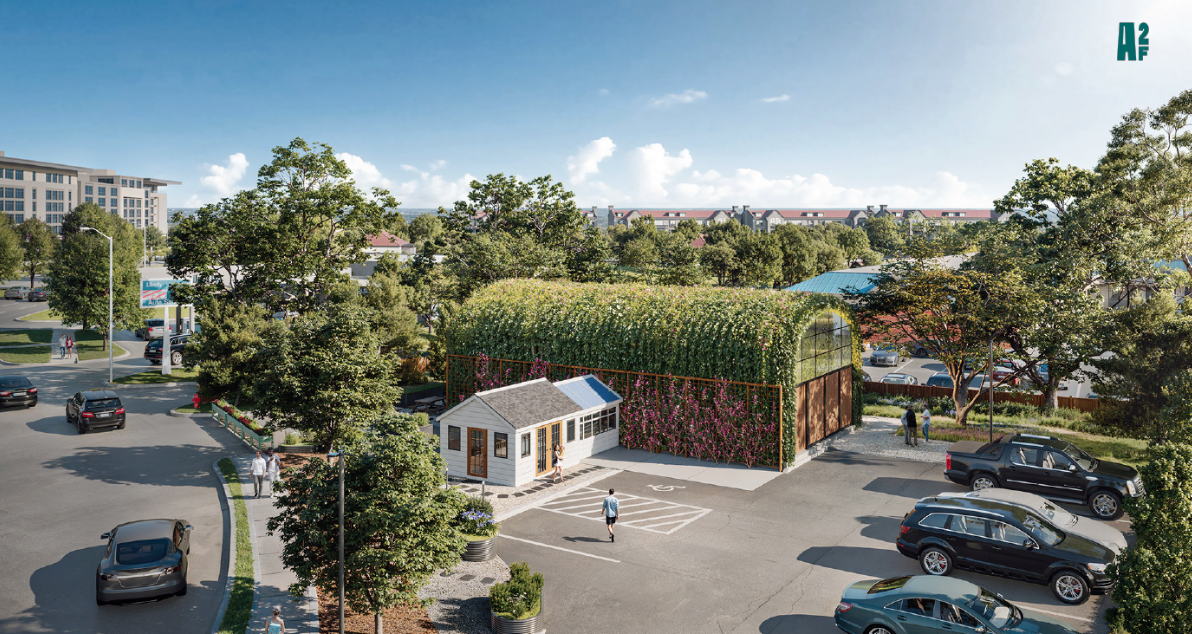
Unlike the previous generation of robotic farms, Area 2 Farms maintains a small and flexible footprint. An Area 2 Farms location has two physical components that should be close but not necessarily contiguous: a 2,000 square foot vertical farm and a 300 square foot retail store or farm stand. While small in footprint, the farm does need a minimum of 18’ in height, making it infeasible for most non-industrial indoor spaces. To get around this limitation, Falkowitz designed a plug-and-play modular vertical farm that can be dropped in any parking lot or other flat surface of at least 0.4 acres.
In addition, Area 2 Farms’s MEP demands are relatively straightforward: they require one 400A circuit and a main water line to operate the farm. Falkowitz’s under-development installation in Fairfax, Virginia is a good representation of the model – the company took a modest ground lease on a small, underutilized piece of land and on it is building both farm and retail stand, aiming to create a new kind of third place.
But the biggest differentiator between Area 2 Farms and the previous generation of indoor farms is the business model itself. While the wholesale vertical farming companies sold a very limited number of crops wholesale to retailers, Area 2 Farms is direct-to-consumer with a CSA-like model. The company’s customers receive a “basket” of five items each week: a lettuce, a microgreen, a root vegetable, an herb, and a specialty item. The basket changes on a weekly basis depending on what is in season growing at the farm that week, but there’s always at least one item in each of the five categories. “We’re a bit like a butcher shop,” said Falkowitz. “A butcher doesn’t have everything a grocery store has, but it has differentiated staples.”
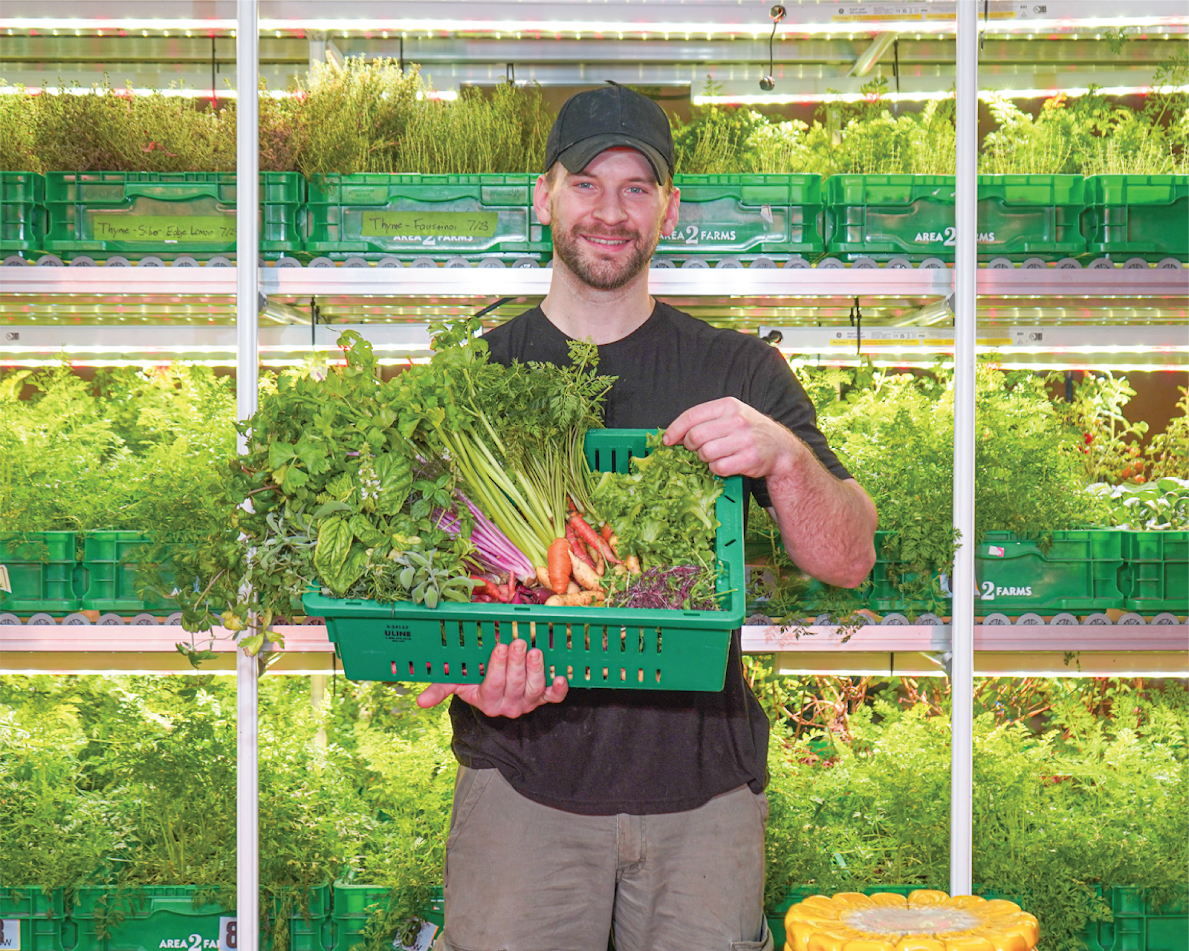
A typical Area 2 Farms location is able to produce 300-400 “baskets” per week of produce. The company’s first location in Arlington, Virginia, has sold out its baskets for 128 straight weeks, according to the company.
For real estate owners, Falkowitz sees Area 2 Farms as an amenity along the lines of a community garden. As an operator, he invites customers to visit the farm itself in addition to harvest at the retail storefront. “We want real estate owners to see this as a genuine amenity,” he explains. “Last year we had over 2,000 K-12 students through our farm. We want full contact between the farm, farmer, and community.” Given the public demand for accessible, fresh food, it’s not hard to imagine locally elected officials finding Area 2 Farms a welcome addition to the neighborhood.
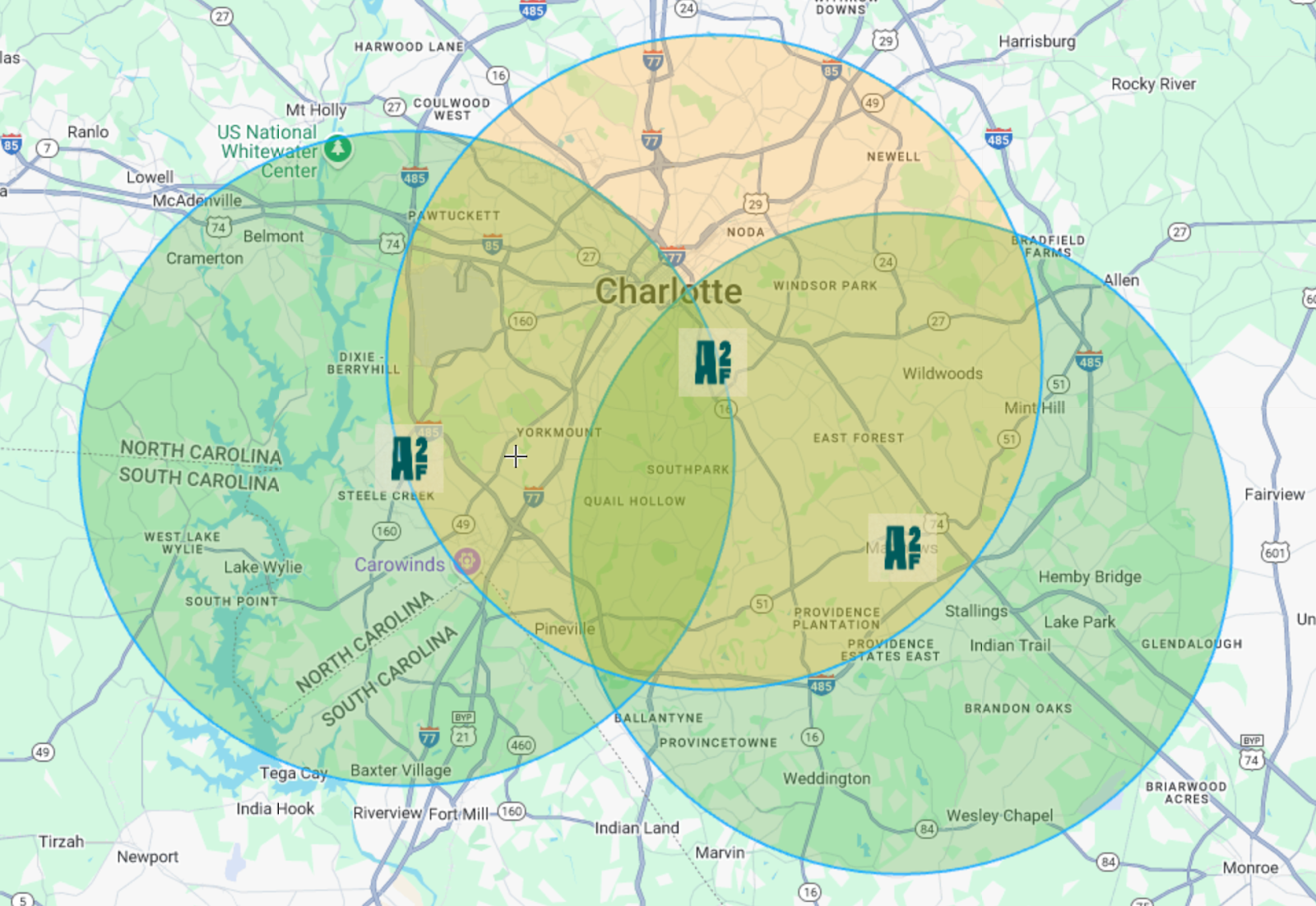
While Falkowitz has grand plans for his indoor farms to eventually be within 10 miles of 90% of Americans, his initial target markets bring few surprises: Washington DC, Charlotte, Miami, Atlanta, Nashville, and a handful of other cities with large affluent, health-conscious populations. From a site selection perspective, he’s looking to build at the “intersection of neighborhoods” that are able to draw on large pools of upper middle-class families and empty nesters.
In all, he sees Area 2 Farms as a way to make productive use of underutilized bits of land – backs of parking lots, wedges too small to develop, awkward gaps between larger buildings – as both a retail space and amenity. While Area 2 Farms locations operate today within existing spaces like warehouses and office buildings, the 18’ ceiling height requirement means future locations will likely be a mix of infills, vacant lots, and repurposed interior space.
Our country’s relationship with its food is one of the defining contradictions of 21st century American life.
On one hand, we relish the idea of connection to the land and the art of producing food. Nothing quite compares to the place of the farm in the American psyche. From the MAHA movement that seeks to return our food supply to some imagined past to the abundance of agricultural imagery in advertising (for trucks, for insurance, for beer, etc), the traditional farm is as powerful as cultural symbols come.
But on the flip side, Americans love convenience. Doordashing a burrito - using silicon and satellites to summon a tortilla stuffed with ingredients imported from the far ends of the earth irrespective of weather or season, hand-delivered to your front door - is perhaps the most abstracted way one could consume food.
And yet.
Reconciling this conflict presents a tremendous opportunity to any entrepreneur brave enough to tackle it. One could argue that Trader Joe’s makes an attempt at bridging this gap; limited SKUs and vernacular / folk branding convey authenticity while low prices (enabled by limited SKUs, of course) provide the value and convenience. Various QSR models, such as Dig Inn, have also made runs at it with varying degrees of success.
But there’s reason to be bullish about what Falkowitz is doing. By dramatically reducing the scale of the farm, pairing it with a small retail footprint, and placing it in convenient retail locations, Area 2 Farms represents one of the most novel takes on bridging the authenticity-convenience contradiction I’ve seen.
And for a real estate owner thinking about what to do with an underutilized patch of pavement, a small modular farm and retail storefront seems better than a giant chess set or dog run.
-Brad Hargreaves

Office demand is recovering, but speculative development in most markets remains stubbornly out of reach


We've been building AI acquisitions agents with real estate GPs. On August 13, we're opening the hood in a live 2-hour workshop

Covering the future of real estate and the people creating it