
Los Angeles, 2036
A city built around cars and entertainment could be remade over the next decade by forces now transforming both
A city built around cars and entertainment could be remade over the next decade by forces now transforming both

In struggling urban markets, the path to preserving affordable apartments may begin with creating more expensive ones
Office demand is recovering, but speculative development in most markets remains stubbornly out of reach

A firsthand account of making real estate magic happen in Silicon Valley by real estate development veteran Steve Edwards


Editor’s Note: Steve Edwards is the President at Rethink Development and SVP of Lifestyle Development at Ensemble, where he shepherded one of my favorite placemaking projects (previously mentioned in Thesis Driven here) from vision to reality in the heart of Silicon Valley.
Now that his first set of projects in Santa Clara are complete, I asked Steve to revisit the story and share how his principles played out in the now-built projects. In that earlier piece, Steve spoke about the theory and ambition behind creating places that feel authentic, social, and magnetic. In today’s letter, Steve shares the story of what it actually takes to deliver placemaking at scale: the victories, the setbacks, the collaboration, and the lessons learned from shaping the Clara District, AVE Santa Clara, and Clara’s Junction.
Steve’s portfolio spans a boutique hotel on Abbot Kinney in Venice, six mixed-use projects in Silicon Valley totaling more than 1,200 units, and additional projects in Southern California and Bend, Oregon — nearly 2 million square feet in all. Over his career, Steve has entitled and delivered more than $1 billion in development, building on an early career at the intersection of entertainment and technology. –BH
Placemaking has an art to it. It is about curating uses, programming them, and nurturing them into something that feels like a community’s heart. Yet before placemaking can happen, there is the war: assembling land, navigating entitlements, securing financing, and enduring the daily gauntlet of construction. The tension between art and war defines this work, and nowhere is that more apparent than in the story of the Clara District.
Real estate development in California demands persistence. Over a decade ago, my Santa Clara effort began with a modest 100‑unit mixed-use community designed to provide walkable housing in the heart of Silicon Valley. What followed was a transformation far beyond what I imagined. That single project grew into six Ensemble-led projects, six more by peers, and together we were on track to deliver a new community for more than 8,000 residents within a decade.
It was never easy. There were lawsuits between neighboring cities. Construction costs climbed relentlessly. The COVID-19 shutdown abruptly froze everything, and in Silicon Valley the work-from-anywhere era sent rents and demand plunging to the point where nothing penciled. Then our contractor — Katerra, a well-funded Silicon Valley modular builder — went bankrupt while our plans were still in permit review. I had to board a flight to Seattle on a moment’s notice to rescue the REVIT model before their servers were shut down. We redrew plans, recalculated engineering, and started again. By the time permits were in hand, interest rates were rising and lumber prices had tripled.
Still, we persevered. We managed to secure debt just before the steep run-up in rates. We leaned into collaboration with the City and fellow developers, coordinating cranes, concrete pours, and even inspection schedules across six concurrent projects. It was exhausting, but it was also a reminder: creating real places is always hard. The battles are daily, but the vision pulls you forward.
When I first looked at the site that would become the Clara District, it wasn’t much to see — just a patchwork of low-slung industrial buildings scattered between transportation corridors and parking lots. But it sat in the middle of Silicon Valley’s innovation corridor, surrounded by Nvidia, Google, and Apple, and down the street from Levi’s Stadium and the VTA/Amtrak rail hub. The potential was obvious, even if the path was anything but.
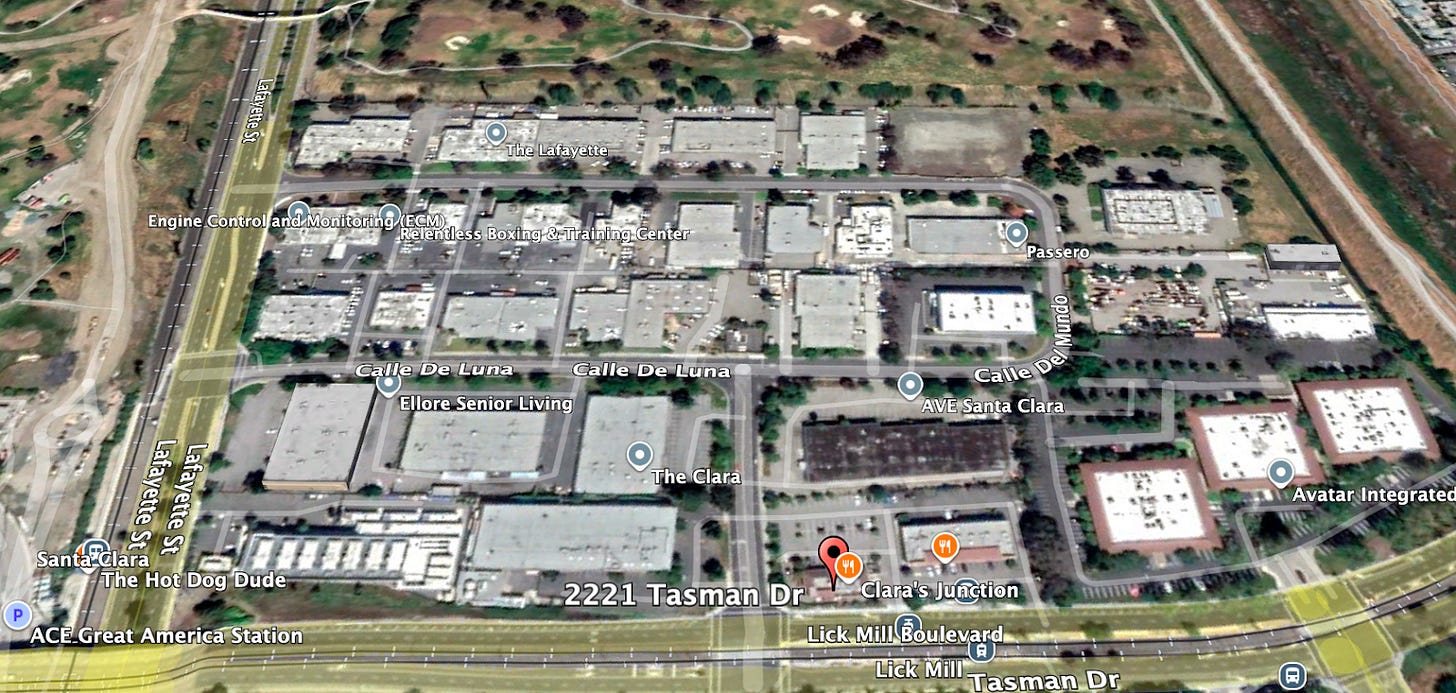
Over time, what began as a single project grew into a coordinated effort. Instead of isolated developments, we were stitching together a district: walkable housing, retail, parks, and public spaces that could actually feel like a neighborhood. The idea wasn’t to drop a “lifestyle center” into Silicon Valley, but to take a place that had been overlooked and make it somewhere people would want to live, gather, and stay.
The scale of change here is bold. Over 4,500 new homes, more than 100,000 square feet of retail and creative space, and a network of parks, greenways, and plazas are replacing what had been empty asphalt and aging warehouses. The vision was you could walk downstairs from an apartment, head to local park for some outdoor time, grab dinner at a neighborhood restaurant, and end the evening at Clara’s Junction for music — without ever getting in a car. That was always the goal: not just building projects, but creating a place that feels bigger and richer than the sum of its parts.
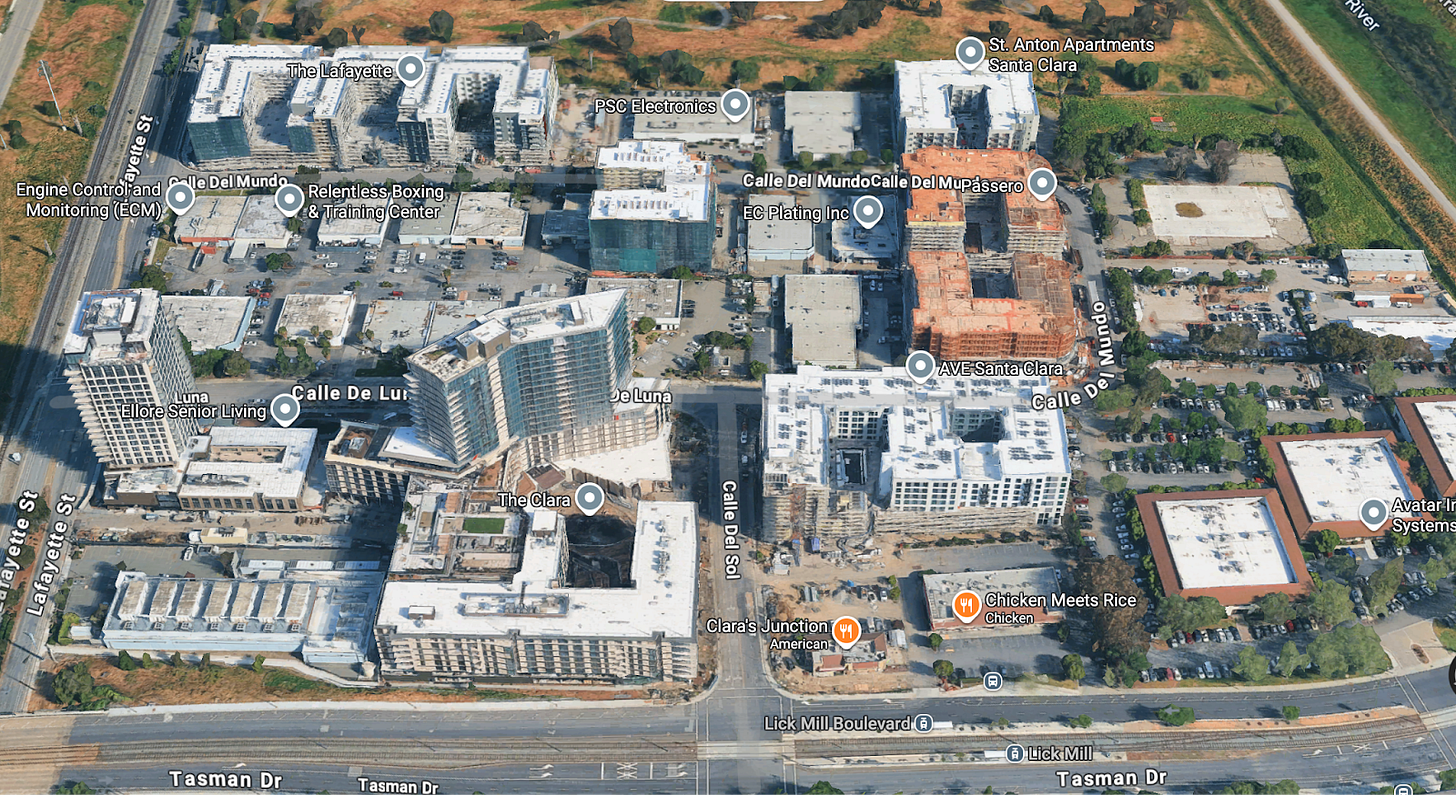
What sets the Clara District apart is not just its physical scale, but the unprecedented collaboration that made it possible. Six developers, each with their own projects and capital stacks, agreed to align around a shared vision with the City of Santa Clara. Normally, developers in close proximity treat each other as competitors. Here, we became co-conspirators in creating something bigger than any single building.
Collaboration is not usually a hallmark of real estate developers. But I started my career in Silicon Valley technology, where openness and shared problem-solving are essential to innovation. Taking a cue from my tech neighbors, I pushed for the same mindset here — and to my surprise, everyone agreed. The district is better for it.
From 2016 through entitlement in 2019, we sat around the table every other week with City Planning, Public Works, the City Manager’s office, Fire, and Silicon Valley Power. At first it felt unusual — developers and regulators don’t typically meet this often, let alone as partners. But the scale of what we were trying to do demanded it. Those meetings weren’t always easy. Everyone had their own perspective, and there were plenty of moments where the economics and the planning didn’t line up. There were also more than a few raw exchanges on both sides — the kind where someone would blurt out, “No way, that’s insane, do you realize what you’re asking?”
We wrestled with issues as granular as street alignments and parking counts. One debate dragged on for months: should we spend $30 million of developer money to move a public sewer lift station and punch through a new street, or leave it where it was and live with the constraint? In the end we left it, which forced us to get creative — designing a pedestrian-only walk street that is now set to become one of the district’s most popular gathering places.
Similar trade-offs played out everywhere. We mapped and remapped where the parks should go and how the greenways would connect. Over time, we showed the City how some of their preferred park placements cut off developable space unnecessarily. With detailed parking and building layouts, we could shift a park 20 feet and gain 30 units, or rotate it and pick up 80. By allowing buildings to project over portions of the greenway, developers not only gained units and community space but also created corridors that doubled as fire lanes and stormwater treatment areas. Those tweaks didn’t just add density — they made the projects, parks, greenways, and the district as a whole work better.
Retail was another battleground. The question was how to zone it in a way that would actually support placemaking, not just check a box. Even liquor approvals became a test of the partnership. Our shared vision for a beer garden and destination restaurants helped convince the City to reduce parking requirements and strip away the subjective approval process for restaurant-related liquor permits — an enormous advantage when courting restaurateurs.
And just when we thought the hardest work was behind us, Public Works came back during construction with a proposal to eliminate all retail street parking to create an extra traffic lane. We knew that would be fatal to retail, so the developer group closed ranks. Together, we pushed back, bringing examples from our collective experience. Public Works kept returning with studies, but we stood firm. Eventually we agreed on a compromise: one side of the street would prohibit parking for two hours each morning during rush hour, but retail parking would remain.
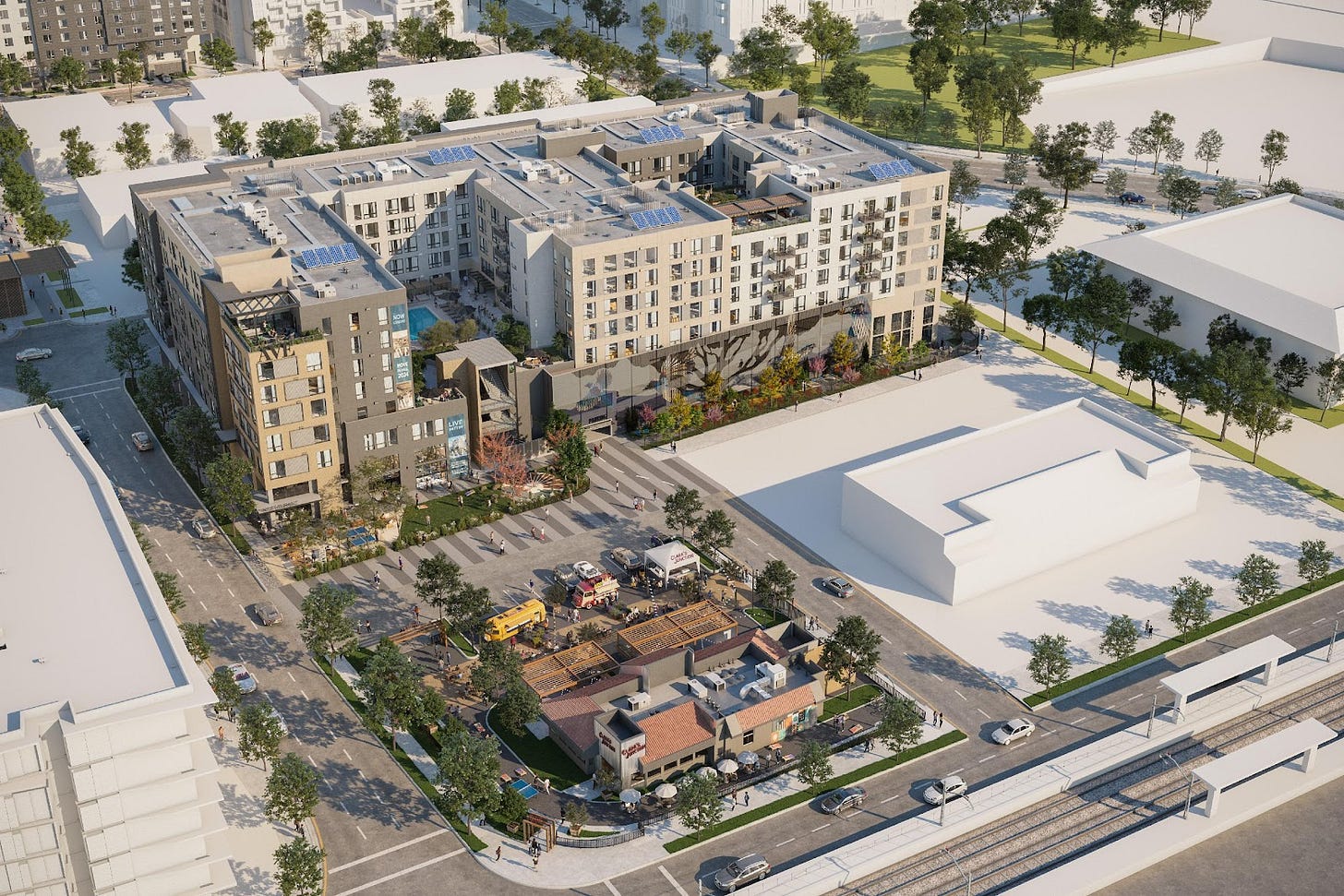
The process was messy, but it worked. What began as a plan for modest density — 50 dwelling units per acre and six stories — ultimately quadrupled to more than 200 units per acre and towers rising 22 stories. That shift wasn’t just a zoning change on paper; it made it possible to support real restaurants, retail, parks, and public spaces. And you can feel the difference. Sitting outside at Clara’s Junction today, the design decisions are tangible: our eight-story building with its courtyard opens toward the beer garden, while Related’s 22-story tower with its porte cochère fronts our mini-park and the connected greenways. The result is a shared energy and sense of place that no single project could have created on its own.
During this collaboration phase–before we started construction–one seasoned developer remarked that it was the most rewarding collaboration of his career.
The collaboration didn’t stop once shovels hit the ground. With six projects rising at once, we coordinated crane swings, timed concrete pours — including one that required 400 trucks and four pumpers in a single day — and staggered deliveries to avoid gridlock. We even coordinated inspections, sometimes lightening schedules so another project could secure its Temporary Certificate of Occupancy. That level of trust and reciprocity among developers is virtually unheard of.
Once the battles of real estate development were behind us, we could finally turn our attention to the art of placemaking. The foundation had been set during planning and design, and in that same spirit of collaboration, developers and the City came together again.
We discussed names, branding, tenant mix, and even coordinated launch timing across projects. Developers who had never marketed together before agreed to co-promote the Clara District, understanding that 2,200 units coming online within months required a unified identity. With the City, the tourism board, and even the 49ers involved, the effort to brand the district became a civic project in itself.
Not only do we desire to placemake the larger District, but we thought about placemaking inside the project itself and how those experiences can deliver community. Our flagship project, AVE Santa Clara, embodies this approach.
At AVE Santa Clara and in most of the projects I work on we start from the inside and work outwards. We think strongly about how we want these projects to live and be experienced for the residents and visitors alike. For the residents, one of the most sought-after attributes for apartment living is walkability. So, to do a project right you need to think both inside and beyond the front door and control or craft that experience.
Completed in early 2025, AVE Santa Clara, our 311-unit community including both furnished flexible-stay apartments and traditional long-term residences, 32,000 SF of amenities along with 15,000 SF of retail is delivering on that vision. It also smartly integrates with the streetscape, new public plaza, greenway and Clara’s Junction food & beverage garden. AVE Santa Clara is not just another apartment building—it is a hospitality-infused placemade living experience.
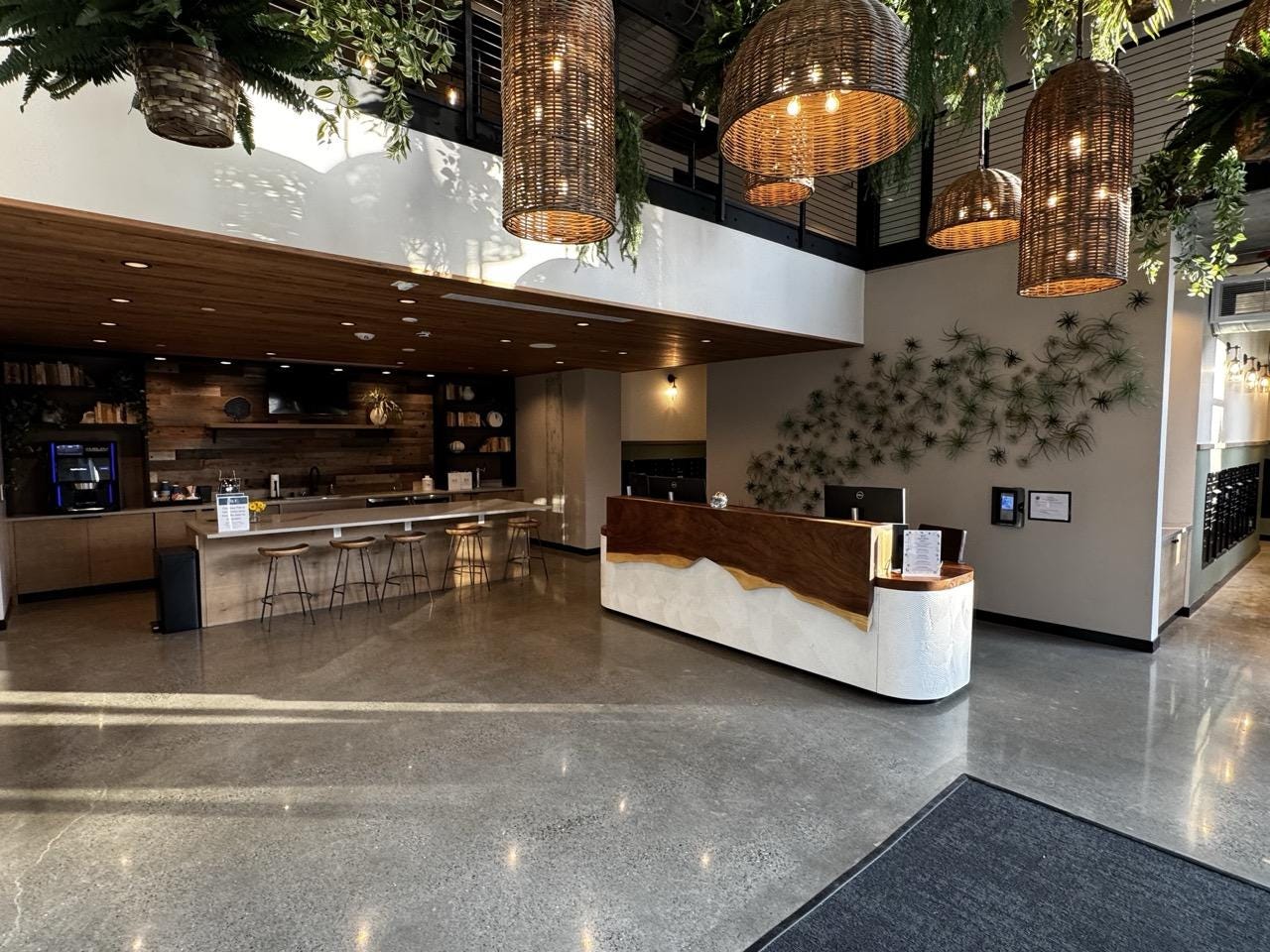
Inside AVE Santa Clara, we curated a suite of amenities designed to foster connection, wellness, and lifestyle. Highlights include:
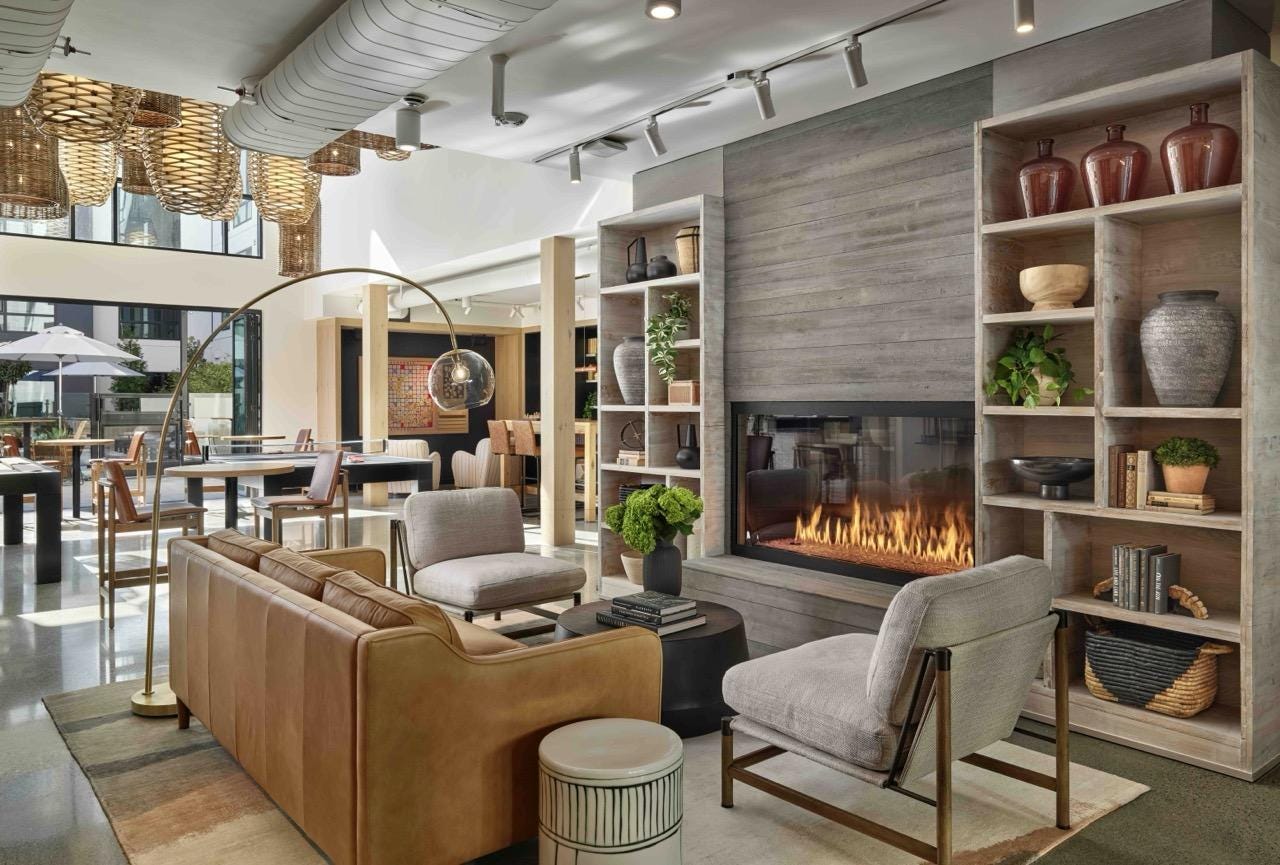
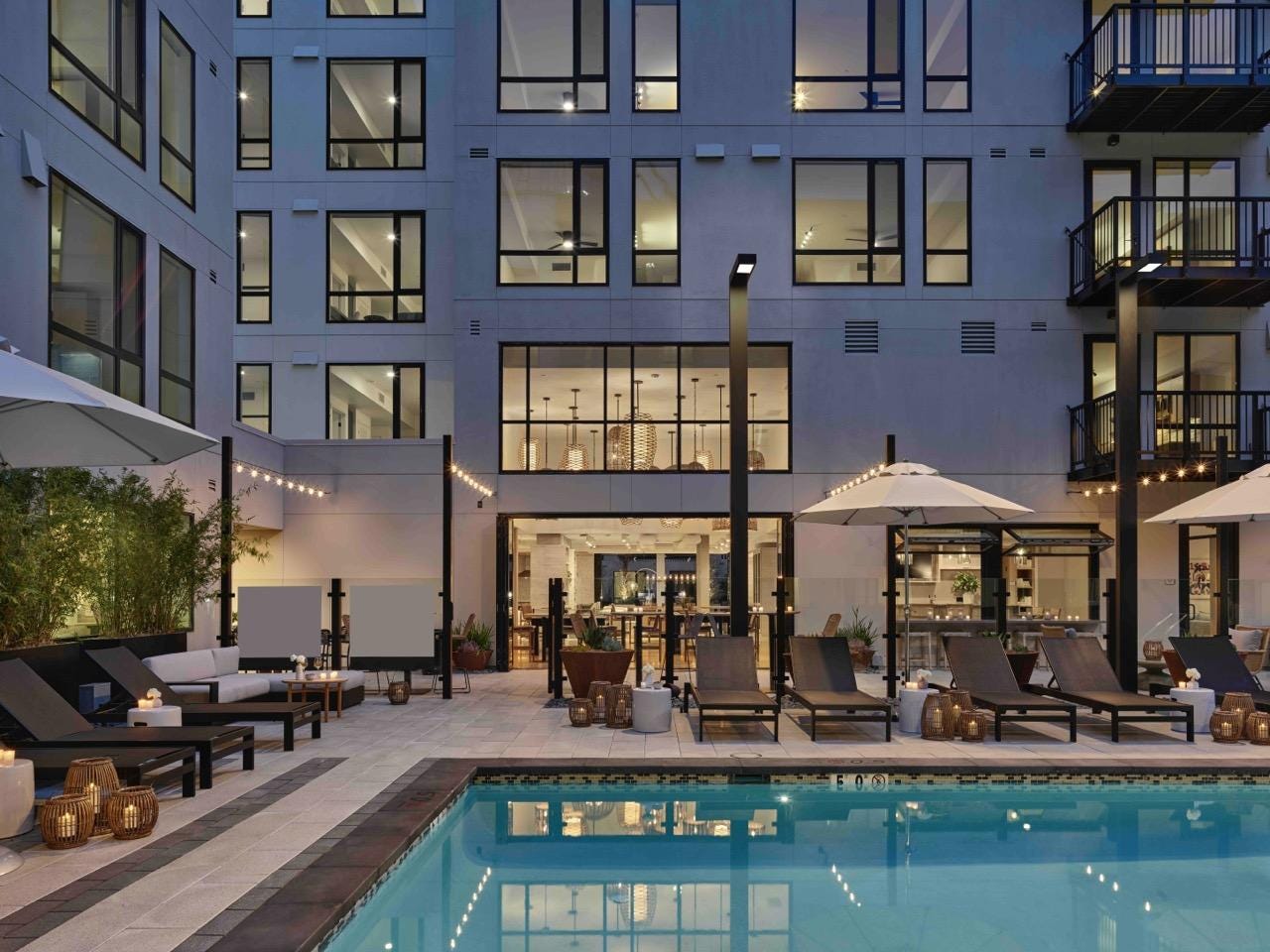
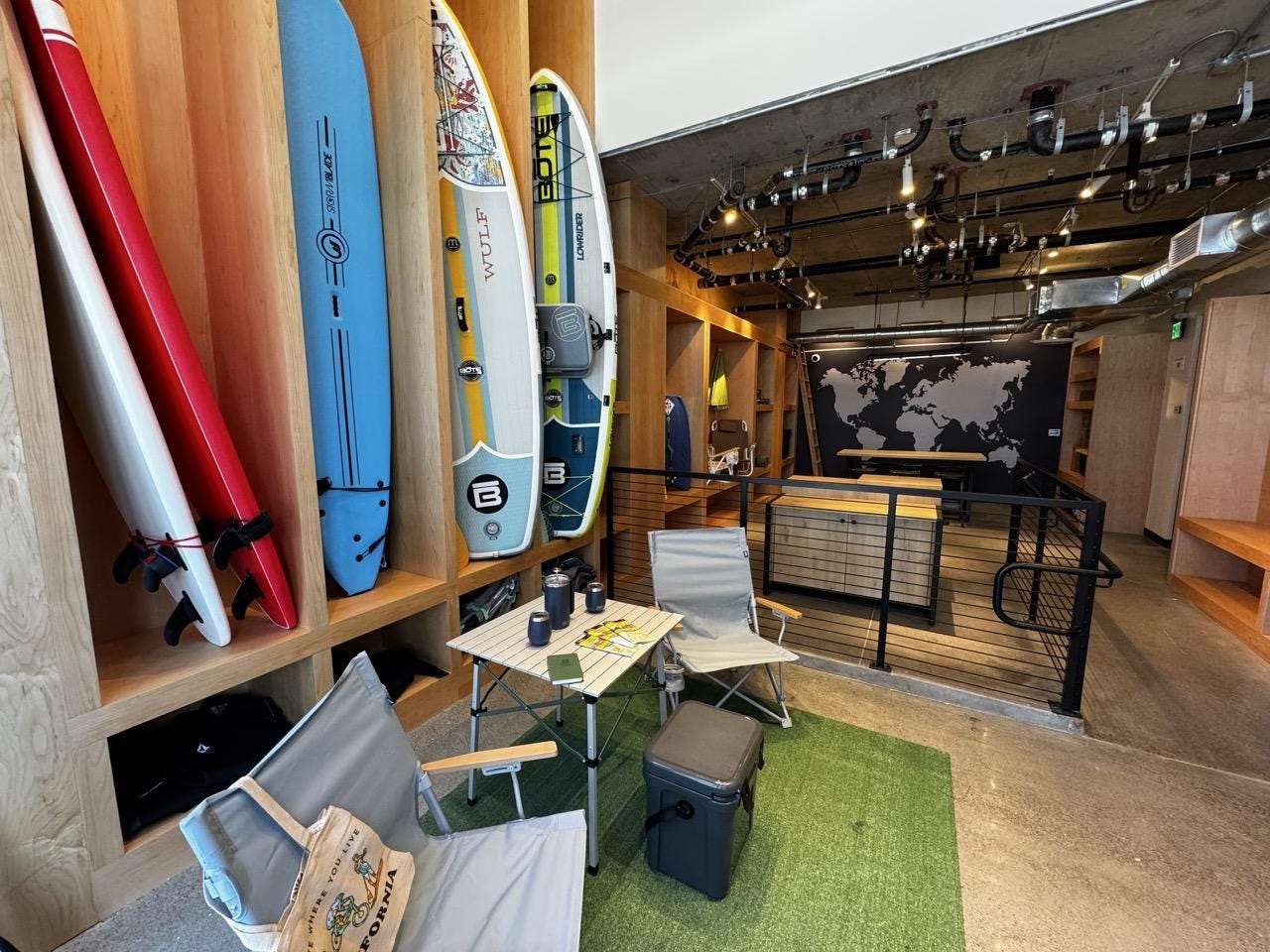
Private amenities create community within AVE Santa Clara’s walls, but true placemaking extends outside. Across the Clara District, we worked to curate retail and public spaces that would pull people out of their apartments and into shared experiences. At the center of that effort were restaurants, coffee shops, streetscapes, and parks — the things that make a place feel alive.
But getting there wasn’t simple. For Clara’s Junction, we talked to a long list of potential operators and kept hearing the same thing: “What do you want us to do here for possibly only five years until you want to build your high-rise?” The uncertainty was too much, and no one else would take it on. In the end, we realized we had to do it ourselves — designing, permitting, programming, and even owning the space. That decision wasn’t about chasing yield; it was about proving the district’s potential and creating the kind of gathering spot that would signal momentum to everyone else.
The same dynamic played out on the retail side. First-generation spaces are notoriously hard to lease — operators are wary of the cost, the risk, and the fact that the neighborhood hasn’t yet proven itself. So instead of just putting out flyers and hoping someone would tour the space,, we treated it like a partnership. We advanced plans and designs ourselves to show a clear vision. For the coffee shop, we even took the drawings all the way to permit-ready with both the building and health departments so an operator could step in with less risk. That extra work paid off — we now have two coffee groups at LOI and are choosing between them based on timing and fit for the district.
On the restaurant side, we approached it differently again. Rather than saying, “Here’s four walls, please lease it,” we pitched a larger idea: integrated hospitality that spilled beyond the restaurant footprint and into select parts of the building. That kind of vision — one that combined private development with curated public space — resonated more deeply and gave operators confidence that they weren’t just joining a building, they were anchoring a district.
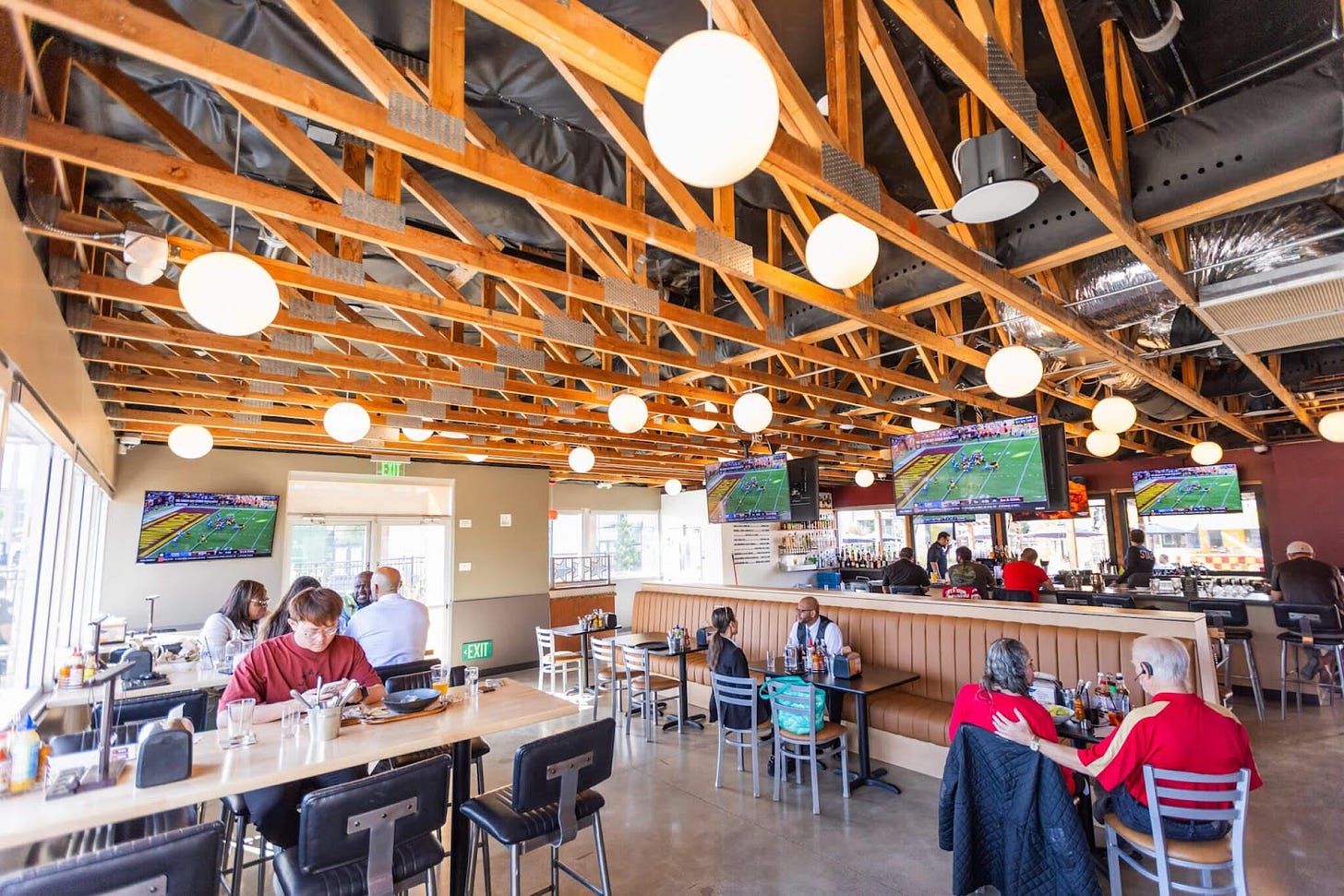
Before the apartments opened, we knew the district needed a destination. The answer was Clara’s Junction — an adaptive reuse of a former Carl’s Jr. In just five months, we transformed it into an 18,000-square-foot indoor-outdoor beer and food garden. Featuring food trucks, a BBQ pit, craft beer, fire pits, lawn games, and music, it quickly became the neighborhood’s hub. On 49ers game days and during away-game watch parties for the 49er wives, it pulsed with energy. By investing in this semi-permanent use, we created an anchor while waiting for the market to support the approved high-rise that will eventually replace it.
The City partnered with us to accelerate approvals, understanding that the neighborhood needed an immediate ‘there there.’ Clara’s Junction proved that placemaking investments pay off before the apartments even lease up.
Signature Restaurant & Coffee Shop: Integrated Hospitality
We actively pursued tenants that could bring life to the district, offering significant TI packages and putting in the legwork to find the right operators. I once sampled nine different coffees in a day while scouting potential coffee tenants. We visited restaurant groups at peak and off-peak hours to understand how they worked. We ended up securing a restaurant group with ties to the 49ers that shared our vision. They are opening an Italian steakhouse with coastal vibes and airy design, an upscale destination that will serve both residents and the broader community. The restaurant doesn’t just serve within its four walls — it integrates directly with AVE Santa Clara’s Amenity Hall and Pool Deck, providing poolside service and weekend bar programs. This blending of private and public placemaking creates a resort-style rhythm of life: you can live upstairs, order dinner or cocktails poolside, and host friends as if you’re at a boutique hotel.
The retail mix extends further with fitness and wellness concepts, personal services, and neighborhood-serving cafes. These tenants aren’t just about convenience — they are about creating daily rituals that stitch the district together. Plazas, promenades, and greenways connect each project, ensuring that the district functions as one continuous community rather than isolated buildings.
Parks and open spaces also add to this placemaking approach. With more than ten acres of neighborhood parks, programmed greenways, walk streets and active sidewalks residents and visitors alike have reasons to gather outside. Weekly events and activations at Clara’s Junction spill into these outdoor areas, ensuring that placemaking is as much about people as it is about buildings.
Ultimately, it is the integration of public and private placemaking that makes the Clara District special. The curated retail mix activates the streets, while the resort-style living experience within AVE Santa Clara ensures that the line between home, hospitality, and community is intentionally blurred. This is not just housing with amenities; it is a neighborhood designed to feel alive at every level.
The numbers tell the story.
Within six months of opening, 304 of AVE Santa Clara’s 311 units were leased — nearly 50% faster than the submarket average and about ⅓ faster than our district neighbors. That rapid absorption generated more than $2 million in additional revenue, which we reinvested in placemaking and attracting the right retail tenants.
On average, residential rents are 5-12% higher per unit type vs. pro forma with the bulk of our units 9% higher. And as a testament to placemaking and what we’ve delivered we are doing a mid-year (6 month) increase of rents of another 4% to 9% per unit type.
Retailers were drawn not just by tenant improvement packages, but by the credibility of a district designed around experience. They also loved how we wanted to placemake in the private spaces and how they could participate with the integrated hospitality. Fast resident lease-up also gave them confidence to commit quickly. We garnered more interest faster than the other retail in the district and had multiple LOI’s and leases. Retail rents are also coming in at 10% higher than proforma.
Our collaboration with the City, the tourism board, and the 49ers reinforced this momentum. The results extended beyond leasing metrics: residents and visitors alike embraced the district, and both AVE Santa Clara and Clara’s Junction earned strong Google reviews, consistently high four-star ratings.
The placemaking, rapid lease up, and rent levels have also helped to get our next 301-unit project in the district financed even in rough economic times. We are now our own comparable and can tour capital partners through that comp.
These results are even more striking when viewed against the backdrop of the pandemic. During 2020 and 2021, Silicon Valley rents fell sharply, with San Jose experiencing an average decline of nearly 8%. Occupancy rates softened as tech workers embraced remote work and many left the region temporarily. For luxury apartments in particular, absorption stalled and new projects were paused. Delivering AVE Santa Clara into that environment required conviction, and leasing up in record time demonstrated not only pent-up housing demand but also the strength of a hospitality-driven placemaking model.
Looking back, several lessons stand out:
The Clara District, AVE Santa Clara, and Clara’s Junction show what happens when both the art and the war of placemaking and development are embraced. The war — of permits, financing, and construction — was relentless. But the art — of creating authentic places, activating public and private spaces, and collaborating across boundaries — made it worthwhile. Today, thousands live, connect, and thrive in what was once an overlooked stretch of Santa Clara. It proves that the right mix of persistence, creativity, and collaboration can transform not just land, but lives.
—Steve Edwards
Connect with Steve on LinkedIn here.

Office demand is recovering, but speculative development in most markets remains stubbornly out of reach


We've been building AI acquisitions agents with real estate GPs. On August 13, we're opening the hood in a live 2-hour workshop

Covering the future of real estate and the people creating it