
When Will Spec Office Get Built Again?
Office demand is recovering, but speculative development in most markets remains stubbornly out of reach
Office demand is recovering, but speculative development in most markets remains stubbornly out of reach

New data from Tailorbird shows why two-thirds of real estate operators blow their capex budgets and where AI could actually help
The opco-propco opportunity in Tier 1 purpose-built student housing


Don’t miss Thesis Driven’s Buy Box deep dive on Aptitude Development & Tier 1 PBSH next Wednesday, December 10th. Register here (for accredited & institutional investors only)
Twenty years ago, my expectations for college housing were low.
We crammed five guys in a 3-bed/2-bath off-campus house. Our backyard was overgrown and littered with college flotsam; the bathrooms were in a state of permanent disrepair–cluttered with half-used toiletries, broken razors, and whatever grooming tools we hadn’t bothered to put away. The refrigerator was always empty (except for maybe an old Papa John’s box). We didn’t even have a kitchen table.
It was a great time, but it was also borderline squalor.
Today, developers have zeroed in (and “cashed in”) on the underserved college renter, where specialized firms like Aptitude Development deliver ground-up residential projects in Tier 1 college markets that are highly aspirational and purpose-built around students’ academic and social lives, providing:
Aptitude Development then operates each asset with its in-house brand, The Marshall, a full-service property management firm with a playbook for optimizing the resident experience and driving NOI.
While Aptitude does not label itself as “OpCo-PropCo” (i.e., a management brand separate from the real estate ownership, like Marriott), they have built a proprietary management platform and brand designed to enhance yield on the buildings they operate by 100-200 bps.
In this Thesis Driven deep dive, we’ll break down:
Purpose-built student housing sits at the intersection of three converging realities:
Together, these forces have turned Tier-1 PBSH into one of the most analytically defensible opportunities in institutional real estate.
1. Precise & measurable demand data
One of the most distinctive features of PBSH is the measurability of demand. Large public universities publish detailed enrollment data–by class year, residency requirement, full-time status, and program–giving developers an unusually transparent view of their renter base. That transparency allows PBSH developers to model demand literally down to the bed.
Start with total enrollment, subtract part-time students and those required to live on campus, plus the existing PBSH inventory already operating in the market. What remains is the true bed deficit.
Developers like Aptitude even layer in the likely “shadow market”–the slice of students who will always choose the older, crowded, five-bedroom house near the campus bar, regardless of what gets built. With that accounted for, plus a review of pipeline projects and planning board agendas, developers can arrive at a demand estimate that is far more precise than what exists in any other residential product.
That precision matters because student demand is not the same at every college or university. While enrollment has declined across more than 7,000 U.S. colleges and universities, the roughly 200 flagship public universities and elite private institutions are at all-time highs–benefitting from rising out-of-state enrollment, international demand, expansion in research and STEM programs, and a “flight to quality” in higher education. At these universities, guarantor (i.e., parents) household incomes have climbed as well, increasing the ability–and willingness–of families to allocate more spending to housing that feels safe, modern, and walkable.
2. Better economics than traditional ground-up multifamily
PBSH outperforms multifamily for structural reasons tied to how students lease housing.
A 1,200-square-foot multifamily unit in a college market might rent for $2,500 to $3,000 a month. But repurposed as a 4-bed/4-bath student unit, where each bed leases for $1,250 to $1,500, that same unit can generate $5,000 to $6,000 per month–double the revenue on identical square footage.
Group leasing and parent guarantees also create one of the lowest delinquency profiles in residential real estate. Traditional multifamily delinquency commonly sits between 4-7%. Student housing at Tier-1 universities often stays between 1-2%.
The category’s revenue visibility is equally strong: leasing begins 9-12 months in advance, tied to the academic calendar rather than the volatility of rolling market demand. That forward visibility allows managers to plan operations, adjust pricing, and reset rents annually with fewer surprises.
In strong Tier-1 markets, developers can typically build to high-6% or low-7% unlevered yields and exit stabilized assets in the low- to mid-5% cap range (generating 150-200 bps of spread) to global investors such as Blackstone, GIC, Harrison Street, DWS, and Global Student Accommodation who have made PBSH a core allocation. Also, financing is often more favorable than in traditional multifamily because lenders value the reliability of collections and the outsized demand relative to supply.
3. Widening gap in quality vs. legacy student housing
Much of the existing off-campus housing stock was built decades ago–when land was cheaper, students tolerated long walks, and bed-bath parity wasn’t the standard. That stock is now aging and largely undifferentiated, and few universities are building enough new beds to keep pace with enrollment. Meanwhile, the most desirable sites–those within a quarter to half a mile of campus–are scarce and often heavily zoned, with entitlement timelines stretching years. New development in these walkable zones is not only limited, it is structurally difficult, which further constrains supply.
Modern PBSH therefore fills a gap that legacy housing cannot. Students today want privacy, en-suite bathrooms, modern study and wellness amenities, and a walkable connection to their daily lives. Parents–who guarantee most leases–want security, predictability, and professional management. Older stock near Tier-1 campuses rarely checks any of those boxes. The gap between expectations and what exists is why occupancy at new PBSH assets near Tier-1 schools has remained consistently strong, even as older product struggles and has begun to function less like a peer competitor and more like a value alternative for a different renter cohort.
As Aptitude co-founder Jared Hutter puts it, “Tier-1 student housing behaves like its own asset class. The demand patterns, the revenue visibility, and the operational cadence are different enough that you have to build a platform around them. You can’t simply treat it like multifamily with younger tenants.”
That framing explains why the category has become so durable–and why specialized developers with deep operating infrastructure have become the dominant performers.
One of the defining characteristics of PBSH is the “two-customer” dynamic. Students decide where they want to live, but parents–who typically guarantee the lease–ultimately evaluate the safety, structure, and reliability of the environment. As Hutter puts it: “You’re effectively designing for an 18-year-old and a 48-year-old at the same time. If you miss on either one, the building won’t lease the way it should.”
Students orient themselves around proximity and routine: the ability to walk to class, live near friends (and bars), and move between studying, socializing, and daily activities without relying on a car. They select housing based on where their day naturally flows, but also on how it reflects their personal preferences… and economic status. When there is the option to live–and host friends–in a brand-new building with modern fitness, wellness and social amenities, they naturally want to live there. If they can afford it.
Parents approach the decision with a different framework, especially those with the ability to cover (or meaningfully supplement) the rent. Their focus is more operational: security standards, building management, visible staffing, and the quality of maintenance and oversight. In other words, they want to sleep well at night knowing they’ve done all they can to ensure their child’s safety in the otherwise chaotic experience that is college life.
This split consumer base has shaped not only the architecture of PBSH but also how the best developers and operators configure their management platforms. Managing student behavior cycles, academic-year leasing patterns, parent communication, and high-frequency use of amenities requires dedicated systems and staffing.
So integrating development (PropCo) and management (OpCo) allows developers to create consistency across projects–and helps drive NOI by aligning the building’s design intent with the way it is operated.
Aptitude’s model starts with the view that Tier-1 PBSH development and operations shouldn’t be siloed as separate businesses. Instead, development and management should function as a single, cohesive product.
This is the rationale behind The Marshall, Aptitude’s in-house operating platform. Instead of relying on conventional multifamily managers, Aptitude created its own playbook to align with students’ unique needs and behavior patterns. The Marshall oversees staffing, security, leasing, maintenance, and amenity programming–aiming to ensure that day-to-day operations reinforce what the building was designed to deliver.
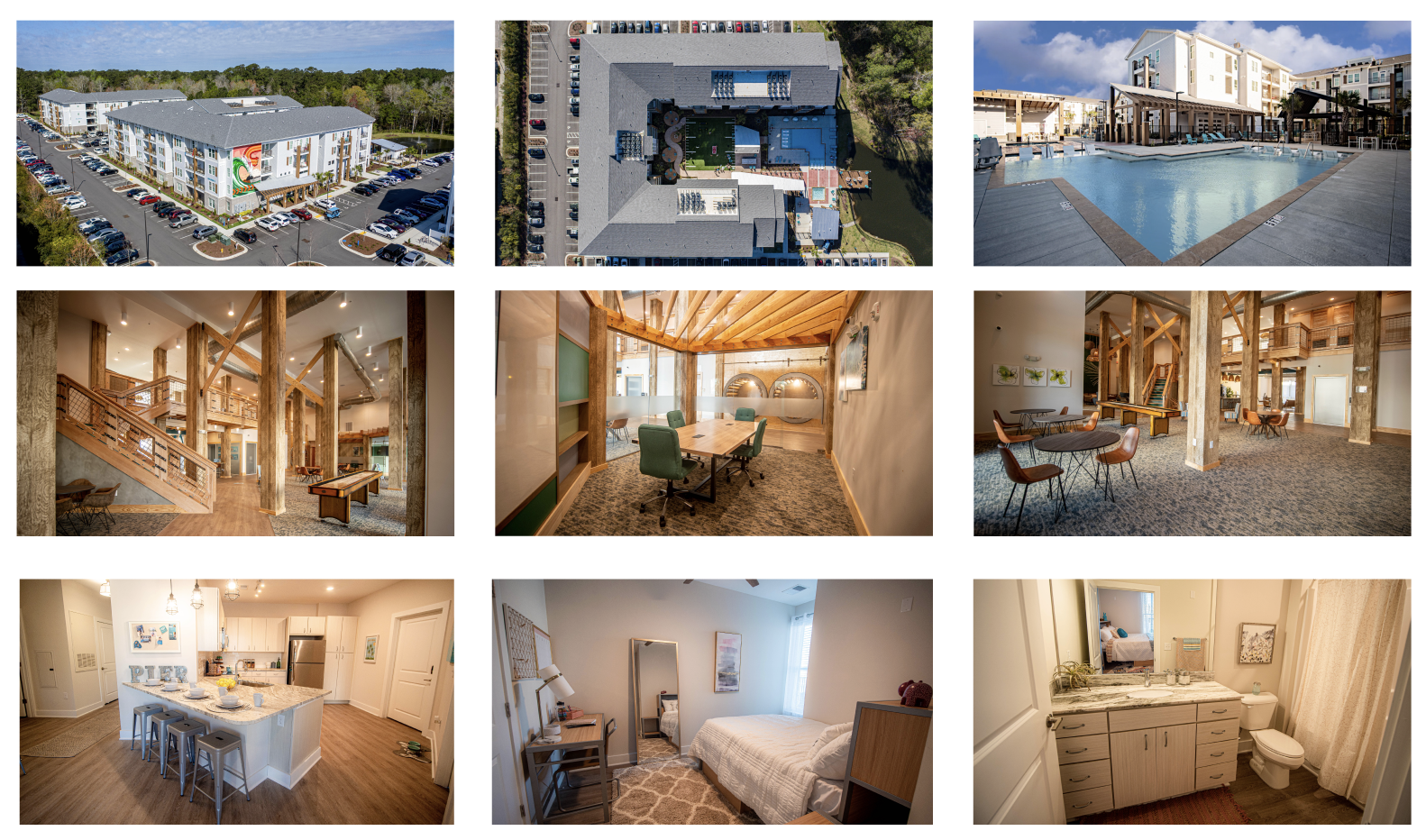
As partner Zach Feldman puts it: “Purpose-built student housing differs materially from multifamily: higher traffic volumes, sharper seasonality, faster shifts in student preferences, and a more involved parent cohort. These create operating risks that generic managers aren’t structured to handle. So we didn’t really have a choice if we wanted to outperform–we had to build The Marshall.”
Feldman continues, “Owning our own management company and brand [The Marshall] is also really strategic early in the development process. Unit layouts, study spaces, amenity distribution, and ground-floor programming are all shaped with our operations team at the table, rather than added after construction.”
The Marshall’s playbook differentiates from generic multifamily management due to its hyper-focus on the “student + parent” user:
The platform treats PBSH as a distinct operating category with its own inputs and constraints. By controlling both the building and the brand, Aptitude creates consistency across markets, reduces operating volatility, and captures efficiencies that are difficult to achieve when development and management are separated.
Aptitude’s “buy box” is relatively straightforward:
The firm assesses these markets with an operating lens layered on top of the traditional development underwriting, asking both “can we build here?” and “can we operate our playbook here in a way that outperforms the existing stock?”
Their two current projects–The Marshall Tempe at Arizona State University and The Marshall Binghamton at SUNY Binghamton–illustrate how they underwrite markets & locations, size buildings, configure amenities, program operations, and evaluate UYOC in relation to institutional exit markets.
The Marshall Tempe (ASU)
485 beds | 188 units | 7 stories | 20,000 SF amenity space | 900 feet from campus
ASU is one of the largest Tier-1 public universities in the country, with 57,808 students on the Tempe campus and enrollment that has grown by 9,100 students over the past decade. The university posts 98% occupancy, #1 national PBSH ranking, and some of the highest rent growth in the U.S., with YOY increases up to 20% in top assets–and roughly 25,000 students who cannot be accommodated in existing purpose-built stock.
Aptitude underwrites ASU with the view that demand is effectively “locked in” for walkable housing within 0.3-0.5 miles of campus–particularly near Greek Row, the Mill Ave node, and light rail. Their site on 1057 E Apache Blvd is 900 feet from campus, a quarter mile from Greek Row, and within walking distance of the school’s social and academic spine.
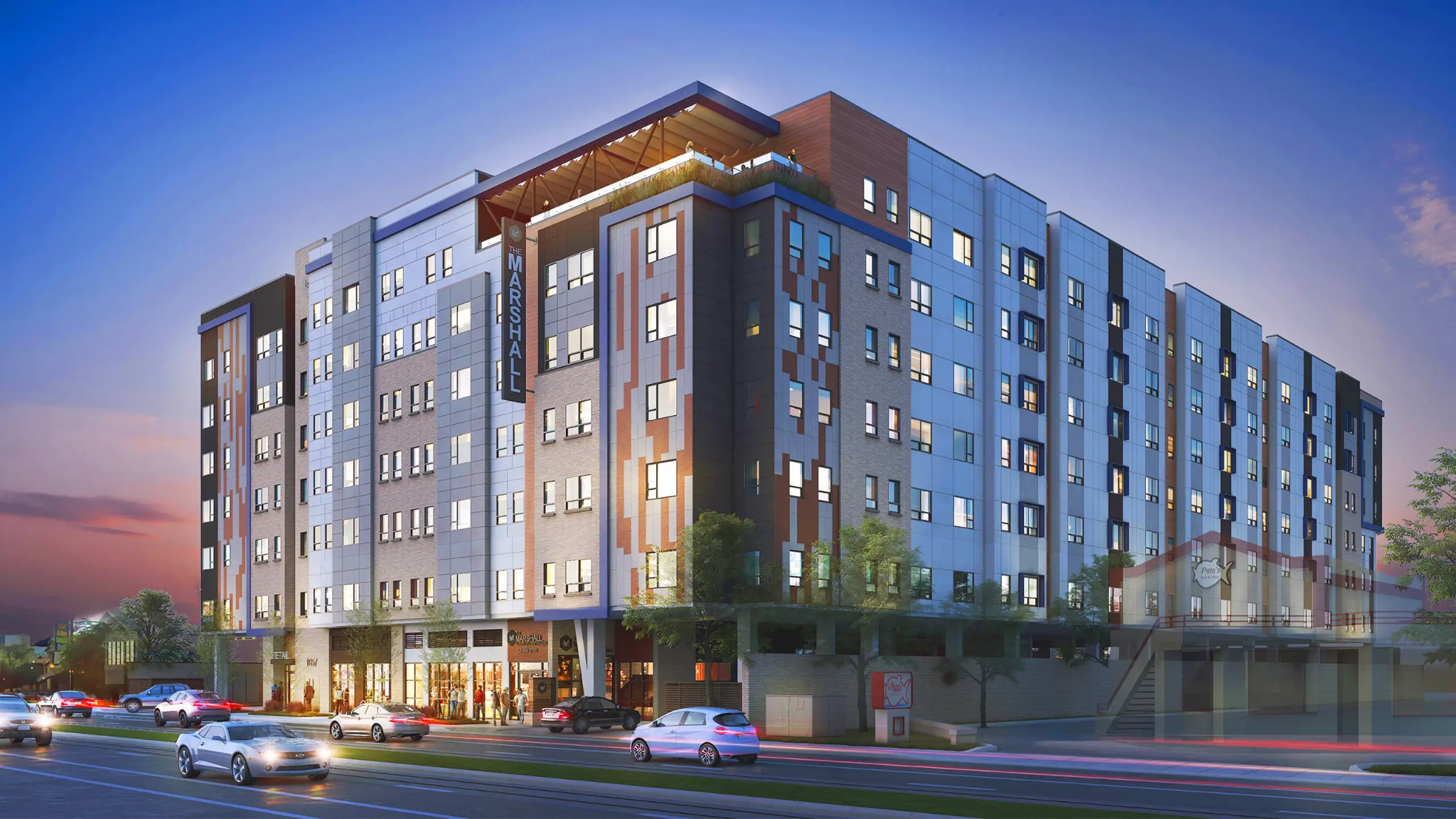

Programmatically, the project reflects the underwriting thesis:
On the financial side, Aptitude is building to a high-6% / low-7% unlevered yield, anticipating a sale in the low- to mid-5 cap rate range once stabilized. This matches current institutional buyer interest in high-quality PBSH in top markets–and leverages ASU’s rent growth profile, the pre-leasing calendar, and the predictability of parent-backed collections.
Construction began Q2 2024, with occupancy in Spring 2026.
The Marshall Binghamton (SUNY Binghamton)
516 beds | 195 units | 5 stories | 500 feet from campus
Although Binghamton is smaller than Tempe, the core PBSH thesis is the same: a major state flagship with strong enrollment growth, expanding application volume, strong educational value, very limited walkable land, an aging off-campus housing stock, and a market rapidly institutionalizing new purpose-built product.
Aptitude’s site sits within the core walkable zone, surrounded by the university’s academic and social districts. The program will offer en-suite layouts, modern amenities (including a wellness center), and high-frequency study and fitness spaces–reflecting the same two-customer underwriting lens as ASU.
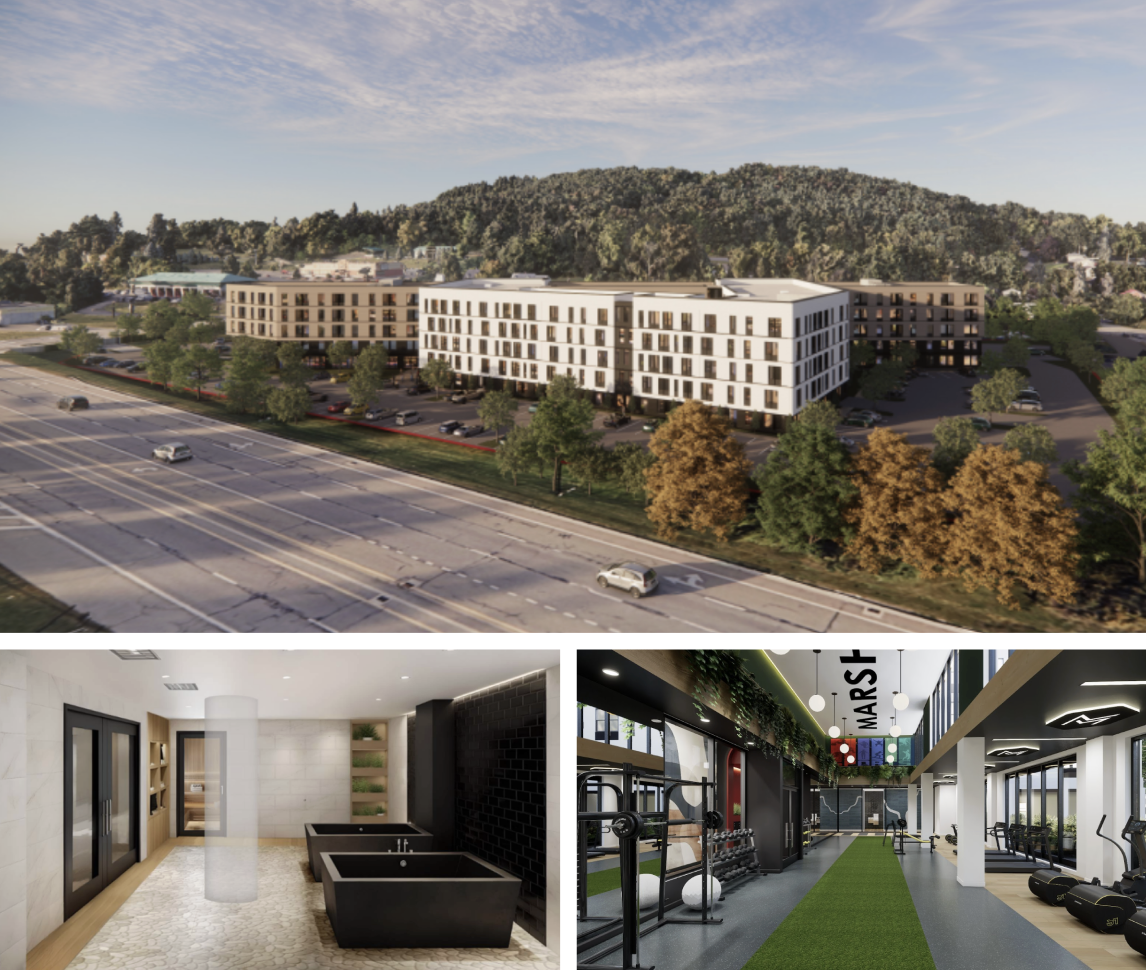
Key underwriting drivers include:
The program aligns directly with these patterns:
Expected yield-on-cost sits in the high-6% range, with projected exit cap in the low-5% band, consistent with active buyer appetite for stabilized product in Tier-1 state schools.
Across ASU and SUNY Binghamton, the underwriting reflects the same six principles: (1) enrollment resilience & excess unmet demand, ensuring a large and durable renter base; (2) walkability as the gating constraint, with a focus on pedestrian sites within a short radius of academic cores; and (3) rent-per-square-foot arbitrage, where shared units consistently outperform conventional multifamily economics.
The firm also evaluates (4) operational integration as risk mitigation, treating The Marshall as an underwriting input rather than a post-development add-on; (5) institutional exit visibility, with both markets supporting low- to mid-5 cap rates for stabilized assets; and (6) design-programming alignment, using building layouts and amenity configurations that match behavioral patterns observed in Aptitude’s existing portfolio.
Tier-1 PBSH has become one of the clearest signals of how younger renters evaluate residential product: not as a commodity defined by square footage, but as an experience shaped by convenience, community, service, and lifestyle. The expectations in evidence on college campuses today–privacy, walkability, wellness amenities, structured common areas, and building-level brand standards–are already influencing the behaviors of 22- to 30-year-olds entering the broader rental market. So in many ways, PBSH operates as a leading indicator for what the next generation of multifamily renters will demand.
That linkage is driving interest in a wider range of user-specific formats: workforce housing designed around shift workers’ schedules; co-living that prioritizes affordability, community, and flexibility; hybrid hospitality models bridging short-term and long-term stays; and micro-unit buildings that trade space for location and services. Each relies on a combination of design, operations, and convenience that looks more like student housing than conventional multifamily. Operators who can match product to user need–and then run it consistently–have become more valuable than the real estate alone.
These trends are also reshaping capital markets. Investors are increasingly allocating to operating companies and branded residential platforms rather than standalone assets (e.g., ICONIQ building their own flex multifamily brand, Sentral). Brand, operating systems, and user experience now drive a material share of enterprise value, especially in categories where renters care as much about service and community as they do about unit size. The Marshall is part of this broader movement: a playbook that combines design, operations, communication standards, and a coherent resident experience across markets.
For Aptitude, these dynamics point to a longer-term strategic path. While the firm remains focused on Tier-1 PBSH today, the integrated model of purpose-designed product paired with in-house management can extend into other user-driven segments over time.
As Hutter puts it: “Student housing is where we built our model, but the idea goes well beyond campuses. If you start with a clear picture of who the renter is and how they live, and then design and operate around that, there are a lot of new residential categories where that approach creates enhanced yield.”
We’re excited to dig deeper with the team on Wednesday, December 10th at 3pm EST to discuss the project, business model, growth strategy, and opportunities to invest.
Register here (for accredited & institutional investors only).

A live two-hour workshop on structuring and raising capital for real estate operating companies plus their underlying assets

EG is applying the American real estate private equity playbook to Australia, starting with medical office

Our annual list of firms actively investing in real estate technology companies

Covering the future of real estate and the people creating it