
Deep Dive: Metropolis
How a computer vision startup became America’s largest parking operator and a test case for a new model of venture-backed growth
How a computer vision startup became America’s largest parking operator and a test case for a new model of venture-backed growth

A live one-hour session on building a Claude workflow that reads any OM, populates your model, and audits the leases against it

The backlash against data centers may do little to slow AI, but it could make almost everything else harder to build

Don’t miss Thesis Driven’s Buy Box deep dive on CA South next Wednesday, October 8th. Register here (for accredited & institutional investors only)
There are 33 million small businesses in America. And if you spend a day with a contractor, landscaper, or tradesperson, you’ll quickly see a problem: their trucks, equipment, and containers are parked anywhere they’ll fit.
On residential driveways. Behind chain-link fences. In self-storage units built for sofas, not skid steers. Or leased by the acre in industrial yards that demand multi-year contracts and corporate-level credit. For many users, these storage solutions are insecure, inefficient, and expensive. But until now, they've been the only option.
That’s the white space being tackled by developer CA South. They’re championing a new category of industrial outdoor storage called Secured Outdoor Storage Yards, or SOSY: purpose-built, Class A yards for small commercial users who need 2,500-10,000 square feet of secure, fenced, lit space with 24/7 access.
The model is relatively simple: low-capex outdoor yards + standardized operations + flexible, short-term leases to small businesses. These tenants are mission-critical and need a secure place to store their tools, vehicles, and materials–plus they’re willing to pay for that convenience and safety. And like self-storage 40 years ago, this mom-and-pop industry is ready to be institutionalized at scale.
Today, most SOSY operators are local players that lack the sophistication to scale beyond a few locations. But CA South, led by a development veteran in Meg Epstein, is taking a different approach: bringing over $1B of development experience and an institutional mindset to the historically overlooked sector.
In this Thesis Driven letter, we’ll break down:
Spend a few hours following a small business owner, such as a contractor or landscaper, and you’ll quickly notice a recurring headache: there’s no obvious place to put their trucks, trailers, and equipment when the day is done.
Parking them at home clogs driveways. Renting a self-storage unit is a mismatch–spaces built for couches and boxes, not tool trailers. Industrial yards, meanwhile, cater to corporate tenants who can commit to acres at a time, not 5,000 square feet. The result is a patchwork of unsafe, inefficient, and often expensive workarounds.
That unmet need is widespread. With over 33 million small businesses in the U.S., many of them operating in trades, construction, and services, the demand for secure, affordable outdoor storage space is large.
Several macro tailwinds are amplifying demand, creating the conditions for secured outdoor storage to emerge as a distinct asset class:
SOSY’s tailwinds echo those of the self-storage sector 40 years ago. Back then, storage was a fragmented, mom-and-pop industry. It took the vision of a few operators–and the entry of institutional capital–to transform it into a $60+ billion REIT-dominated sector.
Secured outdoor storage looks like it’s at a similar inflection point today. The fundamentals are simple: fragmented ownership, real tenant demand, and a lack of purpose-built supply. The challenge is execution in building yards that feel secure, professional, and scalable, while still meeting the everyday needs of small business tenants.
If the demand side of secured outdoor storage looks like déjà vu from self-storage’s early days, CA South’s product looks like the institutional version of what’s long been improvised. Rather than junk yards with no security, their model is purpose built yard solutions, scaled down for the small business user. Customers get all of the benefits from leasing traditional outdoor storage sites at a fraction of the cost.
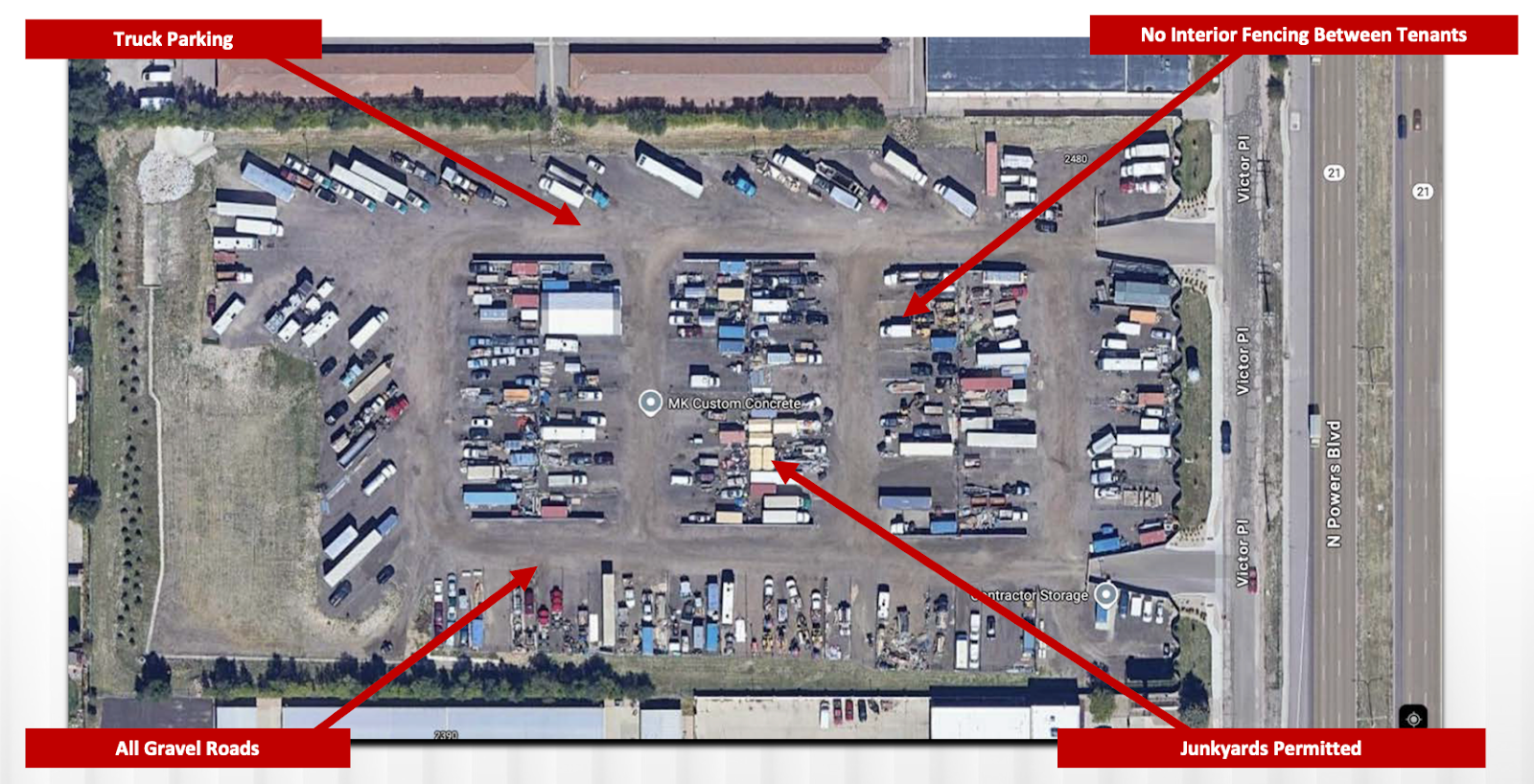
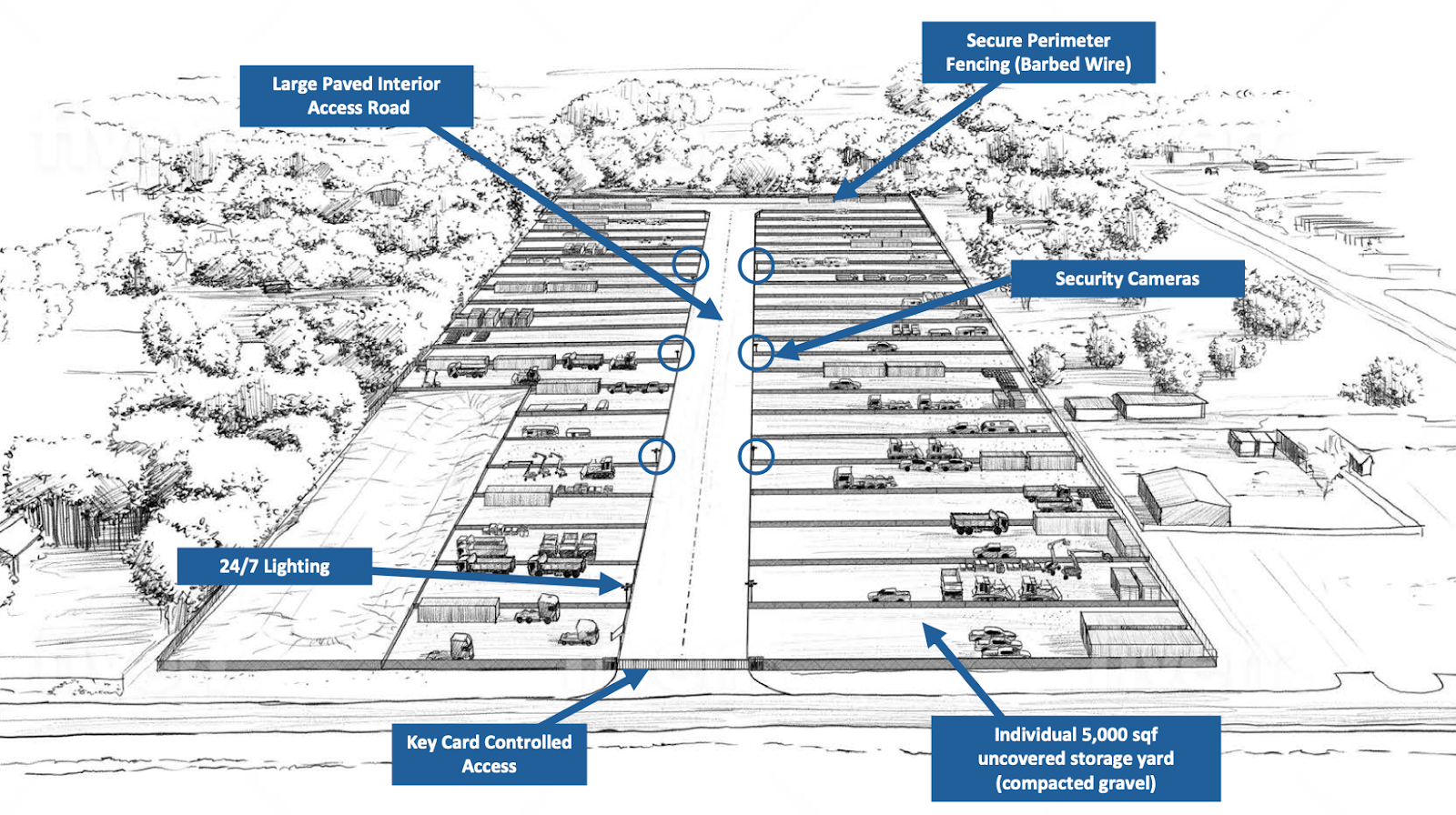
The product is standardized contractor yards ranging from 2,500 to 10,000+ square feet–large enough for trucks, trailers, and containers, but small enough to keep costs accessible ranging from $800 to $2,000 per month per customer. Every site is fenced, lit, and monitored by cameras. Key card access gates and paved roads make them feel more professional than a back-lot yard. Leasing and payments are fully digital, reducing friction for tenants who often work irregular hours and need 24/7 access.
On the leasing side, flexibility is the draw. Contracts are short-term, with the ability to scale up or down yard size as a business grows or contracts.
“This model mirrors what made self-storage a sticky product,” said Meg Epstein, CA South’s CEO. “Tenants can pay month-to-month, but once they’re in, the convenience of secure access keeps them long-term.”
The economics reflect that balance of low cost and sticky demand. Each site can be delivered for roughly $5 million, with a 9-12 month development timeline (much faster and cheaper than a traditional industrial building). By Year 3, CA South projects stabilized yields of 10%+. For investors used to chasing deals in more traditional industries, the strategy represents significant yield enhancements.
The differentiator is institutional-grade execution in an asset class where “Class A” doesn’t yet exist. Most current options are improvised or legacy facilities. CA South is positioning itself as the first mover to bring professional standards–both in physical product and operating platform–to what has historically been a fragmented, overlooked corner of real estate.
CA South’s first secured outdoor storage site is being developed in Tulsa, Oklahoma, which highlights both the market thesis and the economics of the model.
While Tulsa might look like any other mid-sized city in the middle of the map, it’s a central U.S. logistics hub with two inland ports, a fast-growing industrial base, and a $1 billion solar panel manufacturing plant under construction. Vacancy in the industrial sector sits at just 3.1%, leaving smaller tenants with few options for space.
That supply-demand imbalance makes Tulsa an ideal launchpad for CA South to prove the concept and set a blueprint for replication across other growth markets.
A snapshot of the project metrics :
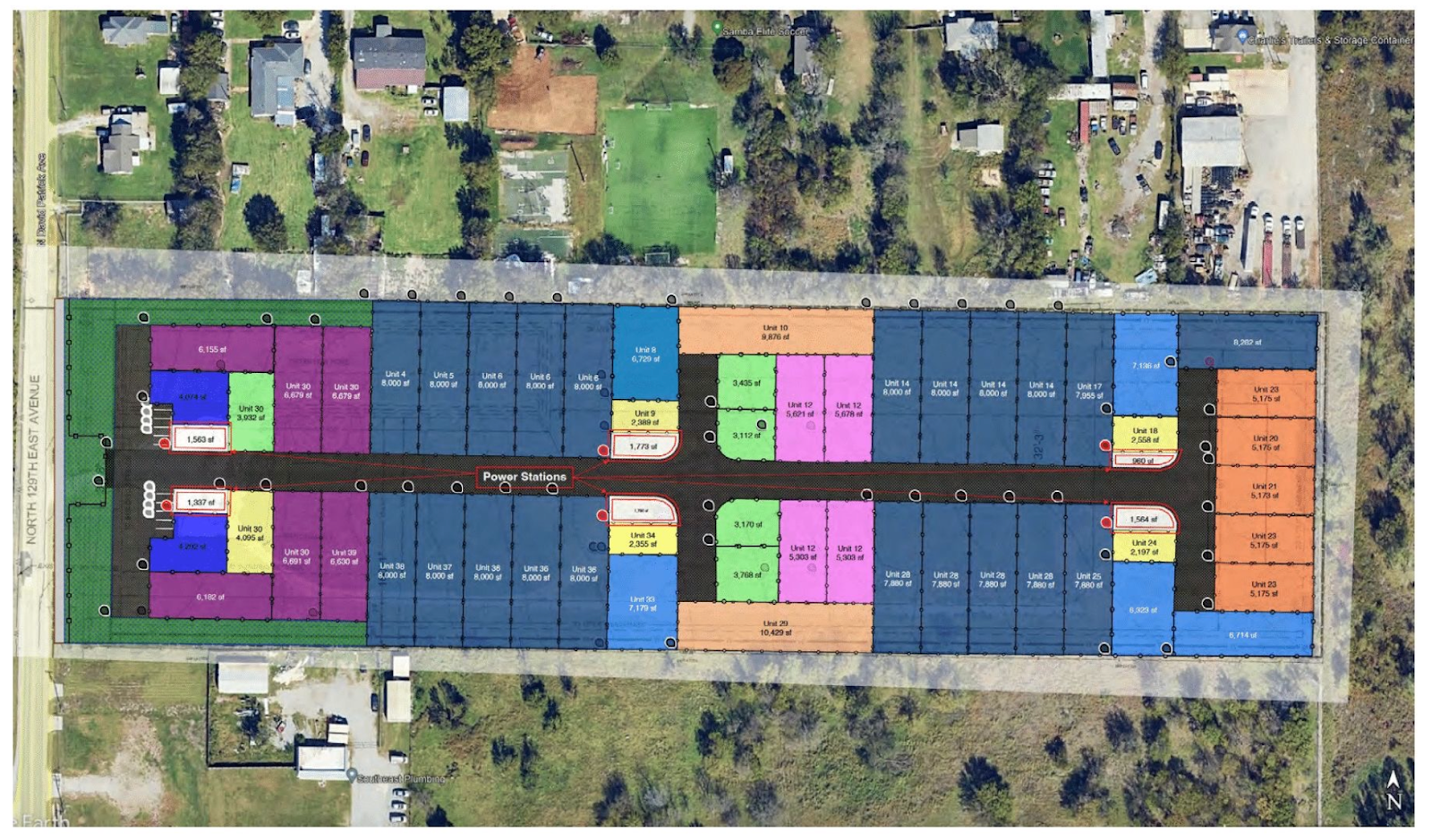
This site will feature 50-75 individual yards ranging from 2,500 to 10,000 square feet, customizable based on tenant demand and on-the-ground feedback. Tenants access their spaces via an interior paved road that connects a mix of gravel laydown areas, all surrounded by fencing, lighting, and electronic access control.
Importantly, Tulsa is shovel-ready with entitlements in place and construction set to begin in Q4 2025.
Next in the pipeline is Oklahoma City, again a CA South owned, fully entitled and ready to break ground opportunity.
CA South has identified additional sites across the Southeast and Texas where industrial supply is tight, small business growth is strong, and land costs allow for low-capex development.
Secured outdoor storage is not a sector where “if you build it, they will come” applies. The challenge is not just pouring gravel and stringing a fence–it’s packaging an overlooked product into something that feels professional, scalable, and reliable for both tenants and investors. That requires a team with deep development experience, specialized operating partners, and local market knowledge.
Meg Epstein, CA South’s founder and CEO, has overseen more than $1 billion in development, including $400 million of completed commercial real estate projects across the Southeast and over 1 million square feet of industrial space.
Epstein has also brought on Khyl Powell, who is one of the only developers nationally with experience in “Class A” outdoor storage. In Phoenix, he’s delivered three fully-leased, purpose-built facilities.
Execution also hinges on operational and leasing partners:
The strategy aims to blend institutional vision with specialized expertise and local execution, to replicate success across a pipeline of sites in Oklahoma, Texas, and the Southeast.
CA South’s first two projects–Tulsa and Oklahoma City–are shovel-ready and expected to break ground in 2025 and early 2026. From there, the medium-term expansion targets nine additional markets across the Southeast and Texas, including Alabama, Georgia, South Carolina, Florida, and Tennessee. These are regions with strong small business growth, favorable land economics, and tight industrial vacancy.
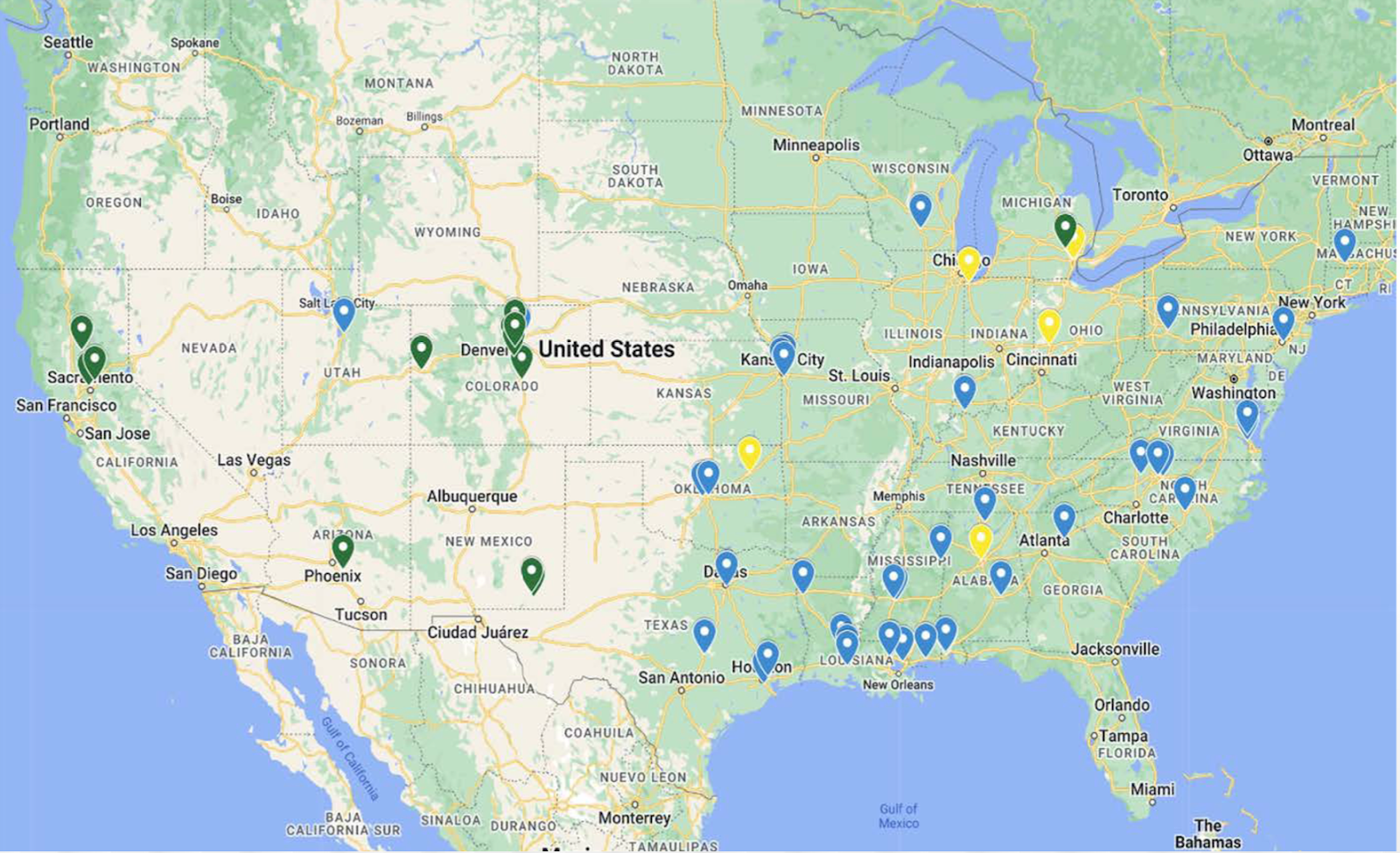
The strategy is to enter each market with a single flagship site, stabilize it, and then expand with follow-on projects–a hub-and-spoke approach designed to build density efficiently.
The rollout will be supported by programmatic capital. CA South has lined up a $50M+ pipeline, with typical deals requiring $3-6M of equity. That provides the runway to execute on roughly 10 sites in the first phase, each one a ~$5mm development on a rolling 9-12 month timeline.
The long-term vision is to do for outdoor contractor yards what institutional capital did for self-storage: transform a fragmented, mom-and-pop industry into a professionalized, national brand. By creating a standardized product with institutional operations, CA South aims to define “Class A” in a category where that label doesn’t yet exist.
We’re not just building a handful of yards in Oklahoma,” Epstein said. “We’re building the first national brand for outdoor contractor storage–a platform that can scale the way self-storage did over the last two decades.”
We’re excited to dig deeper with the founding team on Wednesday, October 8th at 3pm EDT to discuss the project, business model, growth strategy, and opportunities to invest.
Register here (for accredited & institutional investors only).
-Paul Stanton


We've been building AI acquisitions agents with real estate GPs. On August 13, we're opening the hood in a live 2-hour workshop

EG is applying the American real estate private equity playbook to Australia, starting with medical office

Our annual list of firms actively investing in real estate technology companies
Covering the future of real estate and the people creating it