
The State of AI in Real Estate: What We've Learned So Far in 2026
Eight lessons on why AI pays off for some firms and not others
Eight lessons on why AI pays off for some firms and not others
A quarterly look at feasibility study activity with our friends at TestFit

Multifamily operators in the lurch; have the PMS wars begun?
Eight lessons on why AI pays off for some firms and not others

Last November, we published "Seven Surprising Facts About the State of AI in Real Estate,” a look back at what our 2025 coverage taught us about where and how AI was taking hold in the industry. In that compendium (published on Thanksgiving Day!), we argued there was no longer a viable case that the technology would be anything less than an industry-wide change agent.
That argument has certainly held up. AI tools now exist for nearly every stage of a property's life, from finding and underwriting a site to financing it, renovating it, and running it once it's occupied. Adoption has climbed fast. But as these tools have spread, we’ve seen a widening gap between the real estate companies ready to use them and reap the benefits, and those that aren't.
Companies prepared for AI have done the groundwork: they've settled who owns decisions, cleaned up their data, connected their systems, and redefined roles around what the tools now handle. Other operators have bought the tools and left almost everything else as it was. The first group is getting real value from AI; the second, for the most part, is still waiting.
We've watched that split play out all year, covering it every step of the way. Thanksgiving may still be a ways off, but so much has happened since our last AI roundup that we decided it was time for an early sequel.
Here's what we've learned so far in 2026.
Our first clear signal of the emerging schism between AI haves and have-nots came last December, with the results of an AI readiness assessment for readers, which we built with UDP and Insights by Blueprint. As it turns out, most larger operators had already made real progress getting their data in order; the divide came over what they did with it. At firms with agreed-upon definitions for metrics like NOI and occupancy, and a clear owner for each, teams trusted AI's forecasts enough to act on them. At firms without those basics, as we wrote at the time, AI outputs were "surfaced, discussed, and then frequently set aside."
 Brad Hargreaves
Much of the push to adopt AI is coming from the people who control the capital. In September, we got an early look at a Tailorbird survey of more than 300 mostly institutional operators about capital project overruns. Seventy-eight percent said investors, boards, or LPs were pressing them to adopt AI, and operators ranked AI adoption as their backers’ top focus on capital projects, ahead of returns. Investors pushed hardest on the firms seemingly least ready for AI. Among operators still running mostly on spreadsheets, 61 percent described the pressure as significant, well above any other group. But “deploying AI on top of a spreadsheet will fail,” Brad Hargreaves wrote.
 Brad Hargreaves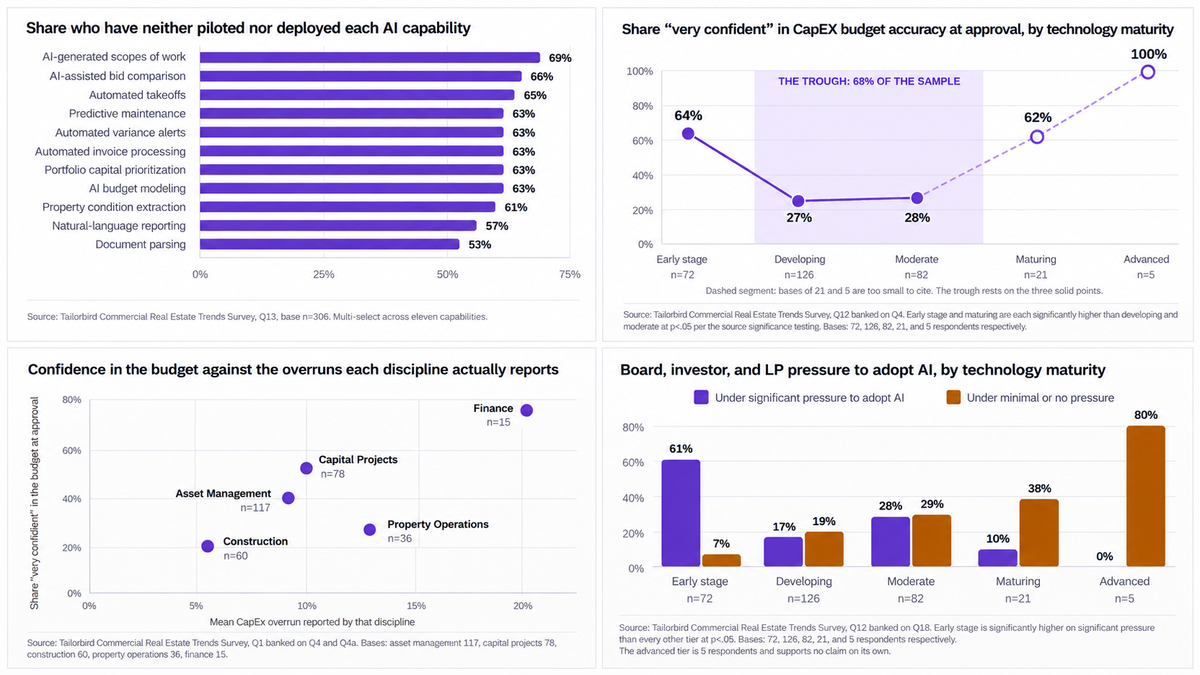
Mortgage lending, a high-volume business built on endless reams of paperwork, sure looks like a perfect fit for AI. Yet adoption has been sluggish. So what gives? As Navitas Capital partner Jenny Song wrote in April, lenders are risk-averse by design, and most are locked into Encompass, the industry’s dominant loan software. They’ll add AI tools on top of it, but replacing the system itself, a move some lenders describe as “open heart surgery,” is a step few top executives seem ready to take. “If we have to switch loan origination systems, I will not be the CEO anymore,” one told her team.
 Jenny Song
Last year, we wrote that natural-language search was poised to replace the toggles and filters of traditional land search, a cumbersome interface Brad Hargreaves has likened to a 2005-era Zillow. In May, he profiled the first platform he’d seen that makes good on that prediction. Acres’ latest release lets developers describe a site in plain English and get back a ranked shortlist of parcels. It can turn weeks of desk research into a single query. The catch is that an AI screening hundreds of sites magnifies any error in the data underneath. “If you show me bad data and great AI, I’ll tell you which one wins,” Acres founder Carter Malloy told us.
 Brad Hargreaves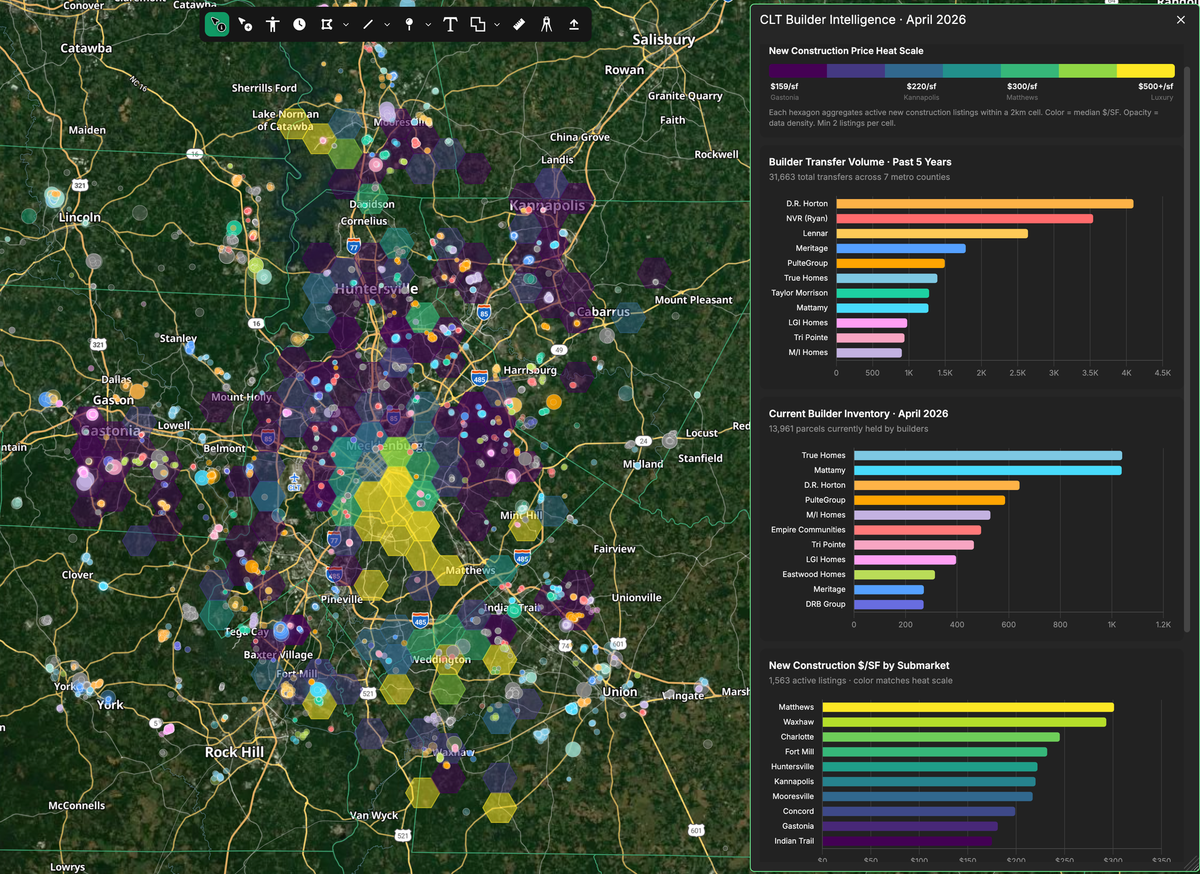
Once a developer finds a promising site, the next question is what can be built there and whether it pencils, a process that has traditionally taken weeks. We profiled Algoma, whose platform produces rough site plans and feasibility studies in minutes. That kind of speed might seem to make architects unnecessary. Algoma hired its own anyway, to see projects through once a developer wins a site. “As the stakes and CapEx increase, customers have more trust when there is a human expert driving and checking the work,” co-founder Kyle MertensMeyer said.
 Brad Hargreaves
Most of our AI coverage looked at operators buying AI tools. In June, we heard from a founder who tried to sell them. Christopher Arraya’s startup, Atria, built software that answered resident messages and handled maintenance requests across roughly 400 apartments, yet he shut the company down less than a year after launch. Smaller owners, who already had staff fielding calls, couldn’t see enough benefit to justify the cost. And Arraya found that operators bore the blame for every AI mistake. “The software acted within its rules, and the manager is the one answering for it,” he wrote. Who ultimately owns AI’s mistakes is a question any operator weighing autonomous AI will have to settle.
 Christopher Arraya
Forecasts that AI will hollow out white-collar work, including Citrini Research’s “The 2028 Global Intelligence Crisis,” which imagined office employment collapsing within two years, raise an obvious question for real estate: whose jobs go first? In March, Brad Hargreaves argued that asset managers, long considered too strategic to automate, are more exposed than the leasing agents AI was supposed to replace. AI agents can now handle the rent comps, budget variances, and refinancing scenarios that fill an asset manager’s week, so one senior person could, in theory, oversee 20,000 units or more instead of today’s 2,000–4,000. “There will be a lot fewer of those humans,” he wrote.
 Brad Hargreaves
In July, Daniel French, CEO of property management platform Northpoint, took on the same Citrini Research scenario Brad cited and reached the opposite conclusion. Property management employment grew about 2 percent a year from 2014 through 2025, despite nearly a decade of AI tools, and only 10 percent of owners and executives in an AppFolio and IREM survey expected AI to shrink their staffs. Freed from paperwork, French argued, the best property managers will start doing the work of asset managers. “The firms that win may not be those with the best buildings,” he wrote. “They will be the ones with the best people running them.”
 Daniel French

We've been building AI acquisitions agents with real estate GPs. On August 13, we're opening the hood in a live 2-hour workshop


Our annual list of firms actively investing in real estate technology companies


Predicting six new real estate marketplaces to rise over the next decade
Covering the future of real estate and the people creating it